Monthly Archives: February 2021

Research – Hepatitis A outbreak with the concurrence of Salmonella Typhi and Salmonella Poona infection in children of urban Vellore, south India – 2019

IJID Online

Background: Outbreaks of Hepatitis A virus (HAV) infection continue to be reported from India, that have transitioned from hyper-to-intermediate endemicity. Hepatitis A and Salmonella sp. share similar routes of transmission and may co-infect individuals at risk. We report here an outbreak of hepatitis A with concomitant Salmonellosis from an urban settlement of Vellore in south India between July and August 2019.

Our findings highlight that Hepatitis A infection can present as sporadic outbreaks in communities with sub-standard water and sewage systems, along with the co-infection of other enteric infections such as invasive Salmonellosis. Thus, population-based surveillance for Hepatitis A is required in India, to identify populations and geographical regions at risk, and thereby potentially plan implementation strategies for Hepatitis A vaccination.

Research – Outbreak of ceftriaxone-resistant Salmonella enterica serotype Typhi attributed to eating chicken at hotel X, Tiruchirappalli, India, 2018

IJID Online

Background: Third-generation cephalosporin is widely used for typhoid treatment. In May 2018, India’s National Centre for Disease Control based Antimicrobial resistance surveillance network notified through Tamil Nadu State Surveillance Unit about clustering of ceftriaxone-resistant Salmonella enterica serotype Typhi cases in Tiruchirappalli city, Central Tamil Nadu. Team led by State public health department investigated to identify risk factors.

Conclusion: The cluster of ceftriaxone-resistant Salmonella Typhi was due to eating chicken gravy at hotel X in central Tamil Nadu. We recommended proper processing of chicken and continuing surveillance for ceftriaxone-resistant.

Research – Case–control study of gastro-intestinal outbreak in a rural village, Philippines – 2017

IJID Online

On March 21, 2017, field investigating team was sent to Cayapa Village, Abra, Philippines due to an increasing cases of foodborne illness. An epidemiologic investigation was conducted to verify the diagnosis, establish existence of outbreak, identify risk factors, and recommend control and prevention measures.

The epidemic curve indicates a point source outbreak of gastrointestinal Anthrax. We found valid statistical and temporal association of eating by-product of dead water buffalo and gastrointestinal Anthrax. Though, bacterial isolation were both negative for human specimen and environmental sample, all clinical manifestations were consistent with Bacillus anthracis rather than other foodborne bacterial pathogens. Hence, we conducted massive information education campaign sick or dead animal by-product should not be sold or eaten and properly handled and disposed.

Austria – Investigators still looking for source of outbreak of E. coli infections in Austria

Food Safety News

Austrian authorities are investigating an outbreak of Shiga toxin-producing E. coli (STEC) infections that has affected a handful of people.

Between September and December 2020, six people fell ill with infections from E. coli O146:H28. Those sick live in five federal states. Two people needed hospital treatment.

As yet, there is no indication as to the source of the outbreak, according to the Austrian Agency for Health and Food Safety (AGES). It is understood other countries in Europe have not reported related infections.

India – Uttar Pradesh: Over 40 hospitalised due to food poisoning after having meal at event in Sitapur

Times Now News

Lucknow: Over 40 people took ill after consuming food at an event in Sitapur district of Uttar Pradesh. Subsequently, they were taken to a hospital for treatment.

“Around 40-50 people are admitted to the hospital after they had a meal at an event in Mahmudabad,” an official said.

After having food at the event in Sitapur’s Mahmudabad town, the health of the people worsened, following which they were rushed to a hospital for food poisoning treatment.

Research – Escherichia coli in flour – sources, risks and prevention

Click to access escherichia-coli-in-flour-sources-risks-and-prevention.pdf

Belgium – Apple juice (3l) of the Dupigny brand – Patulin

AFSCA

Aflatoxin

Image CDC

Farm of Assonleville recalled
Product: Apple juice (3l) of the Dupigny brand.
Problem: too high patulin content.

In agreement with the AFSCA, the Ferme d’Assonleville is withdrawing the product Apple juice (3l) of the Dupigny brand from sale and is recalling it to consumers. The product contains too high a patulin content.

The Ferme d’Assonleville asks its customers not to consume this product and to contact the farm of Assonleville at info@pressoir.net mentioning the quantity purchased and attaching a photo of the products.

Despite our vigilance and the steps taken, 6 pouch-ups of 3L were sold to consumers in 1 point of sale.

Product description

– Product name: Apple juice
– Brand: DUPIGNY
– Date of minimum durability (DDM) (“
Best before (or end)”) : 07/26/2022 – Lot number: 04B21JOP – 00
– Sales period: from 02/15/2021 to 23 / 02/2021
– Type of packaging: Pouch Up 3l
– Weight: 3l

The product has been distributed by the Proxy Ferrières store (Rue Pré du Fa 6a, 4190 Ferrières).

For any further information , contact:
La ferme d’Assonleville with email: info@pressoir.net

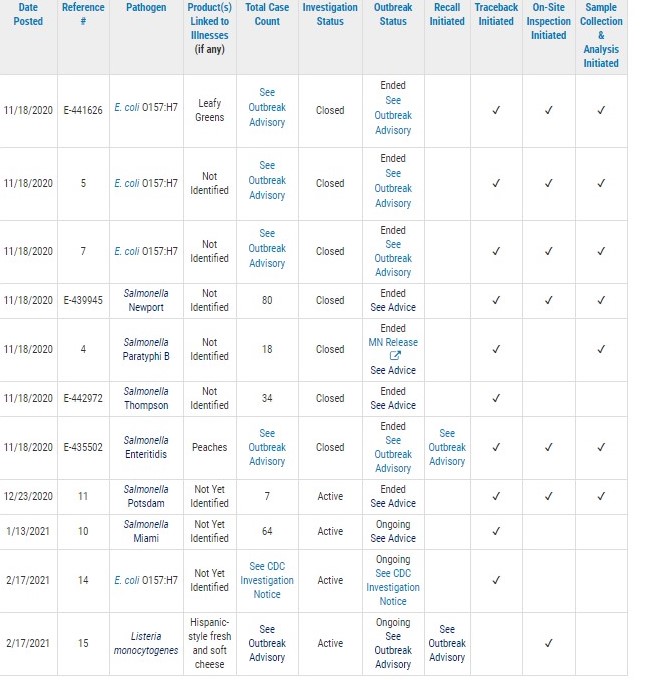
USA – CORE Response Teams – Update

FDA

000

Ireland – Recall of a Batch of SFC Chicken Poppets Due to Presence of Salmonella

FSAI

Recall of a Batch of SFC Chicken Poppets Due to Presence of Salmonella

Friday, 26 February 2021

Summary
Category 1: For Action
Alert Notification: 2021.20
Product: The Original SFC Chicken Poppets, pack size:190g
Batch Code: Best before date: 28.02.2022
Country Of Origin: United Kingdom

Message:

SFC is recalling the above batch of its Chicken Poppets due to the detection of Salmonella. Point-of-sale recall notices will be displayed in Tesco stores.

Nature Of Danger:

People infected with Salmonella typically develop symptoms between 12 and 36 hours after infection, but this can range between 6 and 72 hours.  The most common symptom is diarrhoea, which can sometimes be bloody.  Other symptoms may include fever, headache and abdominal cramps.  The illness usually lasts 4 to 7 days. Diarrhoea can occasionally be severe enough to require hospital admission. The elderly, infants, and those with impaired immune systems are more likely to have a severe illness.

Action Required:

Consumers:

Consumers are advised not to eat the implicated batch.

SFC Chicken Poppets

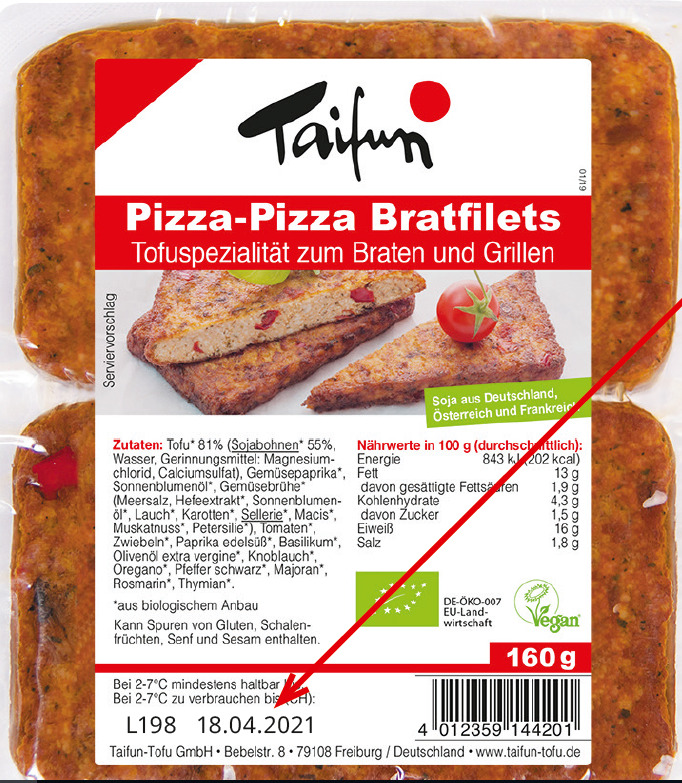
Germany – Pizza-Pizza roast fillet 160 g – Pasteurisation not complete

LMW

Warning type:Food
Date of first publication:02/26/2021
Product name:Pizza-Pizza roast fillet 160 g
Product pictures:

Unnamed.PNG

Customer information

Manufacturer (distributor):Manufacturer: Taifun-Tofu GmbH, 79108 Freiburg
Reason for warning:

A gap has appeared in the documentation for the pasteurization of these products. Therefore, it can be assumed that the shelf life will be significantly shorter than the best before date promised.

Packaging Unit:160 g
Durability:04/18/2021
Lot identification:L198
Further information:Reference is made to the company’s customer information sheet attached.
Contact to the responsible authorities:

Baden-Württemberg:poststelle@mlr.bwl.de

Bavaria:poststelle@lgl.bayern.de
Hamburg:poststelle@justiz.hamburg.de
Hesse:Schnellwarnung@rpda.hessen.de
Lower Saxony:poststelle@ml.niedersachsen.de
Schleswig-Holstein:poststelle@jumi.landsh.de
Press releases and information
title Attachment or web link
Customer information