Category Archives: Food Microbiology Research

Spain – Firm Fined 2000 Euros for Spain’s Worst Listeria Outbreak

Diario de Sevilla

A fine of 2,000 euros now , two years after the Magrudis company caused the largest outbreak of listeriosis in the history of Spain. The Seville City Council has sanctioned the Magrudis company with this amount for various irregularities detected in the license granted at the time for the production of La Mechá brand products, whose infection with the bacterium listeria monocytogenes has caused four deaths and six abortions , in addition to more than 200 injured by the consumption of these products.

USA – Game Day Food Safety Tips

CDC

Spanish Version

Tackling a game day gathering? Play by these rules and keep the runs on the field.

Make sure your game day gathering is memorable for all the right reasons! Follow these six tips to avoid food poisoning:

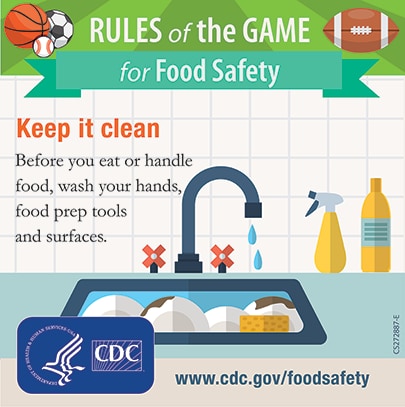
1. Keep it clean.

2. Cook it well.

Cooking food to the right temperature kills harmful germs. Use a food thermometer to check meat, egg, and microwaved dishes on your menu.

  • Make sure chicken wings (and other poultry) reach an internal temperature of at least 165°F. Ground beef and egg dishes should reach at least 160°F. Check the safe internal temperatureexternal icon for other foods.
  • Follow cooking directions on the package when cooking frozen food in the microwaveexternal icon.

3. Keep it safe.

  • If preparing food in advance, divide cooked food into shallow containersexternal icon to cool. This encourages rapid, even cooling. Put the cooked food in a refrigerator or freezer as soon as possible—always within 2 hours of cooking (1 hour if the outdoor temperature is above 90°F).
  • Keep hot foods at 140°F or warmer. Use chafing dishes, slow cookers, and warming trays to keep food hot.
  • Keep cold foods, like salsa and guacamole, at 40°F or colder. Use small service trays or nest serving dishes in bowls of ice.
  • Getting takeout or delivery? Make sure to keep hot foods hot and cold foods cold.
  • Divide large pots of food, such as soups or stews, and large cuts of meats, such as roasts or whole poultry, into small quantities for refrigeration to allow them to cool quickly and minimize time in the temperature “danger zone” between 40°F and 140°F.

4. Watch the time.

  • Follow recommended cooking and standing timesexternal icon.
    • Areas of the food that are not completely cooked (cold spots) can provide a hiding place for germs.
    • Always follow directions for the standing time—the extra minutes food should rest to finish cooking.
  • Keep track of how long food stays out for serving.
    • Throw away any perishable foods that have been out at room temperature for 2 hours or more.

5. Avoid mix-ups.

  • Separateexternal icon raw meats from ready-to-eat foods like veggies when preparing, serving, or storing foods.
    • Use separate cutting boards, plates, and knives for produce and for raw meat, poultry, seafood, and eggs.
  • Offer guests serving utensils and small plates to discourage them from eating dips and salsa directly from the bowls.

6. Store and reheat leftovers the right way.

  • Divide leftovers into smaller portions or pieces, place in shallow containers, and refrigerate or freeze.
  • Refrigerate leftover foods at 40°F or below as soon as possible and within 2 hours of preparation. It’s OK to put hot foods directly into the refrigerator.
  • Refrigerateexternal iconleftovers for 3 to 4 days at most. Freeze leftovers if you won’t be eating them soon.
  • Reheat leftovers to at least 165°F before serving. This includes leftovers warmed up in the microwave.

Research – Small produce farm environments can harbor diverse Listeria monocytogenes and Listeria spp. populations

Journal of Food Protection

A comprehensive understanding of foodborne pathogen diversity in pre-harvest environments is necessary to effectively track pathogens on farms and identify sources of produce contamination. As such, this study aimed to characterize Listeria diversity in wildlife feces and agricultural water collected from a New York State produce farm over a growing season. Water samples were collected from a pond (N=80) and stream (N=52). Fecal samples (N=77) were opportunistically collected from areas <5m from the water sources; all samples were collected from a <0.5km2 area. Overall, 41% (86/209) and 24% (50/209) of samples were positive for Listeria monocytogenes and Listeria spp. (excluding L. monocytogenes), respectively. For each positive sample, one L. monocytogenes or Listeria spp. isolate was speciated by sequencing the sigB gene, which allowed for additional characterization based on the sigB allelic type (AT). The 86 L. monocytogenes and 50 Listeria spp. isolates represented 8 and 23 different ATs, respectively. A subset of L. monocytogenes isolates (N=44) from pond water and pond-adjacent feces (representing a ~5,000m2 area) were further characterized by PFGE; these 44 isolates represented 22 PFGE types, which is indicative of considerable diversity at a small spatial scale. Ten PFGE types were isolated more than once, suggesting persistence or re-introduction of PFGE types in this area. Given the small spatial scale, the prevalence of L. monocytogenes and Listeria spp., as well as the considerable diversity amongst isolates, suggests traceback investigations may be challenging. For example, traceback of finished product or processing facility contamination with specific subtypes to pre-harvest sources may require collection of large sample sets, and characterization of a considerable number of isolates. Our data also support the adage, “absence of evidence does not equal evidence of absence” applies to L. monocytogenes traceback efforts at the pre-harvest level.

Research – Lessons Learned from a Decade of Investigations of Shiga Toxin–Producing Escherichia coli Outbreaks Linked to Leafy Greens, United States and Canada

CDC

Abstract

Shiga toxin–producing Escherichia coli (STEC) cause substantial and costly illnesses. Leafy greens are the second most common source of foodborne STEC O157 outbreaks. We examined STEC outbreaks linked to leafy greens during 2009–2018 in the United States and Canada. We identified 40 outbreaks, 1,212 illnesses, 77 cases of hemolytic uremic syndrome, and 8 deaths. More outbreaks were linked to romaine lettuce (54%) than to any other type of leafy green. More outbreaks occurred in the fall (45%) and spring (28%) than in other seasons. Barriers in epidemiologic and traceback investigations complicated identification of the ultimate outbreak source. Research on the seasonality of leafy green outbreaks and vulnerability to STEC contamination and bacterial survival dynamics by leafy green type are warranted. Improvements in traceability of leafy greens are also needed. Federal and state health partners, researchers, the leafy green industry, and retailers can work together on interventions to reduce STEC contamination.

Research – Association between Shiga Toxin–Producing Escherichia coli O157:H7 stx Gene Subtype and Disease Severity, England, 2009–2019

CDC

Abstract

Signs and symptoms of Shiga toxin–producing Escherichia coli (STEC) serogroup O157:H7 infection range from mild gastrointestinal to bloody diarrhea and hemolytic uremic syndrome (HUS). We assessed the association between Shiga toxin gene (stx) subtype and disease severity for »3,000 patients with STEC O157:H7 in England during 2009–2019. Odds of bloody diarrhea, HUS, or both, were significantly higher for patients infected with STEC O157:H7 possessing stx2a only or stx2a combined with other stx subtypes. Odds of severe signs/symptoms were significantly higher for isolates encoding stx2a only and belonging to sublineage Ic and lineage I/II than for those encoding stx2a only and belonging to sublineage IIb, indicating that stx2a is not the only driver causing HUS. Strains of STEC O157:H7 that had stx1a were also significantly more associated with severe disease than strains with stx2c only. This finding confounds public health risk assessment algorithms based on detection of stx2 as a predictor of severe disease.

Research – Netherlands – Surveillance zoonoses in broilers 2018-2019

RIVM

Animals can carry pathogens that can cause disease in humans. The diseases which they cause are known as zoonoses. In 2018 and 2019 the National Institute for Public Health and the Environment (RIVM) and the Netherlands Food and Consumer Product Safety Authority [Netherlands Food and Consumer Product Safety Authority] (NVWA) investigated how often some of these pathogens occurred in broilers. This study involved broilers at 198 farms as well as 132 livestock farmers, family members and employees. RIVM assessed whether the same pathogens also occurred in these persons. Most of these pathogens usually cause diarrhoea, but the infections can sometimes be more severe. ESBL-producing bacteria were also assessed, as they are resistant to an important group of antibiotics.

A number of pathogens occur frequently in the investigated broilers. They are present in the animals’ intestines and therefore in the manure as well. Meat can become contaminated in the slaughterhouse if it comes into direct contact with the manure. People can prevent an infection by only eating chicken that has been thoroughly cooked. It is also important to prevent other food from coming into contact with raw meat.

Of the pathogens investigated, ESBL-producing bacteria were found most often, namely in the broilers on 36% of the farms. Among livestock farmers and family members, these bacteria were found in 7% of participants. This is comparable to the percentage in the general Dutch population.

Campylobacter was found on 32% of broiler farms. This is comparable to the numbers from Campylobacter surveillance conducted between 1999 and 2002. Campylobacter was also found in two of the human participants.

Salmonella surveillance is carried out on all broiler farms according to European legislation. Salmonella was reported in broilers from 11% of the farms. The types of Salmonella bacteria identified are those that can cause diarrhoea in people. Salmonella was also found in one human participant.

STEC and Listeria were found on very few broiler farms. These bacteria were detected on 1% (Listeria) or less (STEC) of the investigated farms.

Research – Listeria found for years at site of sandwich producer

Food Safety News

The factory of a sandwich producer in England linked to an illness was contaminated by Listeria for almost three years, a report into the incident has found.

In July 2017, Listeria monocytogenes was isolated from the blood of a 53-year-old in a hospital in Yorkshire and Humberside with an underlying health condition. The man had eaten sandwiches made by the company while in the hospital at least 12 times in the three weeks prior to illness.

The isolate was genetically indistinguishable to those from sandwiches and salads produced by the company based in Bradford who supplied National Health Service (NHS) hospitals, other institutions and retailers nationwide.

Research – Surveillance of foodborne disease outbreaks in China, 2003–2017

Science Direct

Foodborne disease remains a major public health problem worldwide. To understand the epidemiology and changes of foodborne disease in China, data reported to the National Foodborne Disease Outbreak Surveillance System during 2003–2017 were collected. A total of 19,517 outbreaks, which resulted in 235,754 illnesses, 107,470 hospitalizations, and 1,457 deaths, were reported in this period. Of the 13,307 outbreaks with known etiology, 31.8% of outbreaks were caused by poisonous mushrooms, followed by Vibrio parahaemolyticus (11.3%), saponin (8.0%), Salmonella (6.8%), nitrite (6.4%), pesticide (4.8%), Staphylococcus aureus (4.2%) and Bacillus cereus (3.0%). Among 18,955 outbreaks with reported setting, 46.6% were associated with food prepared in a household, followed by 22.5% with food prepared in a restaurant, and 18.4% prepared in a canteen. Of the 13,305 outbreaks associated with a single food category, fungi (mainly poisonous mushroom) were the most commonly implicated food category, followed by meats, vegetables, aquatic animals, condiments, poisonous plants (such as saponin, tung oil or seed, aconite) and grains (such as rice, noodle, rice noodle). Analysis of foodborne disease outbreaks can provide insight into the most important causative agents and sources of foodborne disease, and assist public health agencies determine the high-risk etiology and food pairs, specific points of contamination and settings to reduce foodborne disease illnesses.

Research – Potential of pulsed electric field to control Aspergillus parasiticus, aflatoxin and mutagenicity levels: Sesame seed quality

Wiley Online

kswfoodworld

Image CDC

Seed processing technologies are essential for seed safety and functionality through protection of physicochemical quality, pathogen inactivation, aflatoxin detoxification and alleviation of mutagenicity. Design of a pilot‐scale unit of pulsed electric fields (PEF) to treat sesame seeds with respect to quality parameters, Aspergillus parasiticus inactivation and aflatoxin reduction as well as alleviation of aflatoxin mutagenicity were prompted in this study. PEF energy ranged from 0.97 to 17.28 J achieved maximum reductions of peroxide value and acidity number of 67.4 and 85.7%, respectively, and did not change color L*, a*, b* and hue values. A 60% reduction of A. parasiticus counts occurred at the maximum PEF energy. Aflatoxins G1, G2, B1, and B2 contents decreased by 94.7, 92.7, 86.9, and 98.7%, respectively. Except for the samples treated by 2.16 J with 100 μg/plate and by 6.80 J with 10 μg/plate, PEF treatment provided elimination of aflatoxin mutagenity. It is concluded that PEF treatment can be used to treat sesame seeds with preservation of physicochemical properties, inactivation of A. parasiticus and decomposition of aflatoxins with reduced mutagenicity.

Research – Resurgence of an international hepatitis A outbreak linked to imported frozen strawberries, Germany, 2018 to 2020

Eurosurveillance

Hepatitis A kswfoodworld

Following outbreaks linked to frozen strawberries in Sweden and Austria in 2018, 65 cases linked to the same hepatitis A virus strain were detected in Germany between October 2018 and January 2020, presenting in two waves. Two case–control studies and a comparison of cases’ consumption frequencies with purchase data from a large consumer panel provided strong evidence for frozen strawberry cake as the main vehicle of transmission. Of 46 cases interviewed, 27 reported consuming frozen strawberry cake and 25 of these identified cake(s) from brand A spontaneously or in product picture-assisted recall. Trace back investigations revealed that the Polish producer involved in the previous outbreaks in Sweden and Austria had received frozen strawberries from Egypt via a wholesaler that also delivered frozen strawberries to manufacturer of brand A. Phylogenetic analyses linked the outbreak strain to similar strains formerly isolated from sewage, stool and strawberries in Egypt. Complete trace back and timely recall of products with strong evidence of contamination is important to control an outbreak and prevent later resurgence, particularly for food items with a long shelf life. Continued molecular surveillance of hepatitis A is needed to identify outbreaks and monitor the success of food safety interventions.