USA – E. coli O157 Outbreak Linked to Ground Beef is over.

CDC

October 28, 2022

CDC, public health and regulatory officials in several states, and the U.S. Department of Agriculture’s Food Safety and Inspection Service (USDA-FSIS) investigated a multistate outbreak of E. coli O157:H7 infections.

Epidemiologic and traceback data showed that ground beef sold in some HelloFresh meal kits made people sick.

As of October 28, 2022, this outbreak is over.

Epidemiologic and Traceback Data

A total of seven people infected with the outbreak strain of E. coli O157:H7 were reported from six states (see map). Illnesses started on dates ranging from June 8, 2022, to August 17, 2022 (see timeline).

Sick people ranged in age from 17 to 69 years, with a median age of 25, and 43% were female. Six people were hospitalized and none developed hemolytic uremic syndrome, a serious condition that can cause kidney failure. No deaths were reported.

The true number of sick people in this outbreak is likely much higher than the number reported, and this outbreak may not have been limited to the states with known illnesses. This is because many people recover without medical care and are not tested for E. coli.

State and local public health officials interviewed people about the foods they ate in the week before they got sick. Of the six people interviewed, all six (100%) reported eating ground beef from HelloFresh meal kits.

Traceback conducted by USDA-FSIS identified that multiple sick people received ground beef in HelloFresh meal kits that was produced at establishment M46841.

Laboratory Data

Public health investigators used the PulseNet system to identify illnesses that were part of this outbreak. CDC PulseNet manages a national database of DNA fingerprints of bacteria that cause foodborne illnesses. DNA fingerprinting is performed on bacteria using a method called whole genome sequencing (WGS).

WGS showed that bacteria from sick people’s samples were closely related genetically. This suggests that people in this outbreak got sick from the same food.

WGS analysis of bacteria from seven people’s samples did not predict resistance to any antibiotics. Standard antimicrobial resistance testing by CDC’s National Antimicrobial Resistance Monitoring System (NARMS) laboratory is currently underway. These findings do not affect treatment guidance since antibiotics are not recommended for patients with E. coli O157:H7 infections.

Public Health Actions

CDC is advising people to check their freezer if they froze any of the ground beef in HelloFresh meal kits shipped from July 2 to July 21, 2022. Do not eat the ground beef if it has “EST.46841” inside the USDA inspection mark and “EST#46841 L1 22 155” or “EST#46841 L5 22 155” on the side of the packaging.

Research – Barry Callebaut takes $77 million hit in Salmonella incident

Food Safety News

A Salmonella contamination incident cost candy producer Barry Callebaut $77 million, according to the company’s full-year results.

The impact of the problem was CHF 76.9 million Swiss Francs ($77.3 million) in the fiscal year 2021/22, which ended on Aug. 31, 2022.

The Salmonella incident at the Wieze factory in Belgium and temporary production stoppage, followed by a gradual ramp-up toward the end of the fiscal year, had a “notable impact” on volume and profit in Europe, the Middle East, and Africa region. There was a loss because operations were paused at the factory.

As of October, cleaning of the factory was nearing completion and it began operating again at normal capacity after production was stopped in late June.

Ireland – Recall of a Batch of Nam Meo Black Fungus Nature’s Best Harvest due to Presence of Salmonella

FSAI

Black Fungus

Summary
Category 1: For Action
Alert Notification: 2022.66
Product: Nam Meo Black Fungus Nature’s Best Harvest; pack size: 100g
Batch Code: best before date: 10/10/2023
Country Of Origin: Viet Nam

Message:

The above batch of Nam Meo Black Fungus Nature’s Best Harvest is being recalled due to the presence of Salmonella.

Recall notices will be displayed at point-of-sale.

Nature Of Danger:

People infected with Salmonella typically develop symptoms between 12 and 36 hours after infection, but this can range between 6 and 72 hours.  The most common symptom is diarrhoea, which can sometimes be bloody.  Other symptoms may include fever, headache and abdominal cramps.  The illness usually lasts 4 to 7 days. Diarrhoea can occasionally be severe enough to require hospital admission. The elderly, infants, and those with impaired immune systems are more likely to have a severe illness.

Action Required:

Manufacturers, wholesalers, distributors, caterers & retailers:

Retailers are requested to remove the implicated batch from sale and display recall notices at point of sale.

Consumers:

Consumers are advised not to eat the implicated batch.

Research – Jif Salmonella outbreak much larger than reported by CDC

EFOOD ALERT

In the weeks and months following the May 20, 2022, recall of Jif peanut butter products, the US Food and Drug Administration (FDA) received more than 200 reports from consumers complaining of illness after consuming the recalled products.

This information was supplied to eFoodAlert by the FDA in response to a Freedom of Information Act request.

In comparison, the US Centers for Disease Control and Prevention (CDC) reported just twenty-one confirmed cases of Salmonella Senftenberg linked to consumption of Jif peanut butter.

It is usual for an outbreak of foodborne illness to be significantly larger than indicated by CDC statistics. Indeed, the CDC reminded the public of this in its investigation report, saying, “The true number of sick people in this outbreak was likely much higher than the number reported. This is because many people recover without medical care and are not tested for Salmonella.”

Research – The number affected in the Italian Listeria outbreak climbs to 90; three dead

Food Safety News

At least 90 people have been affected and three have died in a major Listeria outbreak in Italy.

The Ministry of Health (Ministero della Salute) said the most recent patient was reported in mid-September.

Deaths occurred in December 2021 and March and June 2022 in Lombardy, Piedmont, and Emilia Romagna. The patients were immunocompromised or particularly vulnerable to infection. One woman lost her baby in the outbreak.

Patients live in Piedmont, Lombardy, Veneto, Emilia Romagna, Liguria, Umbria, Tuscany, Calabria, Lazio, Puglia, Valle D’Aosta and Abruzzo.

France – Nestlé ‘found E. coli in flour at Buitoni pizza factory in 2021’


Just Food

Nestlé reportedly found E. coli in flour at the Buitoni pizza factory in France linked to a fatal outbreak this year back in August 2021.

French TV programme Envoyé Spécial has claimed an internal document shows the bacteria was picked up in flour at the Caudry site seven months before the Swiss giant recalled almost 1m pizzas and halted production.

Around fifty children fell sick, cases that have been linked to eating Buitoni Fraîch’Up pizzas. Two children died.

USA – Norovirus Sickened 173 at D. C. Cobb’s Restaurant in Illinois

Food Poisoning Bulletin

Eurofins

A norovirus outbreak sickened 173 people at D. C. Cobb’s restaurant in McHenry, Illinois in August 2022, according to an investigation by the McHenry County Department of Health (MCDH). Two of those patients were hospitalized. The last time this investigation was updated was on September 16, 2022, when it was reported that 16 people were sick after eating at that restaurant. The restaurant is located at 1204 North Green Street in McHenry.

Research – Recent Research on Fusarium Mycotoxins in Maize—A Review

MDPI

Maize (Zea mays L.) is one of the most susceptible crops to pathogenic fungal infections, and in particular to the Fusarium species. Secondary metabolites of Fusarium spp.—mycotoxins are not only phytotoxic, but also harmful to humans and animals. They can cause acute or chronic diseases with various toxic effects. The European Union member states apply standards and legal regulations on the permissible levels of mycotoxins in food and feed. This review summarises the most recent knowledge on the occurrence of toxic secondary metabolites of Fusarium in maize, taking into account modified forms of mycotoxins, the progress in research related to the health effects of consuming food or feed contaminated with mycotoxins, and also the development of biological methods for limiting and/or eliminating the presence of the same in the food chain and in compound feed. View Full-Text

Denmark – Outbreak with invasive Listeria infection sequence type 7 in Denmark

SSI

Between 18 August and 13 October 2022, five cases of Listeria monocytogenes have been registered at the Statens Serum Institut . The Statens Serum Institut, the Danish Veterinary and Food Administration and the Norwegian Food Institute DTU are investigating the disease outbreak.

Last edited on October 31, 2022

About the disease outbreak

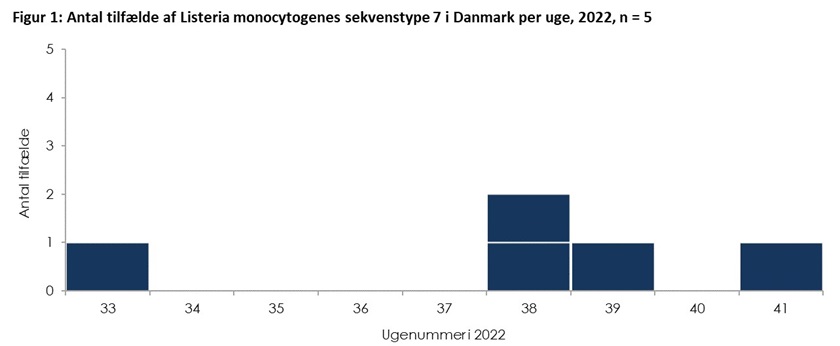
Between 18 August and 13 October 2022, the Statens Serum Institut registered five people who are infected with the same type of Listeria monocytogenes (figure 1). Among the sick are 2 men and 3 women. The patients are between 6-83 years old (median age is 75 years). The patients are infected throughout the country (table 1).

Figure 1 Number of cases of Listeria monocytogenes sequence type 7 per week 2022 in Denmark

Table 1. Patients with the same type of Listeria monocytogenes in Denmark, August to October 2022, per region (n=5)

Region

Number of patients

The capital  1
Central Jutland  1
Northern Jutland 0
Zealand 1
Southern Denmark 2
Total 5

The investigation of the outbreak

The outbreak is handled by the Central Outbreak Group, which consists of SSI, the Danish Veterinary and Food Administration and the DTU Food Institute. SSI stands for whole-genome sequencing of listeria isolates from the patients and interviews with patients or relatives with a view to identifying a possible source of infection.

The outbreak strain

The bacteria is of the type Listeria monocytogenes . By whole-genome sequencing of the Listeria monocytogenes bacteria isolated from the patients, it can be seen that they are very closely related and belong to sequence type 7.

Hong Kong – CFS actively follows up on food poisoning outbreak involving tuna fillet – Histamine

CFS

The Centre for Food Safety (CFS) of the Food and Environmental Hygiene Department said today (October 31) that it is actively following up on a food poisoning outbreak involving tuna fillet, including investigating the restaurant and the importer concerned, and conducting source tracing. A sample of tuna fillet collected from the importer was found to contain a toxic metabolite, histamine. The CFS urged the public not to consume the product. The trade should stop using or selling the affected product immediately if they possess it.

Details of the product are as follows:

Product name: Frozen tuna fillet
Place of origin: Vietnam
Lot No.: VN 166 VI 157
Production date: July 5, 2022
Expiry date: July 5, 2024
Importer: Ichiban Pacific (H.K.) Ltd

A spokesman for the CFS said, “Upon notification by the Centre for Health Protection of the Department of Health of food poisoning cases involving tuna fillet, the CFS immediately sent staff to the restaurant concerned in Tsim Sha Tsui and the importer to conduct an investigation and source tracing, and took samples for testing. The test results showed that a frozen tuna fillet sample from the importer contained histamine at a level of 2800 milligrams per kilogram, which can cause food-borne intoxication.”

The spokesman added, “The importer, suppliers and restaurant concerned are following the CFS’s advice to stop sale and discard the affected product. The importer has also initiated a recall. Members of the public may call its hotline at 2512 2900 during office hours for enquiries about the recall. The CFS has also provided health education on food safety and hygiene to the person-in-charge and staff concerned, and instructed them to carry out thorough cleaning and disinfection, as well as to implement improvement measures to ensure food safety. Should there be sufficient evidence, prosecution will be instituted.”

According to section 54 of the Public Health and Municipal Services Ordinance (Cap. 132), all food for sale in Hong Kong, whether locally produced or imported, should be fit for human consumption. An offender is subject to a maximum fine of $50,000 and imprisonment for six months upon conviction.

“Histamine is a toxic metabolite commonly found in certain kinds of fish such as tuna, sardine, mackerel and anchovy, as a result of bacterial spoilage. Consumption of fish containing high levels of histamine can cause food-borne intoxication. Symptoms of histamine poisoning include a tingling and burning sensation around the mouth, facial flushing and sweating, nausea, vomiting, headache, palpitations, dizziness and rash. The onset of intoxication symptoms is within a few hours after consumption and these symptoms will normally disappear in 12 hours without long-term effects,” the spokesman said.

The CFS will alert the trade to the incident, continue to follow up and take appropriate action. An investigation is ongoing.