Category Archives: Food Toxin

RASFF Alert- Botulism Case – Fish Soup

RASFF

Botulism case suspected to be linked to fish soup from France in Belgium

RASFF Alert- Mycotoxin – Patulin – Apple Juice

RASFF

Patulin in apple juice from Denmark in Sweden

RASFF Alerts – Aflatoxin – Hazelnuts – Peanuts – Groundnuts – Ground Chilly – Dried Figs – Nutmeg- Cashew Nuts

RASFF

Aflatoxin in hazelnut kernel from Georgia in Bulgaria

RASFF

Aflatoxin B1 in hazelnuts from Turkey in Germany

RASFF

Aflatoxins in groundnut kernels from South Africa in the Netherlands

RASFF

Aflatoxin B1 in Ground Chilly from India in Greece

RASFF

Aflatoxins in groundnuts in shell from Egypt in Italy

RASFF

Aflatoxins in nutmeg from Indonesia in the Netherlands

RASFF

Aflatoxin in Bolivian peanuts in the Netherlands

RASFF

Aflatoxin B1 in Indian Groundnut Kernels in the Netherlands

RASFF

Aflatoxins in Egyptian Peanut Kernels for Further Processing in the Netherlands

RASFF

Aflatoxin in Egyptian groundnuts in the Netherlands

RASFF

Aflatoxin in Egypt groundnuts in the Netherlands

RASFF

Aflatoxins in dried figs from Turkey in Germany

RASFF

Aflatoxin in Indian groundnuts from India in the Netherlands

RASFF

Aflatoxin in organic cashew kernels from Togo in the Netherlands

RASFF Alerts – Animal Feed -Aflatoxin – Peanuts – Hazelnut Kernels

RASFF

Aflatoxin B1 in U.S.A. peanuts in the Netherlands

RASFF

Aflatoxins in hazelnut kernels from Georgia in Bulgaria

Czech Republic – TARTAR DI MANZO – EPEC E.coli

Potravinynapranyri

Illustration photo no. 1

Place of inspection:
Ostrava ( Masarykovo namesti 2572/7, 702 00 Ostrava )
Company ID: 06433847
Food group: Meals Cold dishes

TARTAR DI MANZO
Category: Dangerous food
Unsatisfactory parameter:

Escherichia coli enteropathogenic (EPEC) – intimin (eaeA)

The food was found to have the pathogenic enteropathogenic bacterium  Escherichia coli (EPEC), which causes watery diarrhea, vomiting and fever.

Expiration date: 8/31/2021
Quantity of product in package: 100 g
Producer: Anebia food sro, Masarykovo namesti 2572/7, Ostrava
Sampling date: 31. 8. 2021
Reference number: 21-000545-CAFIA-CZ
The sample was found by an official inspection of the State Agricultural and Food Inspection Authority.

Ukraine – Four hospitalized with botulism after eating homemade canned mushrooms

Outbreak News Today

In Sumy Oblast in northeastern Ukraine, four people were hospitalized with botulism after eating homemade canned mushrooms at a dinner in the city of Lebedin.

According to the medical director of the Clinical Center for Infectious Diseases and Dermatology, Krasovitsky Irina Trotskaya, two victims were hospitalized at the center for infectious diseases in Sumy, two remained to be treated in the city hospital.

So far in 2021, Ukraine has reported 80 foodborne botulism outbreaks involving 89 patients, including three children.

In most cases, botulism in Ukraine is due to the consumption of dried and salted freshwater and sea fish (40%), meat, fish, vegetables, mushroom canned food and other meat products made at home or bought in unauthorized places.

Research – The Investigation of Mycotoxins and Enterobacteriaceae of Cereal-Based Baby Foods Marketed in Turkey

MDPI

In this study, a total of 85 cereal-based baby foods with or without milk (four different brands; A, B, C, and D) collected from Ankara local markets, Turkey were analyzed for mycotoxins, total aerobic mesophilic bacteria (TAMB), and Enterobacteriaceae contamination. Baby foods were analyzed for 12 toxicological important mycotoxins such as aflatoxin B1, B2, G1, and G2; fumonisin B1 and B2; ochratoxin A; sterigmatocystin (STE); deoxynivalenol (DON); zearalenone (ZON); and T-2 toxin and HT-2 toxin by LC-MS/MS multi-mycotoxin method. In addition to these mycotoxins, the presence of aflatoxin M1 (AFM1) was investigated in baby foods containing milk. The classical culture method was used for microbiological analysis. Consequently, at least one mycotoxin was detected in 69.41% of the total samples. The most frequently detected mycotoxins were STE (34.12%) and HT-2 (34.12%). However, AFM1 was not detected in any of the baby foods containing milk. Also, TAMB and Enterobacteriaceae were isolated from 30.59% and 10.59% of samples, respectively. As a result, it was determined that the mycotoxin levels in the analyzed samples were in accordance with the mycotoxin levels specified in the Turkish Food Codex.

Italy – Animal Feed – HYBRID CORN – Aflatoxin

Salute

Brand : LA FATTORIA DI MZ

Name : HYBRID MAIZE zoot use KG 25 RAW MATERIAL FOR FEED

Reason for reporting : Recall due to microbiological risk

Publication date : 6 December 2021

Click to access C_17_PubblicazioneRichiami_1602_azione_itemAzione0_files_itemFiles0_fileAzione.pdf

Italy – Animal Feed – MEDIUM HYBRID CRUSHED CORN – Aflatoxin

Salute

Brand : LA FATTORIA DI MZ

Name : MEDIUM HYBRID FRANTURCO GRASS 25 KG ZOOTECHNICAL USE RAW MATERIAL FOR FEED

Reason for reporting : Recall due to microbiological risk

Publication date : 6 December 2021

Click to access C_17_PubblicazioneRichiami_1601_azione_itemAzione0_files_itemFiles0_fileAzione.pdf

USA – Outbreak Investigation of E. Coli O157:H7 – Spinach (November 2021)

FDA

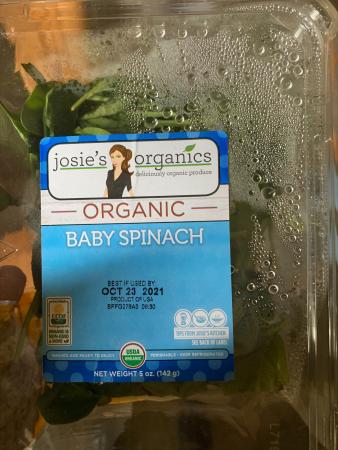
Outbreak Investigation of E. Coli O157:H7 in Spinach (November 2021): Sample Image of Josie's Organics Baby Spinach

The FDA and CDC, in collaboration with state and local partners, are investigating illnesses in a multistate outbreak of E. coli O157:H7. According to the CDC, as of November 15, 2021, 14 people infected with the outbreak strain of E. coli O157:H7 have been reported from nine states. Illnesses started on dates ranging from October 13 to October 27, 2021. 10 people in this outbreak report eating spinach in the week before becoming sick and six people reported Josie’s Organics brand.

On November 15, 2021, the Minnesota Department of Agriculture reported that, as part of this outbreak investigation, a sample of Josie’s Organics Baby Spinach collected from the home of an ill person tested positive for E. coli O157:H7. This sample had a “Best If Used By” date of October 23, 2021. Whole Genome Sequencing (WGS) analysis determined that the strain of E. coli O157:H7 present in the product sample matches the outbreak strain.

FDA traced the supply chain for this positive product sample back to a small number of farms in two different geographic regions and deployed Investigators along the supply chains of interest. FDA continues tracing back reported spinach exposures to identify if spinach from additional farms could have been implicated.

FDA and state partners are working with the firm to determine if additional products could be affected. This is an ongoing investigation and additional information will be provided as it becomes available.

Recommendation

Consumers, restaurants, and retailers, should not eat, sell, or serve Josie’s Organics Baby Spinach with a “Best If Used By” date of October 23, 2021. Josie’s Organics Baby Spinach is sold in a clear plastic clamshell with the Best If Used By Date on the top label.

Although this product is past expiration and should no longer be available for purchase, consumers should check their homes for product and discard it. If consumers froze fresh Josie’s Organics Baby Spinach, they should discard it.


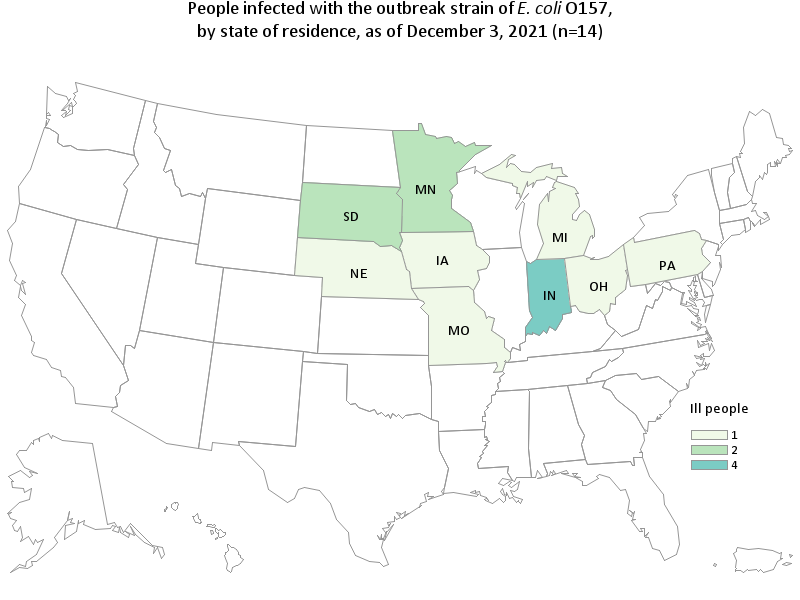
Case Count Map Provided by CDC

Outbreak Investigation of E. Coli O157:H7 in Spinach: Case Count Map Provided by CDC (December 3, 2021)

Case Counts

Total Illnesses: 14
Hospitalizations: 4
Deaths: 0
Last Illness Onset: October 27, 2021
States with Cases: IA (1), IN (4), MI (1), MN (2), MO (1), NE (1), OH (1), PA (1), SD (1)