Category Archives: Food Toxin

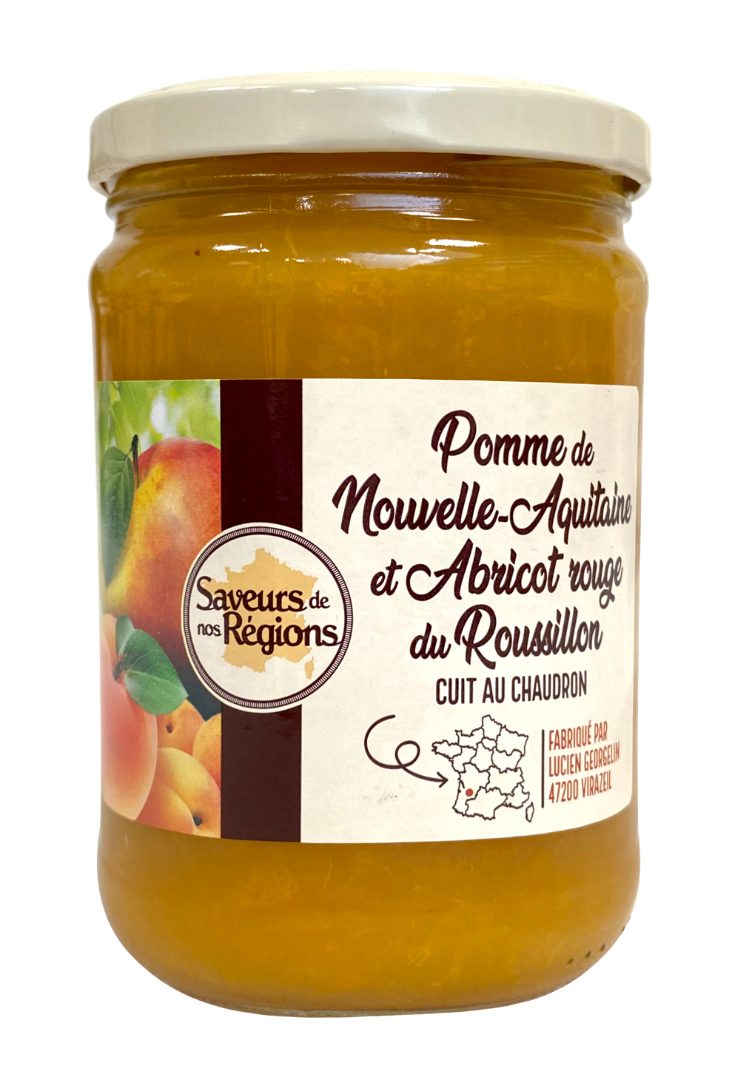
France – Fruit Dessert – Mycotoxin – Patulin

Gov france

Identification information of the recalled product

  • Product category Food
  • Product subcategory Sweet products
  • Product brand name Flavors of our regions
  • Model names or references Apple Apricot
  • Identification of products
    GTIN Dated
    20291495 Date of minimum durability 20/12/2024
  • Packaging glass jars
  • Marketing start/end date From 21/12/2021 to 18/02/2022
  • Storage temperature Product to be stored at room temperature
  • Further information New Aquitaine apple and Roussillon red apricot
  • Geographic area of ​​sale Regions: Auvergne-Rhône-Alpes, , Burgundy-Franche-Comté, , Centre-Val de Loire, , Île-de-France, , New-Aquitaine, , Occitanie, , Provence-Alpes-Côte d’azur
  • Distributors Some Lidl supermarkets. See attached list.
  • List of points of sale20220201_List_SM.pdf

Practical information regarding the recall

  • Reason for recall An analysis revealed a Patulin content higher than the limit authorized by European regulations.
  • Risks incurred by the consumer Patulin
  • Additional description of the risk Patulin is a mycotoxin which can present a health risk in the event of significant and repeated consumption over the long term.

Belgium – Golden Sun brand Basmati rice – Aflatoxin B1

AFSCA

LT Foods recall
Product: Golden Sun brand Basmati rice.
Problem: Aflatoxin B1 content too high.
LT Foods has decided, in agreement with the FASFC, to withdraw the product Basmati Rice (1 kg) of the Golden Sun brand from sale and to recall it from consumers because of an excessively high aflatoxin B1 content.

We ask that you do not consume this product and return it to your point of sale. You will be reimbursed even without presenting the receipt. Product description: – Product name: Basmati rice – Brand: Golden Sun – Best before date (BDD): 06/10/2023 – EAN code: 20364625

 Sale period: from 08/10/2021 to 18/02 /2022 – Type of packaging: plastic packaging (bag) – Weight: 1 kg The product was distributed in Belgium by Lidl.

For any further information , contact Lidl customer service ( 0800/73520 (free))

Germany – Oat King “Milk & Honey” Oat Bar – Salmonella

LMW

Alert type: Food
Date of first publication: 02/18/2022
Product name:

Oat King “Milk & Honey” Oat Bar

Product images:

Photo OatKing.JPG

Consumer information from LSP Sportnahrung GmbH

Manufacturer (distributor):

LSP Sportnahrung GmbH Römerstr. 45-51 53111 Bonn

Reason for warning: It cannot be ruled out that individual oat bars contain salmonella.
Durability: Best before September 20th, 2022
Lot identification: 777
Further information:

Further information can be found in the attached consumer information.

Belgium – Basmati rice “Basmati rijst Aromatisch” from the AH brand – Ochratoxin

AFSCA

Recall by Albert Heijn
Product: Basmati rice “Basmati rijst Aromatisch” from the AH brand.
Problem: the product contains too high an ochratoxin content.

In agreement with the FASFC, Albert Heijn reminds consumers of the basmati rice “Basmati rijst Aromatisch” of the Albert Heijn brand with the expiry date 10/08/2023. The product contains too high an ochratoxin content. Consumption of this product may pose a health risk.

Albert Heijn asks its customers not to consume this product and to return it to the point of sale where it was purchased. The product will be refunded or exchanged there. Please contact a doctor in case of any health problem.

Product description

• Product category: rice
• Product name: Basmati rijst Aromatisch
• Brand: Albert Heijn
• Expiry date (BDD): 10/08/2023
• Sale period: from 11/08/2021, product no. is no longer on sale in stores
• Nature of packaging: cardboard
• Weight: 400 g

For any further information , please contact Albert Heijn via 0800 777 05.

RASFF Alert – Histamine – Tuna

RASFF

Histamine in chilled tuna from The Netherlands in Belgium

RASFF Alerts – Aflatoxin – Rice – Dried Figs – Peanuts – Groundnuts – Nutmeg- Golden Sun Basmati Rice

RASFF

Aflatoxin in Pakistan Rice in the Netherlands

RASFF

Aflatoxin in Pakistan Rice in the Netherlands

RASFF

Aflatoxins beyond the limits allowed in Dried Figs from Turkey in Italy

RASFF

Excessive aflatoxin levels (aflatoxin B1 and total aflatoxin) in dried figs from Turkey in Germany

RASFF

Aflatoxin in peanuts from Argentina in the Netherlands

RASFF

Aflatoxin in groundnut kernels from Argentina in the Netherlands

RASFF

Aflatoxin in Indian groundnuts in the Netherlands and Switzerland

RASFF

Aflatoxin in Indian groundnuts in the Netherlands and Switzerland

RASFF

Aflatoxin in Turkish Figs in the Netherlands and Germany

RASFF

Aflatoxin B1 found in golden sun basmati rice from Pakistan in Belgium and the Netherlands

RASFF

Aflatoxin in Indonesian Nutmeg in the Netherlands

Research – How do Time, Tannin and Moisture Content Influence on Toxicogenic Fungal Populations during the Storage of Sorghum Grains?

Journal of Food Protection

Cereal grains are usually ensiled to improve their nutritional value and are one of the main sources of feed for dairy cattle. However, during storage, grains can be contaminated with toxicogenic fungi. Sorghum is one of the most economically important cereals in the world. Therefore, the aim of this work was to evaluate the influence of storage duration and tannin and moisture contents on toxicogenic fungal populations in sorghum grain storage. Samples were prepared with variety high in tannins (genotypes Morgan 108 and ACA 558, >5g/kg DM) and with variety low tannin content (genotypes Flash 10 and ACA 546, <1g/kg DM) were collected and manually compacted in experimental laboratory silos where they received different moisture content treatments, namely low (15-25%), medium (26-32%) and high (33-42%). Freshly harvest grains were analyzed at time 0 and storage grains were analyzed at different times (30, 90 and 180 days). Fungal isolation and identification were performed following conventional mycological methods. Penicillium citrinum (34%), Aspergillus flavus (60%) and Fusarium nygamai (68%) were the most abundant species. Rapid detection of aflatoxins and fumonisins in each sample was performed by ELISA according to the AOAC method, and the quantification of aflatoxin B 1 was performed by HPLC. Aflatoxins were detected in four samples with levels of 6.7-28.8 µg/kg and aflatoxin B 1 with a level of 2-14 µg/kg in pre- and post-storage grains . Fumonisins were only detected in two freshly harvested samples with levels of 500-900 µg/kg . In general, the storage time favored the increase of Penicillium population, instead the Aspergillus and Fusarium are reduced. Conversely the abundance of the three population was not affected by the moisture content. The results of this study show that fungal population must be analyzed at different times.

Research – Escherichia coli O103 outbreak associated with minced celery among hospitalized individuals in Victoria, British Columbia, 2021

PHAC

Abstract

Background: In April 2021, a Shiga toxin-producing Escherichia coli (E. coli) (STEC) O103 outbreak was identified among patients at two hospitals in Victoria, British Columbia (BC). The objective of this study is to describe this outbreak investigation and identify issues of food safety for high-risk products prepared for vulnerable populations.

Methods: Confirmed cases of E. coli O103 were reported to the Island Health communicable disease unit. The provincial public health laboratory conducted whole genome sequencing on confirmed case isolates, as per routine practice for STEC in BC. Exposure information was obtained through case interviews and review of hospital menus. Federal and local public health authorities conducted an inspection of the processing plant for the suspect source.

Results: Six confirmed cases of E. coli O103 were identified, all related by whole genome sequencing. The majority of cases were female (67%) and the median age was 61 years (range 24–87 years). All confirmed cases were inpatients or outpatients at two hospitals and were exposed to raw minced celery within prepared sandwiches provided by hospital food services. A local processor supplied the minced celery exclusively to the two hospitals. Testing of product at the processor was infrequent, and chlorine rinse occurred before mincing. The spread of residual E. coli contamination through the mincing process, in addition to temperature abuse at the hospitals, are thought to have contributed to this outbreak.

Conclusion: Raw vegetables, such as celery, are a potential source of STEC and present a risk to vulnerable populations. Recommendations from this outbreak include more frequent testing at the processor, a review of the chlorination and mincing process and a review of hospital food services practices to mitigate temperature abuse.

USA – Pepperoni recalled due to Bacillus cereus

FSIS USDA

WASHINGTON, Dec. 14, 2021 – Smithfield Packaged Meats Corp., doing business as Margherita Meats, Inc., an Omaha, Neb. establishment, is recalling approximately 10,990 pounds of ready-to-eat (RTE) pepperoni products that may be adulterated with Bacillus cereus (B. cereus), the U.S. Department of Agriculture’s Food Safety and Inspection Service (FSIS) announced today.

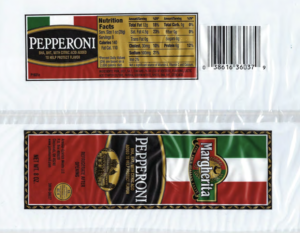
The RTE unsliced pepperoni product was produced and packaged on June 17, 2021.  The following products are subject to recall [view label]:

  • 8-oz. plastic shrink-wrapped packages containing unsliced pepperoni “Margherita PEPPERONI” with lot code P1931C and a “use by date” of 12-14-21 represented on the label.

The products subject to recall bear establishment number “EST. 19” inside the USDA mark of inspection. These items were shipped to retail locations nationwide.

The problem was discovered when the Department of Defense notified FSIS that they found B. cereus during routine product testing.

B. cereus is a toxin-producing microorganism that causes diarrhea and vomiting in people. Those with compromised immune systems are at risk for more severe illness. Vigorous rehydration and other supportive care including antibiotics are the usual treatment.

There have been no confirmed reports of adverse reactions due to consumption of these products. Anyone concerned about an injury or illness should contact a healthcare provider.

FSIS is concerned that some product may be in consumers’ pantries or refrigerators. Consumers who have purchased these products are urged not to consume them. These products should be thrown away or returned to the place of purchase.

FSIS routinely conducts recall effectiveness checks to verify recalling firms notify their customers of the recall and that steps are taken to make certain that the product is no longer available to consumers. When available, the retail distribution list(s) will be posted on the FSIS website at www.fsis.usda.gov/recalls.

Media with questions regarding the recall can contact Jim Monroe, Corporate Affairs, Margherita Meats Corp., at (703) 559-1875. Consumers should call the Margherita Consumer Affairs Hotline at (844) 342-2596.

Consumers with food safety questions can call the toll-free USDA Meat and Poultry Hotline at 1-888-MPHotline (1-888-674-6854) or live chat via Ask USDA from 10 a.m. to 6 p.m. (Eastern Time) Monday through Friday. Consumers can also browse food safety messages at Ask USDA or send a question via email to MPHotline@usda.gov. For consumers that need to report a problem with a meat, poultry, or egg product, the online Electronic Consumer Complaint Monitoring System can be accessed 24 hours a day at https://foodcomplaint.fsis.usda.gov/eCCF/.

RASFF Alert – STEC E.coli – Raw Milk Cheese – Bovine Meat – Frozen Lamb

RASFF

Shiga toxin-producing Escherichia coli in raw milk cheese from France in Belgium and Luxembourg

RASFF

Presence E. coli STEC in Bovine meat from Brazil in Spain

RASFF

Shiga toxin-producing Escherichia coli in frozen lamb meat from New Zealand in Italy