Category Archives: Food Microbiology Research

Research – Role of climate change in increased mycotoxin levels

All About Feed

Climate change is likely to be part of the reason for the increase in mycotoxin issues for the global animal feed business. And the trend is expected to continue and even accelerate over the next 5 years.

7 out of 10 analyses run last year found raw ingredients contaminated with mycotoxins, according to Cargill’s annual review. But reassuringly, just 35% of these reached performance risk thresholds, showing that positive analyses are not always concerning.

Last year’s study analysed more than 328,000 samples across more than 150 global feed plants, on-farm samplings and storage locations in 54 countries. The majority of these were corn (212,254), cereals (85,478), oilseeds (27,602) or others (3,632). It found 72% of analyses were contaminated with at least one mycotoxin showing that contamination is more likely than not across all ingredients.

Since mycotoxins are produced by moulds as a natural defence response to environmental factors, their occurrence is linked to climate conditions.
USA – Core Investigation Table Update

FDA

Date
Posted
Ref


#

Pathogen
Product(s)
Linked to
Illnesses

(if any)
Investigation
Status
1/10/

2022

1050 E. coli
O121:H19
Romaine Ended
12/29/

2021

1052 E. coli
O157:H7
Packaged Salad Active
12/20/

2021

1039 Listeria
monocytogenes
Packaged Salad Active
12/15/

2021

1048 Listeria
monocytogenes
Packaged Salad Active
9/15/

2021

1031 Salmonella
Oranienburg
Red, Yellow,
and White Onions
Active

Research – Are Frozen Fruits and Vegetables Healthy and Safe?

Consumer Reports

At Consumer Reports, we’ll always tell you what we find with our testing—it’s important to highlight when products and services excel and when they fall short. When we look at food through a safety lens, unfortunately we often find reasons to be concerned—whether that’s because of substances like heavy metals in supplements, baby food, or spices, or disease-causing bacteria such as E. coli in ground beef.

But sometimes, as is the case with CR’s recent tests of frozen fruits and veggies, we get good news. Our food scientists recently tested more than 300 samples of eight types of frozen produce and didn’t find any harmful bacteria.

Most frozen vegetables are blanched in hot water or steamed before freezing, which may lead many to think they are already cooked and risk free—people let their toddlers snack on frozen veggies, or might toss them into a salad without cooking them first. But though frozen produce is convenient and generally safe, it may still harbor bacteria that cause foodborne illness, such as Listeria monocytogenes or salmonella.

Read more at the link above.

Research – Publisher’s Platform: The World’s Largest and Deadliest Listeria Outbreak is turning 4 in March

Food Safety News

In March of this year it will be 4 years since I boarded a flight from Seattle to Johannesburg (20 plus hour flight) to speak at a food safety conference just days after the South African health authorities announced that a Listeria outbreak had been linked to a product named polony manufactured by the largest food manufacturer in Africa.

I recall how similar it felt to the early days of the Jack-in-the-Box E. coli outbreak of 1993– how everyone seemed honestly shocked that such a tragedy could happen.

I have spent the last 4 years working (being 10 hours behind has required far too many late nights and early morning calls) with a cadre of amazing lawyers and more amazing staff moving forward in the first foodborne illness class action in Africa.  We have much to do to find justice to the more than 1,000 sickened and their families.  I am saddened by the pace of the litigation, but determined to take care of our class members – we have to work harder.

Canada – Absence of information necessary for the safe consumption of smoked salmon sold by the company To each his own beer

MAPAQ

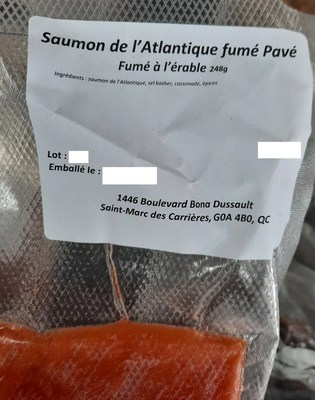
QUEBEC CITY, Jan. 25, 2022 /CNW Telbec/ – The Ministère de l’Agriculture, des Pêcheries et de l’Alimentation (MAPAQ), in collaboration with the company À each his beer, located at 1446, boulevard Bona-Dussault, in Saint-Marc- des-Carrières, warns the population not to consume the product indicated in the table below if it has not been kept in the freezer at all times since the time of purchase. Indeed, the product label does not include the information necessary for its safe consumption, namely the statement “Keep frozen until use” which is required.

Product name

Format

Affected lot

“MAPLE-SMOKED PAVÉ-SMOKED ATLANTIC SALMON”

248g

Units sold until
January 25, 2022

The product that is the subject of this warning was offered for sale until January 25, 2022 inclusively, and only at the establishment designated above. It was packaged in a clear plastic bag and sold frozen. The product label includes, in addition to its name and list of ingredients, the address of the establishment.

The operator is voluntarily recalling the product. It has agreed with MAPAQ to issue this warning as a precautionary measure. Persons who have this product in their possession and have not kept it in the freezer at all times since the time of purchase are advised not to consume it. They must either return it to the establishment where they bought it or throw it away. Even if the affected product shows no signs of tampering or suspicious odors, consuming it may pose a health risk. It should be noted that no case of illness associated with the consumption of this food has been reported to MAPAQ to date.

Atlantic Salmon Pavé (CNW Group/Ministry of Agriculture, Fisheries and Food) 

Hazard Classification:  Class 1
Reference Number:  4477

Source:
Media relations
Direction des communications
Ministry of Agriculture, Fisheries
and Food
Tel. : 418 380-2100, extension 3512
www.mapaq.gouv.qc.ca

QuoteView original content to download multimedia: http://www.newswire.ca/en/releases/archive/January2022/25/c7508.html

Research – What Is Listeria Meningitis? Causes, Treatment, and More

Healthline

Listeria meningitis is a type of bacterial meningitis that is a serious complication of a listeria infection. Without prompt treatment, it can quickly become life threatening. After recovering from meningitis, some people are left with permanent disabilities.

Meningitis involves inflammation and swelling of the protective membranes, called meninges, that surround the brain and spinal cord. This can happen for many reasons, including injury and infection.

Listeria infection, also called listeriosis, is a rare disease caused by the bacteria called Listeria monocytogenes. According to the Food and Drug Administration (FDA)Trusted Source, almost all cases stem from consuming contaminated food. It’s most likely to affect pregnant people, newborns, and those with a weakened immune system.

We’ll overview what causes listeria meningitis to occur, how to treat it, prevention, and more.

Research – Food Poisoning Treatment

Food Poisoning News

While the effects of food poisoning are usually not life-threatening, they can be very unpleasant and result in additional health conditions that require medical attention. Some patients may be at risk for more serious complications depending on their overall health condition and the type of bacteria or virus causing the illness.

Research – Preventing Food Poisoning

Food Poisoning News

Food poisoning is a common, yet potentially serious environmental health issue. The occurrence of food poisoning can be reduced by following some simple rules while preparing, cooking, and serving food.

The most common causes of food poisoning are bacteria, viruses, or parasites that are present in foods that are contaminated with human or animal feces or their toxins. Most of the food poisoning cases are due to the consumption of foods that have not been thoroughly cooked or properly stored.

All these micro-organisms that cause food poisoning can be killed if they are exposed to adequate heat for a sufficient time, as in cooking or pasteurization.

USA – Annual Reports on Foodborne Illness Source Attribution Estimates

CDC

Foodborne Illness Source Attribution Estimates for SalmonellaEscherichia coli O157, Listeria monocytogenes, and Campylobacter Using Multi-Year Outbreak Surveillance Data, United States.

Latest Report for 2019

IFSAC analyzed data from 1,532 foodborne disease outbreaks that occurred from 1998 through 2019 to assess which categories of foods were most responsible for SalmonellaE. coli O157, Listeria monocytogenes, and Campylobacter infections. These pathogens were chosen because of the frequency or severity of the illnesses they cause, and because targeted interventions can have a major impact in reducing them. The implicated foods were divided into 17 categories for the analysis, and the method gives the greatest weight to the most recent five years of outbreak data (2015–2019).

Read the 2019 report pdf icon[PDF – 14 pages]

USA – Listeria was Top Pathogen Source of Recalls and Related Deaths in 2021

Food Poisoning Bulletin

In-depth analysis from Food Poisoning Bulletin 

Listeria was the top pathogen source of food recalls and related deaths in 2021, according to an in-depth analysis by Food Poisoning Bulletin. After our second annual analysis of recalls for meat and poultry, which are regulated by the U.S. Department of Agriculture (USDA), we turned our attention to recalls for all other foods which are regulated by the U.S. Food and Drug Administration (FDA). The Listeria findings are some of the key takeaways from our deep dive into 2021 food recalls.