Category Archives: STEC E.coli

RASFF Alert – STEC E.coli – Chilled Meat Preparation

European Food Alerts

RASFF

Escherichia coli (eae+, stx1+, stx2-) in chilled meat preparation from Belgium in Belgium

USA – Outbreak Investigation of E. coli – Leafy Greens (December 2020)

FDA

Total Illnesses: 40
Hospitalizations: 20 (4 Cases HUS)
Deaths: 0

The FDA, along with CDC and state and local partners, investigated a multistate outbreak of E. coli O157:H7 infections in the fall of 2020. The epidemiology and traceback investigation have determined that the outbreak was linked to leafy greens. The epidemiological and traceback investigations were not able to determine a specific type of leafy green linked to illnesses. On 12/22/2020, the CDC announced that this outbreak appears to be over. This outbreak, announced by FDA and CDC on October 28, 2020, was caused by a strain of E. coli that is genetically related to a strain linked to the fall 2019 romaine outbreak.

The FDA completed a traceback investigation of multiple types of leafy greens identified in patient interviews. Although no single ranch was identified as a common source of the leafy greens, FDA and state partners also conducted on-site investigations on farms of interest.

Teams were deployed to dozens of ranches in the region to conduct large scale environmental sampling. Additionally, no Shiga toxin-producing E. coli were found on leafy greens. As part of the field investigation, teams conducted environmental sampling on and around ranches of interest to identify any factors that could have led to contamination. Samples of soil, scat or animal droppings, compost, water, and other environmental sources were collected and analyzed.

Laboratory analysis of samples is now complete. The analysis has confirmed a positive match to the outbreak strain in a sample of cattle feces, which was collected during follow-up investigations on a roadside, uphill from where leafy greens or other food identified in the traceback investigation were grown. While the finding does not provide definitive information on how E. coli may have contaminated product during the growing and harvesting season, it does confirm the presence of a strain of E. coli O157:H7 that causes recurring outbreaks in a more narrowly defined growing region and a potential, continued source of contamination.

At this time, FDA’s investigational activities have concluded. The FDA continues to review the findings from this outbreak and a detailed report will be released in the near future. This report will include recommendations shaped by the investigation findings.

In the meantime, as recommended in our Leafy Greens Action Plan, the FDA continues to recommend growers assess and mitigate risk associated with adjacent and nearby land use practices, particularly as it relates to the presence of livestock, which are a persistent reservoir of E. coli O157:H7 and other STEC.

Recommendation

CDC has declared this outbreak to be over. There is no recommendation for consumers, retailers, or suppliers.


France – PREMIUM prepared from the Traiteur Pierrot brand -STEC E.coli

AFSCA

Recall of Euro-Délices Distribution
Product: PREMIUM prepared from the Traiteur Pierrot brand.
Problem: Possible presence of E. coli STEC.


In agreement with the AFSCA, Euro-Délices Distribution is withdrawing from sale the “Prepared PREMIUM” products of the Traiteur Pierrot brand and is recalling them to consumers because of the possible presence of STEC.

Euro-Délices Distribution asks its customers not to consume these products and to bring them back to the point of sale where they were purchased, where they will be reimbursed.

Product description Product

name: Prepared PREMIUM TP
Brand: Traiteur Pierrot Use by
date (DLC): 29/01/2021
Batch number: 105201
Sales period: from 07/01/2021 to 21/01/2021
Type of packaging: plastic jar with lid
Weight: 180g – 0.5kg – 1.25kg


The product was sold through various supermarkets, retailers and food stores.

For any further information , contact:

Fabienne Cluts
Tel: 04 / 278.78.12
fabiennecluts@eurodelices.be

Korea – 3 officials from McDonald’s supplier get suspended sentences for selling tainted patties – E.coli

Korea Herald

Ecoli Istock

Three officials from a burger patty supplier for McDonald’s Korea were given suspended prison sentences by a local court Tuesday for providing patties potentially contaminated with E. coli to the local unit of the global fast-food giant.

A managing director of the supplier, whose name was withheld, and two mid-ranking officials in charge of production and quality management, respectively, were indicted without detention in 2018 for allegedly distributing 63 tons of beef patties that tested positive for intestinal hemorrhagic E. coli contamination.

In addition, they were charged with selling 2,160 tons of beef patties with Shiga toxin genes detected in a PCR (polymerase chain reaction) test, a test method that amplifies DNA. Shiga toxin is a toxin component released from intestinal hemorrhagic E. coli.

The Seoul Central District Court convicted all three for violating the Livestock Products Sanitary Control Act but handed out suspended jail terms ranging from two to three years.

USA – Sources of Foodborne Illness Report Released – IFSAC

Click to access P19-2018-report-TriAgency-508.pdf

RASFF Alert- STEC E.coli – Vacuum Packed Beef Salami

European Food Alerts

RASFF

shigatoxin-producing Escherichia coli ( stx1+ stx2+ /25g) in vacuum-packed beef salami from Slovenia in Slovenia

USA – Outbreak Investigation of E. coli – Leafy Greens (December 2020) – CDC declares outbreak over, FDA investigation ongoing

FDA

The FDA, along with CDC and state and local partners, investigated a multistate outbreak of E. coli O157:H7 infections in the fall of 2020. The epidemiology and traceback investigation have determined that the outbreak was linked to leafy greens. The epidemiological and traceback investigations were not able to determine a specific type of leafy green linked to illnesses. On 12/22/2020, the CDC announced that this outbreak appears to be over. This outbreak, announced by FDA and CDC on October 28, 2020, was caused by a strain of E. coli that is genetically related to a strain linked to the fall 2019 romaine outbreak.

The FDA completed a traceback investigation of multiple types of leafy greens identified in patient interviews. Although no single ranch was identified as a common source of the leafy greens, FDA and state partners also conducted on-site investigations on farms of interest. 

Teams were deployed to dozens of ranches in the region to conduct large scale environmental sampling. Additionally, no Shiga toxin-producing E. coli were found on leafy greens. 

At this time, FDA’s investigational activities, including sample analysis are ongoing. A detailed report of FDA’s findings in the investigation will be released in early 2021, following the conclusion of investigational activities.

Recommendation

CDC has declared this outbreak to be over. There is no recommendation for consumers, retailers, or suppliers.


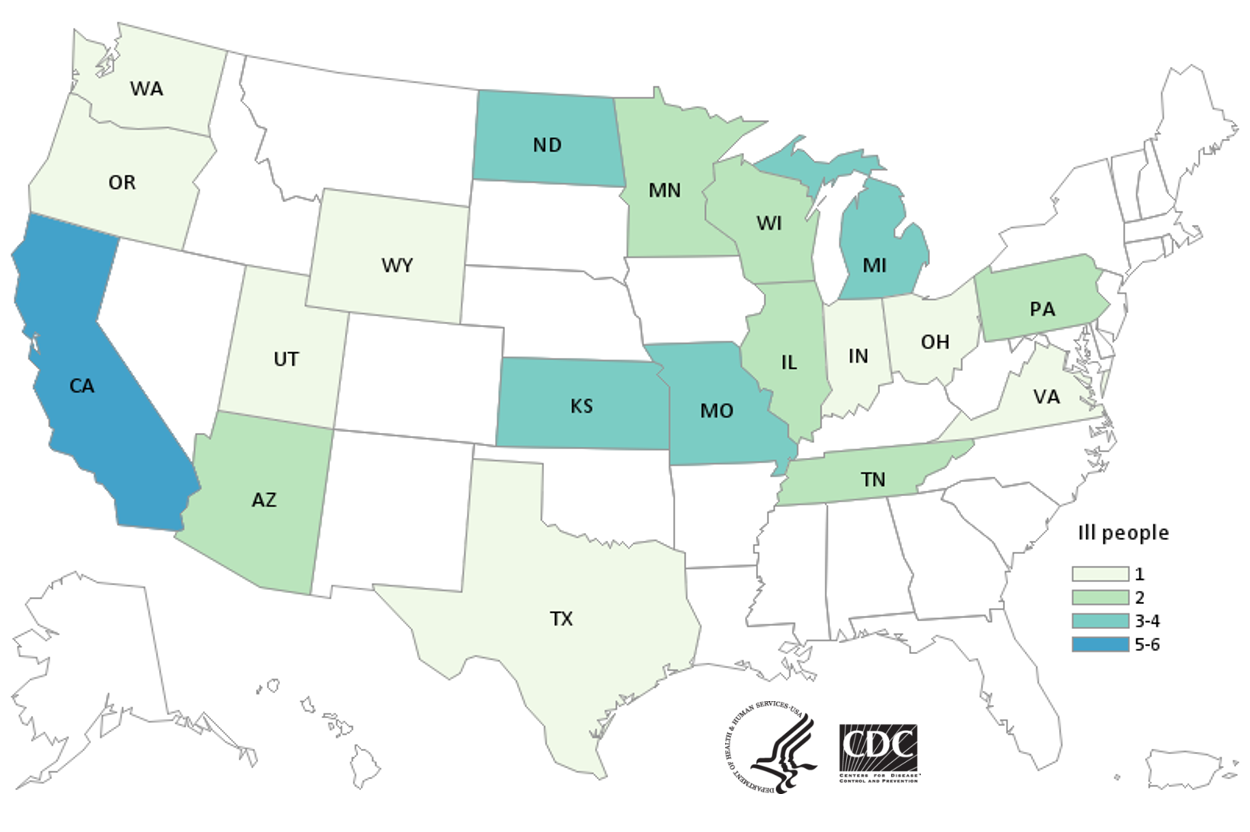
Case Count Map Provided by CDC

Outbreak Investigation of of E. coli in Leafy Greens (December 2020) - Case Count Map from CDC 12/22/2020

Case Counts

Total Illnesses: 40
Hospitalizations: 20 (4 Cases HUS)
Deaths: 0
Last Illness Onset Date: October 31, 2020
States with Cases: AZ (2), CA (6), IL (2), IN (1), KS (4), MI (3), MN (2), MO (3), ND (4), OH (1), OR (1), PA (2), TN (2), TX (1), UT (1), VA (1), WA (1), WI (2), WY (1)
*States with confirmed distribution; product could have been distributed further

Useful Links

Research – Special Issue: Shiga Toxin-Producing Escherichia coli

MDPI

Globally, Shiga toxin-producing Escherichia coli (STEC) is an important cause of diarrheal disease, most notably hemorrhagic colitis, and post-diarrheal sequela, such as hemolytic-uremic syndrome (HUS) [1]. Cattle are a major reservoir of STEC, with approximately half of the cases in humans attributable to foodborne exposure [2]. Prevention of human illness has mainly been through food safety measures [2]. Despite extensive research, no other generally accepted and effective preventive measures or therapies for STEC infections in human patients are available [3]. Many questions remain about STEC virulence factors, pathogenesis, detection, and other aspects that necessitate a continuation of basic and applied research on a wide front. This Special Issue includes 14 papers (nine articles, two communications, one review, one comment, and one reply) that collectively provide novel information on the epidemiology [4,5,6,7], virulence factors [7,8,9,10], and pathogenesis [11,12,13] of STEC, and the molecular structure or toxicity [14,15,16] and immunodetection [17] of Shiga toxin.

USA – Outbreak Investigation of E. coli O157:H7: Unknown Food (Fall 2020)

FDA

The FDA and CDC, in collaboration with state and local partners, have completed the investigation on two of three multistate outbreak of E. coli O157:H7 infections in the U.S. this fall.

One of these investigations, Outbreak Unknown Source 3, identified 18 reported illnesses in nine states: California, Colorado, Illinois, Michigan, New York, Ohio, Pennsylvania, Virginia, Washington.

FDA completed a traceback investigation of several potential food vehicles identified in patient interviews and although no single farm was identified as a common source of the outbreak, FDA and state partners also conducted on-site investigations on farms of interest. However, information and samples collected in these inspections did not link these farms to the outbreak. The investigation of a farm does not mean that the farm is linked to an outbreak. The results of an investigation into a farm may well lead to that firm being ruled out of the investigation. On 12/18/2020, the CDC announced that this outbreak had ended.

The other completed outbreak investigation, Outbreak Unknown Source 1, identified 32 reported illnesses in 12 states: California, Illinois, Louisiana, Maryland, Michigan, Montana, New Jersey, Ohio, Utah, Virginia, Washington, Wisconsin. This strain of E. coli is genetically similar to a strain linked to a romaine outbreak that occurred in the spring of 2018, though a food was not linked to the current outbreak. FDA completed a traceback investigation and was unable to determine a common source of the outbreak. FDA and state partners also conducted on-site inspections on farms of interest, though information collected in these inspections did not link these farms to the outbreak. On 12/18/2020, the CDC announced that this outbreak had ended.

Investigations of a third E. coli outbreak of Unknown Source 2 continue.

Recommendation

Consumers, restaurants, and retailers, were advised not to eat, sell, or serve recalled Tanimura & Antle, Inc. brand packaged single head romaine lettuce with a pack date of 10/15/2020 or 10/16/2020.

The recalled products are now well beyond expiration and likely no longer on the market or in consumers’ homes.

RASFF Alerts – STEC E.coli – O26 – O103 – Chilled Beef – Cow Carcasses

European Food Alerts

RASFF

shigatoxin-producing Escherichia coli (stx1+, stx2+, eae+, O26) in chilled beef from Belgium in Belgium

RASFF

shigatoxin-producing Escherichia coli (stx+; eae+, O103) in cow carcasses from Belgium in Belgium