Category Archives: foodbourne outbreak

USA – Better Testing Needed to Address Listeria Outbreaks

Food Poisoning News

Just in the past year, 2021, there were four different major multistate listeria outbreaks, as well as numerous food recalls related to listeria contamination. When two or more people are determined to have gotten the same illness from the same contaminated food or drink, health officials qualify this as a foodborne illness outbreak. According to the U.S. Centers for Disease Control and Prevention (CDC), roughly 1,600 people become infected with listeria each year and 260 of those cases result in death. Though listeria infection is not the most common pathogenic cause of foodborne illness, it is responsible for a large percentage (19%) of the deaths caused by foodborne illnesses each year. For this reason, listeria monocytogenes are considered one of the “big three” foodborne illness pathogens. Those who are most at-risk for serious onset of listeria infection are those with compromised immune systems, pregnant women, newborn babies, and elderly people.

Sweden – Report on food poisoning in Sweden during 2020. 

Livsmedelsverket

The report describes how many people become ill from the food, which are the most common infectious agents and foods that cause the disease cases, where in the food chain the designated foods are contaminated, which countries of origin were indicated for the designated foods, what contributing factors were identified, seasonal variation and changes in recent years. The results from the report provide information to those who have an interest or need for this type of knowledge in their profession and not least to show and give feedback on the valuable work performed by those who investigate, report and otherwise study food poisoning.

Summary Reported Foodborne Illness in Sweden 2020
This Report compiles food poisonings reported to the Swedish Food Agency in 2020. A new online form for submitting reports to the Swedish Food Agency was launched in January 2020, aiming to raise the quality of reported data. In 2020, the Covid-19 pandemic was ongoing also, which affected the number of food poisoning outbreaks during the year.
By food poisoning is meant here an illness caused by eating food containing harmful bacteria, parasites, viruses or toxins. The main purpose of the compilation is to support food poisoning investigations in several ways:
by giving the present position of the most recent food poisonings;
by presenting data that can be used to connect different pathogens to different kinds of foods.by making it possible to follow the development of different combinations;
by making it possible to implement risk management measures as effectively as possible.
The Swedish Food Agency regulation LIVSFS 2005:7 instructs municipal control authorities, in co-operation with health professionals, the County Administrative Board and the Public Health Agency of Sweden, to conduct epidemiological investigations of foodborne outbreaks.
The results must be reported to the Swedish Food Agency without delay. Health Agency and Swedish Food Agency in consultation supplement the control authorities’ reports with reports on local and national outbreaks.
The Report is based on 173 reported events of suspected or confirmed food poisoning with a total of 1,314 cases of illness. In 160 of the reports it was stated that two or more persons were infected from the same source. When compared to the 2019 compilation, we can note that both the number of reports and cases of illness were almost halved in 2020.
This reduction may be due to the restrictions and recommendations introduced in connection to Covid-19 pandemic. For example, there were fewer people using restaurant services, better hand hygiene among people handling food and the cancellation of major public events where food may have been served.
Most reports indicated that the cause was unknown (71%), however for 44% of the reported cases virus was cited as the cause. This is due to 23 outbreaks with 571 cases of illness where the cause was virus. Norovirus continues to cause major outbreaks (22 food poisoning outbreaks with a total of 513 cases), followed by campylobacter which was reported in 4 outbreaks with 158 cases, Vibrio parahaemolyticus, an unusual foodborne pathogen in Sweden, was associated with one outbreak of 50 cases of illness.
The food categories that had the most reported cases of illness were bakery products (210 cases), chicken (155 cases) and foods from the sea (164 cases).Bakery products were a source of infection in outbreaks where norovirus and STEC (Shigatoxin-producing E. coli) were the cause -200 cases and 10 cases, respectively.

Chicken was a source of infection in outbreaks where Campylobacter was the cause -155 cases.
When the source of infection was food from the sea, norovirus in oysters was the cause most cases of illness (124 cases), followed by Vibrio parahaemolyticus in seagrass (50 cases) and histamine in fish (34 cases).
The number of food poisoning reports was highest during the first quarter: between January to March there were 63 reports in, with a total of 634 cases of illness. This is due to both a number of oyster-related outbreaks early in the year and fewer outbreaks occurred during the rest of the year due to restrictions and hygiene recommendations during the covid-19 pandemic. For almost 65% of the disease cases, the source of contamination was food contaminated early in the production chain, e.g. industrial facilities, from which the food was then widely distributed (industry 30 %, primary production 3% and other 31.5%). In order to reduce the number of food poisonings, it is therefore important to have good systems for food safety in primary production and such facilities.
The most commonly mentioned contributing factor was incorrect storage with respect to time and temperature. This factor was listed in 21 reports. For example, this may refer to inappropriate temperature when keeping food heated, or not low enough temperature in cold storage. The second most common factor was “a contaminated ingredient”, as stated in 11 reports.
There is often no information about the country of origin of the implicated food products. This may be due to the fact that this information is optional in the reporting form. It can be also difficult to know in which country viruses or bacteria contaminated a food product.
The reporting authority usually does not have access to information about whether patients have received hospital care. However in 5 reports, it was stated that a total of 7 people received hospital care. No deaths were reported.

Click to access l-2021-nr-23-rapporterade-misstankta-matforgiftningar-2020.pdf

USA – 11 Hepatitis A cases linked to Gino’s Ristorante & Pizzeria

Food Poison Journal

The Montgomery County Office of Public Health (OPH) announced today the temporary closure of Gino’s Ristorante & Pizzeria in West Norriton in relation to a Hepatitis A Virus (HAV) outbreak in the county. The restaurant will be closed until further notice while the investigation continues.

At this time, 11 total cases are under investigation, with 9 confirmed cases of Hepatitis A and 2 potential cases of Hepatitis A. Of the 9 confirmed cases, 7 people were hospitalized. To date, one death is confirmed and one additional death is under investigation.

Denmark – Deadly E. coli O157 outbreak sickens 13 in Denmark

Food Safety News

Officials in Denmark are investigating a deadly outbreak of Shiga toxin-producing E. coli (STEC) O157 that has affected more than a dozen people.

The outbreak began in December 2021 and includes 13 patients with a possible common source of infection, said the Statens Serum Institut (SSI). Nine people have been hospitalized and an elderly patient has died.

Since early December, 13 patients have been detected and samples from nine of those sick are closely related after an analysis by whole genome sequencing at the Statens Serum Institut. This means they were likely infected by a common source.

USA – Fourth person dies in hepatitis A outbreak traced to Virginia restaurants

Food Safety News

A fourth person has died in a hepatitis A outbreak traced to Famous Anthony’s restaurants in Roanoke Valley in Virginia.

Larry Vest died on Christmas after fighting the liver disease for months. His wife Diane, who was also infected, died in the fall of 2021. 

More than 50 people were infected with the hepatitis A virus in relation to an infected employee who worked at three Famous Anthony’s locations at Grandin Road Extension, Williamson Road and Crystal Spring Avenue, according to public health officials. Infected people may not show symptoms for up to two weeks while they are contagious.

James Hamlin, a Roanoke County man, died Oct. 8. The name of the other person who died has not been released. About 30 people have been so sick from the virus that they had to be admitted to hospitals.

Hepatitis A can be prevented with a vaccine. Vaccines are generally available from primary care providers, occupational health care clinics or health departments.

Argentina – Salmonella: Salta, Argentina reports 1,643 cases in 2021

Outbreak News Today

kswfoodworld Salmonella

In a follow-up on the Salmonella situation in Salta province, Argentina, The Salta Ministry of Public Health reported that, in 2021, they confirmed 1,643 cases of salmonellosis in the province.

“Of the total number of cases, 72% were concentrated in the city of Salta and 28% in the interior of the province,” officials said.

According to provincial statistics, children from 0 to 14 years of age are the most affected by salmonellosis, adding 1,008 cases, which is equivalent to 61.35% of the total.

USA – Wendy’s patrons may have been exposed to hepatitis A; still time for treatment for some

Food Safety News

The Arkansas Department of Health  is warning of possible hepatitis A exposures after an employee of Wendy’s at 721 North Arkansas, in Russellville tested positive for the virus.

Anyone who ate at the restaurant between Dec. 12, 2021, and Jan. 3, 2022, should seek care immediately if they have never been vaccinated against hepatitis A or are unsure of their vaccine status.

There are no specific treatments once a person contracts the liver virus. However, it can be prevented through vaccination. It can also be prevented from developing in people who have been exposed if a medicine called immune globulin is administered within two weeks of exposure. This medicine contains antibodies from other people who are immune to hepatitis A.

Research – Tracking down the origin of cholera pandemics

Science Direct

Food Illness

The bacterium Vibrio cholerae is the causative agent of the diarrheal disease cholera and is responsible for seven known pandemics. The seventh cholera pandemic began in 1961 and is still active. Unlike previous pandemics, it is caused by cholera strains of a slightly different type. How did the modified cholera strains develop and spread, and what might have contributed to their success? Scientists from the Max Planck Institute for Evolutionary Biology in Plön, Germany, and CAU Kiel, in an international team with colleagues from City College New York and the University of Texas Rio Grande Valley, have now gained new insights into a molecular mechanism that provides insight into the interactions between cholera bacteria and may have played a role in the emergence of the seventh pandemic.

In their natural environment, bacteria are subject to competition with other bacteria for space and nutrients. In this process, molecular mechanisms help them to hold their own. One such mechanism is the so-called “type 6 secretion system” (T6SS), with which a bacterium transports toxic proteins into a neighboring bacterium and thereby kills it. Thus, cholera bacteria of the seventh pandemic use their T6SS to keep other bacteria in check and presumably more easily cause infection.

Researchers now had the special opportunity to study the T6SS of cholera bacteria from previous pandemics. For this purpose, among other things, the T6SS genome sequence of cholera bacteria from the 2nd pandemic was reconstructed from a museum specimen from the 19th century in a complex procedure and recreated in the laboratory.

In the process, the scientists were able to show that 2nd and 6th pandemic cholera bacteria lack a functional T6SS. As a result, the bacteria of earlier pandemics not only lack the ability to attack other bacteria, they are themselves killed by bacterial strains of the seventh pandemic. This may have been one of the reasons that older cholera strains were displaced by modified cholera strains of the seventh pandemic and are now hard to find.

Data from new lab

Daniel Unterweger, one of the study’s authors and a group leader at the Max Planck Institute in Plön, Germany, says: “With these findings, we support the theory that microbial competition between bacteria is very important for understanding pathogens and bacterial pandemics. Our research on the cholera bacterium was made possible by an S2 laboratory newly established at the institute. Here, we can conduct experiments with bacterial pathogens under the necessary safety precautions. The study contains some of the first data from the new laboratory.”

Link to Article

USA – Outbreak Investigation of E. coli O157:H7: Power Greens Packaged Salad (January 2022)

FDA

The FDA and CDC, in collaboration with state and local partners, are investigating illnesses in a multistate outbreak of E. coli O157:H7. According to the CDC, as of January 6, 2022, 10 people infected with the outbreak strain of E. coli O157:H7 have been reported from four states. Consumer purchase data indicate that seven people purchased Nature’s Basket Power Greens or Simple Truth Organic Power Greens at grocery stores before becoming sick. Based on those purchase dates, the latest “best if used by” date is estimated to be December 20, 2021. These two salad blends consist of organic spinach, mizuna, kale, and chard; both brands were manufactured by the same processor.

FDA has initiated a traceback investigation on the products of interest. To date, no single production code has been identified by the traceback. For the estimated production code range that may have been available for purchase to ill consumers, records collected indicate that leafy greens used in these products were sourced from Salinas and Imperial Valley, CA, and Yuma, AZ. FDA continues to evaluate the available information to determine if a single source, such as a farm or ranch, can be identified. Some challenges encountered in this traceback are those often seen in tracing back leafy greens. These include multiple consumer purchases of the same product on different days, lack of product lot codes tracked to retail stores from distribution centers, and the inability to directly link product lot codes to consumer purchase data. Additionally, the range of possible production dates falls into the harvest transition period from central and northern CA to southern CA and AZ growing regions, and as this product has multiple components, some production days of the product include ingredients co-mingled from multiple growing regions.

At this time, the available evidence does not indicate that there are implicated products currently on the market. FDA and state partners are continuing to work with firms of interest to determine if there are additional or unexpired products that could potentially be affected. This is an ongoing investigation and additional information will be provided as it becomes available.

Recommendation

Although this product is past expiration and should no longer be available for purchase, if consumers froze Nature’s Basket or Simple Truth Power Greens salad blend with a “Best if Used By” date through December 20, 2021, they should discard it.


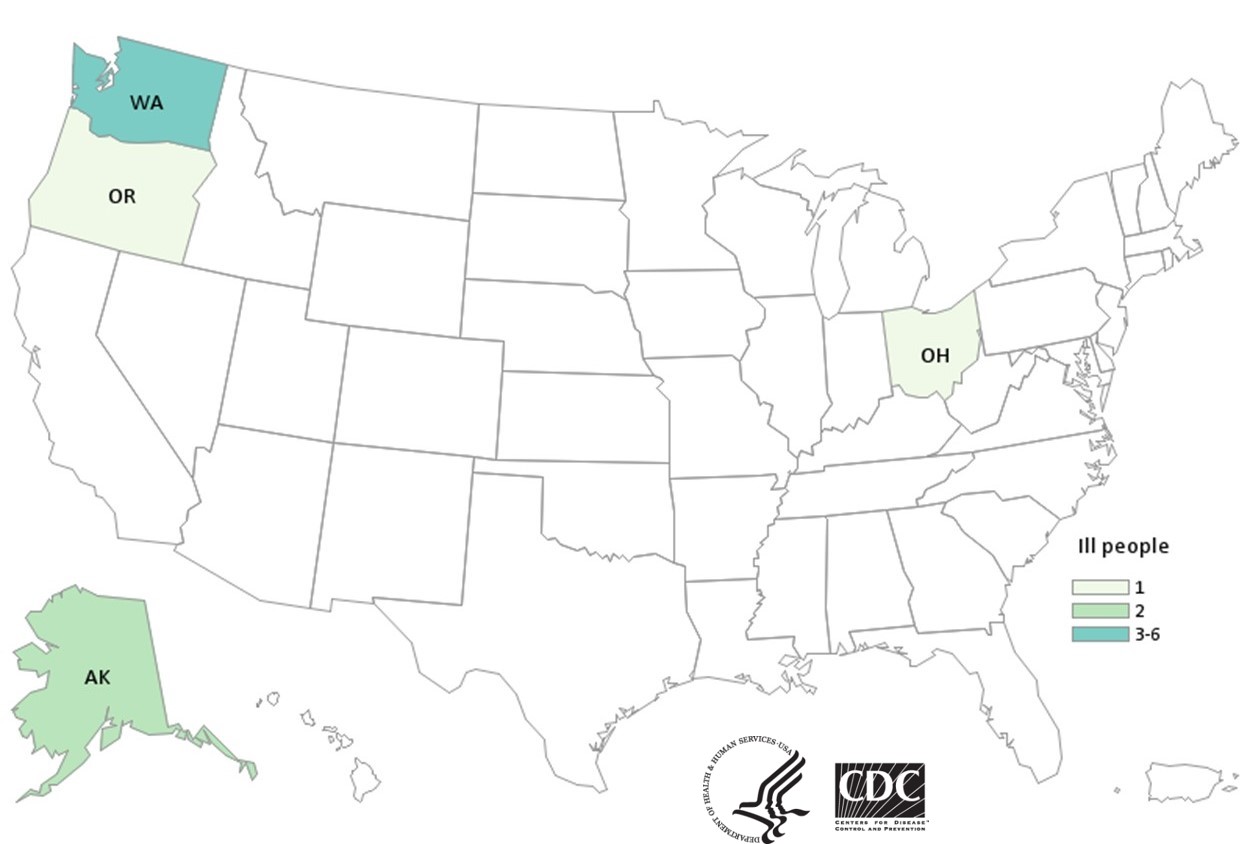
Case Count Map Provided by CDC

Outbreak Investigation of E. coli O157:H7: Packaged Salad - CDC Case Count Map (January 6, 2022)

Case Counts

Total Illnesses: 10
Hospitalizations: 4
Deaths: 0
Last Illness Onset: December 19, 2021
States with Cases: AK (2), OH (1), OR (1), WA (6)

UK – Estimating deaths from foodborne disease in the UK for 11 key pathogens

NCBI

Objective

To estimate the number of deaths from foodborne disease in the UK from 11 key pathogens.

Design

Four different models were developed using data from a range of sources. These included enhanced surveillance, outbreaks, death certificates and hospital episode statistics data. For each model, median estimates were produced with 95% credible intervals (CrI). The results from the different models were compared.

Results

The estimates for foodborne deaths for each pathogen from the different models were consistent, with CrIs largely overlapping. Based on the preferred model for each pathogen, foodborne norovirus is estimated to cause 56 deaths per year (95% CrI 32 to 92), foodborne Salmonella 33 deaths (95% CrI 7 to 159), foodborne Listeria monocytogenes 26 deaths (95% CrI 24 to 28), foodborne Clostridium perfringens 25 deaths (95% CrI 1 to 163) and foodborne Campylobacter 21 deaths (95% CrI 8 to 47). The considerable overlap in the CrIs means it is not possible to make any firm conclusions on ranking. Most of these deaths occur in those aged over 75 years. Foodborne deaths from ShigellaCryptosporidiumGiardia, adenovirus, astrovirus and rotavirus are all rare.

Conclusions

We estimate that there are 180 deaths per year in the UK (95% CrI 113 to 359) caused by foodborne disease based on these 11 pathogens. While this is a small fraction of the estimated 2.4 million cases of foodborne illness per year it still illustrates the potential severity of these illnesses demonstrating the importance in continuing efforts to reduce these infections.

Keywords: infectious disease, CampylobacterSalmonella

Summary box

What is already known about this subject?

  • Foodborne disease is a common illness in the UK.

  • Previous research has estimated that there are 566 000 cases, 74 000 general practitioner presentations and 7600 hospital admissions related to foodborne disease from 13 known pathogens in UK; no estimate was made for deaths.

  • Campylobacter and norovirus are the most common foodborne pathogens in the UK.

  • Other common foodborne pathogens include Clostridium perfringens and Salmonella.

What are the new findings?

  • This study provides updated estimates of deaths for each of the 11 key foodborne pathogens considered; in total, these 11 pathogens cause 180 deaths per year in the UK (95% credible interval (CrI) 113 to 359).

  • Among them, Campylobacter, C. perfringens, Listeria monocytogenes, Salmonella and norovirus pathogens are responsible for over 98% of these deaths.

  • Ranking between these five is difficult due to overlapping CrIs.

How might it impact on clinical practice in the foreseeable future?

  • This highlights the potential severity of Salmonella, L. monocytogenesC. perfringensCampylobacter and norovirus, particularly in comparison with other infectious intestinal diseases that have a food source.