Category Archives: Food Microbiology Testing

USA – FDA Advises Restaurants, Retailers and Consumers to Avoid Recalled Wild Harvest Oysters from Harvest Area FL-3012, Cedar Key, Florida Potentially Contaminated with Salmonella

FDA

Audience

  • Restaurants and food retailers that have received shipments of wild harvest oysters from harvest area FL-3012, Cedar Key, Florida, harvested between December 16, 2022, and February 24, 2023.
  • Consumers who have recently purchased oysters from area FL-3012 sold in Alabama, Florida, and Georgia.

Product

  • Wild harvest oysters from FL-3012, Cedar Key, Florida, harvested between December 16, 2022, and February 24, 2023. The oysters were distributed to restaurants and retailers in Alabama, Florida, and Georgia It is possible that additional states received these oysters through further distribution.
  • Packaged oysters include harvest area information on the packaging.

Purpose

The FDA is advising consumers not to eat, and restaurants and food retailers not to sell, and to dispose of recalled wild harvest oysters from FL-3012, Cedar Key, Florida, harvested between December 16, 2022, and February 24, 2023, due to possible Salmonella contamination. These oysters were sold in Alabama, Florida, and Georgia. Consumers who purchased oysters after December 16, 2022, should check the packaging to see if they were wild harvest oysters from FL-3012, Cedar Key, Florida. Contaminated oysters can cause illness if eaten raw, particularly in people with compromised immune systems. Food contaminated with Salmonella may look, smell, and taste normal. Consumers of these products who are experiencing symptoms of salmonellosis should contact their healthcare provider, who should report their symptoms to their local Health Department.

Summary of Problem and Scope

The Florida Department of Health and the state health departments of Georgia and Alabama have detected a Salmonella outbreak associated with the consumption of raw oysters harvested from shellfish harvesting area FL-3012 in Cedar Key, Florida. To date, there have been 8 cases linked to this outbreak within Florida, Georgia, and Alabama. On February 24, 2023, the Florida Department of Agriculture and Consumer Services issued an emergency closure order for wild harvest oysters from harvest area FL-3012 and initiated a recallExternal Link Disclaimer of wild harvest oysters from harvest area FL-3012 in Cedar Key that were harvested from December 16, 2022, to February 24, 2023. On February 24, the State of Florida also notified the Interstate Shellfish Sanitation Conference of the closure and recall. Florida Department of Health posted an advisory bulletin on February 28. 2023.

FDA Actions

The FDA is issuing this alert advising consumers not to eat, and restaurants and food retailers not to sell, recalled wild harvest oysters from FL-3012, Cedar Key, Florida, harvested between December 16, and February 24, 2023, due to possible Salmonella contamination. The FDA will assist with and coordinate interstate notification efforts as necessary pending receipt of shellfish distribution information.

Symptoms of Salmonellosis

Most people infected with Salmonella will begin to develop symptoms 12 to 72 hours after infection. The illness, salmonellosis, usually lasts four to seven days and most people recover without treatment.

Most people with salmonellosis develop diarrhea, fever, and abdominal cramps. More severe cases of salmonellosis may include a high fever, aches, headaches, lethargy, a rash, blood in the urine or stool, and in some cases may become fatal. The U.S. Centers for Disease Control and Prevention estimated that approximately 450 persons in the United States die each year from acute salmonellosis.

Due to the range in severity of illness, people should consult their healthcare provider if they suspect that they have developed symptoms that resemble a Salmonella infection.

Recommendations for Restaurants and Retailers

Restaurants and retailers should not sell the potentially contaminated oysters. Restaurants and retailers should dispose of any potentially contaminated products by throwing them in the garbage or returning to their distributor for destruction.

Restaurants and retailers should also be aware that oysters and other filter-feeding bivalve molluscan shellfish may be a source of pathogens and should control the potential for cross-contamination of food processing equipment and the food processing environment. They should follow the steps below:

  • Wash hands with warm water and soap following the cleaning and sanitation process.
  • Retailers, restaurants, and other food service operators who have processed and packaged any potentially contaminated products need to be concerned about cross-contamination of cutting surfaces and utensils through contact with the potentially contaminated products.
  • Retailers that have sold bulk product should clean and sanitize the containers used to hold the product.
  • Regular frequent cleaning and sanitizing of food contact surfaces and utensils used in food preparation may help to minimize the likelihood of cross-contamination.
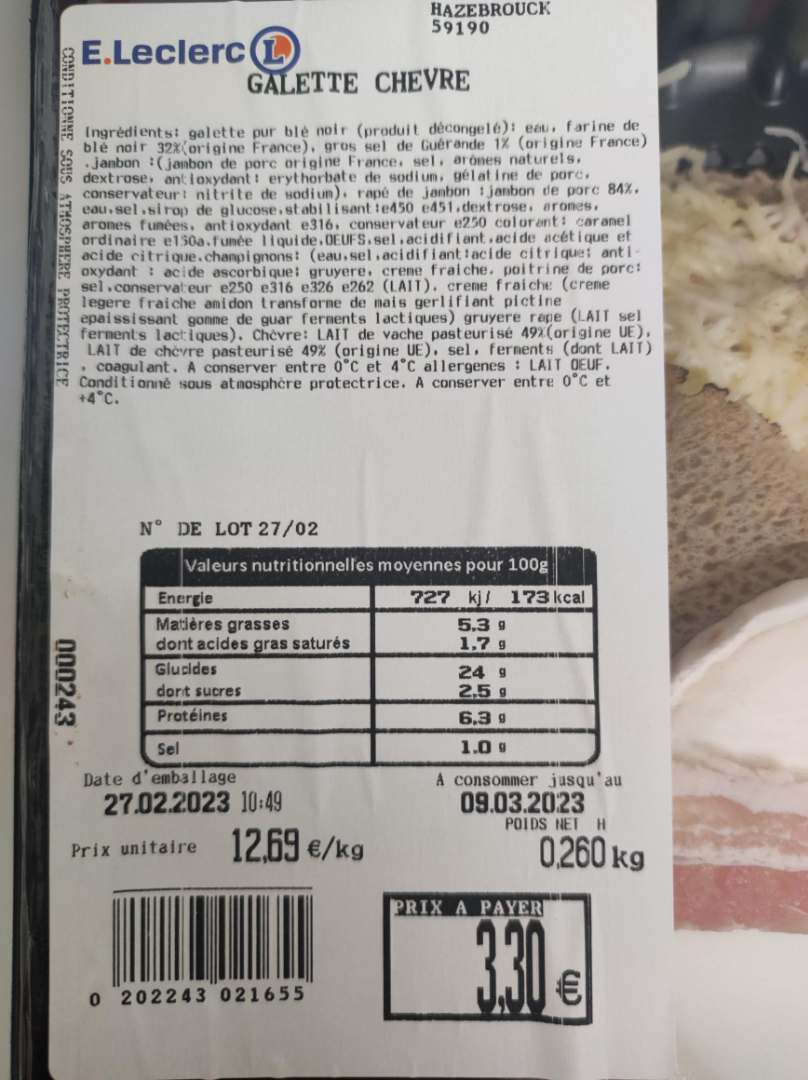
France – GOAT CHEESE CAKE AND COMPLETE CAKE – Listeria monocytogenes

Gov france

Identification information of the recalled product

  • Product category Feed
  • Product subcategory Prepared meals and snacks
  • Product brand name CATERER
  • Model names or references GOAT CAKE 0202243021655 COMPLETE CAKE 0202039019354
  • Identification of products
    GTIN Batch Date
    0202243021655 BATCH NUMBER FROM 27/02 Use-by date 09/03/2023
    0202039019354 BATCH NUMBER FROM 27/02 Use-by date 09/03/2023
  • Marketing start/end date From 02/27/2023 to 03/01/2023
  • Storage temperature Product to be stored in the refrigerator
  • Geographic area of ​​sale E.LECLERC HAZEBROUCK
  • Distributors E.LECLERC HAZEBROUCK

Practical information regarding the recall

  • Reason for recall When assembling the goat and wholemeal pancakes, Tradilège VPF 150g Smoked Ham Grate is used, which is affected by a product recall following the detection of the presence of Listeria monocytogenes.
  • Risks incurred by the consumer Listeria monocytogenes (causative agent of listeriosis)

RASFF Alerts – Salmonella – Polish Chicken Products – Sesame Seeds – Betel Leaves- Live Clams – Sesame Paste – Chilled Chicken Breast

RASFF

Salmonella Typhimurium in turkey meat from France via Belgium in France and the Netherlands

RASFF

Presence of Salmonella enteritidis in live clams (Venus gallina) from Italy in San Merino

RASFF

Salmonella in Indian Sesame seed in the Netherlands

RASFF

Salmonella in betel leaves from India in France

RASFF

Salmonella infantis in halal frozen chicken wings from Poland in Italy

RASFF

Salmonella spp. in sesame paste from Türkiye in Germany

RASFF

Salmonella enterica ser. Enteritidis (presence /25g) in frozen chicken fingers and chicken fillets from Poland in France

RASFF

Salmonella Mbandaka in chilled chicken breast from Ukraine in Hungary, Netherlands and Slovakia

RASFF Alert- Mycotoxin – Ochratoxin A – Pistachios – Dried Raisins – Nutmeg – Indian Rice – Roasted and Salted Pistachios

RASFF

Ochratoxin A in pistachios from Türkiye in Austria, Belgium, Germany, Luxembourg and Netherlands

RASFF

Ochratoxin A (91 ± 17 µg/kg) in dried raisins from Uzbekistan in Latvia

RASFF

Ochratoxin A in nutmeg from Indonesia in the Netherlands

RASFF

Ochratoxin A in Indian Rice in the Netherlands

RASFF

Ochratoxin A in roasted and salted pistachios from the United States in Austria, Belgium, Denmark, Finland, Germany, Luxembourg, Netherlands and Sweden

RASFF Alert – Norovirus – French Oysters – Clams

RASFF

Norovirus in oysters from France in Finland

RASFF

Presence of norovirus genogroup ii in clam (Chamelea gallina) from Italy in Spain

RASFF Alert -Coagulase-Positive Staphylococci – Frozen Vegetable Dumplings

RASFF

Coagulase-positive staphylococci in frozen vegetable dumplings from Bulgaria in Germany

RASFF Alert- STEC E.coli – Beef Tenderloin

RASFF

Shigatoxin-producing E. coli (STEC) in beef tenderloin from Argentina in France, Germany, Luxembourg, Netherlands and Switzerland

RASFF Alerts – E.coli – Clams

RASFF

Escherichia coli exceeding the legal limits in Chamelea gallina and Scapharca inaequivalvis from Italy in Austria

RASFF

Presence of Escherichia coli in clams from Italy in Spain

RASFF Alerts – Aflatoxin – Rice – Pistachios – Halva – Almonds

RASFF

Aflatoxins in rice from Pakistan in Portugal

RASFF

Aflatoxin in pistachios from Afghanistan in Belgium and Lithuania

RASFF

Aflatoxin B1 in Halva from Türkiye in Finland

RASFF

Aflatoxin in Pakistan Rice in the Netherlands

RASFF

Aflatoxins above limit in almonds from Australia in the Netherlands and Spain

France Research – Acute gastroenteritis: review of the 2020-2021 and 2021-2022 winter seasons

Sante Publique

Every year, an increase in acute gastroenteritis (AGE) is observed caused mainly by the circulation of noroviruses and rotaviruses. Noroviruses are responsible for AGE in people of all ages, while rotaviruses mainly affect children under 5 years of age. 

During the winter season, Public Health France monitors, with its network of partners , the epidemiological evolution of acute gastroenteritis and publishes weekly national and regional epidemiological bulletins on its website . These data are also made available as open data on Géodes .

Santé publique France is today publishing the winter monitoring report covering the 2020-2021 and 2021-2022 seasons in mainland France and recalls the simple actions to take to limit the risk of contamination.

What are the highlights of the last two seasons?

2020-2021: a season marked by a historically low level of activity

The low level of activity observed from March 2020 (end of the 2019-2020 season), in the context of the COVID-19 pandemic, continued during the 2020-2021 season. In city medicine or in hospital emergency departments, activity remained relatively stable and lower than the years prior to the COVID-19 pandemic in all metropolitan areas. 

A return to activity comparable to pre-COVID seasons during winter 2021-2022

The activity levels recorded throughout the 2021-2022 season were again comparable to those observed during the pre-COVID seasons. In hospital emergencies, activity for acute gastroenteritis remained close to historical maximums, from December 2021 to April 2022. Consultations at SOS Médecins were similar to the data observed before the COVID-19 pandemic.