Category Archives: Illness

Canada – Public Health Notice: Outbreak of Salmonella infections – Update

PHAC

The Public Health Agency of Canada (PHAC) is collaborating with provincial public health partners, the Canadian Food Inspection Agency (CFIA) and Health Canada to investigate an outbreak of Salmonella infections involving five provinces: British Columbia, Alberta, Saskatchewan, Manitoba and Ontario. The illnesses reported in Ontario were related to travel to Alberta and British Columbia.

The source of the outbreak has not been confirmed and the investigation is ongoing. Many of the individuals who became sick reported eating fresh avocados purchased from grocery stores or served at restaurants before their illness. Investigation findings to date have identified that these avocados have been distributed in British Columbia, Alberta, Saskatchewan and Manitoba. More information is needed to confirm the source of the outbreak. The outbreak appears to be ongoing, as illnesses continue to be reported.

The Public Health Agency of Canada is issuing this public health notice to inform residents and businesses in British Columbia, Alberta, Saskatchewan and Manitoba of the investigation findings to date so that they can make informed decisions. At this time, there is no evidence to suggest that residents in other provinces and territories are affected by this outbreak. This notice also includes important safe food handling information for Canadians and businesses that may help prevent further Salmonella infections.

This public health notice will be updated as the investigation evolves.

Investigation summary

As of December 9, there have been 79 laboratory-confirmed cases of Salmonella Enteritidis illness investigated in: British Columbia (34), Alberta (28), Saskatchewan (4), Manitoba (11) and Ontario (2). The illnesses reported in Ontario are related to travel to Alberta and British Columbia. Individuals became sick between early September 2021 and mid-November 2021. Four individuals have been hospitalized. No deaths have been reported. Individuals who became ill are between 5 and 89 years of age. The majority of cases (63%) are female.

CFIA is conducting a food safety investigation. If specific contaminated food products are identified, they will take the necessary steps to protect the public, including requesting a recall of product as required. Currently there are no Food Recall Warnings associated with this outbreak.

Research -EU One Health report: drop in reported zoonotic diseases in humans and foodborne outbreaks in 2020

EFSA

Campylobacteriosis was the most reported zoonosis in the EU in 2020, with 120,946 cases compared to more than 220,000 the previous year. It was followed by salmonellosis, which affected 52,702 people compared to 88,000 in 2019. The number of reported foodborne outbreaks also fell by 47%. These findings are based on the annual EU One Health zoonosis report, by EFSA and ECDC.

Experts acknowledged the impact of the COVID-19 pandemic in Europe in the remarkable drop in reported zoonotic diseases in humans – ranging from 7% to 53% depending on the reported disease in question – and foodborne outbreaks.

Possible factors behind the large decrease in cases include changes in health seeking behaviour, restrictions on travel and on events, the closing of restaurants, quarantine, lockdown, and other mitigation measures such as the use of masks, physical distancing and hand sanitisation.  

The next most commonly reported diseases were yersiniosis (5,668) and infections caused by Shigatoxin-producing E.coli (4,446). Listeriosis was the fifth most reported zoonosis (1,876 cases), mainly affecting people over the age of 64.

Listeriosis and West Nile virus infections were the diseases with the highest case fatality and hospitalisation rates – with most locally acquired human infections of West Nile virus reported in Greece, Spain and Italy.

The report also monitors foodborne outbreaks in the EU, events during which at least two people contract the same illness from the same contaminated food. A total of 3,086 foodborne outbreaks were reported in 2020. Salmonella remained the most frequently detected agent and caused about 23% outbreaks. The most common sources of salmonellosis outbreaks were eggs, egg products and pig meat.

The report also includes data on Mycobacterium bovis/caprae, BrucellaTrichinellaEchinococcus, Toxoplasma gondii, rabies, Q fever and tularaemia.

EFSA is publishing two interactive communication tools on foodborne outbreaks – a story map and a dashboard. The story map provides general information on foodborne outbreaks, their causative agents and implicated food vehicles. The dashboard allows people to search and query the large amount of data on foodborne outbreaks collected by EFSA from EU Member States and other reporting countries since 2015.

USA – FDA Core Investigation Table Update

FDA

Increase in numbers of cases from Salmonella Javiana, source still not identified

USA – Outbreak Investigation of Salmonella Thompson – Seafood (October 2021) – Outbreak Over.

FDA

The FDA, along with CDC and state and local partners, investigated a multistate outbreak of Salmonella Thompson infections linked to seafood manufactured or processed by Northeast Seafood Products, Inc. of Denver, CO. As of 12/6/2021, the CDC has declared this outbreak over. According to CDC, the majority of sick people were either Colorado residents or reported traveling to Colorado in the week before they got sick.

FDA’s traceback investigation identified Northeast Seafood Products, Inc. as a common distributor among illness sub-clusters. As part of this outbreak investigation, environmental samples were collected from Northeast Seafood Products, Inc. On 10/7/2021, environmental samples collected from Northeast Seafood Products, Inc. were reported positive for Salmonella Thompson and were determined to be a match to the outbreak strain through whole genome sequencing.

On 10/8/2021, Northeast Seafood Products, Inc. recalled Haddock, Monkfish, Bone-in Trout, Grouper, Red Snapper, Red Rock Cod, Ocean Perch, Pacific Cod, Halibut, Coho Salmon, Atlantic Salmon Portions, Lane Snapper, Tilapia, All Natural Salmon Fillet, Pacific Sole, and Farm Raised Striped Bass. These products were sold to restaurant and Albertsons, Safeway, and Sprouts supermarkets in Colorado. The Pacific Cod sold through Sprouts is not being recalled. A full list of recalled products is available on FDA’s website.

Recommendation

Consumers, restaurants, and retailers should not eat, sell, or serve any recalled seafood. Recalled seafood was sold fresh and would be past shelf-life unless it was frozen after purchase. FDA recommends that anyone who might have purchased or received recalled product, check their freezers and throw away recalled product.

A full list of recalled products is available on FDA’s website.


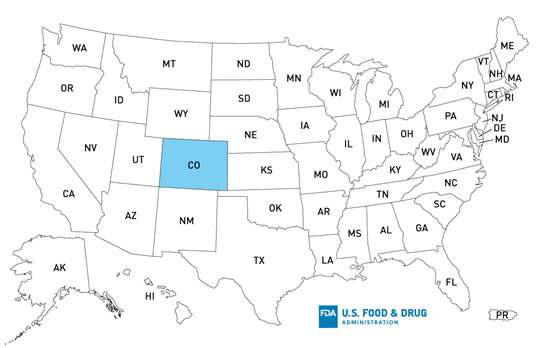
Map of U.S. Distribution of Recalled Northeast Seafood Products

 Outbreak Investigation of Salmonella Thompson – Seafood - Map of U.S. Distribution of Recalled Products (October 8, 2021)

Case Count Map Provided by CDC

Outbreak Investigation of Salmonella Thompson – Seafood - CDC Case Count Map (December 6, 2021)

Case Counts

Total Illnesses: 115
Hospitalizations: 20
Deaths: 0
Last Illness Onset: September 7, 2021
States with Cases: AZ (1), CA (1), CO (93), CT (1), IA (1), MN (2), MO (1), NE (2), NJ (2), PA (1), TX (2), VA (3), WA (1), WI (2), WY (2)
Product Distribution*: CO
*States with confirmed distribution; product could have been distributed further

Norway – Imported frozen raspberries probable source of Hepatitis A outbreak

Outbreak News Today

The source of infection for the national outbreak of hepatitis A was probably imported, frozen raspberries. This is shown by the investigation that the Norwegian Food Safety Authority and the Norwegian Institute of Public Health have carried out in connection with the outbreak, which is now considered over.

The outbreak of hepatitis A lasted from April to October this year and involved 20 infected people.

Tracing of the source shows that the raspberries are probably no longer on the market. The outbreak is therefore considered over, says senior adviser Heidi Lange at the National Institute of Public Health (NIPH).

USA – Outbreak Investigation of E. Coli O157:H7 – Spinach (November 2021)

FDA

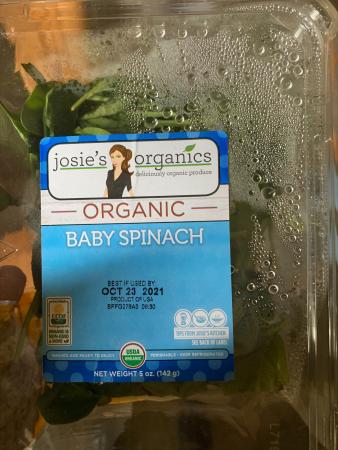
Outbreak Investigation of E. Coli O157:H7 in Spinach (November 2021): Sample Image of Josie's Organics Baby Spinach

The FDA and CDC, in collaboration with state and local partners, are investigating illnesses in a multistate outbreak of E. coli O157:H7. According to the CDC, as of November 15, 2021, 14 people infected with the outbreak strain of E. coli O157:H7 have been reported from nine states. Illnesses started on dates ranging from October 13 to October 27, 2021. 10 people in this outbreak report eating spinach in the week before becoming sick and six people reported Josie’s Organics brand.

On November 15, 2021, the Minnesota Department of Agriculture reported that, as part of this outbreak investigation, a sample of Josie’s Organics Baby Spinach collected from the home of an ill person tested positive for E. coli O157:H7. This sample had a “Best If Used By” date of October 23, 2021. Whole Genome Sequencing (WGS) analysis determined that the strain of E. coli O157:H7 present in the product sample matches the outbreak strain.

FDA traced the supply chain for this positive product sample back to a small number of farms in two different geographic regions and deployed Investigators along the supply chains of interest. FDA continues tracing back reported spinach exposures to identify if spinach from additional farms could have been implicated.

FDA and state partners are working with the firm to determine if additional products could be affected. This is an ongoing investigation and additional information will be provided as it becomes available.

Recommendation

Consumers, restaurants, and retailers, should not eat, sell, or serve Josie’s Organics Baby Spinach with a “Best If Used By” date of October 23, 2021. Josie’s Organics Baby Spinach is sold in a clear plastic clamshell with the Best If Used By Date on the top label.

Although this product is past expiration and should no longer be available for purchase, consumers should check their homes for product and discard it. If consumers froze fresh Josie’s Organics Baby Spinach, they should discard it.


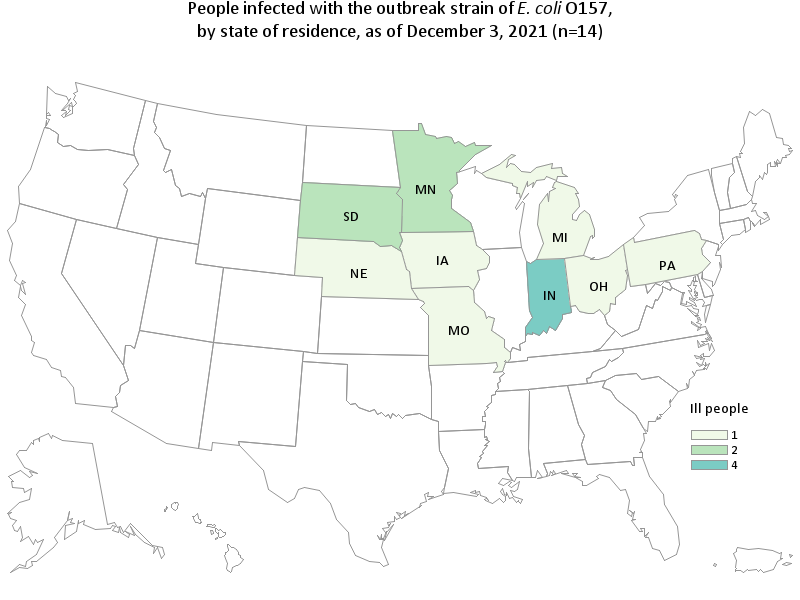
Case Count Map Provided by CDC

Outbreak Investigation of E. Coli O157:H7 in Spinach: Case Count Map Provided by CDC (December 3, 2021)

Case Counts

Total Illnesses: 14
Hospitalizations: 4
Deaths: 0
Last Illness Onset: October 27, 2021
States with Cases: IA (1), IN (4), MI (1), MN (2), MO (1), NE (1), OH (1), PA (1), SD (1)

UK – Chef sentenced after one killed and 31 left ill by undercooked shepherd’s pie

The Guardian

A church harvest supper at a village pub ended in tragedy when one of the congregation was killed and 31 others suffered food poisoning after eating a shepherd’s pie filled with mince that had been incorrectly prepared by a rushing chef.

Elizabeth Neuman, 92, repeatedly vomited after eating the pie and died while other parishioners became “unpleasantly ill” and three of those attending only escaped because they were vegetarians, Reading crown court heard.

The cook, John Croucher, who at the time was head chef at the Crewe Arms in the Northamptonshire village of Hinton-in-the-Hedges, was given a four-month jail sentence, suspended for 12 months, after admitting a charge of contravening food regulations.

China – Dozens of college students sickened with norovirus in Guangdong Province

Outbreak News Today

Eurofins

In Guangdong Province in southern China, hundreds of students at the Guangzhou Vocational and Technical University of Science and Technology have been stricken with symptoms including stomachache, diarrhea, vomiting and fever.

The university reported on Tuesday that 315 students suffered from symptoms including stomachache, diarrhea, vomiting and fever with 24 being preliminarily diagnosed as having contracting Norovirus as of  Tuesday morning.

An investigation reveals the sick students dined at various venues including seven canteens inside the campus and several restaurants outside the campus.

Australia – More than 100 sick in Australia as oysters recalled – Vibrio parahaemolyticus

Food Safety News

KSWFOODWORLD

Seven Australian states have recorded more than 100 Vibrio illnesses linked to raw oysters from South Australia.

There are 56 people sick in South Australia since September and three have been hospitalized. Western Australia has 17 cases since late September, Victoria reported 31 illnesses since the first week of October and 15 infections have been recorded in New South Wales. Further illnesses have also been reported in Queensland and the Northern Territory.

Two cases of Vibrio parahaemolyticus were identified in the Australian Capital Territory in people who had recently consumed oysters. Investigations are ongoing to find out where they were sourced from.

USA – Core Outbreak Table Update

FDA

Date Ref Pathogen Product(s) Total Investigation Status
11/24/2021 1044 Salmonella     Javiana Not Yet Identified 19 Active
11/17/2021 1043 E. coli O157:H7 Spinach See Outbreak Advisory Active
9/15/2021 1031 Salmonella Oranienburg Red, Yellow, and White Onions See Outbreak Advisory Active
9/15/2021 1025 Salmonella Thompson Seafood See Outbreak Advisory Active