Category Archives: Food Toxin

Spain – Alert for the presence of Histamine in tuna pizza from Italy

asca

Tuna pizza CONSUME

The Spanish Agency for Food Safety and Nutrition has informed the autonomous communiqués through the Coordinated Rapid Information Exchange System of an alert notification sent by the health authorities of the Valencian Community, regarding the presence of histamine in frozen tuna pizzas of the CONSUM brand, made in Italy.

The product involved is as follows:

  • Product name (on the label): Tuna pizza
  • Trademark: CONSUM
  • Appearance, weight and packaging: 370g cardboard packaging
  • Batch number and expiry/best before: NE16, NE25, NE09, NF27, NF23, NG08, NB17, NB24, NC03 and NH05
  • Storage temperature: frozen product

This product has been the subject of an alert in the Coordinated System of Rapid Information Exchange.

The distribution company (CONSUM and CHARTER supermarkets) have initiated the withdrawal of the product from sale and the recovery of the product from consumers.

The company CONSUM has also made a communication on its website.

We provide you with the link to the informative note published on the AESAN website, with details of the product and batches subject to withdrawal.

The relevant authorities are verifying the withdrawal of the affected product from the marketing channels. It is recommended that people who have this product at home refrain from consuming it and return it to the point of sale.

With the information available, there is no evidence in Spain of any notified case associated with this alert.
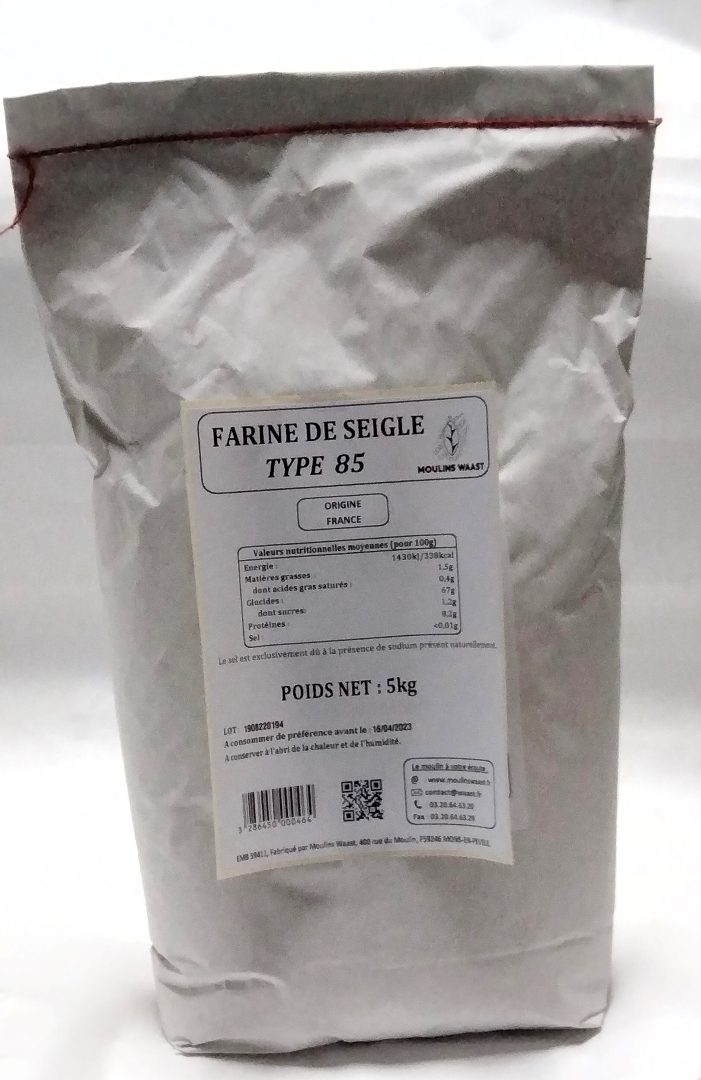
France – RYE FLOUR T85 – Mycotoxin – Ergot Alkaloids

Gov france

Identification information of the recalled product
Product category
Feed
Product subcategory
Cereals and baked goods
Product brand name
WAAST MILLS
Model names or references
RYE FLOUR T85 IN 5 KG
Identification of products
GTIN Batch Date
3286450000464 1402220187 Best before date 12/10/2022
3286450000464 2502220393 Best before date 23/10/2022
Packaging
5KG
Marketing start/end date
Since 02/14/2022
Storage temperature
Product to be stored at room temperature
Geographic area of ​​sale
NORTH OF FRANCE
Distributors
WAAST MILLS
Practical information regarding the recall
Reason for recall
risk of presence of ergot alkaloids at a concentration above the regulatory limit

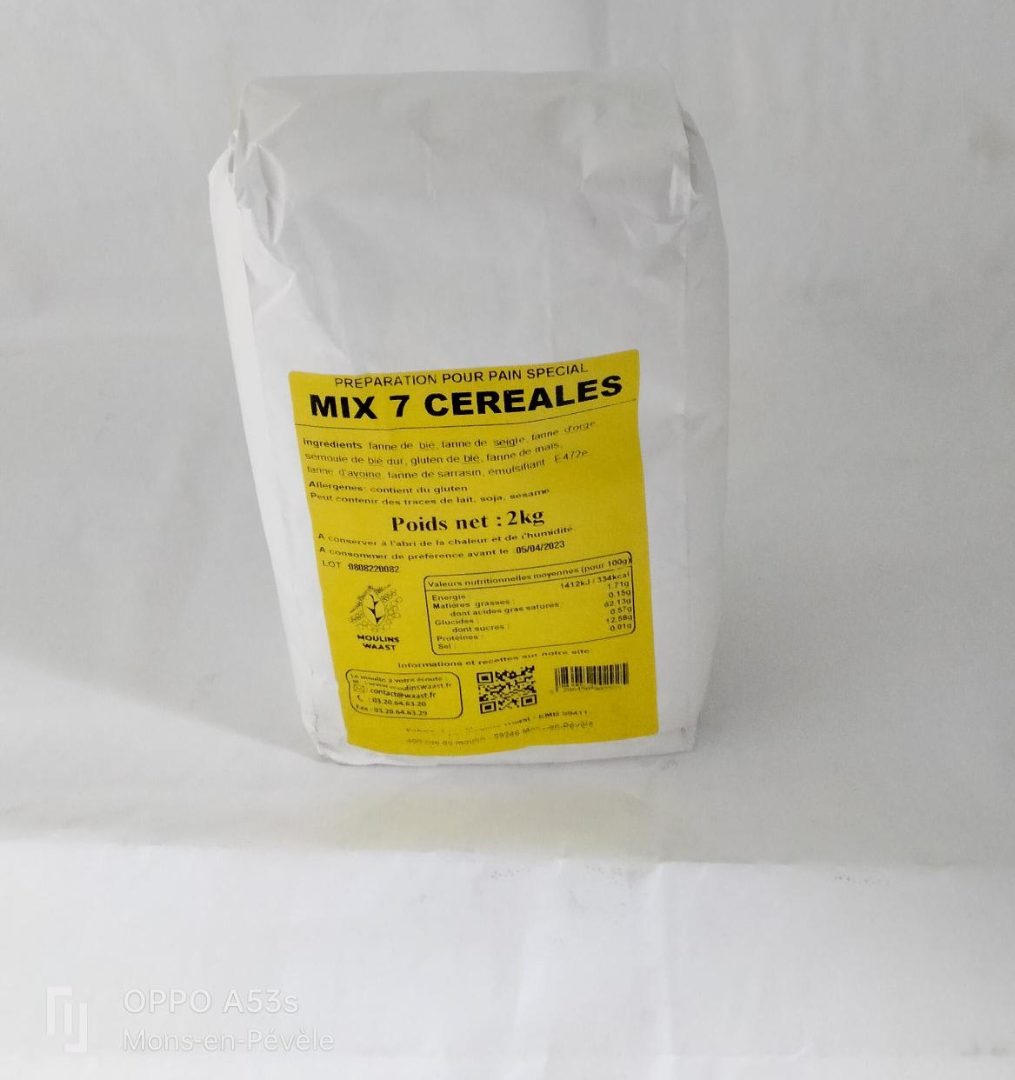
France – MIX 7 CEREALS – Mycotoxin – Ergot Alkaloids

Gov france

Identification information of the recalled product
Product category
Feed
Product subcategory
Cereals and baked goods
Product brand name
WAAST MILLS
Model names or references
MIX 7 CEREALS IN 2 KG
Identification of products
GTIN Batch Date
3286450002925 0703220107 Best before date 02/11/2022
3286450002925 2103220379 Best before date 16/11/2022
Packaging
2KG
Marketing start/end date
Since 07/03/2022
Storage temperature
Product to be stored at room temperature
Geographic area of ​​sale
NORTH OF FRANCE
Distributors
AUCHAN NOYELLES CLAYE GENECH INSTITUTE MOULINS WAAST
Practical information regarding the recall
Reason for recall
risk of presence of ergot alkaloids at a concentration above the regulatory limit

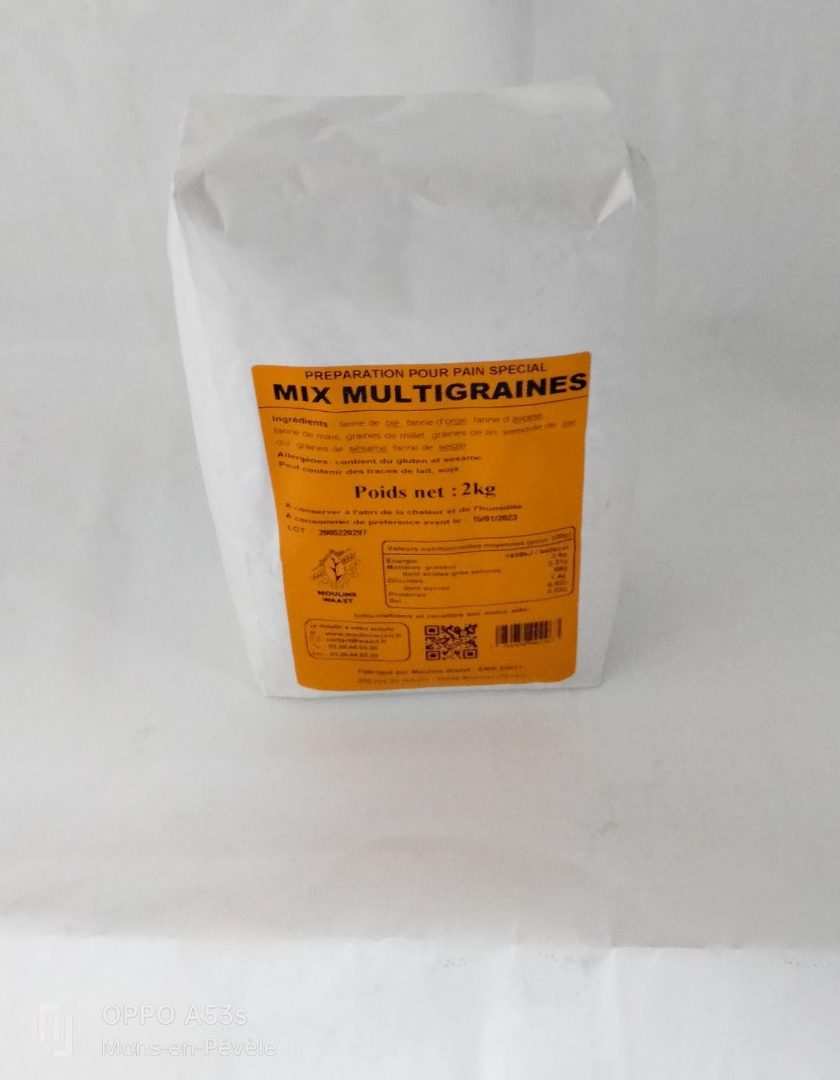
France – MULTISEEDS MIX – Mycotoxin – Ergot Alkaloids

Gov france

Identification information of the recalled product
Product category
Feed
Product subcategory
Cereals and baked goods
Product brand name
WAAST MILLS
Model names or references
MULTIGRAINE MIX IN 2 KG
Identification of products
GTIN Batch Date
3286450002963 0903220169 Best before date 04/11/2022
Packaging
2KG
Marketing start/end date
Since 09/03/2022
Storage temperature
Product to be stored at room temperature
Geographic area of ​​sale
NORTH OF FRANCE
Distributors
CLAYE INSTITUTE OF GENECH MOULINS WAAST
Practical information regarding the recall
Reason for recall
risk of presence of ergot alkaloids at a concentration above the regulatory limit

USA – FSIS Issues Public Health Alert for Ground Beef Products Due to Possible E. coli O157:H7 Contamination

FSIS USDA

FSIS Announcement

WASHINGTON August 18, 2022 – The U.S. Department of Agriculture’s Food Safety and Inspection Service (FSIS) is issuing a public health alert due to concerns that specific ground beef products may be adulterated with E. coli O157:H7. A recall was not requested because the products are no longer available for purchase.

The “Hawaii Big Island Beef” brand ground beef products were produced on August 8, 2022. The following products are subject to the public health alert [view labels]:

  • 1-lb. vacuum sealed packages containing “Ground Beef (80) Fine 1#/pkg” with “Packed 08/08/22” and “Lot 220808” on the label and case code “134R1”.
  • 1-lb. vacuum sealed packages containing “Ground Beef (Ln) Fine 1#/pkg” with “Packed 08/08/22” and “Lot 220808” on the label and case code “135R1”.
  • 2-lb. vacuum sealed packages containing “Ground Beef (80) Fine 2#/pkg” with “Packed 08/08/22” and “Lot 220808” on the label and case code “134R2”.
  • 10-lb. bags containing “Ground Beef (80) Fine 10# Poly Bag” with “Packed 08/08/22” and “Lot 220808” on the label and case code “0134P10”.
  • 10-lb. vacuum sealed packages containing “Ground Beef (75) Fine 10# Vac Seal” with “Packed 08/08/22” and “Lot 220808” on the label and case code “130R10”.
  • 10-lb. vacuum sealed packages containing “Ground Beef (80) Fine 10# Vac Seal” with “Packed 08/08/22” and “Lot 220808” on the label and case code “134R10”.
  • 40-lb. box containing four 10-lb chubs of “Ground Beef (80) Fine 10#” with “Packed 08/08/22” and “Lot 220808” on the label and case code “0134”.

The products bear establishment number “EST. 1063” inside the USDA mark of inspection. These items were shipped to retail and restaurant locations in Hawaii.

The problem was discovered by FSIS during an assessment of the establishment’s production records associated with a sample that tested positive for E. coli O157:H7.

There have been no confirmed reports of adverse reactions due to consumption of these products.

Anyone concerned about an illness should contact a healthcare provider. E. coli O157:H7 is a potentially deadly bacterium that can cause dehydration, bloody diarrhea and abdominal cramps 2-8 days (3-4 days, on average) after exposure the organism. While most people recover within a week, some develop a type of kidney failure called hemolytic uremic syndrome (HUS). This condition can occur among persons of any age but is most common in children under 5-years old and older adults. It is marked by easy bruising, pallor, and decreased urine output. Persons who experience these symptoms should seek emergency medical care immediately.

FSIS is concerned that some product may be in consumers’ refrigerators or freezers. Consumers who have purchased these products are urged not to consume them. These products should be thrown away or returned to the place of purchase.

FSIS advises all consumers to safely prepare their raw meat products, including fresh and frozen, and only consume ground beef that has been cooked to a temperature of 160 F. The only way to confirm that ground beef is cooked to a temperature high enough to kill harmful bacteria is to use a food thermometer that measures internal temperature, https://www.fsis.usda.gov/safetempchart.

RASFF Alerts – Aflatoxin – Peanuts – Organic Peanuts – Cheese Flavoured Peanuts – Nutmeg Whole Shrivels – Blanched Split Peanuts –

RASFF

Aflatoxins in Argentine peanuts in the Netherlands

RASFF

Too much aflatoxins (aflatoxin B1 and sum of aflatoxins) in cheese flavoured peanuts. from Netherlands in Finland

RASFF

Aflatoxins in Indonesian nutmeg whole shrivels in Netherlands and Germany

RASFF

Aflatoxins in Argentine blanched split peanut kernel in the Netherlands

RASFF

Aflatoxins in Egyptian Organic Peanuts in the Netherlands

RASFF Alerts – Mycotoxin – Ochratoxin A – Raisins – Cereal Based Food for Infants

RASFF

Ochratoxin A (OTA) in raisins from India in Poland

RASFF

Ochratoxin A in cereal-based foods for infants from Austria, via Hungary in the Czech Republic

RASFF Alert – Animal Feed – Aflatoxin – Groundnut kernels

RASFF

Aflatoxin B1 in Brazilian groundnut kernels for birdfeed in the Netherlands

New Zealand – Consumers urged not to eat illegal mussels

MPI

New Zealand Food Safety is urging consumers not to eat mussels being sold illegally at independent retailers or online.

The sale of imported mussels is carefully controlled to ensure they meet New Zealand’s food safety requirements. While mussels from Fiji may be brought into New Zealand for personal use, they cannot be sold.

Deputy director general Vincent Arbuckle says Fijian mussels have been removed from sale at some smaller retailers catering to Pacific Island communities, and online.

“As New Zealand Food Safety has not assessed Fiji’s growing, harvesting and processing controls for mussels we cannot be confident that the mussels don’t pose a food safety risk to consumers.”

The mussels are also known as: Nakai, Naakai, Nakaai, Kai, Batissa violacea and Fresh Water Mussels.

“It’s vital that mussels available to buy for members of the public are safe to eat. Knowing where the mussels you want to buy have come from can help reduce the risk of any potential health problems.

“Our message to people buying mussels is that if you are in any doubt, ask the retailer where the product has come from. If it is from Fiji, the mussels should not be for sale.”

Mussels are a higher risk food because of the way they feed, which increases the likelihood of contamination from bacteria, viruses, toxins and chemicals.

New Zealand – North Island warning Kawhia Harbour area, West Coast -PSP

MPI

North Island warning

Kawhia Harbour area, West Coast

Reason for alert Paralytic Shellfish Poisoning (PSP)

Date warning issued 17 August 2022

Media release

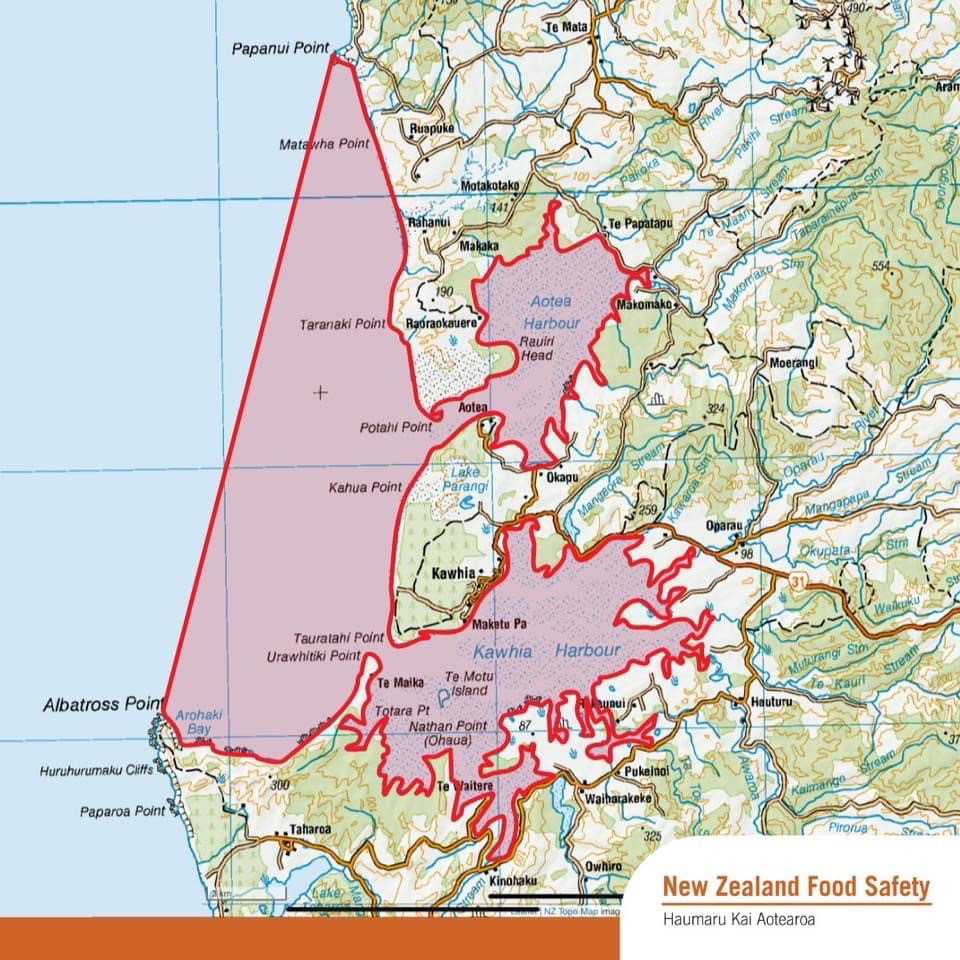
Affected area From Albatross Point across to Papanui Point, Including Kahwia and Aotearoa Harbours, West Coast North Island.
Shellfish affected Mussels, oysters, tuatua, pipi, toheroa, cockles, scallops, catseyes, kina (sea urchin) and all other bivalve shellfish.

Note, cooking shellfish does not remove the toxin.

Pāua, crab and crayfish may still be eaten if the gut has been completely removed prior to cooking, as toxins accumulate in the gut. If the gut is not removed its contents could contaminate the meat during the cooking process.

Symptoms Symptoms typically appear between 10 minutes and 3 hours after ingestion and may include:

  • numbness and a tingling (prickly feeling) around the mouth, face, and extremities (hands and feet)
  • difficulty swallowing or breathing
  • dizziness
  • headache
  • nausea
  • vomiting
  • diarrhoea
  • paralysis and respiratory failure and in severe cases, death.
Other information Paralytic shellfish toxins have been detected in shellfish at levels over the safe limit of 0.8mg/kg set by MPI. Ongoing testing will continue and any changes will be communicated accordingly.

Map of affected area

Map of the affected area in the Kawhia Harbour area, West Coast, North Island
Map of the affected area Kawhia Harbour area, West Coast