Category Archives: Food Testing

RASFF Alert- Aflatoxin – Blanched Groundnuts

RASFF-Logo

RASFF – aflatoxins (B1 = 3; Tot. = 5.9 µg/kg – ppb) in blanched groundnuts from China in Spain

RASFF Alert – Ochratoxin A – Dried Figs

RASFF-Logo

RASFF – ochratoxin A (39.7 µg/kg – ppb) in dried figs from Spain in Switzerland

RASFF Alert – DON – Mycotoxin – Durum Wheat

RASFF-Logo

RASFF – deoxynivalenol (DON) (4023.1 µg/kg – ppb) in durum wheat from Italy in Italy

RASFF Alert – Mould – Cheese

RASFF-Logo

RASFF – cheese from Sweden infested with moulds in Denmark

RASFF Alerts – Salmonella – Chicken Broiler Fillets – Chilled Bacon and Smokey Apple Marinade -Boneless Half Chicken Fillets -Chicken Meat – Chicken Breast – Chicken Quarters

RASFF-Logo

RASFF – Salmonella enterica ser. Enteritidis (presence /25g) in frozen chicken broiler fillets from Poland in Lithuania

RASFF – Salmonella (presence /10g) in chilled bacon in smoky apple marinade from Estonia in Estonia

RASFF – Salmonella (in 2 out of 5 samples /25g) in frozen salted skinless boneless half chicken breasts from Brazil in the UK

RASFF – Salmonella enterica ser. Enteritidis (presence /25g) in frozen chicken fresh meat from Poland in France

RASFF – Salmonella (presence /25g) in frozen salted half chicken breasts from Brazil in the Netherlands

RASFF – Salmonella enterica ser. Enteritidis (present /25g) in frozen chicken leg quarters from Poland in Bulgaria

Netherlands – Dutch Salmonella illnesses linked to Brazilian poultry

Food Safety News

Chicken meat from Brazil is being investigated as the source of Salmonella illnesses in the Netherlands.

Between the end of 2019 and mid-February 2020, the National Institute for Public Health and the Environment (RIVM) identified a cluster of six Salmonella Virchow infections distributed across the country using whole genome sequencing (WGS) but no epidemiological link among them was reported.

An outbreak investigation by RIVM and the Netherlands Food and Consumer Product Safety Authority (NVWA) identified six food isolates as genetically closely related to cases and associated with the source of the infection.

These isolates came from poultry meat, including frozen poultry imported from Brazil.


USA – Outbreak Investigation of Listeria monocytogenes: Enoki Mushrooms (March 2020)

FDA

Case Counts

Total Illnesses: 36
Hospitalizations: 30
Deaths: 4
Illness Onset Date Range: November 23, 2016 – December 13, 2019

Recommendation

Consumers should not eat and should check their refrigerators and throw away any recalled enoki mushrooms from Sun Hong Foods, Inc., Guan’s Mushroom Co., and H&C Food, Inc. because they may be contaminated with Listeria monocytogenes.

Restaurants and retailers should not sell or serve recalled enoki mushrooms distributed by Sun Hong Foods, Inc., Guan’s Mushroom Co., and H&C Food, Inc.

FDA recommends that anyone who received recalled products use extra vigilance in cleaning and sanitizing any surfaces and containers that may have come in contact with these products to reduce the risk of cross-contamination. Listeria can survive in refrigerated temperatures and can easily spread to other foods and surfaces.

At this time, high risk groups, including the elderly, people with weakened immune systems or chronic diseases, pregnant women and their newborn babies, should not eat enoki mushrooms from Korea (Republic of Korea), even if they were not part of the recalls.

Consumers, restaurants, retailers, and high risk groups should discard and not eat, sell, or serve enoki mushrooms if they cannot tell where they came from.

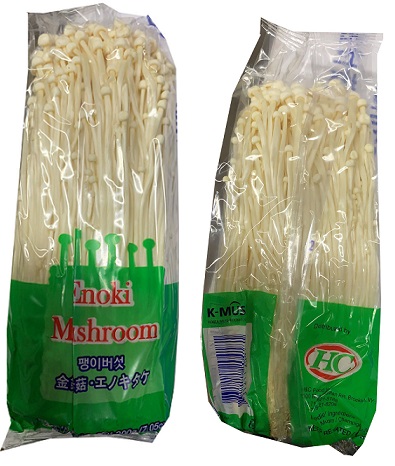
H&C Food Inc Enoki Mushrooms


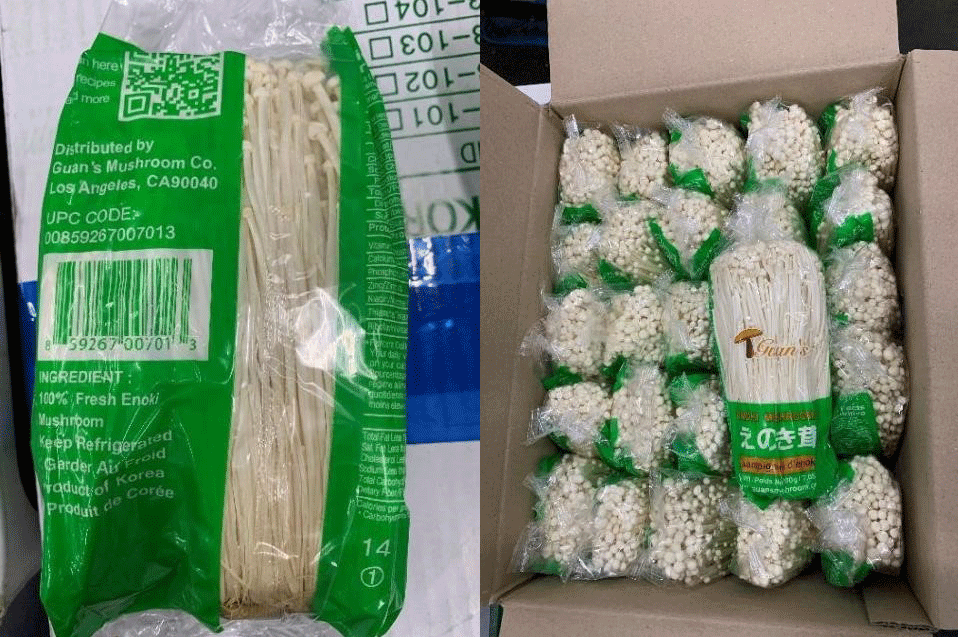
Guan’s Mushroom Co.
Guan’s Mushroom Co.
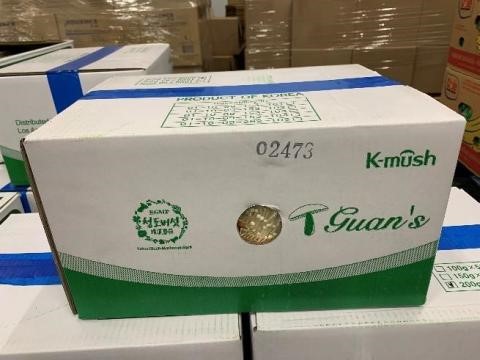
Picture of enoki mushroom case
Sample Enoki Mushrooms Imported from Korea
Company Size UPC Code Retailers* Distribution*
Sun Hong Foods, Inc. 200 g/ 7.05 oz. 7 426852 625810 J&L Supermarket, Jusgo Supermarket, ZTao Market, New Sang Supermarket, Galleria Market, Distributors CA, FL, IL, OR, TX, WA
Guan’s Mushroom Co. 200 g/ 7.05 oz. 859267007013 Sold to Distributors and Wholesalers CA, NY, PA
H&C Food Inc. 200 g/ 7.05 oz. 831211204181 Great Wall Supermarket NY, MD, VA

*This includes confirmed distribution information from companies; products could have been further distributed and sent to additional retailers and states.

Update

FDA, CDC, and state and local partners are currently investigating a multistate outbreak of Listeria monocytogenes infections linked to enoki mushrooms. Enoki mushrooms are a long thin white mushroom, usually sold in clusters. They are especially popular in East Asian cuisine and are also known as enokitake, golden needle, futu, or lily mushrooms.

On April 7, 2020, H&C Foods Inc. recalled 200 g/7.05 oz packages of enoki mushrooms imported from Green Co. LTD of the Republic of Korea. FDA import samples of enoki mushrooms from Green Co. LTD tested positive for Listeria monocytogenes and on April 6, 2020, whole genome sequencing analysis determined that the Listeria monocytogenes found in the positive samples matched the outbreak strain. As a result, On April 7, 2020, Green Co. LTD was placed on Import Alert 99-23, which flags imported shipments from this firm for potential detention without physical examination. The FDA is encouraging the international community to consult the Import Alert.

The investigation is ongoing to determine the source of contamination and if additional products are linked to illness. Additional information will be provided as it becomes available.


Research – Evaluation of the growth potential of Listeria monocytogenes in Belgian farm cheeses, according to a committee of experts

Background and terms of reference In its advice 02-2016, the Scientific Committee (SciCom) made recommendations for carrying out challenge and durability tests for Listeria monocytogenes (L. monocytogenes) in cheese.On the basis of these recommendations, a scientific study was carried out in order to collect data from Belgian homestead cheeses. The Scientific Committee was asked to evaluate the  growth potential of L. monocytogenes in Belgian homestead cheeses. Method Based on new scientific knowledge and data (including the results of the study project “Étude du potentiel de croissance de Listeria monocytogenes dans les fromages produits par les producteurs fermiers, 2019”) and based on expert opinion, the Scientific Committee has assessed the growth potential of L. monocytogenes in Belgian homestead cheeses (fresh cheeses, soft cheeses and semi-hard cheeses).
Results
The production processes of Belgian homestead cheeses and their characteristics were
examined by means of a survey of 142 producers and a market study of 65 different Belgian homestead cheeses. Subsequently, the growth of L. monocytogenes in 32 Belgian homestead cheeses was studied by means of challenge tests. No growth of L. monocytogenes was observed for fresh cheeses. For soft cheeses, there was growth of L. monocytogenes in 7 out of 8 cheeses. For the semi-hard cheeses, much variation was observed for the growth potential of L. monocytogenes. Durability tests were carried out on five Belgian farm cheeses which were naturally contaminated with L. monocytogenes, each on one batch. Only for feta, no growth was detected in this durability test.
Conclusions
Based on the available data, the Scientific Committee concludes that in fresh cheeses (Belgian homestead cheeses) the risk of L. monocytogenes growth is low if the pH value drops below 5,0 by the end of the production process. Based on the challenge tests, the growth of L. monocytogenes in soft cheeses and semi-hard cheeses cannot be excluded. Soft cheeses are a known risk product. Semi-hard cheeses present a potential risk for growth of L. monocytogenes and the growth potential should be assessed on a case-by-case basis. The durability test with feta shows no growth of L. monocytogenes. However, a single durability test is not sufficient to conclude that all feta cheeses are a low risk product. In addition, a correct implementation of Good Manufacturing Practices (GMP) and an adequate Hazard Analysis and Critical Control Points (HACCP) remain essential, with the aim of striving for the absence of L. monocytogenes (in 25g) in Belgian homestead cheese (preferably sampling several units n=5) for the delivery of a safe product to the consumer.
Recommendations
The Scientific Committee recommends that pH controls at the end of the production process of fresh cheeses (Belgian homestead cheeses) are included in the HACCP procedures as a control measure, so that the operator can ensure that a sufficient pH reduction has occurred at the end of the production process. It is recommended that in future durability studies with low initial concentrations of L. monocytogenes (< 10 cfu/g) also semi-quantitative data are collected by carrying out isolations on smaller quantities such as 10 g and 1 g or by determining the Most Probable Number of L. monocytogenes. Finally, for durability tests it is proposed to use, when possible, an initial contamination level below 1000 cfu/g L. monocytogenesin order to be able to effectively assess the growth potential.
The full text is available on this website in dutch and in french.

Hong Kong – Food Alert Not to consume a batch of bottled fruit juice drink contaminated with patulin

CFS

Issue Date 8.4.2020
Source of Information Routine Surveillance Programme
Food Product A bottled fruit juice drink imported from New Zealand
Product Name and Description Product name: 100% Raw Apple Juice with Manuka Honey, Lemon & Ginger

Country of origin: New Zealand

Manufacturer: The Homegrown Juice Company

Importer: The Dairy Farm Company Limited

Volume : 1 litre per bottle

Best-before date: June 21, 2020

Reason For Issuing Alert
  • The test result showed that the sample contained patulin at a level of 150 parts per billion (ppb), exceeding the action level of 50ppb adopted by the CFS.
  • Patulin mostly occurs in rotten apple and its products. Generally speaking, apple juice with a low level of patulin will not cause acute intoxification. However, studies have shown that gastrointestinal hyperaemia, distension, haemorrhage and ulceration could be resulted if animals are exposed to high levels of patulin over a short period of time.
Action Taken by the Centre for Food Safety
  • The CFS has informed the importer concerned of the irregularity, and the importer has stopped sale and removed from shelves the affected batch of the product and initiated a recall according to the CFS’ instructions.
  • Prosecution will be instituted should there be sufficient evidence.
Advice to the Trade
  • Stop using or selling the affected products immediately if they possess them.
Advice to Consumers
  • Not to consume the affected products.
Further Information The CFS press release


Members of the public may call the company’s hotline at 2299 1133 for enquiries about the recall during office


Information – Common Symptoms of All of the Food Poisoning Pathogens

Food Poisoning Bulletin

Food poisoning outbreaks occur every year in the United States. These outbreaks can be caused by bacteria such as E. coli, Salmonella, Listeria Monocytogenes, Clostridium botulinum, Campylobacter, Shigella, Staphylococcus aureus, Brucella, Vibrio, and Bacillus cereus; and viruses such as norovirus and hepatitis A. At least 48,000,000 Americans are sickened with food poisoning every year. Do you know the common symptoms of all of the food poisoning pathogens? Follow the link above to find out.