Category Archives: Food Microbiology Research

USA – FDA Releases Cyclospora Prevention, Response and Research Action Plan

FDA

Cyclospora_LifeCycle201

As part of our ongoing efforts to combat foodborne illness and aligned with our New Era of Smarter Food Safety initiative, today, the U.S. Food and Drug Administration released the Cyclospora Prevention, Response and Research Action Plan. Modeled after our Leafy Greens Shiga toxin-producing E. coli (STEC) Action Plan, the plan focuses on improving prevention, enhancing response activities and filling knowledge gaps in order to help prevent Cyclospora contamination of foods and to help prepare for responding to future outbreaks.

Cyclosporiasis is a foodborne intestinal illness caused by Cyclospora cayetanensis. The most common symptoms of cyclosporiasis are diarrhea, weight loss, nausea and fatigue. Cyclospora is historically associated with imported produce or travel outside the U.S.; however, we have also detected Cyclospora in domestically produced foods in recent years.

The FDA first documented Cyclospora in domestically grown produce (cilantro) in 2018 as part of an ongoing sampling assignment of fresh herbs. The testing was done as part of a surveillance sampling, and the cilantro sample was not linked to any illnesses or outbreaks. Not long after, domestically grown produce was again associated with an outbreak linked to a salad mix. During the FDA’s investigations into this outbreak, Cyclospora was also detected in an unused package of the salad containing domestically grown produce.

The availability of new testing methods for Cyclospora developed at the FDA’s Center for Food Safety and Applied Nutrition played an important role in helping the FDA identify these positive samples of Cyclospora in the cilantro and in the salad mix. The number of reported cases of this foodborne illness has been rising in recent years, in part because of better diagnostic and detection methods. According to the Centers for Disease Control and Prevention, there have been roughly 6,000 domestically acquired cases of Cyclospora over the last three years. The number of reported cases typically rises during the spring and summer, usually in May, June and July. Rising case numbers and the emergence of Cyclospora contamination in domestically grown produce prompted the FDA to create the Cyclospora Task Force in 2019. The task force is comprised of multidisciplinary experts across the FDA and CDC, with the goal of reducing the public health burden of foodborne illness caused by Cyclospora in produce.

The task force formulated the action plan announced today, which will serve as a strategic guide to improve prevention, enhance response activities and fill knowledge gaps about the presence of Cyclospora in or on foods. In the area of prevention, the new action plan highlights how we’re addressing this food safety issue through the development and delivery of prevention-focused education materials and outreach to stakeholders. We’re also working with industry to encourage the development of rapid test kits to specifically detect Cyclospora to better facilitate industry testing and root cause analysis activities. In addition, we plan to collaborate with industry to look for ways to more effectively control Cyclospora in the environment and on farms.

In the area of response, the plan is focused on expanding laboratory capacity across the FDA, state, foreign partners and academia to sample and test for Cyclospora, providing greater capacity to investigate during outbreak events. The FDA is also developing a new investigational tool to help guide assessments of farms potentially implicated in a Cyclospora outbreak to determine potential sources and routes of contamination.

Given the emerging nature of Cyclospora contamination in domestic produce, a large number of action items in this plan are aimed at addressing knowledge gaps. In this area, the FDA intends to work with CDC to better understand the case distribution of cyclosporiasis across the U.S. and to advance genotyping methods in clinical, food and environmental samples that will allow us to genetically link clinical cases to food products and environments identified by traceback during an outbreak. As part of this plan, the FDA also intends to work with industry and academia to better understand the prevalence of Cyclospora in agricultural water and to encourage data sharing to help stakeholders identify trends associated with Cyclospora contamination. Our action plan underscores the importance of collaboration across industry, academia, state, federal and foreign government partners, and other stakeholders to reduce the risks and public health burden caused by foodborne Cyclospora. We’ll continue updating this plan as actions are completed and new actions are identified.

While the U.S. has one of the safest food supplies in the world, we are focused on making it better. The FDA is focused on working with all stakeholders to achieve the goals identified in this Cyclospora Prevention, Response and Research action plan.
Research – Cyclospora Infection: What to Know

WebMD

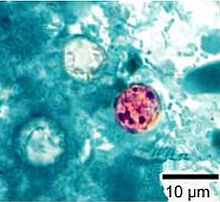
220px-Cyclospora_cayetanensis_stained

parasite that’s too tiny to see without a microscope can make you ill if you eat or drink the food or water it fouls. The illness is called a cyclospora infection (or cyclosporiasis), and it can bring on problems like watery diarrhea and stomach pain.

About 15,000 people in the U.S. catch it each year, and outbreaks of the infection have been linked to different kinds of imported fresh produce.

Here’s what you need to know to stay safe and lower your chances of catching this bug.  See at the link above.

USA – Listeria Outbreak Linked to Fully Cooked Chicken

FDA

Fast Facts
  • Illnesses: 3
  • Hospitalizations: 3
  • Deaths: 1
  • States: 2
  • Recall: Yes
  • Investigation status: Active
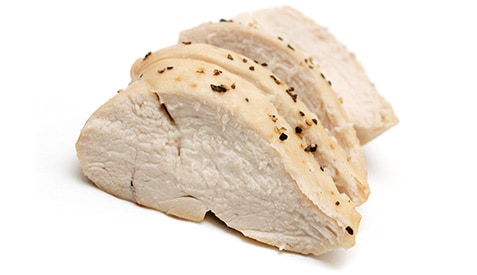
Precooked chicken

Recalled Food

Frozen, fully cooked chicken products, such as chicken strips and diced chicken, and products made with fully cooked chicken, supplied by Tyson Foods Inc.external icon

  • Shipped nationwide to retailers and institutions including hospitals, nursing facilities, restaurants, schools and Department of Defense locations
  • Products include frozen, fully cooked chicken strips, diced chicken, chicken wing sections, and fully cooked pizza with chicken
  • Products were sold under many brands including Tyson, Jet’s Pizza, Casey’s General Store, Marco’s Pizza, and Little Caesars
  • The products subject to recall bear establishment number “EST. P-7089” on the product bag or inside the USDA mark of inspection
  • See the complete list of recalled productsexternal icon, including product and date codes, on the USDA-FSIS website
What Businesses Should Do
  • Do not serve or sell recalled products.
  • Long-term care facilities, hospitals, and other facilities that serve people at higher risk for severe Listeria illness should take extra precautions.
    • Listeria is particularly harmful to people who are 65 years or older, pregnant, or have a weakened immune system.
    • All of the sick people in this outbreak ate foods served at a long-term care facility or hospital.
  • Follow USDA-FSIS’s guidanceexternal icon to prevent the spread and growth of Listeria.
What You Should Do
  • Do not eat any recalled products. Throw them away or return them to where you bought them.
  • Follow these five steps to clean your refrigerator, containers, and surfaces that may have touched the recalled products. Listeria can survive in the refrigerator and can easily spread to other foods and surfaces.
  • Call your healthcare provider right away if you have these symptoms after eating recalled products:
    • If you are pregnant: Fever and muscle aches. Your illness may be mild, but Listeria can cause pregnancy loss or premature birth. It can also cause serious illness or death in newborns.
    • If you are not pregnant: Headache, stiff neck, confusion, loss of balance, and convulsions, in addition to fever and muscle aches.
Symptoms of Listeria Illness
  • Listeria can cause severe illness (known as invasive listeriosis) when the bacteria spread beyond the gut to other parts of the body.
    • Pregnant people, adults 65 years or older, and people with weakened immune systems are at higher risk for severe illness.
  • Symptoms of severe illness usually start 1 to 4 weeks after eating contaminated food. However, symptoms can start as late as 10 weeks after.
    • Pregnant people usually experience only fever, fatigue, and muscle aches. However, Listeria can cause pregnancy loss or premature birth. It can also cause serious illness or death in newborns.
    • People who are not pregnant may experience headache, stiff neck, confusion, loss of balance, and convulsions, in addition to fever and muscle aches.
  • Listeria can also cause common food poisoning symptoms, like diarrhea and fever. People who experience these symptoms usually recover without treatment.
  • For more information about Listeria, see the Listeria Questions and Answers page.
file alt solid icon
Investigation Details
usa map icon
Map
chart icon
Timeline

Research – Effect of Gaseous Ozone on Listeria monocytogenes Planktonic Cells and Biofilm: An In Vitro Study

MDPI

Among food-borne pathogens, Listeria monocytogenes continues to pose concerns to food business operators due to its capacity to form biofilm in processing environments. Ozone may be an eco-friendly technology to control microbial contaminations, but data concerning its effect on Listeria monocytogenes biofilm are still limited. In this study, the effect of gaseous ozone at 50 ppm on planktonic cells and biofilm of reference and food-related Listeria monocytogenes strains was evaluated. Ozone caused a reduction in microbial loads of 3.7 ± 0.4 and 3.9 ± 0.4 Log10 CFU/mL after 10 and 30 min, respectively. A complete inactivation of planktonic cells after 6 h of treatment was observed. Biofilm inhibition and eradication treatments (50 ppm, 6 h) resulted in a significant decrease of the biofilm biomass for 59% of the strains tested, whilst a slight dampening of live cell loads in the biofilm state was observed. In conclusion, gaseous ozone is not sufficient to completely counteract Listeria monocytogenes biofilm, but it may be useful as an additional tool to contrast Listeria monocytogenes free-living cells and to improve the existing sanitization procedures in food processing environments. View Full-Text

Research – Genetic diversity and pathogenic potential of Shiga toxin-producing Escherichia coli (STEC) derived from German flour

Science Direct

Abstract

Shiga toxin-producing Escherichia coli (STEC) can cause severe human illness, which are frequently linked to the consumption of contaminated beef or dairy products. However, recent outbreaks associated with contaminated flour and undercooked dough in the United States and Canada, highlight the potential of plant based food as transmission routes for STEC. In Germany STEC has been isolated from flour, but no cases of illness have been linked to flour.

In this study, we characterized 123 STEC strains isolated from flour and flour products collected between 2015 and 2019 across Germany. In addition to determination of serotype and Shiga toxin subtype, whole genome sequencing (WGS) was used for isolates collected in 2018 to determine phylogenetic relationships, sequence type (ST), and virulence-associated genes (VAGs).

We found a high diversity of serotypes including those frequently associated with human illness and outbreaks, such as O157:H7 (stx2c/d, eae), O145:H28 (stx2a, eae), O146:H28 (stx2b), and O103:H2 (stx1a, eae). Serotypes O187:H28 (ST200, stx2g) and O154:H31 (ST1892, stx1d) were most prevalent, but are rarely linked to human cases. However, WGS analysis revealed that these strains, as well as, O156:H25 (ST300, stx1a) harbour high numbers of VAGs, including eae, nleB and est1a/sta1.

Although STEC-contaminated flour products have yet not been epidemiologically linked to human clinical cases in Germany, this study revealed that flour can serve as a vector for STEC strains with a high pathogenic potential. Further investigation is needed to determine the sources of STEC contamination in flour and flour products particularly in regards to these rare serotypes.

Research – Behavior of Listeria monocytogenes and Other Microorganisms in Sliced Riojano Chorizo (Spanish Dry-Cured Sausage) during Storage under Modified Atmospheres

MDPI

Sliced ready-to-eat meat products packaged under modified atmospheres are often marketed since they cover consumer demands. The slicing process could be a potential risk for consumers since contamination with Listeria monocytogenes could occur during this stage. The current study evaluated the behavior of L. monocytogenes and other microorganisms in commercial sliced Riojano chorizo. This meat product was sliced and inoculated with L. monocytogenes (3.5 log CFU/g) before packaging under different atmospheres (air, vacuum, 100% N2, 20% CO2/80% N2 and 40% CO2/60% N2) and stored at 4 °C for up to 60 days. Samples were taken on days 0, 7, 21, 28 and 60 of storage. L. monocytogenes, mesophiles, Enterobacteriaceae, lactic acid bacteria, Micrococcaceae, molds and yeast counts were evaluated. Additionally, water activity, humidity and pH were determined. L. monocytogenes counts decreased in inoculated sliced chorizo during storage. Packaging conditions and day of storage influenced microbial counts. After 60 days, a significant reduction (p ≤ 0.05) in the initial Listeria contamination levels (3.5. log CFU/g) between 1.1 and 1.46 logarithmic units was achieved in the sausages packaged in modified atmosphere. The highest reductions were observed in slices packaged in 40% CO2/60% N2 after 60 days of storage at 4 °C. View Full-Text

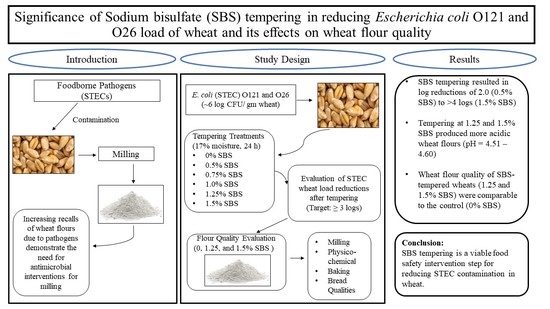
Research – Significance of Sodium Bisulfate (SBS) Tempering in Reducing the Escherichia coli O121 and O26 Load of Wheat and Its Effects on Wheat Flour Quality

MDPI

The occurrence of recalls involving pathogenic Escherichia coli-contaminated wheat flours show the need for incorporating antimicrobial interventions in wheat milling. The objectives of this study were to assess the efficacy of sodium bisulfate (SBS) tempering in reducing E. coli O121 (ATCC 2219) and O26 (ATCC 2196) wheat load and to evaluate the impact of effective (≥3.0 log reductions) SBS treatments on wheat flour quality. Wheat grains were inoculated with E. coli (~6 log CFU/g) and tempered (17% moisture, 24 h) using the following SBS concentrations (%wheat basis): 0, 0.5, 0.75, 1.0, 1.25, and 1.5% SBS. Reductions in E. coli O121 and O26 wheat load at different time intervals (0.5, 2, 6, 12, 18, and 24 h) during tempering were evaluated. The addition of SBS during tempering resulted in E. coli (O121 and O26) log reductions of 2.0 (0.5% SBS) to >4.0 logs (1.5% SBS) (p ≤ 0.05). SBS tempering (1.25 and 1.5% SBS) produced acidic wheat flours (pH = 4.51–4.60) but had comparable wheat flour properties in terms of composition, dough, and bread-making properties relative to the control (0% SBS). SBS tempering reduced the E. coli O121 and O26 load of wheat after tempering with minimal effects on wheat flour quality. View Full-Text

Vietnam Research – Microbiological safety of ready-to-eat foods in hospital and university canteens in Hanoi, Vietnam

Journal of Food Protection

The aim of this study is to analyze and document the microbiological safety and quality of ready-to-eat foods in hospital and university canteens in Hanoi, Vietnam. A total of 420 ready-to-eat food products from 21 canteens were sampled in July 2018 and May 2019. The ratio of samples exceeding the unsatisfactory level for Total Plate Count (TPC) was 31%. Escherichia coli, Listeria and Staphylococcus aureus were detected in 35 (8.3%), 99 (24%), 46 (11%) samples, with 3%, 10% and 0% exceeding the unsatisfactory level, respectively. The Total Plate Count (TPC), Listeria, Bacillus cereus, E. coli, S. aureus ranged from below detection limit to 5×10 9 , 4.6×10 5 , 6.2×10 3 , 3.4×10 3 , 7.6×10 3 CFU/g, respectively. Listeria monocytogenes was isolated from 3/420 samples (0.7%). In addition, there were 21 out of 410 samples (5%) contaminated with Salmonella. Overall, our data indicate frequent problems with the microbiological quality and safety of these canteen foods in Hanoi, and provide a baseline measurement that will allow environmental health officers and food microbiologists to develop targeted intervention strategies to reduce the economical and public health risk associated with these foods.

Research – Low-Temperature Virus vB_EcoM_VR26 Shows Potential in Biocontrol of STEC O26:H11

MDPI

Shiga toxin-producing Escherichia coli (STEC) O26:H11 is an emerging foodborne pathogen of growing concern. Since current strategies to control microbial contamination in foodstuffs do not guarantee the elimination of O26:H11, novel approaches are needed. Bacteriophages present an alternative to traditional biocontrol methods used in the food industry. Here, a previously isolated bacteriophage vB_EcoM_VR26 (VR26), adapted to grow at common refrigeration temperatures (4 and 8 °C), has been evaluated for its potential as a biocontrol agent against O26:H11. After 2 h of treatment in broth, VR26 reduced O26:H11 numbers (p < 0.01) by > 2 log10 at 22 °C, and ~3 log10 at 4 °C. No bacterial regrowth was observed after 24 h of treatment at both temperatures. When VR26 was introduced to O26:H11-inoculated lettuce, ~2.0 log10 CFU/piece reduction was observed at 4, 8, and 22 °C. No survivors were detected after 4 and 6 h at 8 and 4 °C, respectively. Although at 22 °C, bacterial regrowth was observed after 6 h of treatment, O26:H11 counts on non-treated samples were >2 log10 CFU/piece higher than on phage-treated ones (p < 0.02). This, and the ability of VR26 to survive over a pH range of 3–11, indicates that VR26 could be used to control STEC O26:H11 in the food industry. View Full-Text

Research – A Microbiological Survey of Minced Beef at Retail in Scotland

FSS

Click to access FSS_Report_Retail_Mince_FINAL.pdf