Author Archives: KSW

USA – FDA – Enforcement Report – Potential C. botulinum growth and toxin formation

FDA

Event ID: 93557

Voluntary / Mandated:

Voluntary: Firm initiated

Product Type: Food

Status: Ongoing

Distribution Pattern:

U.S. Distribution to Supermarkets in CA, HI, WA, IL, NV, and TX. No foreign distribution.

Recalling Firm:Foremost Foods International, Inc.
2883 Surveyor St
Pomona, CA 91768-3251
United States

Press Release URL(s):

Recall Initiation Date:

12/1/2023

Center Classification Date:

1/4/2024

1
Pamana Premium Marinated Baby Bangus (Deboned Marinated Baby Milkfish), Net Weight to be Weight at Time of Sale

F-0691-2024

Class II
All product codes

432 boxes

Potential C. botulinum growth and toxin formation. Frozen bangus (milkfish) in reduced oxygen packaging does not contain instructions to keep frozen and instructions for proper thawing (e.g., “Important, keep frozen until used, thaw under refrigeration immediately before use.”).

2
Pamana Premium Marinated Bangus (Deboned Marinated Milkfish), Net Weight to be Weight at Time of Sale

F-0692-2024

Class II
All product codes

407 boxes

Potential C. botulinum growth and toxin formation. Frozen bangus (milkfish) in reduced oxygen packaging does not contain instructions to keep frozen and instructions for proper thawing (e.g., “Important, keep frozen until used, thaw under refrigeration immediately before use.”).

3
Pamana Premium Bangus Belly (Cut Deboned Milkfish Belly), 340 g (120 oz)

F-0693-2024

Class II
All product codes

448 boxes

Potential C. botulinum growth and toxin formation. Frozen bangus (milkfish) in reduced oxygen packaging does not contain instructions to keep frozen and instructions for proper thawing (e.g., “Important, keep frozen until used, thaw under refrigeration immediately before use.”).

USA- Salmonella Outbreak Linked to Charcuterie Meats

CDC

Fast Facts
  • Illnesses: 24
  • Hospitalizations: 5
  • Deaths: 0
  • States: 14
  • Recall: Yes
  • Investigation status: Active   (first posted on January 5, 2024)

Recalled product image

Recalled Food
Salmonella was identified in an unopened sample of “Busseto Foods Charcuterie Sampler Prosciutto, Sweet Soppressata, and Dry Coppa” collected by the Minnesota Department of Agriculture as a part of the investigation. Testing is being conducted to determine if the Salmonella in the sample is the outbreak strain.

On January 3, 2024, Fratelli Beretta USA, Inc., recalled approximately 11,097 pounds of Busseto Foods brand ready-to-eat charcuterie meat products.

Busseto Charcuterie Sampler
18-oz. plastic tray packages of “Busseto Foods Charcuterie Sampler Prosciutto, Sweet Soppressata, and Dry Coppa”
LOT Code L075330300 and “best by” date on April 27, 2024. This product is sold as a twin pack with two 9-oz. packages.
The products have the establishments numbers “EST. 7543B” inside the U.S. Department of Agriculture’s mark of inspection and “EST. #47967” on the package. See recall notice for more details.
These items were shipped to Sam’s Club distribution centers in Georgia, Illinois, Indiana, Minnesota, North Carolina, Ohio, Oklahoma, and Texas.
What You Should Do
Check your fridge for recalled products. Do not eat them. Throw them away or return them to where you bought them.
Wash surfaces and containers that may have touched the recalled product using hot soapy water or a dishwasher.
Call your healthcare provider right away if you have any of these severe Salmonella symptoms:
Diarrhea and a fever higher than 102°F
Diarrhea for more than 3 days that is not improving
Bloody diarrhea
So much vomiting that you cannot keep liquids down
Signs of dehydration, such as:
Not peeing much
Dry mouth and throat
Feeling dizzy when standing up
What Businesses Should Do
Do not sell or serve the recalled “Busseto Foods Charcuterie Sampler Prosciutto, Sweet Soppressata, and Dry Coppa.”
Wash and sanitize items and surfaces that may have come in contact with recalled products.

Spain – Alert for possible presence of Cronobacter sakazakii in food for special medical use from the United States (Ref. ES2024/006)

AESAN

The Spanish Agency for Food Safety and Nutrition has learned, through the Coordinated System for Rapid Information Exchange (SCIRI), of an alert notification sent by the health authorities of Catalonia regarding the possible presence of Cronobacter sakazaki , in the Nutramigen product. 1 PRO 400mg.

This information has been transferred to the contact point in Catalonia by the marketing company in Spain following the decision of the manufacturer, located in the United States, to voluntarily withdraw the product, as a precautionary measure, due to possible cross-contamination with Cronobacter sakazakii . detected in a unit from another batch tested outside of Spain.

The ZL3F6J batch has been distributed in Spain since August 2023 and so far no incident has been reported with it. The operator has already contacted its customers to proceed with the withdrawal of the affected product.

The data of the product involved are:

  • Product name: Nutramigen 1 PRO 400mg.
  • Brand Name: Mead Johnson Nutrition.
  • Product appearance: metal packaging.
  • Lot number: The lot number is located on the bottom of the can: ZL3F6J.
  • Unit weight/vol: 400 mg.
  • Room temperature.

Available images are attached.


According to the information available, distribution has occurred in most of the national territory.

This information has been transferred to the competent authorities of the autonomous communities through the Coordinated System for Rapid Information Exchange (SCIRI) and to the Coordination Center for Health Alerts and Emergencies (CCAES), in order to verify the withdrawal of the affected products from the marketing channels and the existence of possible cases is reported.

People who have products affected by this alert in their homes are recommended to refrain from consuming them.

If you have consumed the product from the affected batch and present any symptoms compatible with Cronobacter sakazakii toxiinfection (gastrointestinal symptoms, fever, irritability, jaundice, seizures), go to a health center.

You can expand the information from the AESAN on Cronobacter sakazakii toxiinfection at the following link.

Germany- Pizza meatloaf baked in the oven – Listeria monocytogenes

Lebensmittelwarnung

Alert type: Groceries
Date of first publication:

01/05/2024

Product name:

Pizza meatloaf baked in the oven In addition, the following products are being voluntarily recalled as a precautionary measure: ham red sausage, baked meat loaf, fine ham sausage with Peppadew, ham Scherz’l, crusted roast, Kasseler saddle

Product images:

Pizza meat cheese front side.png
Pizza meat cheese back side.png
Manufacturer (distributor):

Company Wolf GmbH Am Lindenhof 40 04626 Schmölln

Reason for warning: Detection of listeria
Packaging Unit: 100 g
Durability:

see attached consumer information about the product recall

Lot identification:

see attached consumer information about the product recall

Additional Information:

Wolf GmbH is carrying out a voluntary recall for reasons of preventative consumer protection.

Click to access Mitteilung_Verbraucherportal_04012024.pdf

Italy – Organic Corn Flour – Aflatoxin

Salute

Brand : AZIENDA AGRICOLA BIO FLORIDDIA

Name : ORGANIC CORN FLOUR

Reason for reporting : Recall due to chemical risk

Publication date : 5 January 2024

Documentation

Documentation

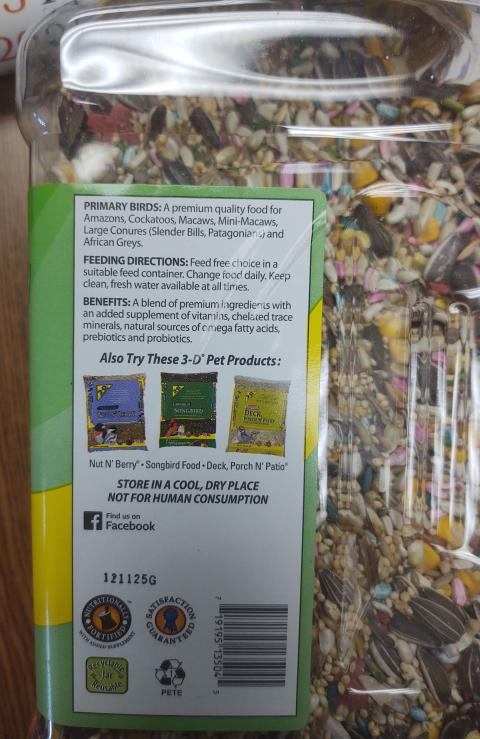
USA – Urgent Voluntary Recall of D&D Commodities Ltd. 3-D Pet Products Premium Parrot Food Due to Potential Salmonella Contamination

FDA

Image 1: “Photograph of label for 3-D Parrot Food Side Panel with lot code, 4 lbs.”

Company Announcement

Greeley, CO – D&D Commodities Ltd. is voluntarily recalling one lot of 3-D® Pet Products Premium Parrot Food, 4 lb. jar, UPC 719195135045, Lot Number 102525G, due to potential Salmonella contamination.

The product affected by this recall announcement is:

Product

Size

UPC

Lot No.

3-D Pet Products Premium Parrot
Food
4 lb. 719195135045 102525G

Product and product lots that do not appear on the list above are not subject to this recall.

Please see attached photos to accurately identify the product.

The recall notification is being issued based on a single manufacturing batch wherein a sample with the Lot Number 102525G and UPC 719195135045 had a positive result for Salmonella in a random sample test collected by the U.S. Food and Drug Administration (FDA) on November 30, 2023. The 3-D® Pet Product Premium Parrot Food was originally manufactured on October 25, 2023. D&D Commodities Ltd. is taking immediate action to remove the product from retail distribution centers and to fully investigate the cause.

Salmonella can affect animals eating the products and there is a risk to humans from handling contaminated pet products, especially if they have not thoroughly washed their hands after having contact with the products or any surfaces exposed to these products.

Healthy people exposed to Salmonella should monitor themselves for some or all the following symptoms: nausea, vomiting, diarrhea or bloody diarrhea, abdominal cramping, and fever. Rarely, Salmonella can result in more serious ailments, including arterial infections, endocarditis, arthritis, muscle pain, eye irritation, and urinary tract symptoms. Consumers exhibiting these signs after having contact with this product should contact their healthcare providers.

Pets with Salmonella infections may be lethargic and have diarrhea or bloody diarrhea, fever, and vomiting. Some pets will have only decreased appetite, fever, and abdominal pain. Infected but otherwise healthy pets can be carriers and infect other animals or humans. If your pet has consumed the recalled product and has these symptoms, please contact your veterinarian.

Research – Effectiveness of Ultra-High Irradiance Blue-Light-Emitting Diodes to Control Salmonella Contamination Adhered to Dry Stainless Steel Surfaces

MDPI

Controlling Salmonella contamination in dry food processing environments represents a significant challenge due to their tolerance to desiccation stress and enhanced thermal resistance. Blue light is emerging as a safer alternative to UV irradiation for surface decontamination. In the present study, the antimicrobial efficacy of ultra-high irradiance (UHI) blue light, generated by light-emitting diodes (LEDs) at wavelengths of 405 nm (841.6 mW/cm2) and 460 nm (614.9 mW/cm2), was evaluated against a five-serovar cocktail of Salmonella enterica dry cells on clean and soiled stainless steel (SS) surfaces. Inoculated coupons were subjected to blue light irradiation treatments at equivalent energy doses ranging from 221 to 1106 J/cm2. Wheat flour was used as a model food soil system. To determine the bactericidal mechanisms of blue light, the intracellular concentration of reactive oxygen species (ROS) in Salmonella cells and the temperature changes on SS surfaces were also measured. The treatment energy dose had a significant effect on Salmonella inactivation levels. On clean SS surfaces, the reduction in Salmonella counts ranged from 0.8 to 7.4 log CFU/cm2, while, on soiled coupons, the inactivation levels varied from 1.2 to 4.2 log CFU/cm2. Blue LED treatments triggered a significant generation of ROS within Salmonella cells, as well as a substantial temperature increase in SS surfaces. However, in the presence of organic matter, the oxidative stress in Salmonella cells declined significantly, and treatments with higher energy doses (>700 J/cm2) were required to uphold the antimicrobial effectiveness observed on clean SS. The mechanism of the bactericidal effect of UHI blue LED treatments is likely to be a combination of photothermal and photochemical effects. These results indicate that LEDs emitting UHI blue light could represent a novel cost- and time-effective alternative for controlling microbial contamination in dry food processing environments.

Research – Adhesion to and survival of foodborne pathogens in produce and strategies for their biocontrol

Wiley Online

Abstract

Foodborne pathogens can cause gastrointestinal infections in consumers and in some cases can even lead to outbreaks. In the last decade, it has been observed that some zoonotic pathogenic bacteria can use plants as secondary hosts. Contamination with foodborne bacteria becomes relevant in foods that are regularly eaten raw, such as lettuce, cilantro, fenugreek, rocket leaves, basil, and so forth, and some fruits such as tomatoes, melons, and green peppers; because the elimination of these pathogenic bacteria is difficult to achieve with conventional sanitization processes. Contamination of produce can occur throughout the entire production chain. In farmlands, pathogenic bacteria can contaminate the seed, mainly when contaminated water is used for irrigation. Later, bacteria can reach other plant tissues such as the stems, leaves, and fruits. Another form of contamination is when the produce is in contact with faeces from domestic, production, or wild animals. Additionally, poor handling practices during harvest, packaging, distribution, and sale can contaminate produce. Studies have shown that foodborne pathogens can adhere to produce, sometimes forming a biofilm, and can also be internalized into the plant or fruit, which protects them from sanitation processes. For this reason, in this text we address three biocontrol strategies such as bacteria, lytic bacteriophages, and some fungi, as an alternative approach for the control of both foodborne and plant pathogens. Additionally, the use of these biological agents can represent an advantage for the development of the plant, making them a good strategy to favour yield.

Research – Food Safety Aspects of Breeding Maize to Multi-Resistance against the Major (Fusarium graminearum, F. verticillioides, Aspergillus flavus) and Minor Toxigenic Fungi (Fusarium spp.) as Well as to Toxin Accumulation, Trends, and Solutions—A Review

MDPI

Abstract

Maize is the crop which is most commonly exposed to toxigenic fungi that produce many toxins that are harmful to humans and animals alike. Preharvest grain yield loss, preharvest toxin contamination (at harvest), and storage loss are estimated to be between 220 and 265 million metric tons. In the past ten years, the preharvest mycotoxin damage was stable or increased mainly in aflatoxin and fumonisins. The presence of multiple toxins is characteristic. The few breeding programs concentrate on one of the three main toxigenic fungi. About 90% of the experiments except AFB1 rarely test toxin contamination. As disease resistance and resistance to toxin contamination often differ in regard to F. graminearumF. verticillioides, and A. flavus and their toxins, it is not possible to make a food safety evaluation according to symptom severity alone. The inheritance of the resistance is polygenic, often mixed with epistatic and additive effects, but only a minor part of their phenotypic variation can be explained. All tests are made by a single inoculum (pure isolate or mixture). Genotype ranking differs between isolates and according to aggressiveness level; therefore, the reliability of such resistance data is often problematic. Silk channel inoculation often causes lower ear rot severity than we find in kernel resistance tests. These explain the slow progress and raise skepticism towards resistance breeding. On the other hand, during genetic research, several effective putative resistance genes were identified, and some overlapped with known QTLs. QTLs were identified as securing specific or general resistance to different toxicogenic species. Hybrids were identified with good disease and toxin resistance to the three toxigenic species. Resistance and toxin differences were often tenfold or higher, allowing for the introduction of the resistance and resistance to toxin accumulation tests in the variety testing and the evaluation of the food safety risks of the hybrids within 2–3 years. Beyond this, resistance breeding programs and genetic investigations (QTL-analyses, GWAM tests, etc.) can be improved. All other research may use it with success, where artificial inoculation is necessary. The multi-toxin data reveal more toxins than we can treat now. Their control is not solved. As limits for nonregulated toxins can be introduced, or the existing regulations can be made to be stricter, the research should start. We should mention that a higher resistance to F. verticillioides and A. flavus can be very useful to balance the detrimental effect of hotter and dryer seasons on aflatoxin and fumonisin contamination. This is a new aspect to secure food and feed safety under otherwise damaging climatic conditions. The more resistant hybrids are to the three main agents, the more likely we are to reduce the toxin losses mentioned by about 50% or higher.

Research – Hazards in Seafood Notified in the Rapid Alert System for Food and Feed (RASFF) in 1996–2020

MDPI

Abstract

Seafood covering fish, crustaceans, molluscs and cephalopods is broadly recognised for its nutritional value and popularity, but it can pose some hazards to health to the potential consumer. The aim of the study was to analyse Rapid Alert System for Food and Feed (RASFF) notifications for seafood over the period 1996–2020 by hazard, year, product, notifying country, country of origin, notification type, notification basis, distribution status and action taken. The research applied cluster analysis using the joining and two-way joining methods. The main reported hazards were micro-organisms (ListeriaSalmonellaEscherichia coliVibrio, norovirus, mesophiles, Enterobacteriaceae and histamine), heavy metals (mercury and cadmium), veterinary products (nitrofuran, chloramphenicol and leucomalachite green), controls (poor temperature control and hygienic state), parasites (Anisakis) and additives/allergens (sulphite). The reported seafood products originated mainly from European and Asian countries and were notified on the basis of official or border controls, respectively. In order to minimize or eliminate risks, it is important to have the right activity of control authorities, appropriate legislation at the European and national levels and awareness at the different stages of the food chain.