Research -Recent advances in the preservation effects of spice essential oils on fruits and vegetables

Science Direct

Abstract

Spice essential oils (SEOs) are currently a prominent area of investigation in food preservation due to their natural, effective, and environmentally friendly properties. This review discussed the latest research progress concerning the application of SEO in fruits and vegetables preservation. The article commenced with an overview of the sources of SEOs and their main components, explored their bioactivities, antimicrobial mechanisms, and the microencapsulation and nanotechnology utilizing spice essential oils. Further research explored the applications of SEOs in culinary, pharmaceuticals, cosmetics, agriculture, and food industries, with a focus on evaluating their effectiveness in extending the shelf-life of fruits and vegetables. Additionally, it discusses limitations such as intense aroma and toxicity concerns, while also outlining prospects for future research and applications in the food sector. Overall, SEOs offer promising avenues for effectively prolonging the storage period of post-harvested fruits and vegetables while maintaining their quality attributes.

USA – FDA Takes Exciting Steps Toward Establishing the Rare Disease Innovation Hub

FDA

This summer, the U.S. Food and Drug Administration announced plans to establish the Rare Disease Innovation Hub (the Hub), and today, we are excited to share more about our progress. The Hub is an FDA cross-center program that will act as the single point of engagement and connection with outside parties for drug and biological product development and as a forum for the Center for Biologics Evaluation and Research (CBER) and the Center for Drug Evaluation and Research (CDER) to collaborate on cross-cutting rare disease-related issues. Through the Hub, we plan to foster a community at the FDA for open dialogue and knowledge sharing to identify new approaches to drug and biologic development and overcome hurdles that have traditionally impeded progress for rare disease treatments.

Research – Vibrio parahaemolyticus Foodborne Illness Associated with Oysters, Australia, 2021–2022

CDC

Abstract

The bacterium Vibrio parahaemolyticus is ubiquitous in tropical and temperate waters throughout the world and causes infections in humans resulting from water exposure and from ingestion of contaminated raw or undercooked seafood, such as oysters. We describe a nationwide outbreak of enteric infections caused by Vibrio parahaemolyticus in Australia during September 2021–January 2022. A total of 268 persons were linked with the outbreak, 97% of whom reported consuming Australia-grown oysters. Cases were reported from all states and territories of Australia. The outbreak comprised 2 distinct strains of V. parahaemolyticus, sequence types 417 and 50. We traced oysters with V. parahaemolyticus proliferation back to a common growing region within the state of South Australia. The outbreak prompted a national recall of oysters and subsequent improvements in postharvest processing of the shellfish.

Research – Mycotoxins in Food: Cancer Risks and Strategies for Control

MDPI

Abstract

Mycotoxins are toxic compounds produced by fungi such as AspergillusPenicillium, and Fusarium, contaminating various food crops and posing severe risks to food safety and human health. This review discusses mycotoxins‘ origins, significance, and impact, particularly in relation to cancer risk. Major mycotoxins like aflatoxins, ochratoxins, fumonisins, zearalenone, and patulin are examined, along with their sources and affected foods. The carcinogenic mechanisms of these toxins, including their biochemical and molecular interactions, are explored, as well as epidemiological evidence linking mycotoxin exposure to cancer in high-risk populations. The review also highlights critical methodologies for mycotoxin detection, including HPLC, GC-MS, MS, and ELISA, and the sample preparation techniques critical for accurate analysis. Strategies for controlling mycotoxin contamination, both pre- and post-harvest, are discussed, along with regulations from organizations like the FAO and WHO. Current challenges in detection sensitivity, cost, and control effectiveness are noted. Future research is needed to develop innovative analytical techniques, improve control strategies, and address the influence of climate change on mycotoxin production. Finally, global collaboration and emerging technologies are essential for advancing mycotoxin control and enhancing food safety.

Research – Estimating Underdetection of Foodborne Disease Outbreaks

CDC

To the Editor: In the February issue, Ford et al. used the power law to estimate underdetection of foodborne disease outbreaks in the United States (1). Two of their main conclusions are entirely reasonable: small outbreaks are more likely to go undetected than large outbreaks, and the use of whole-genome sequencing (WGS) has improved the detection of small outbreaks caused by pathogens for which WGS is used. However, their conclusion on the usefulness of the power law itself needs further consideration.

Ford et al. analyzed the size of all foodborne outbreaks reported to the national Foodborne Disease Outbreak Surveillance System during 1998–2019. They defined outbreak size as the number of laboratory-confirmed cases. However, laboratory-confirmed cases are only good estimators for the size of outbreaks detected through pathogen-specific surveillance, such as for Salmonella, where outbreak detection follows the accumulation of confirmed cases. For outbreaks associated with events or establishments, identification might rely on reports from consumers, many of whom do not seek healthcare; thus, stool specimens might only be collected from a few cases to confirm the etiology. Consumer complaints are the primary means for identifying foodborne outbreaks caused by norovirus. The Council to Improve Foodborne Outbreak Response recommends collecting clinical specimens from >5 members from the ill group in such settings (2). Thus, the number of confirmed cases in an outbreak is dependent on how the outbreak is detected. Outbreaks detected by complaint generally have few confirmed cases, even though they can involve large numbers of illnesses.

To provide a fair evaluation for the usefulness of the power law, it may be better to restrict analyses to outbreaks with common detection pathways. For outbreaks detected by pathogen-specific surveillance, counting confirmed cases seems appropriate. For outbreaks detected through consumer complaints, analyses should include all outbreak-associated illnesses.

Research – UK food microbiology lab reports updates on recent work

Food Safety News

The main food microbiology lab in the United Kingdom has shared highlights of its recent activity in an annual report.

The report covers work of the UK’s national reference laboratory (NRL) for food microbiology between April 2023 and March 2024.

The UK Health Security Agency (UKHSA) provides the service for the Food Standards Agency (FSA) and Food Standards Scotland (FSS). It covers Listeria monocytogenes, coagulase-positive staphylococci, E. coli, Campylobacter, Salmonella, and antimicrobial resistance.

Research – Outbreak of Listeriosis Likely Associated with Baker’s Yeast Products, Switzerland, 2022–2024

CDC

Abstract

We traced back a nationwide outbreak of human listeriosis in Switzerland to a persisting production line contamination of a factory producing baker’s yeast with Listeria monocytogenes serotype 1/2a sequence type 3141. We used whole-genome sequencing to match clinical isolates to isolates from product samples.

Research – Effects of Combined Cold Plasma and Organic Acid-Based Sanitizer Treatments Against Salmonella enterica on Tomato Surfaces

Wiley Online

ABSTRACT

Incidence of foodborne illness due to bacterial contamination of fresh produce continue to exist despite continuous research on processing interventions to mitigate the problem. In this study, we combined atmospheric cold plasma treatments with an antimicrobial solution containing specific organic acids generally recognized as safe (GRAS) by the FDA and tested its antimicrobial efficacy against Salmonella enterica inoculated on tomato surfaces. Tomato surfaces were inoculated with at 5.6 log CFU/g of Salmonella by spotting 0.1 mL of 7 log CFU/ml Salmonella onto the tomato stem scars, and by dipping whole tomatoes into a solution of 7 log CFU/ml Salmonella for 3 min to achieve 4.1 log CFU/g. Antimicrobial efficacy of the organic acid-based sanitizer + cold plasma treatments for 30, 60, 120, 180, and 360 s, were investigated, and significant bacterial inactivation was achieved above 120 s treatments. At 120 s, surviving populations of aerobic mesophilic bacteria recovered on the tomatoes surfaces averaged < 2 logs/g while yeast and mold survival averaged < 1 CFU/g. Treatment combination with this organic acid-based sanitizer + cold plasma for 120 s resulted in a 4.9 log reduction of Salmonella on the stem scar area and a 3.9 log reduction on the smooth peel surface. Similarly, populations of aerobic mesophilic bacteria recovered on treated tomato surfaces averaged < 0.3 log CFU/g. The results of this study indicate that combining an organic acid-based sanitizer with cold plasma treatments for ≥ 120 s can inactivates significant populations of Salmonella to enhance the microbial safety of tomato surfaces designated for fresh-cut salad.

Denmark – Yeast growth in snack sausages

Foedevarestyrelsen

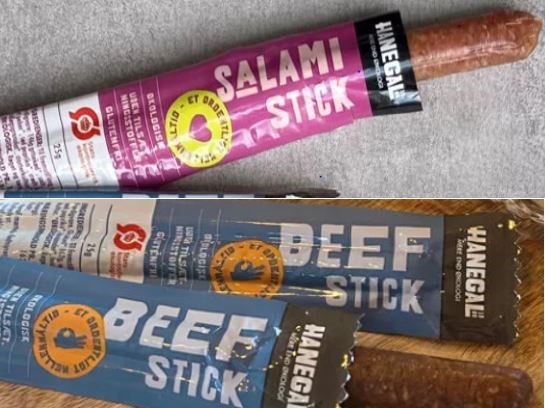
Hanegal A/S is recalling the snack sausages Salami Stick and Beef Stick, as yeast growth has been found in the products. The yeast growth can discolor the snack sausages and give them a sour, off-flavor that makes them unsuitable as food.

If you have the products, you should discard them or return them to the store where you bought them.

Picture of the snack sausages
Image of the products

Which food is recalled

Chicken Salami Stick, 25g

EAN no: 5709760003775

Best before dates: 10/12/2024; 12.12.2024; 18.12.2024; 25.12.2024 and 01.01.2025

Rooster Beef Stick, 25g

EAN no: 5709760003782

Best-before dates: 04.12.2024; 12.12.2024; 18.12.2024; 25.12.2024 and 01.01.2025

Where is the product sold

The product is sold in:  Rema1000, Føtex, Bilka, Netto, Meny, Coop365, Kvickly, Brugsen, Dagli’Brugsen and in SuperBrugsen stores throughout the country and on http://www.nemlig.com.

Why is the product being recalled?

There is a risk of yeast growth in the products. Fermentation in products can cause them to appear discolored and with a sour and deviant taste. The snack sausages are therefore unsuitable as food.

Read more on the Danish Veterinary and Food Administration’s website about spoilage bacteria, yeasts and molds by clicking on the link here.

What should you do as a consumer?

The Danish Veterinary and Food Administration advises consumers to discard the products or return them to the store where they were purchased. 

Who recalls the product

Hanegal A/S

Finlandsvej 12

6100 Haderslev

Iceland – E. coli O145 confirmed in children and mixed mince

MAST

Foodborne infection has been confirmed at the Mánagardı nursery school in Reykjavík. The causative agent is E. coli bacteria of a type known as STEC and of serotype O145. Analysis of samples at Matís confirmed that the same serotype, i.e. E. coli O145 was found both in faecal samples from children from the kindergarten and in a sample of minced meat used in cooking at the kindergarten. Their sequencing of the bacteria’s genetic material showed that the origin is the same.

After detailed interviews with the parents of the children, who fell ill, attention soon turned to Thursday, October 17 last. The Reykjavík Health Authority went to the site and took numerous samples for analysis of the food used in the cooking that day, such as minced meat, vegetables, lentils, melons, oatmeal and more. All food samples were negative for E. coli except for the mince. A few children who normally do not eat meat also fell ill, but it is not possible to confirm the route of infection for them. They may have been infected by other children who attended the kindergarten after they got sick but before the kindergarten was closed.

The mince turned out to be mixed beef and sheep mince from Kjarnaföð. It did not go on general sale, but only sold to larger kitchens, such as restaurants, canteens and kindergartens. Matvælastofnun contacted the representatives of the company when suspicion was directed at the mince, and the same day the company contacted all parties who received mince from the same production batch that was used in the Mánagard nursery school. During the recall, it was found that buyers had already used it in their operations. There have been no reports of infection or sickness among consumers at other kitchens.

E. coli bacteria are part of the natural intestinal flora of humans and animals and can be introduced into water, meat, vegetables and other foods during their production. Different types of E. coli exist. Most types of E. coli are harmless, but Shigatoxin-producing E. coli (STEC) carry genes that encode toxins that can cause illness (virulence genes). However, their strains can be highly pathogenic.

According to legislation on meat production, producers are not required to ensure that all meat is free of E. coli before it goes to market. However, meat producers should do everything in their power to reduce the chance of contamination of carcasses and meat products in the process. It is primarily done with clean grips, proper hand techniques and clean equipment. Sampling in the process is therefore aimed at checking whether working methods are adequate. The Food Agency reported on a screening of the presence of pathogenic bacteria in Icelandic meat on the Icelandic market in 2018. It stated that STEC virulence genes were found in almost 30% of lamb samples and 11.5% of beef samples.

Cleanliness and proper handling of meat and adequate cooking by users/consumers is therefore key to preventing infection caused by E. coli , including STEC from meat. The steering group’s research has revealed that the handling of the minced meat in this respect during cooking in the kindergarten was insufficient.

It is common practice that beef, lamb and horse steaks are served without being deep-fried. Raw cuts of meat have bacteria on the surface of the meat but not inside the muscle. They are therefore killed when the meat is fried or grilled at high temperatures. Hamburgers and other dishes made from minced meat are different, because during the mincing process, microorganisms spread throughout the mince. Insufficient heating/frying does not kill bacteria present deep inside the mince. In order to kill E. coli and other disease-causing microorganisms, hamburgers and other mincemeat dishes must be fried through or so that the core temperature is at least 75°C.