Category Archives: Foodborne Illness Death

Research – Listeria monocytogenes Illness and Deaths Associated With Ongoing Contamination of a Multi-Regional Brand of Ice Cream Products, United States, 2010–2015 

Academia Edu

Abstract

Background

Frozen foods have rarely been linked to Listeria monocytogenes illness. We describe an outbreak investigation prompted both by hospital clustering of illnesses and product testing.

Methods

We identified outbreak-associated listeriosis cases using whole-genome sequencing (WGS), product testing results, and epidemiologic linkage to cases in the same Kansas hospital. We reviewed hospital medical and dietary records, product invoices, and molecular subtyping results. Federal and state officials tested product and environmental samples for L. monocytogenes.

Results

Kansas officials were investigating five cases of listeriosis at a single hospital when, simultaneously, unrelated sampling for a study in South Carolina identified L. monocytogenes in Company A ice cream products made in Texas. Isolates from four patients and Company A products were closely related by WGS, and the four patients with known exposures had consumed milkshakes made with Company A ice cream while hospitalized. Further testing identified L. monocytogenes in ice cream produced in a second Company A production facility in Oklahoma; these isolates were closely related by WGS to those from five patients in three other states. These ten illnesses, involving three deaths, occurred from 2010 through 2015. Company A ultimately recalled all products.

Conclusion

In this U.S. outbreak of listeriosis linked to a widely distributed brand of ice cream, WGS and product sampling helped link cases spanning five years to two production facilities, indicating longstanding contamination. Comprehensive sanitation controls and environmental and product testing for L. monocytogenes, with regulatory over

Research – E. coli O104:H4 is similar to the 2011 outbreak strain found in Europe

Food Safety News

A type of E. coli similar to what caused a large outbreak in 2011 has recently been detected in Europe, according to researchers.

Two cases of Shiga toxin-producing Enteroaggregative E. coli (EAEC) O104:H4 were reported in the Netherlands in 2019 and 2020 and in one food isolate from 2017. There was also a patient from Austria in 2021.

In 2011, a huge outbreak caused by STEC O104:H4 occurred in Europe, mainly Germany and France, that was associated with sprouts grown from fenugreek seeds from Egypt. The outbreak resulted in more than 4,000 infections and 54 deaths from 16 countries, including six cases in the United States.

After this outbreak, only a few sporadic infections with EAEC O104:H4 were reported, most related to travel to Turkey or North Africa, said the study published in Emerging Infectious Diseases.

Research – 10 Deadly Food Poisoning Outbreaks in US History

Food Poisoning News

Over the years, the United States has seen several foodborne illness outbreaks, some of which have been more lethal than others. The Centers for Disease Control and Prevention (CDC) estimates that contaminated food causes approximately 128,000 hospitalizations and 3,000 deaths yearly. The number of cases is usually higher during an outbreak than in a normal year. Foodborne illness outbreaks typically occur when multiple people contract a similar illness after consuming a common food, and analysis of the food implicates it as the source of the disease.

In the early 1920s, the Public Health Service was responsible for reporting foodborne illness outbreaks in the US. In 1961, the CDC, then known as the Communicable Disease Center, took over the role, and in 2011, it began publishing annual summaries of food poisoning outbreaks online.

Check the link above for the top ten.

USA – FDA Coe Investigation Table Update

FDA

What’s New

  • An outbreak of E. coli O157:H7 (ref# 1081) in an unidentified product was added to the table and FDA has initiated a traceback investigation. CDC has issued an Investigation Notice.
  • An outbreak of Salmonella Senftenberg (ref# 1087) in an unidentified product was added to the table.
  • An outbreak of Salmonella Typhimurium (ref# 1095) in an unidentified product was added to the table and traceback has been initiated.
  • For the outbreak of Salmonella Braenderup (ref# 1075) in an unidentified product, the outbreak has ended.
  • For the outbreak of Cyclospora in an unidentified product (ref# 1084), the case count has increased from 77 to 98.
  • For the outbreak of hepatitis A illnesses linked to fresh strawberries (ref# 1066), the FDA investigation has closed and the outbreak is over.
Date
Posted
Ref
Pathogen
Product(s)
Linked to
Illnesses

(if any)
Total
Case Count

Status
8/17/

2022

1081 E. coli
O157:H7
Not Yet Identified See CDC Investigation Notice Active
8/17/

2022

1087 Salmonella
Senftenberg
Not Yet Identified 19 Active
8/17/

2022

1095 Salmonella
Typhimurium
Not Yet Identified 44 Active
8/3/

2022

1080 Cyclospora Not Yet Identified 6 Active
7/27/

2022

1084 Cyclospora Not Yet Identified 98 Active
6/29/

2022

1076 Not Yet Identified Frozen Food See Outbreak
Advisory
Active
6/22/

2022

1075 Salmonella
Braenderup
Not Yet Identified 74 Active
6/22/

2022

1072 Salmonella
Paratyphi B var. L(+) tartrate+
Not Identified 14 Closed
6/15/

2022

1070 Listeria
monocytogenes
Not Identified 12 Closed
6/8/

2022

1068 E. coli
O157:H7
Not Identified 10 Closed
6/1/

2022

1066 Hepatitis A Virus Strawberries See Outbreak
Advisory
Closed
5/25/

2022

1067 Salmonella 
Senftenberg
Peanut Butter See Outbreak Advisory Closed
4/20/

2022

1064 Not Yet
Identified
Dry Cereal 558 adverse
event reports
Active
4/13/

2022

1057 Listeria
monocytogenes
Ice Cream See Outbreak Advisory Active
3/30/

2022

1060 None
Identified
Meal Replacement
Drink
6 adverse
event reports
Closed
3/16/

2022

1055 Salmonella
Saintpaul
Not Identified 60 Closed
2/17/

2022

1056 Cronobacter
sakazakii
Powdered
Infant
Formula
See
Advisory
Active (IMG)
2/9/

2022

1040 Listeria
monocytogenes
Not Identified 20 Closed
2/2/

2022

1054 Enteroinvasive
E. coli
O143:H26
Not
Identified
16 Closed
1/10/

2022

1050 E. coli
O121:H19
Romaine 4 Closed

USA – Man Dead After Eating Raw Oyster at Seafood Restaurant in Dania Beach: Vibrio

NBC Miami

A man is dead after contracting a bacterial infection from eating a raw oyster at the Rustic Inn Crabhouse in Dania Beach, according to the Sun Sentinel.

His death was traced to the bacteria, Vibrio, which is typically found in raw or undercooked seafood, like oysters.

According to the Sun Sentinel, the manager of the Rustic Inn, Gary Oreal, said the man who died was a former employee who had dined there earlier this month when the restaurant served as many as 100 dozen oysters. He was the only person who became sick.

“He had that one in a billion that was bad,” Oreal told the Sun Sentinel. “I feel horrible.”

Denmark – Health and Economic Burden of Seven Foodborne Diseases in Denmark, 2019

Mary Anne Liebert

We ranked seven foodborne pathogens in Denmark on the basis of their health and economic impact on society in 2019. We estimated burden of disease of infections with Campylobacter spp., Salmonella spp., Shiga toxin-producing Escherichia coli (STEC), Yersinia enterocoliticaListeria monocytogenes, norovirus, and hepatitis A virus in terms of incidence, mortality, disability-adjusted life years (DALY), and economic burden in terms of direct and indirect health costs. These seven pathogens accounted for 268,372 cases, 98 deaths, and 3121 DALYs, and led to a total expenditure of 434 million Euro in 1 year in a country with 5.8 million citizens. Foodborne infections by CampylobacterSalmonella, and norovirus caused the most DALYs, whereas Campylobacter, and norovirus and STEC had the higher costs. A combination of disease burden and cost of illness estimates is useful to inform policymaking and establish food safety priorities at the national level.

USA – FDA Core Investigation Table Update

FDA

What’s New

  • For the outbreak of Cyclospora in an unidentified food (ref # 1084) the total case count has increased from 60 to 77.
Date
Posted
Ref Pathogen or
Cause of Illness

Product(s)
Linked to
Illnesses

(if any)
Total
Case Count
Status
8/3/

2022

1080 Cyclospora Not Yet Identified 6 Active
7/27/

2022

1084 Cyclospora Not Yet Identified 77 Active
6/29/

2022

1076 Not Yet Identified Frozen Food See Outbreak
Advisory
Active
6/22/

2022

1075 Salmonella
Braenderup
Not Yet Identified 74 Active
6/22/

2022

1072 Salmonella
Paratyphi B var. L(+) tartrate+
Not Identified 14 Closed
6/15/

2022

1070 Listeria
monocytogenes
Not Identified 12 Closed
6/8/

2022

1068 E. coli
O157:H7
Not Identified 10 Closed
6/1/

2022

1066 Hepatitis A Virus Strawberries See Outbreak
Advisory
Active
5/25/

2022

1067 Salmonella 
Senftenberg
Peanut Butter See Outbreak Advisory Closed
4/20/

2022

1064 Not Yet
Identified
Dry Cereal 558 adverse
event reports
Active
4/13/

2022

1057 Listeria
monocytogenes
Ice Cream See Outbreak Advisory Active
3/30/

2022

1060 None
Identified
Meal Replacement
Drink
6 adverse
event reports
Closed
3/16/

2022

1055 Salmonella
Saintpaul
Not Identified 60 Closed
2/17/

2022

1056 Cronobacter
sakazakii
Powdered
Infant
Formula
See
Advisory
Active (IMG)
2/9/

2022

1040 Listeria
monocytogenes
Not Identified 20 Closed
2/2/

2022

1054 Enteroinvasive
E. coli
O143:H26
Not
Identified
16 Closed
1/10/

2022

1050 E. coli
O121:H19
Romaine 4 Closed

Outbreak Investigation of Listeria monocytogenes: Ice Cream (July 2022)

FDA

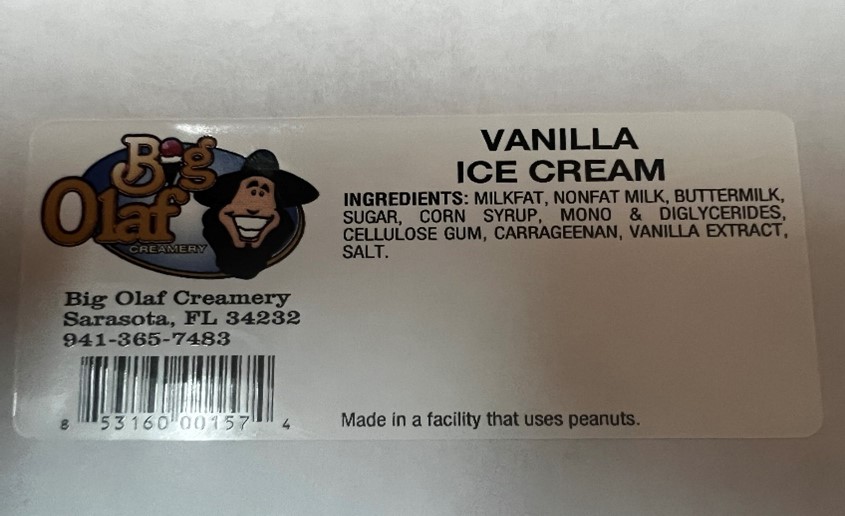
The FDA, along with CDC, is assisting the Florida Department of Health (FL DOH) and Florida Department of Agriculture & Consumer Services (FDACS) in investigating an outbreak of Listeria monocytogenes infections linked to ice cream supplied by Big Olaf Creamery of Sarasota, Florida. As of August 2, 2022, CDC reports 25 illnesses in 11 states.

This is an ongoing investigation, and the FDA is continuing to work with the FL DOH and FDACS to investigate. FDA will update this advisory should additional consumer safety information become available.

Recommendation

Consumers, restaurants, and retailers should not eat, sell, or serve any recalled Big Olaf ice cream products and should throw the product away, regardless of the “Best By” or expiration date.

Listeria is most likely to sicken pregnant people and their newborns, adults aged 65 or older, and people with weakened immune systems. Other people can be infected with Listeria, but they rarely become seriously ill.

Call your healthcare provider right away if you have these symptoms after eating Big Olaf ice cream products:

  • Pregnant people typically experience only fever, fatigue, and muscle aches. However, Listeria infection during pregnancy can lead to miscarriage, stillbirth, premature delivery, or life-threatening infection of the newborn.
  • People who are not pregnant may experience headache, stiff neck, confusion, loss of balance, and convulsions, in addition to fever and muscle aches.

Consumers, restaurants, and retailers who purchased or received any recalled Big Olaf ice cream products should throw the products away, follow FDA’s safe handling and cleaning advice and use extra vigilance in cleaning and sanitizing any surfaces and containers that may have come in contact with these products to reduce the risk of cross-contamination. Listeria can survive in refrigerated temperatures and can easily spread to other foods and surfaces.

Product Images

Big Olaf Ice Cream Product Image

The Big Olaf brand ice cream was sold to consumers in plastic pint size containers, plastic ½ gallon containers, and plastic 2.5-gallon tubs, scoopable are sold to the independent retail stores. All flavors, lots, codes, and all expiration dates through 6/30/2022 are included in this recall.

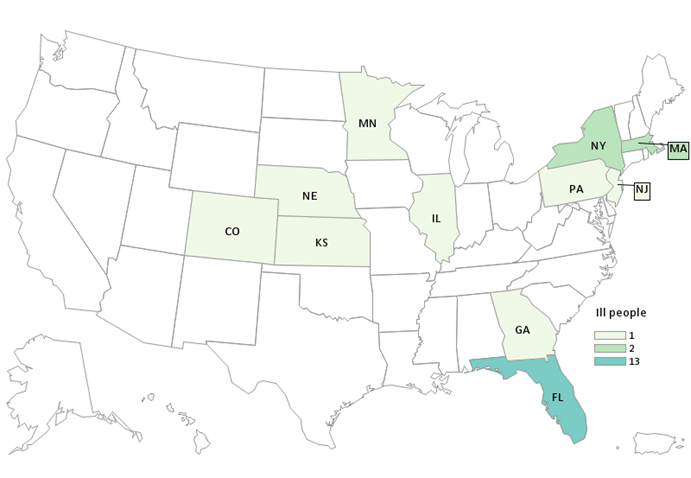
Case Count Map Provided by CDC

Outbreak Investigation of Listeria Monocytogenes in Florida-Based Big Olaf Ice Cream (July 2022) - CDC Case Count Map as of August 4, 2022

Map of U.S. Distribution of Recalled Big Olaf’s Ice Cream Products

Outbreak Investigation of Listeria Monocytogenes from Florida-Based Ice Cream - Map of U.S. Distribution of Recalled Ice Cream (July 13, 2022)

Case Counts

Total Illnesses: 25
Hospitalizations: 24
Deaths: 1
Fetal Loss: 1
Last illness onset: 6/24/2022
States with Cases: CO (1), FL (13), GA (1), IL (1), KS (1), NE (1), MA (2), MN (1), NJ (1), NY (2), PA (1)
Product Distribution*: FL, OH
*Distribution has been confirmed for states listed, but product could have been distributed further, reaching additional states

USA – FDA Core Table – Investigations of Foodborne Illness Outbreaks

FDA

What’s New

  • For the Cyclospora outbreak in an unidentified vehicle (ref# 1084), the number of cases has increased from 51 to 60 and sample collection and analysis has been initiated.
  • A new outbreak has been added to the table: Cyclospora in a not yet identified food (ref #1080). Traceback has been initiated.
  • For the Salmonella Paratyphi B var. L(+) tartrate+ outbreak (ref# 1072) in a not identified food, FDA’s investigation status is now closed.
  • For the Listeria monocytogenes outbreak (ref# 1070) in a not identified food, the outbreak status has ended and FDA’s investigation status is now closed.
  • For the Salmonella Braenderup outbreak (ref #1075), the number of cases has increased from 70 to 74.
Date
Posted
Ref Pathogen or
Cause of Illness

Product(s)
Linked to
Illnesses

(if any)
Total
Case Count

Status
8/3/

2022

1080 Cyclospora Not Yet Identified 6 Active
7/27/

2022

1084 Cyclospora Not Yet Identified 60 Active
6/29/

2022

1076 Not Yet Identified Frozen Food See Outbreak
Advisory
Active
6/22/

2022

1075 Salmonella
Braenderup
Not Yet Identified 74 Active
6/22/

2022

1072 Salmonella
Paratyphi B var. L(+) tartrate+
Not Identified 14 Closed
6/15/

2022

1070 Listeria
monocytogenes
Not Identified 12 Closed
6/8/

2022

1068 E. coli
O157:H7
Not Identified 10 Closed
6/1/

2022

1066 Hepatitis A Virus Strawberries See Outbreak
Advisory
Active
5/25/

2022

1067 Salmonella 
Senftenberg
Peanut Butter See Outbreak Advisory Closed
4/20/

2022

1064 Not Yet
Identified
Dry Cereal 558 adverse
event reports
Active
4/13/

2022

1057 Listeria
monocytogenes
Ice Cream See Outbreak Advisory Active
3/30/

2022

1060 None
Identified
Meal Replacement
Drink
6 adverse
event reports
Closed
3/16/

2022

1055 Salmonella
Saintpaul
Not Identified 60 Closed
2/17/

2022

1056 Cronobacter
sakazakii
Powdered
Infant
Formula
See
Advisory
Active (IMG)
2/9/

2022

1040 Listeria
monocytogenes
Not Identified 20 Closed
2/2/

2022

1054 Enteroinvasive
E. coli
O143:H26
Not
Identified
16 Closed
1/10/

2022

1050 E. coli
O121:H19
Romaine 4 Closed

China – Research – Vital Surveillances: Epidemiological Analysis of Foodborne Botulism Outbreaks — China, 2004–2020

China CDC

kswfoodworld

Abstract

IntroductionFoodborne botulism is a rare, potentially fatal illness resulting from the ingestion of foods contaminated with preformed botulinum neurotoxin types A, B, E, or F, produced by Clostridium botulinum. The descriptive epidemiology of foodborne botulism outbreaks in China during 2004−2020 was performed to inform public health response strategies.

Results

During 2004−2020, a total of 80 foodborne botulism outbreaks occurred in China, involving 386 illnesses and 55 deaths; most outbreaks were reported between June and August, with a sharp peak in January; 22 out of 31 PLADs reported foodborne botulism outbreaks, Xinjiang reported the largest number of outbreaks (20), followed by Qinghai (13); the most commonly implicated food was home-prepared traditional processed stinky tofu and dried beef, accounting for 51.25% events. Improper processing and improper storage in contributing factors accounted for 77.50% outbreaks. Initial misdiagnosis occurred in 27.50% of cases.

Conclusions

Outbreaks of foodborne botulism had a high case-fatality rate. Targeted food safety and popularization education to farmers and herdsmen in Xinjiang and Qinghai related to botulism prevention should be carried out, and timely outbreak investigation and hospital surge capacity should be improved.