Category Archives: Food Toxin

Denmark – Deadly E. coli O157 outbreak sickens 13 in Denmark

Food Safety News

Officials in Denmark are investigating a deadly outbreak of Shiga toxin-producing E. coli (STEC) O157 that has affected more than a dozen people.

The outbreak began in December 2021 and includes 13 patients with a possible common source of infection, said the Statens Serum Institut (SSI). Nine people have been hospitalized and an elderly patient has died.

Since early December, 13 patients have been detected and samples from nine of those sick are closely related after an analysis by whole genome sequencing at the Statens Serum Institut. This means they were likely infected by a common source.

Canada – Moncton Fish Market brand “La” Stimpson’s Surf Clams recalled due to potential presence of Clostridium botulinum

CFIA

Summary

Product
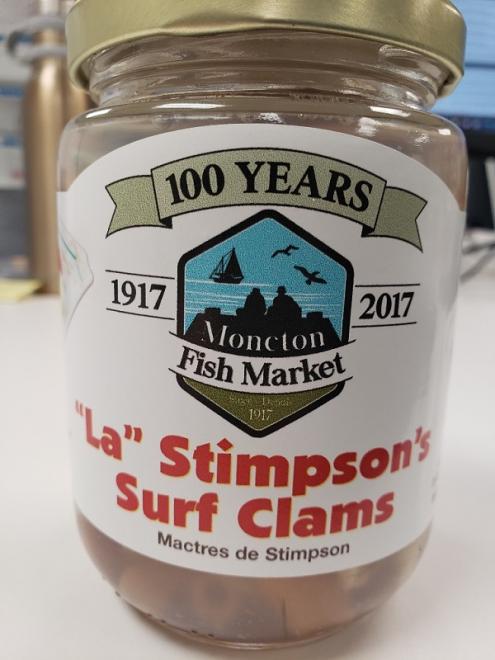
“La” Stimpson’s Surf Clams
Issue
Food » Microbial Contamination » Clostridium botulinum
What to do

Do not consume the recalled product

Moncton Fish Market brand "La" Stimpson's Surf Clams – 153 grams

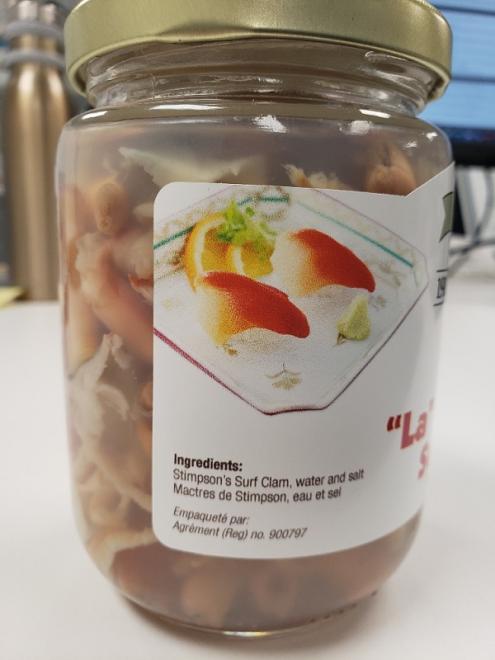
Moncton Fish Market brand "La" Stimpson's Surf Clams – 153 grams – ingredients

Issue

Moncton Fish Market Ltd. is recalling Moncton Fish Market brand “La” Stimpson’s Surf Clams that have been sold unrefrigerated from the marketplace because the product may permit the growth of Clostridium botulinum.

The recalled product has been sold at Moncton Fish Market, Moncton, New Brunswick.

What you should do

  • If you think you became sick from consuming a recalled product, call your doctor
  • Check to see if you have the recalled product in your home
  • Do not consume the recalled product
  • Recalled products should be thrown out or returned to the location where they were purchased

Food contaminated with Clostridium botulinum toxin may not look or smell spoiled but can still make you sick. Symptoms in adults can include facial paralysis or loss of facial expression, unreactive or fixed pupils, difficulty swallowing, drooping eyelids, blurred or double vision, difficulty speaking, including slurred speech, and a change in sound of voice, including hoarseness. Symptoms of foodborne botulism in children can include difficulty swallowing, slurred speech, generalized weakness and paralysis. In all cases, botulism does not cause a fever. In severe cases of illness, people may die.

Belgium – QUESO IBERICO of the ALBERT HEIJN brand – Listeria monocytogenes and STEC E.coli

AFSCA

Recall of Albert Heijn
Product: QUESO IBERICO of the ALBERT HEIJN brand (with DDM 5-01-2022, 6-01-2022, 7-01-2022, 8-01-2022, 12-01-2022 ).
Problem: possible presence of Listeria monocytogenes and E.coli

In agreement with the AFSCA, Albert Heijn withdraws from sale the product ‘AH queso iberico’ (with DDM 5-01-2022, 6-01-2022, 7-01-2022, 8-01-2022, 12-01 -2022) and reminds consumers.

A presence of Listeria monocytogenes and E.coli is possible in this product. Its consumption can therefore present a health risk, in particular for young children, the elderly, people with weakened immune systems and pregnant women.

Albert Heijn asks his customers not to consume this product and to return it to the point of sale where it was purchased. The product will be refunded or exchanged there. Please contact a doctor if you have any health problem.

Product description

– Product category: cheese
– Product name: AH QUESO IBERICO
– Brand: ALBERT HEIJN
– Dates of minimum durability (DDM): 5-01-2022, 6-01-2022, 7-01-2022, 8 -01-2022, 12-01-2022
– Type of packaging: plastic packaging
– Sales period: until 06-01-2022 (included)
– Weight: 118 g

For any further information , please contact Albert Heijn on 0800 777 05.

Netherlands – Safety warning Queso Iberico from Albert Heijn – STEC E.coli – Listeria monocytogenes

NVWA

Albert Heijn is removing Queso Iberico cheese from the stores. The product contains increased numbers of E. coli which may belong to the pathogenic STEC bacteria. Listeria monocytogenes may be present in some products. Eating the cheese can be a health hazard, especially for young children, the elderly, people with weakened immune systems and pregnant women.

Albert Heijn Website

USA – Interstate Meat Dist. Inc., Recalls Ground Beef Products Due To Possible E. Coli O157:H7 Contamination

FSIS USDA

WASHINGTON, Jan. 6, 2022 – Interstate Meat Dist. Inc., a Clackamas, Ore., establishment, is recalling approximately 28,356 pounds of ground beef products that may be contaminated with E. coli O157:H7, the U.S. Department of Agriculture’s Food Safety and Inspection Service (FSIS) announced today.

The raw, ground beef items were produced on Dec. 20, 2021. The products subject to recall and the labels can be viewed here.

The products subject to recall bear establishment number “EST. 965” inside the USDA mark of inspection or printed next to the time stamp and use or freeze by date. These items were shipped to retail locations in Arizona, California, Nevada, Oregon, Utah, Washington and Wyoming.

The issue was reported to FSIS after a retail package of ground beef was purchased and submitted to a third-party laboratory for microbiological analysis and the sample tested positive for E. coli O157:H7.  FSIS conducted an assessment of the third-party laboratory’s accreditation and methodologies and determined the results were actionable.

Anyone concerned about an illness should contact a healthcare provider. E. coli O157:H7 is a potentially deadly bacterium that can cause dehydration, bloody diarrhea and abdominal cramps 2–8 days (3–4 days, on average) after exposure the organism. While most people recover within a week, some develop a type of kidney failure called hemolytic uremic syndrome (HUS). This condition can occur among persons of any age but is most common in children under 5-years old and older adults. It is marked by easy bruising, pallor, and decreased urine output. Persons who experience these symptoms should seek emergency medical care immediately.

FSIS is concerned that some product may be in consumers’ refrigerators or freezers. Consumers who have purchased these products are urged not to consume them. These products should be thrown away or returned to the place of purchase.

FSIS routinely conducts recall effectiveness checks to verify recalling firms notify their customers of the recall and that steps are taken to make certain that the product is no longer available to consumers. When available, the retail distribution list(s) will be posted on the FSIS website at www.fsis.usda.gov/recalls.

FSIS advises all consumers to safely prepare their raw meat products, including fresh and frozen, and only consume ground beef that has been cooked to a temperature of 160 °F. The only way to confirm that ground beef is cooked to a temperature high enough to kill harmful bacteria is to use a food thermometer that measures internal temperature, https://www.fsis.usda.gov/safetempchart.

Consumers and members of the media with questions about the recall can contact Sales Manager Mike Sinner and Quality Assurance Manager Rodolfo Mendoza, Interstate Meat Dist., Inc., at (503) 656-6168.

Click to access recall-001-2022-labels.pdf

USA – Outbreak Investigation of E. Coli O157:H7 – Spinach (November 2021) – FDA’s investigation is complete. CDC declares outbreak over.

FDA

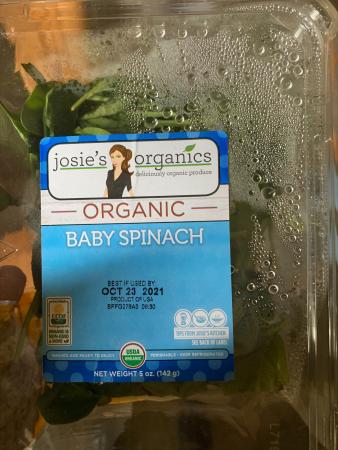
Outbreak Investigation of E. Coli O157:H7 in Spinach (November 2021): Sample Image of Josie's Organics Baby Spinach

The FDA and CDC, in collaboration with state and local partners, investigated illnesses in a multistate outbreak of E. coli O157:H7. As of January 6, 2022, CDC declared this outbreak over.

FDA traced the supply chain for this positive product sample and deployed investigators to three farms in two separate states: California and Oregon. FDA conducted inspections, including sample collection and analysis, but inspections were limited because at the time the fields were fallow and no production activities were being conducted for spinach at any of the three farms. All samples collected were reported negative and no source or direct routes of contamination to the suspected spinach were found during the inspections. Investigators did report that one location processes product and sometimes uses product from multiple growers in one production run. This type of product co-mingling is not uncommon; but continues to present challenges for traceback investigations of foodborne outbreaks.

Recommendation

CDC announced the outbreak is over. There are no recommendations for consumers, retailers, or suppliers.


Case Count Map Provided by CDC

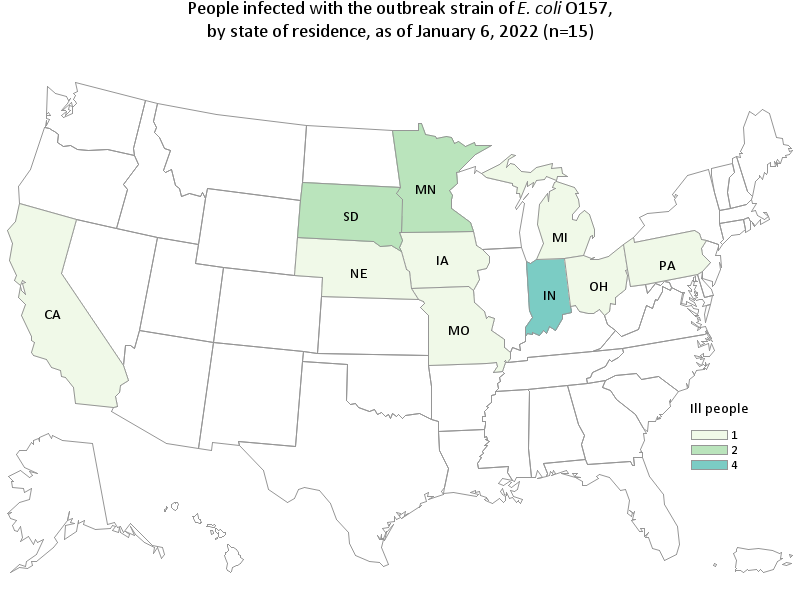
Outbreak Investigation of E. Coli O157:H7 in Spinach: Case Count Map Provided by CDC (January 6, 2022)

Case Counts

Total Illnesses: 15
Hospitalizations: 4
Deaths: 0
Last Illness Onset: November 8, 2021
States with Cases: CA (1), IA (1), IN (4), MI (1), MN (2), MO (1), NE (1), OH (1), PA (1) SD (2)

USA – Outbreak Investigation of E. coli O157:H7: Power Greens Packaged Salad (January 2022)

FDA

The FDA and CDC, in collaboration with state and local partners, are investigating illnesses in a multistate outbreak of E. coli O157:H7. According to the CDC, as of January 6, 2022, 10 people infected with the outbreak strain of E. coli O157:H7 have been reported from four states. Consumer purchase data indicate that seven people purchased Nature’s Basket Power Greens or Simple Truth Organic Power Greens at grocery stores before becoming sick. Based on those purchase dates, the latest “best if used by” date is estimated to be December 20, 2021. These two salad blends consist of organic spinach, mizuna, kale, and chard; both brands were manufactured by the same processor.

FDA has initiated a traceback investigation on the products of interest. To date, no single production code has been identified by the traceback. For the estimated production code range that may have been available for purchase to ill consumers, records collected indicate that leafy greens used in these products were sourced from Salinas and Imperial Valley, CA, and Yuma, AZ. FDA continues to evaluate the available information to determine if a single source, such as a farm or ranch, can be identified. Some challenges encountered in this traceback are those often seen in tracing back leafy greens. These include multiple consumer purchases of the same product on different days, lack of product lot codes tracked to retail stores from distribution centers, and the inability to directly link product lot codes to consumer purchase data. Additionally, the range of possible production dates falls into the harvest transition period from central and northern CA to southern CA and AZ growing regions, and as this product has multiple components, some production days of the product include ingredients co-mingled from multiple growing regions.

At this time, the available evidence does not indicate that there are implicated products currently on the market. FDA and state partners are continuing to work with firms of interest to determine if there are additional or unexpired products that could potentially be affected. This is an ongoing investigation and additional information will be provided as it becomes available.

Recommendation

Although this product is past expiration and should no longer be available for purchase, if consumers froze Nature’s Basket or Simple Truth Power Greens salad blend with a “Best if Used By” date through December 20, 2021, they should discard it.


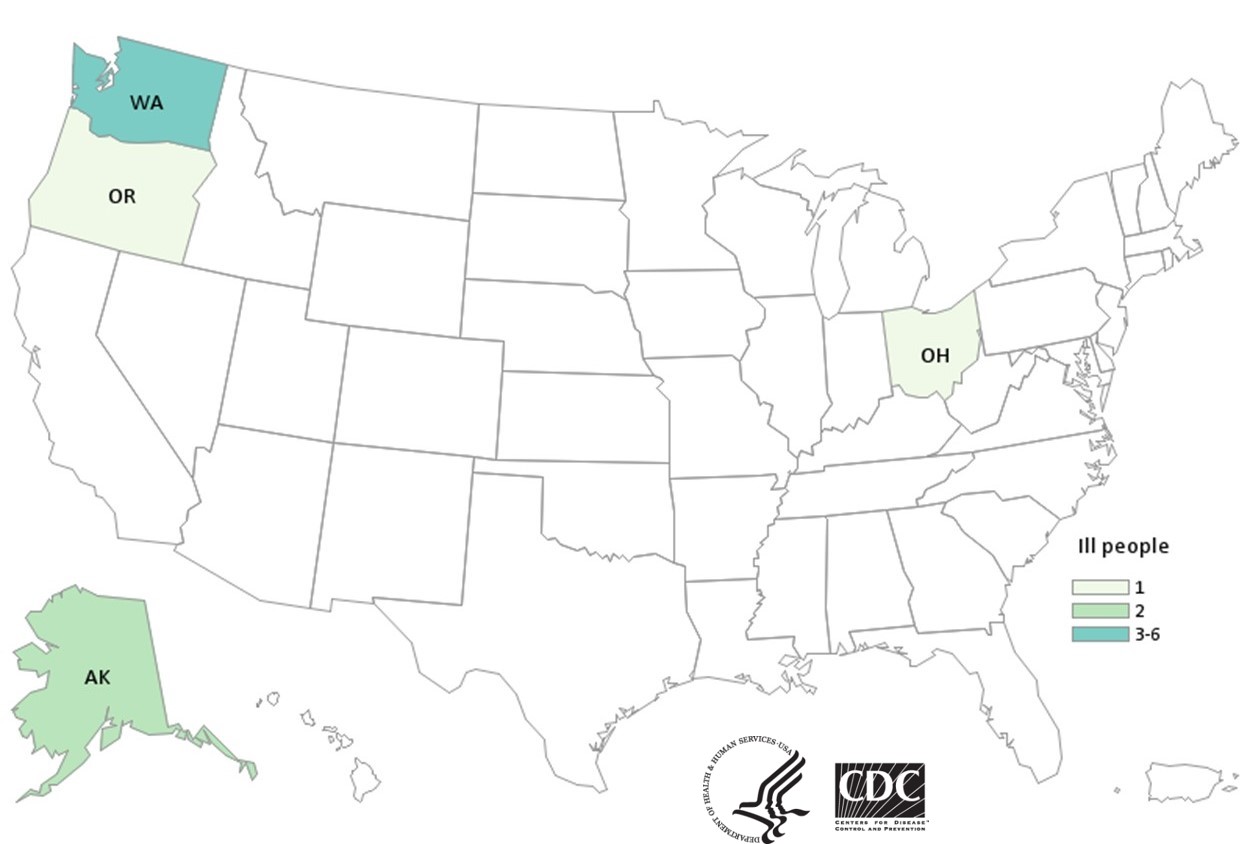
Case Count Map Provided by CDC

Outbreak Investigation of E. coli O157:H7: Packaged Salad - CDC Case Count Map (January 6, 2022)

Case Counts

Total Illnesses: 10
Hospitalizations: 4
Deaths: 0
Last Illness Onset: December 19, 2021
States with Cases: AK (2), OH (1), OR (1), WA (6)

RASFF Alert – Diarrhoeic Shellfish Poisoning (DSP) – Live Mussels

RASFF

Diarrhoeic Shellfish Poisoning (DSP) toxins (161 µg/kg – ppb) in live mussels (Mytilus galloprovincialis) from Italy in Spain

RASFF Alert – Mycotoxin – Ochratoxin A – Whole Meal Rye Flour – Ground Roasted Coffee

RASFF

Ochratoxin A (8.2 µg/kg – ppb) in wholemeal rye flour (type 2000) from Poland in Ireland and Poland

RASFF

Ochratoxin in ground roasted coffee blend from Italy in Slovenia

RASFF Alerts – Aflatoxin – Dried Figs – Groundnuts – Peanuts- Pistachios

RASFF

Aflatoxins in dried figs from Turkey in Germany

RASFF

Aflatoxins in shelled groundnuts from the United States in the Netherlands

RASFF

Aflatoxins (B1 = 330; Tot. = 540 µg/kg – ppb) in dried figs from Turkey in France

RASFF

Aflatoxins (B1 = 16.1; Tot. = 17.9 µg/kg – ppb) in dried figs from Turkey in France

RASFF

Aflatoxins (Tot. = 8.9 µg/kg – ppb) in peanuts in shell from China in Italy

RASFF

Aflatoxins (B1 = 21; Tot. = 23 µg/kg – ppb) in pistachios in shell from Iran in France

RASFF

Aflatoxins (B1 = 39; Tot. = 41 µg/kg – ppb) in shelled pistachios from Turkey in Germany and Italy

RASFF

Aflatoxin B1 in Bolivian organic groundnuts in the Netherlands and Spain

RASFF

Aflatoxins (B1 = 20.8; Tot. = 29.5 µg/kg – ppb) in dried figs from Turkey, via Bosnia and Herzegovina in Croatia