Category Archives: Food Microbiology Research

Germany -Officials admit failures in German Listeria outbreak

Food Safety News

Officials in a German district have apologized for mistakes made as part of an investigation into a Listeria outbreak in which one person died.

Four people were infected between October 2021 and January this year but the person died with, not because of, listeriosis. Contaminated cucumbers from one company have been linked to the illnesses.

Thomas Will, Groß-Gerau district administrator and Walter Astheimer, district health officer, said in the past two and a half years, there have been significant gaps in food controls and this had been a big mistake with hygiene deficiencies overlooked.

“We deeply regret that food contaminated with Listeria could come into circulation and several people fell ill because a company in Gernsheim was not properly checked for two years,” they said.

The company should have been checked more often but inspections were running behind because of the COVID-19 pandemic and a lack of staff resources.

USA – Alaska has among the nation’s highest rates of paralytic shellfish poisoning, but reported incidents are declining

ADN

Over the last decade, Alaska has reported fewer cases of a serious condition caused by consuming contaminated shellfish than in previous years.

But health officials say Alaskans who self-harvest shellfish should still be aware of the risks of paralytic shellfish poisoning.

Katherine Newell, an Epidemic Intelligence Service officer with the Centers for Disease Control and Prevention who is assigned to Alaska’s Division of Public Health, helped put together a new state report tracking cases of PSP in Alaska between 1993 and 2021.

There have been 132 reports of the poisoning in Alaska during that time, including five fatal cases. About 25% of those cases occurred in or near Kodiak, 20% were in Juneau and 14% occurred in Ketchikan, the report found.

The condition, also known as PSP, is a foodborne illness caused by neurotoxins known as saxitoxins, which are produced by harmful algal blooms that shellfish sometimes take into their systems while filter feeding, Newell explained.

When a human ingests the contaminated shellfish, it can be “pretty serious, and sometimes fatal,” Newell said. “It’s a reportable condition in Alaska because of how serious it is.”

EU – 19 April update: Monophasic Salmonella Typhimurium outbreak

ECDC

As of 19 April 2022, an outbreak of 187 confirmed and probable cases of monophasic S. Typhimurium (cluster 1) has been identified in the EU/EEA and the United Kingdom.

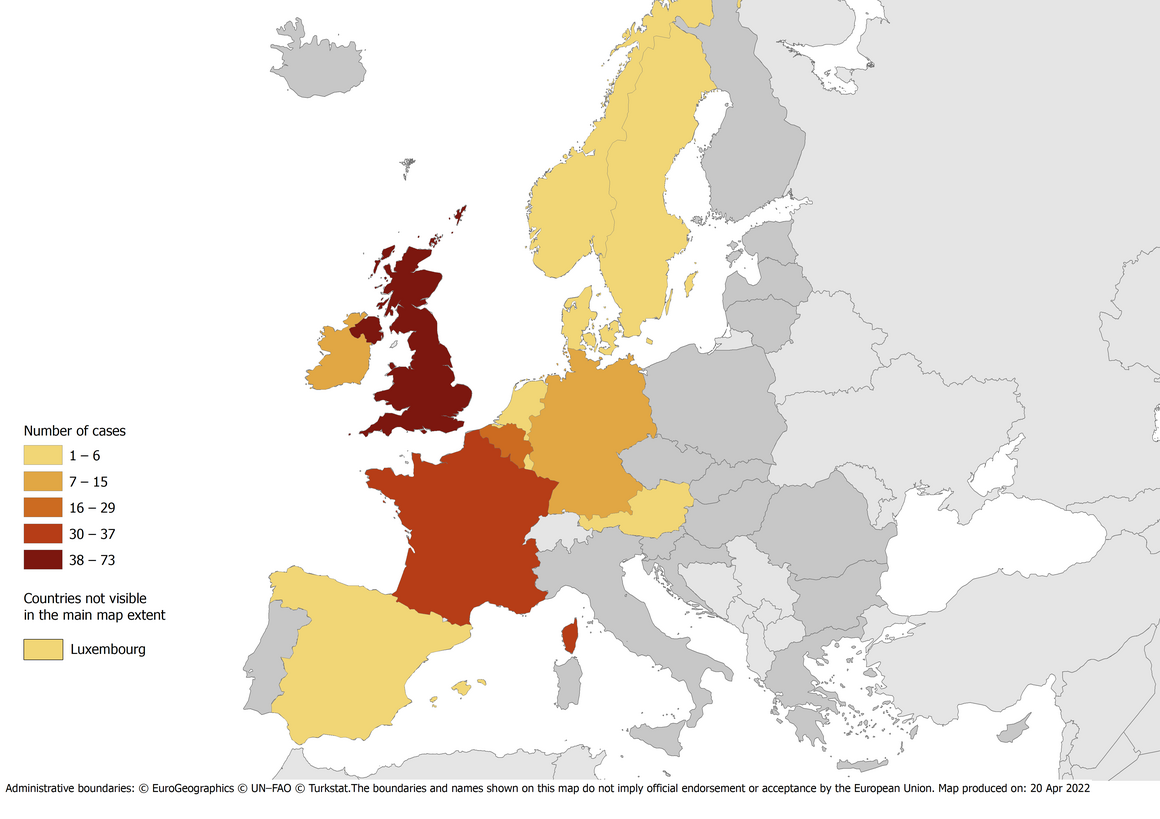
Number of confirmed and probable cases* with monophasic S. Typhimurium infection by country, EU/EEA and the UK, as of 19 April 2022

The outbreak is characterised by an unusually high proportion of children being hospitalised, some with severe clinical symptoms such as bloody diarrhoea. Based on interviews with patients and initial analytical epidemiological studies, specific chocolate products have been identified as the likely route of infection. Affected cases have been identified through advanced molecular typing techniques. As this method of testing is not routinely performed in all countries, some cases may be undetected.

Product recalls have been launched globally and examples of these can be found on several countries web sites including BelgiumFranceGermanyIrelandLuxembourgNetherlandsNorway, and the UK. The recalls aim to prevent the consumption of products potentially contaminated with Salmonella. Further investigations are being conducted by public health and food safety authorities in countries where cases are reported, to identify the cause and the extent of the contamination, and to ensure contaminated products are not put on the market.

ECDC and EFSA published a rapid outbreak assessment on 12 April 2022. The second strain of monophasic S. Typhimurium in non-human samples (cluster 2), which is mentioned in the published ROA, was found matching with 23 human cases from Belgium (n=5), France (n=5), Germany (n=4), Ireland (n=1), the Netherlands (n=1), and the UK (n=7).

Questions regarding ongoing product recalls should be addressed to national food safety authorities.

Number of confirmed and probable cases* with monophasic S. Typhimurium infection (cluster 1) by country, EU/EEA and the UK, as of 19 April 2022

Country Confirmed cases Probable cases Total cases
Austria 5 1 6
Belgium 7 22 29
Denmark 1 0 1
France 37 0 37
Germany 11 3 14
Ireland 15 0 15
Luxembourg 1 1 2
Netherlands 2 0 2
Norway 1 0 1
Spain 1 2 3
Sweden 4 0 4
Total EU/EEA 85 29 114
United Kingdom 73 0 73
Total 158 29 187

*According to the European outbreak case definition

Research – Observational Study of the Impact of a Food Safety Intervention on Consumer Poultry Washing

Journal of Food Protection

This study was conducted to test the effectiveness of a consumer poultry washing educational intervention that included video observation of meal preparation with participants who self-reported washing poultry. Treatment group participants received three e-mail messages containing information that the U.S. Department of Agriculture has used on social media sites (video and infographics) related to poultry preparation, including advising against washing chicken. Participants were observed cooking chicken thighs (inoculated with traceable nonpathogenic Escherichia coli strain DH5α) and preparing a salad to determine whether they washed the chicken and the extent of cross-contamination to the salad and areas of the kitchen. After meal preparation, participants responded to an interview about food handling behaviors, including questions about the intervention for treatment group participants. Three hundred people participated in the study (158 control, 142 treatment). The intervention effectively encouraged participants not to wash chicken before cooking; 93% of treatment group participants but only 39% of control group participants did not wash the chicken (P < 0.0001). The high levels of E. coli DH5α detected in the sink and on the salad lettuce suggest that microbes transferred to the sink from the chicken, packaging, or contaminated hands are a larger cause for concern than is splashing contaminated chicken fluids onto the counter. Among chicken washers, 26 and 30% of the lettuce from the prepared salad was contaminated for the control and treatment groups, respectively. For nonwashers, 31 and 15% of the lettuce was contaminated for the control and treatment groups, respectively. Hand-facilitated cross-contamination is suspected to be a factor in explaining this resulting lettuce cross-contamination. This study demonstrates the need to change the frame of “don’t wash your poultry” messaging to instead focus on preventing contamination of sinks and continuing to emphasize the importance of hand washing and cleaning and sanitizing surfaces.

HIGHLIGHTS
  • The intervention was effective for convincing participants to not wash chicken before cooking.
  • High levels of the bacterial tracer were detected in the sink and on the salad lettuce.
  • Messaging should focus on hand washing and cleaning and sanitizing surfaces.

Research – Innovative Antibiofilm Smart Surface against Legionella for Water Systems

MDPI

Legionella pneumophila contamination of water systems is a crucial issue for public health. The pathogen is able to persist in water as free-living planktonic bacteria or to grow within biofilms that adhere to and clog filters and pipes in a water system, reducing its lifespan and, in the case of hospital buildings, increasing the risk of nosocomial infections. The implementation of water management is considered to be the main prevention measure and can be achieved from the optimization of water system architecture, notably introducing new materials and strategies to contrast Legionella biofilm proliferation and so prolong the water system functionality. In this research, we propose a new smart surface against L. pneumophila biofilm formation. This is based on an innovative type of coating consisting of a sulfonated pentablock copolymer (s-PBC, commercially named Nexar™) deposited on top of a polypropylene (PP) coupon in a sandwich filter model. The covering of PP with s-PBC results in a more hydrophilic, acid, and negatively charged surface that induces microbial physiological inhibition thereby preventing adhesion and/or proliferation attempts of L. pneumophila prior to the biofilm formation. The antibiofilm property has been investigated by a Zone of Inhibition test and an in vitro biofilm formation analysis. Filtration tests have been performed as representative of possible applications for s-PBC coating. Results are reported and discussed.

Research – Effect of Pulsed Light on Quality of Shelled Walnuts

MDPI

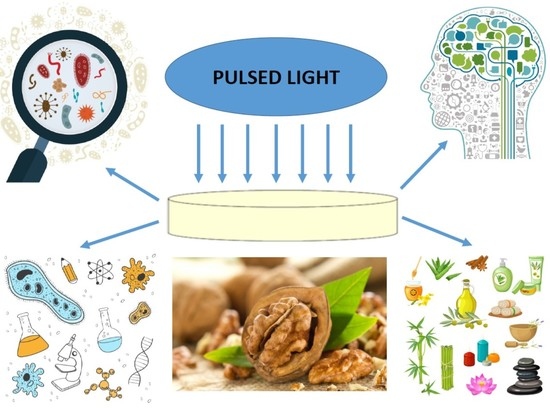
Shelled walnuts are considered a microbiologically low-risk food but have been linked to some outbreaks, and a treatment aiming to decrease this risk is desirable. Pulsed light (PL) may be an alternative, providing it does not seriously impair their quality. This work assessed the impact of PL on some quality attributes of walnuts. To do this, measurements of rancidity, volatiles, total phenols, antioxidant activity, and descriptive sensory analysis were carried out on untreated and PL (43 J/cm2)-treated kernels. PL had no statistically significant (p > 0.05) effects on TBARS, peroxide value, total phenols, and antioxidant activity but significantly increased the concentration of volatiles related to green/herbaceous odors and decreased compounds related to fruity and citrus odors. The descriptors nut overall, walnut odor and flavor, and aftertaste were given statistically significantly (p < 0.05) higher scores, while descriptors woody odor and sweet received lower scores; 16 other traits such as all those related to color, texture, and rancidity were unaffected. No significant (p > 0.05) effects on total phenols and antioxidant activity in general were observed during the course of PL treatment. It can be concluded that PL technology may be used in shelled walnuts with only mild effects on their quality; a storage study must be carried out in order to determine the effect of PL treatment on its shelf-life. View Full-Text

Research – Fall Seasonal Effects Connected to E. coli Outbreaks in Bagged Romaine

USDA

Agricultural Research Service scientists have begun to uncover details underlying a pattern of seasonal E. coli O157:H7 outbreaks linked to bagged romaine lettuce.

That E. coli O157:H7 infection outbreaks connected to romaine are more frequently associated with lettuce commercially grown and harvested at the end of the growing seasons in California and Arizona has been recognized for several years. Although contamination of lettuce products is rare, between 1998 and 2019, 36 outbreaks that traced back to lettuce were recorded by the Centers for Disease Control and Prevention. Most of these outbreaks involved romaine lettuce harvested in the fall on the California Central Coast such as in Salinas, and in late winter in Southern California and Arizona. These two states are the major lettuce growing areas in the United States with farm production valued at nearly $2.7 billion in 2021.

“To begin unravelling the causes of these seasonal outbreaks, our research team looked at various factors to identify conditions that may increase E. coli survival on fresh-cut lettuce that we grew in Salinas, and processed and cold-stored in modified atmosphere packaging as is done commercially,” said ARS microbiologist Maria Brandl, with the Produce Safety and Microbiology Research Unit of the ARS Western Regional Research Center in Albany, California, and leader of the study.

One of the most significant findings of this study is that E. coli survived on average 5.6 times better in cold-stored packaged romaine harvested in the fall than on the same varieties harvested in late spring.

Romaine lettuce

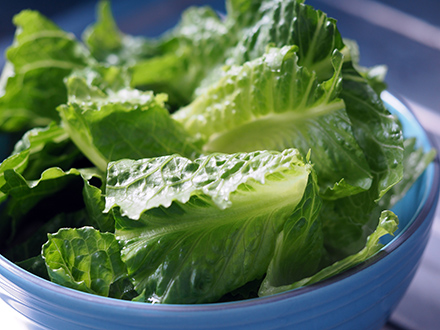
ARS scientists have begun to unravel details that may underly a pattern of fall E. coli O157:H7 outbreaks linked to bagged romaine lettuce. (Photo courtesy of Getty Images)

“We also found that among romaine varieties with longer and shorter shelf life in this study, the deterioration rate of the variety with long shelf life was significantly greater when harvested in the fall than in spring. I have observed this in previous studies as well but the significance to E. coli on lettuce had not been tested. Here we showed that greater deterioration in the fall lettuce was associated with better pathogen survival,” explained study co-author ARS geneticist Ivan Simko, with the Crop Improvement and Protection Research Unit in Salinas, California.

In addition, the research team, which included biologist Susan Leonard and others at the U.S. Food and Drug Administration, demonstrated that the bacterial community present on bagged romaine differed by season, lettuce deterioration state, and whether survival of E. coli on the lettuce was high or low. This suggests a potential for using the microbiome as an indicator of the microbial quality of fresh-cut bagged lettuce.

The researchers were a little surprised to find such differences in E. coli survival in fall harvested-lettuces compared to spring-harvested ones because many current hypotheses about the seasonality of outbreaks linked to lettuce focus on differences in the prevalence of the E. coli pathogen in the environment.

“While prevalence may also be involved, our results strongly indicate that fall-harvested romaine and the microbe communities it harbors have intrinsic characteristics that make them a better place for E. coli to survive in fresh-cut product. These are the next areas we want to work on. For example, is this something we could try to manipulate in the long run through plant physiology and breeding, and microbiome engineering? And would this trend also be observed for E. coli survival in the field? Our observations definitely open an entire new branch of inquiry about outbreak seasonality,” Brandl said.

Research – New NARMS report shows rising resistance in Salmonella, Campylobacter

CIDRAP

The latest data from a national surveillance system that monitors foodborne bacterial pathogens for antimicrobial resistance (AMR) shows some concerning changes in resistance patterns among serotypes of Salmonella.

The findings come from the National Antimicrobial Resistance Monitoring Systems (NARMS) 2019 Integrated Summary, which combines data from the Centers for Disease Control and Prevention (CDC), the Food and Drug Administration (FDA), and the US Department of Agriculture (USDA). The report provides a snapshot of resistance patterns found in bacteria isolated from humans, animals, raw meats from retail outlets (chicken, ground turkey, ground beef, and pork chops), and meat and poultry product samples collected at slaughtering facilities.

In addition to Salmonella, which causes an estimated 1.35 million illnesses and 26,500 hospitalizations each year, the NARMS report also includes resistance data on Campylobacter (1.5 million illnesses and 19,500 hospitalizations), Escherichia coli, and Enterococcus. NARMS monitors these bacteria to detect emerging resistance patterns to the antibiotics that are most important to human medicine, multidrug resistance, and specific resistance genes.

Increase in multidrug-resistant Salmonella serotype

Overall, the NARMS report shows that more than three fourths of the Salmonella isolates (78%) from humans were not resistant to any of the antibiotics tested, and that the overall level of resistance in humans remains relatively unchanged since 2018. However, the report also found rising resistance to ciprofloxacin—one of the three antibiotics used to treat severe Salmonella infections.

From 2018 to 2019, Salmonella with decreased susceptibility to ciprofloxacin increased from 9% to 11% in humans, from 18% to 31% in retail chicken, from 20% to 30% in chicken product samples, from 26% to 32% in chicken cecal content samples, and from 0% to 14% in retail pork samples.

The increase in resistance to ciprofloxacin among poultry isolates was primarily due to the increase in Salmonella Infantis, a multidrug-resistant (MDR) serotype that emerged in 2014.

The rise in Salmonella Infantis isolates was also behind an increase in MDR isolates found in retail chicken (from 20% to 32%) and in chicken product samples (22% to 29%). Up to 10 antimicrobial resistance (AMR) genes were found in some of the Salmonella Infantis isolates.

In addition, the NARMS report shows an increase in another MDR Salmonella serotype, I 4,[5],12:i:-, which is linked to pigs and has become an increasing public health concern in Europe and the United States. The percentage of MDR isolates from humans that are of the I 4,[5],12:i:- serotype rose from 7% in 2010 to 26% in 2019, and from 7% to 35% in swine samples.

NARMS data also show rising fluoroquinolone resistance in Campylobacter isolates. In humans, the proportion of ciprofloxacin-resistant Campylobacter isolates rose from 29% in 2018 to 34% in 2019 for Campylobacter jejuni and from 41% to 45% in C coli. Ciprofloxacin-resistant C jejuni isolated from chicken cecal contents (21% in 2018 to 26% in 2019) and chicken retail samples (20% to 22%) also rose.

Analysis of E coli isolates found increases in ceftriaxone resistance in sow cecal samples (3% in 2018 to 7% in 2019) and in retail pork (4% to 7%). Whole-genome sequencing of Salmonella and E coli from animals, animal products, and retail meats found that none harbored any of the MCR-1 through MCR-8 colistin-resistance genes.

USA/Canada – Norovirus Outbreak Linked to Raw Oysters from British Columbia

CDC

Fast Facts
Illnesses: 103 illnesses* have been reported as of April 6, 2022

States affected: CA, CO, FL, HI, IL, MA, MN, NJ, NV, NY, OR, TX and WA

Recall: No

Investigation Status: Active

*This number is an estimate based on the information we have at this time. CDC is working with state and local partners to determine a more accurate number of illnesses in this outbreak and will update this number as more information is gathered.

CDC is working with the U.S. Food and Drug Administration (FDA) state, and local officials, and with Canadian public health authorities to investigate a multistate norovirus outbreak linked to raw oysters from British Columbia, Canada.

As of April 6, 2022, at least 103 norovirus illnesses have been reported from 13 states: CDC is working with state and local partners to determine a more accurate number of illnesses in this outbreak and will update this number as more information is gathered. FDA Advises Restaurants and Retailers Not to Serve or Sell Potentially Contaminated Raw Oysters from Canada (April 2022)external icon

Norovirus is the leading cause of foodborne illness in the United States. However, state, local, and territorial health departments are not required to report individual cases of norovirus illness to a national surveillance system. That’s why we may not know about many cases, especially if people do not go to a doctor’s office or hospital. Each year, there are about 2,500 reported norovirus outbreaks in the United States. Norovirus outbreaks occur throughout the year but are most common from November to April.

State and local public health officials are interviewing people about the foods they ate a day to four days before they got sick. In interviews, many of the sick people reported eating raw oysters.

State and local officials have collected information about the source of oysters from restaurants where sick people ate. FDA has confirmed that potentially contaminated raw oysters were harvested in the south and central parts of Baynes Sound, British Columbia, Canada. The FDA and the states are conducting a trace forward investigation to determine where the raw oysters were distributed and to ensure they’re removed from the food supply.

This investigation is ongoing. CDC will update the public as more information is gathered.

Research – Microbiology and Epidemiology of Escherichia albertii—An Emerging Elusive Foodborne Pathogen

MDPI

Escherichia albertii, a close relative of E. coli, is an emerging zoonotic foodborne pathogen associated with watery diarrhea mainly in children and immunocompromised individuals. E. albertii was initially classified as eae-positive Hafnia alvei, however, as more genetic and biochemical information became available it was reassigned to its current novel taxonomy. Its infections are common under conditions of poor hygiene with confirmed transmission via contaminated water and food, mainly poultry-based products. This pathogen has been isolated from various domestic and wild animals, with most isolates being derived from birds, implying that birds among other wild animals might act as its reservoir. Due to the absence of standardized isolation and identification protocols, E. albertii can be misidentified as other Enterobacteriaceae. Exploiting phenotypes such as its inability to ferment rhamnose and xylose and PCR assays targeting E. albertii-specific genes such as the cytolethal distending toxin and the DNA-binding transcriptional activator of cysteine biosynthesis encoding genes can be used to accurately identify this pathogen. Several gaps exist in our knowledge of E. albertii and need to be bridged. A deeper understanding of E. albertii epidemiology and physiology is required to allow the development of effective measures to control its transmission and infections. Overall, current data suggest that E. albertii might play a more significant role in global infectious diarrhea cases than previously assumed and is often overlooked or misidentified. Therefore, simple, and efficient diagnostic tools that cover E. albertii biodiversity are required for effective isolation and identification of this elusive agent of diarrhea. View Full-Text