Category Archives: Algal Blooms

Research – IAEA helps Cuba with Ciguatoxin problem

Food Safety News

Scientists are helping researchers in Cuba find dangerous toxins in marine algae that can lead to outbreaks from contaminated seafood.

The International Atomic Energy Agency (IAEA) has been building capacity for monitoring ciguatera using nuclear and isotopic techniques to identify seafood biotoxins.

Ciguatoxins are a class of algal toxins. They enter the food chain by consuming Ciguatoxin-containing algae by fish and shellfish and accumulating in larger predatory fish.

ECDC – Facts on Ciguatera fish poisoning

ECDC

Ciguatera poisoning (CP) is caused by consumption of fish that have accumulated ciguatoxins in their flesh. CP is endemic in tropical and subtropical regions, particularly in the Pacific and Indian Oceans and the Caribbean Sea. Isolated outbreaks have occurred sporadically in Europe but with an increasing frequency in temperate areas like the Canary Islands, Spain.

CP is not under routine surveillance in the European Union (EU), but unexpected, potentially serious cross-border biological threats to health are monitored by ECDC [1]. Cases are usually not notified in national surveillance systems but may be reported to national poisoning centres.

Ciguatoxins

Ciguatoxins (CTXs) are temperature-stable, so they are not destroyed by cooking or by freezing the fish. Furthermore, the toxins are colourless, odourless, and flavourless, which make it impossible to taste or smell them [2,3].

Transmission

CP is caused by the consumption of herbivorous fish that feed on toxic microalgae (Gambierdiscus spp. and Fukuyoa spp.), which are attached to macrophytes or dead corals, and from carnivorous fish that have consumed toxic herbivorous fish [3,4].

Over 400 known fish species from tropical and subtropical waters have been classified as potential carriers of CTXs. Examples of the fish most frequently associated with cases of CP include barracuda, grouper, amberjack, snapper, moray eel, hogfish, mackerel, surgeonfish, and parrotfish. Greater severity of illness is associated with eating fish head or organs. It is therefore advisable to avoid consuming visceral organs, roe (fish eggs), and carcasses (e.g. heads, eyes, and bones) of these fish species [4-6].

Person-to-person transmission of CTXs is extremely rare, but transmission of toxin from mother to child during breastfeeding or across the placenta, as well as during sexual intercourse, has been described [6-10].

Clinical features and sequelae

Intoxication of humans occurs via consumption of fish containing CTXs. In humans, CTXs activate voltage-gated sodium channels in cell membranes, increasing sodium ion permeability and depolarizing the nerve cell. Clinical presentation varies according to the individual characteristics and the geographical origin of the CTXs. Gastrointestinal symptoms can precede or accompany neurological symptoms, which usually appear two to 48 hours after eating the contaminated fish. Symptoms can include nausea, vomiting, diarrhoea, abdominal cramps, paraesthesia of lips, tongue and extremities, cold allodynia (burning pain caused by a normally innocuous cold stimulus), a metallic taste in the mouth, arthralgia, myalgia, pruritus without urticaria or erythema, muscle weakness, blurred vision, painful intercourse, hypotension, and bradycardia [4,8,11].

Cold allodynia is characteristic of CP, although it is not present in all patients. Neurological symptoms usually resolve within weeks, although some symptoms can last for months. Recurrent symptoms can occur following the ingestion of certain food or beverages such as alcohol, nuts, or non-toxic fish. CP is rarely fatal, but death can occur in severe cases due to severe dehydration, cardiovascular shock, or respiratory failure [4,8,11].

Research – Microbiological and Toxicological Investigations on Bivalve Molluscs Farmed in Sicily

MDPI

Abstract

Bivalves can concentrate biological and chemical pollutants, causing foodborne outbreaks whose occurrence is increasing, due to climatic and anthropic factors that are difficult to reverse, hence the need for improved surveillance. This study aimed to evaluate the hygienic qualities of bivalves sampled along the production and distribution chain in Sicily and collect useful data for consumer safety. Bacteriological and molecular analyses were performed on 254 samples of bivalves for the detection of enteropathogenic VibrioArcobacter spp., Aeromonas spp., Salmonella spp., and beta-glucuronidase-positive Escherichia coli. A total of 96 out of 254 samples, collected in the production areas, were processed for algal biotoxins and heavy metals detection. Bacterial and algal contaminations were also assessed for 21 samples of water from aquaculture implants. Vibrio spp., Arcobacter spp., Aeromonas hydrophilaSalmonella spp., and Escherichia coli were detected in 106/254, 79/254, 12/254, 16/254, and 95/254 molluscs, respectively. A total of 10/96 bivalves tested positive for algal biotoxins, and metals were under the legal limit. V. alginolyticusA. butzleri, and E. coli were detected in 5, 3, and 3 water samples, respectively. Alexandrium minutumDinophysis acuminataLingulodinium polyedra, and Pseudonitzschia spp. were detected in water samples collected with the biotoxin-containing molluscs. Traces of yessotoxins were detected in molluscs from water samples containing the corresponding producing algae. Despite the strict regulation by the European Commission over shellfish supply chain monitoring, our analyses highlighted the need for efficiency improvement.

Research – The monitoring program for algal toxins in shellfish 2021

Mattilsynet

In general, less poisonous shells were detected during the covid-19 years 2020 and 2021 than in the three previous years. We cannot determine whether this is due to fewer samples or less blooms of toxic algal plankton.

In 2021, a total of 723 shell samples were taken and analyzed for various toxins; 384 samples from the Norwegian Food Safety Authority’s annual monitoring program (including the Mussel Alert) and 339 samples from the producers’ own control samples. 

The number of samples from the industry was somewhat fewer in 2021 because demand for shells was lower due to covid-19 with closed restaurants and hotels.

On the monitoring of algal toxins in shellfish

The Norwegian coast is monitored throughout the year for marine algal toxins in shells in connection with commercial harvesting and trade in addition to the Mussel Alert.

The shell samples are analyzed for both the fat-soluble toxins DSP (OA group), AZA, YTX and PTX and the water-soluble toxins with the neurotoxin PSP (STX group), and for the amnesia toxin ASP (DA group).

What did we investigate? Mostly mussels, but also some scallops, flat oysters, Pacific oysters, cockles, knife clams, O-clams, carpet clams, sand clams, circle clams, king snails and sea urchins
Time range: 2021
What were we looking for? The algae toxins DSP, YTX, PTX and AZA, PSP and ASP.
What did we find? Around 98 per cent of all submitted mussels were below the limit value for DSP (OA group).

For PSP (STX group) around 95 per cent were below the limit value, while around 99 per cent were below the limit value for ASP.

For the toxin groups YTX, PTX and AZA, all samples were below given limit values.

Mussels: Had the most detections of DSP and PSP above the limit value, but ASP was also detected above the limit value

Scallops : PSP and ASP were detected above the limit value

Flat oysters : PSP was detected above the limit value in Western Norway for a period in April

PSP : As in previous years, was mainly detected in the spring and early summer.

DSP : The detections above the limit value were distributed throughout the year from April to October with a peak in September. This is consistent with previous years where DSP mainly performs in late summer and autumn.

Research – Illnesses Linked to Harmful Algal Blooms

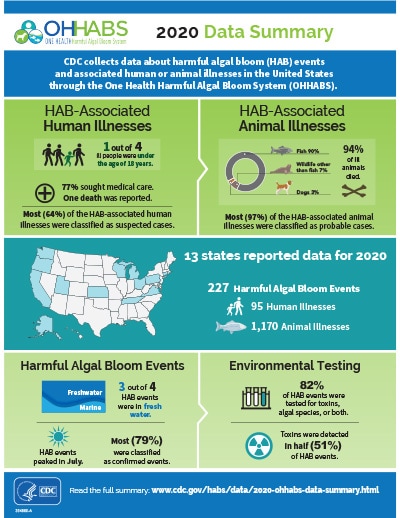
Graphic showing 2020 data about illnesses in people caused by harmful algal blooms

Highlight

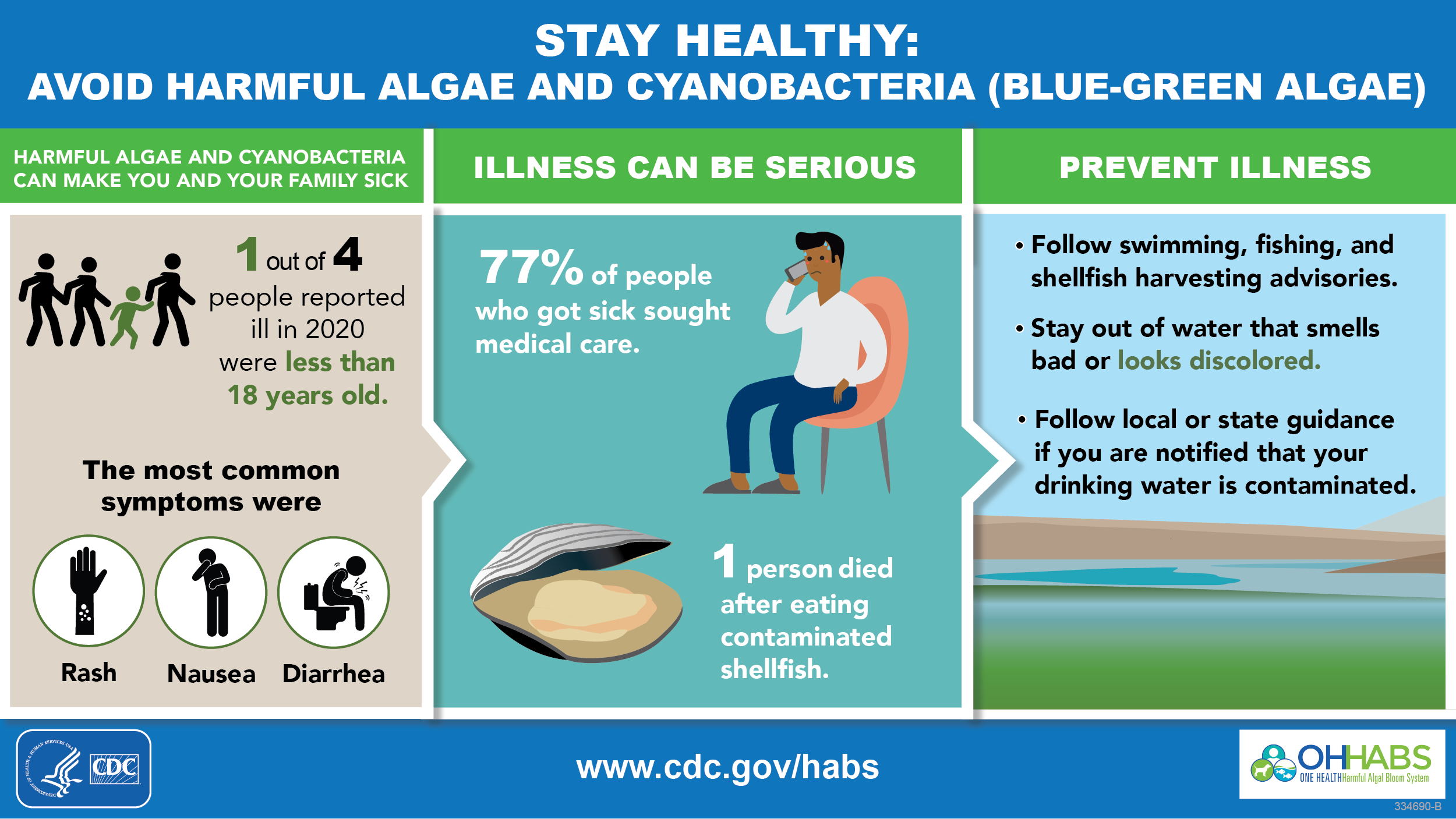
  • Thirteen states reported 227 harmful algal blooms (HABs) that resulted in a total of 95 human illnesses and at least 1,170 animal illnesses.
  • The first human death reported in OHHABS was associated with paralytic shellfish poisoning.
  • A HAB event in September killed at least 1,000 fish (carp).
  • 22 human illnesses (23%) were associated with national parks, with 21 illnesses attributed to a single HAB event.

Background

Harmful algal blooms (HABs) that result from the rapid growth of algae or cyanobacteria (sometimes referred to as blue-green algae) in natural waterbodies can harm people, animals, or the environment. HAB events of public health concern are primarily caused by microalgae called diatoms and dinoflagellates, cyanobacteria, and the toxins they can produce. HAB events, which can be intensified by factors such as nutrient pollution and warmer water temperature, can have public health, environmental, and economic impacts.

HABs are a One Health issue—they affect the health of people, animals, and our shared environment. One Health is a collaborative and multi-sectoral approach that involves engagement across disciplines including public health, animal health, and environmental health. Using a One Health approach, CDC collects data about HAB events and associated human or animal illnesses through the One Health Harmful Algal Bloom System (OHHABS) to inform public health prevention efforts.

Within the context of OHHABS, the term HAB event describes the identification of a bloom or the detection of HAB toxins in water or food (i.e., absent a visual bloom). Human illnesses are reported individually. Animal illnesses are reported as single cases of illness or in groups, such as flocks of birds. The reporting system can link HAB event data with human or animal illness data. OHHABS uses standard definitions [PDF – 3 pages] to classify HAB events as suspected or confirmed and human or animal illness as suspected, probable, or confirmed.

OHHABS is available for voluntary reporting by public health agencies and their designated environmental health or animal health partners in the United States, District of Columbia, Federated States of Micronesia, Guam, Marshall Islands, Northern Mariana Islands, Palau, Puerto Rico, and U.S. Virgin Islands. Public health agencies use standard forms to report HAB events, human cases of illness, and animal cases of illness to OHHABS. Public health agencies do not need to submit all three types of forms to participate.

Data collected for HAB events include general information (e.g., observation date), geographic information, water body characteristics (e.g., salinity), observational characteristics (e.g., water color, scum), and laboratory testing. Data collected for cases of illness include general demographic characteristics, exposure information, signs and symptoms, medical care, and health outcomes. OHHABS is a dynamic electronic reporting system; data within individual reports are subject to change over time. Data included in this report are from a specific point in time.

Research – Marine Harmful Algal Bloom (HAB)-Related Illness Tracking

OEHHA

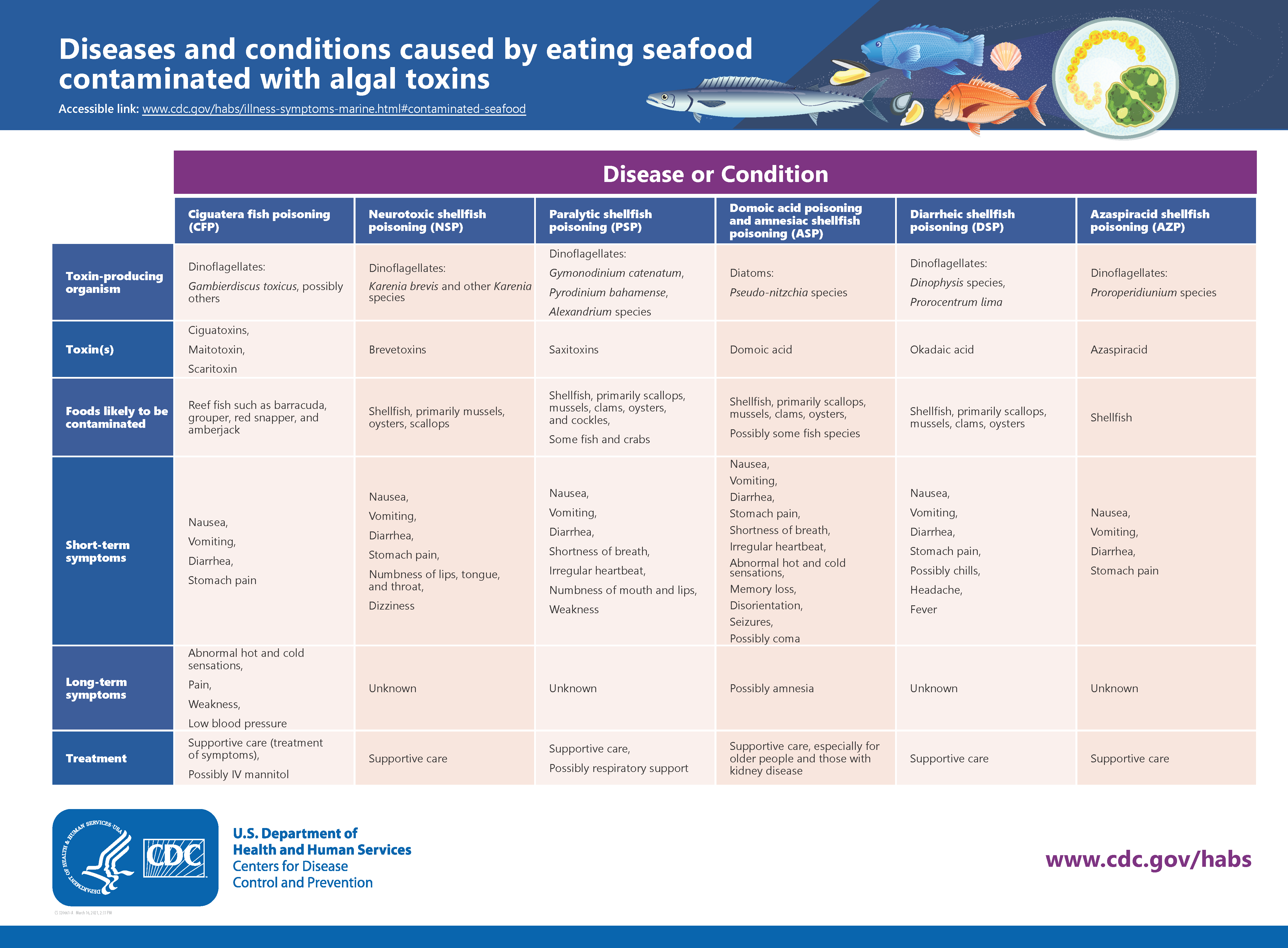
Diseases and conditions caused by eating seafood contaminated with algal toxins

What are marine harmful algal bloom (HAB)-related illnesses?

When phytoplankton and algae in marine waters occur at levels that pose a health risk to humans, animals, and the environment, they are referred to as marine harmful algal blooms (HABs). The US Centers for Disease Control and Prevention (CDC) provide resources on potential human and animal exposures to marine HABs or associated marine biotoxins via skin contact or inhalation, or consumption of fish and shellfish.

RASFF Alert – Tellins – Algal Lipophilic Toxin

RASFF

Detection of lipophilic toxins on tellins from France in Belgium, Italy, Netherlands, Spain and Switzerland

The lipophilic toxins in shellfish can be divided into four groups of toxins with different chemical structures and biological effects: OA and its derivatives, the DTXs; the pectenotoxins (PTXs); the yessotoxins (YTXs); and the azaspiracids (AZAs). These toxins can often be found in combination in shellfish.

Tanzania – 3 Children Die After Consuming Sea Turtle Meat, 22 People Hospitalised – Algal Toxins?

Republic World

Three children lost their lives after consuming sea turtle flesh on Pemba Island in Tanzania’s Zanzibar. On November 27, police reported that all of the children who died belonged to the same family. According to Juma Sadi, the regional police chief for Pemba North, 22 additional individuals have been brought to hospitals after eating sea turtle flesh on Friday, Xinhua reported.

The police added that samples of the sea turtle flesh have been delivered to the appropriate authorities for testing to examine the cause of the fatalities. “Two of the people admitted to hospital are children and they are in critical condition,” Juma Sadi was quoted by Xinhua as saying. He further highlighted that the sea turtle flesh is suspected of being poisonous.

Algae on the seafloor are known to discharge deadly poisons between the months of November to March when the nation’s temperatures rise and during these months, sea turtles, as well as over 20 kinds of fishes, feast on toxic algae at the bottom of the seafloor. Further, the poisons in the plants eventually seep into the flesh of the organisms that consume them. It has the potential to be lethal if eaten.

Research – Project confirms growing threat in Europe from toxins created by microalgae

Food Safety News

gam

A project looking at the risk of ciguatera poisoning in Europe has finished work after almost five years.

An international scientific meeting was held in October for the EuroCigua project which began in April 2016 and ends this month.

Ciguatera is a type of food poisoning associated with consumption of fishery products that contain toxins produced by a microalgae called Gambierdiscus toxicus. The toxin does not affect the appearance, odor or taste of the fish and is not destroyed by cooking, refrigeration or freezing.

It causes an estimated 10,000 to 50,000 cases per year worldwide and outbreaks have been reported in Spain and Portugal. From 2012 to 2018, four European countries reported 23 ciguatera outbreaks and 167 cases.

Results confirmed the appearance of ciguatera in the European Union, having identified native species of fish with ciguatoxins in Macaronesia, Madeira and the Canary Islands. The presence of Gambierdiscus in the Mediterranean Sea, Cyprus and Greece was also detected, as well as the first finding in the Balearic Islands.

Australia – NSW Annual Food Testing Report Released

Food Safety.com

Campylobacter kswfoodworld

Every year, the New South Wales Food Authority (NSW Food Authority) releases their Annual Food Testing Report on the testing conducted by their primary testing provider and by other laboratories. This year’s report highlights some key findings with regards to food safety testing results and trends.

Testing is conducted for a variety of reasons including food-borne illness investigations, Food Safety Program verifications and other types of research. In the report, the NSW Food Authority breaks down the significant findings in each of these categories which provides important information for the Australian food industry.

Key facts from the report

The NSW Annual Food Testing Report provides the following facts for the period of July 2018 to June 2019:

  1. During this time period, there were a total of 6,431 samples submitted for testing.
  2. Sample types analysed included:
  • meat
  • seafood
  • dairy
  • plant products
  • packaged food
  • eggs
  • food from retail outlets
  • environmental samples

3. There were over 70 different types of tests performed. These included:

  • microbiological assessment
  • pH
  • water activity
  • allergens
  • additives such as preservatives

Key findings from the report

The findings listed in the report are categorized based on different programs. The following is a breakdown of some of the key findings:

Food-borne illness investigation findings

The report states that between 2018 and 2019 there were a total of 4,010 samples (food and environmental) that were submitted for testing. These samples were submitted for testing due to food-borne illness investigations and the follow-ups for these investigations.

Increase in Salmonella Enteritidis cases

The report discusses a marked increase in the cases of Salmonella Enteritidis that has been observed since the middle of 2018. The cases have now been linked to an outbreak of Salmonella Enteritidis that was locally acquired. This a significant difference from cases of Salmonella Enteritidis in Australia in the past, with most cases typically presenting in people who had travelled overseas.

Testing was conducted and monitoring took place to determine where the outbreak was stemming from. The investigation involved taking 2,072 samples from egg production businesses and testing eggs and environmental samples. The results from the testing showed that Salmonella Enteritidis was on 13 properties that were interconnected through people, eggs and/or equipment.

The result was six food recalls at the consumer level from properties affected in NSW, and one consumer level recall in Victoria. The report states that surveillance and monitoring of NSW egg farms is slated to continue throughout 2020.

Decrease in Listeria prevalence in melons

The melon industry in Australia, particularly the rockmelon industry, has been linked to food-borne illness outbreaks of Listeria in recent years. The report states that listeriosis cases in New South Wales has actually declined sharply as of late, which is being attributed to the improved food safety measures that have been put in place in the Australian melon industry.

During the period of November 2018 and April 2019, the New South Wales Department of Primary Industries (NSW DPI) conducted food safety training workshops for rockmelon growers in NSW. NSW DPI also conducted sampling of melon harvests and packhouse environments to make sure that melon growers were following food safety protocols.

Verification findings

Concerns about Campylobacter and Salmonella on poultry

Campylobacter and Salmonella infections are both significant health concerns for Australians. In order to monitor the prevalence of these two food-borne pathogens, the raw poultry verification program gathers ongoing data on their prevalence and levels in raw poultry.

The report states that during the period of July 2018 and June 2019, samples were taken from raw poultry including 196 from whole chickens/chicken portions from processing plants, and 312 chicken portions from retail facilities. The samples were tested for the presence of Campylobacter and Salmonella.

The results for processing plants:

Salmonella

  • detected in 21.4% of samples
  • 9.2% of samples had quantifiable levels

Campylobacter

  • detected in 86.7% of samples
  • 1.5% of samples had quantifiable levels

The results for retail facilities:

Salmonella

  • detected in 25.8% of samples
  • 1.7% of samples had quantifiable levels

Campylobacter

  • detected in 89.9% of samples
  • 6.4% of samples had quantifiable levels

Research findings

Investigating algal biotoxins in wild harvest shellfish

There are other types of food-borne pathogens that are not as well known as Listeria, Salmonella or Campylobacter. The report touches on how some algae produce toxic compounds that can then accumulate in certain types of fish, particularly filter-feeding bivalve shellfish. The concern is that the toxic compounds can be harmful to humans if they are consumed by eating the shellfish.

The NSW Food Authority conducted testing between 2018 and 2019 which involved taking samples from pipis which are a type of shellfish group. There were 76 samples taken and they were tested for three different types of algae toxin groups which were amnesic shellfish toxins, paralytic shellfish toxins and diarrhetic shellfish toxins. The results revealed that diarrhetic shellfish toxins were detected in 13 of the 76 samples.

The NSW Food Authority will continue to investigate the health concerns around algae toxins in harvest shellfish in the 2019-2020 fiscal year.