Category Archives: outbreak

Research – 10 Deadly Food Poisoning Outbreaks in US History

Food Poisoning News

Over the years, the United States has seen several foodborne illness outbreaks, some of which have been more lethal than others. The Centers for Disease Control and Prevention (CDC) estimates that contaminated food causes approximately 128,000 hospitalizations and 3,000 deaths yearly. The number of cases is usually higher during an outbreak than in a normal year. Foodborne illness outbreaks typically occur when multiple people contract a similar illness after consuming a common food, and analysis of the food implicates it as the source of the disease.

In the early 1920s, the Public Health Service was responsible for reporting foodborne illness outbreaks in the US. In 1961, the CDC, then known as the Communicable Disease Center, took over the role, and in 2011, it began publishing annual summaries of food poisoning outbreaks online.

Check the link above for the top ten.
USA – E. coli Outbreak with Unknown Food Source

CDC

A food has not yet been identified as the source of this fast-moving outbreak. So far, illnesses have only been reported from Michigan and Ohio. To prevent getting sick from E. coli, follow these four steps when handling or preparing food: clean, separate, cook, and chill.

Fast Facts
Illnesses: 29
Hospitalizations: 9
Deaths: 0
States: 2
Recall: No
Investigation status: Active
Illustration of E. coli pathogen
What You Should Do
Call your healthcare provider right away if you have any of these severe E. coli symptoms:

Diarrhea and a fever higher than 102°F
Diarrhea for more than 3 days that is not improving
Bloody diarrhea
So much vomiting that you cannot keep liquids down
Signs of dehydration, such as:
Not peeing much
Dry mouth and throat
Feeling dizzy when standing up
If you have symptoms of E. coli, help us solve this outbreak:

Write down what you ate in the week before you got sick.
Report your illness to your local or state health department.
Answer public health officials’ questions about your illness.
Follow these four food safety steps to prevent getting sick from E. coli.

Clean: Wash your hands, utensils, and surfaces often. Rinse fruits and vegetables under running water before eating, cutting, or peeling.
Separate: Keep food that won’t be cooked separate from raw meat, poultry, and seafood.
Cook: Use a food thermometer to make sure you have cooked your food to a temperature high enough to kill germs.
Chill: Refrigerate perishable food (food that goes bad) within 2 hours. If the food is exposed to temperatures above 90°F (like a hot car or picnic), refrigerate within 1 hour. Thaw food in the refrigerator, not on the counter.

Denmark – Outbreak of Salmonella Enteritidis in Denmark

SSI

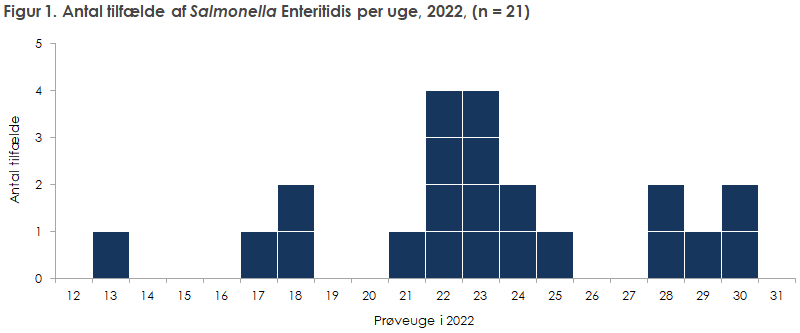
Since 31 March 2022, 21 cases of Salmonella Enteritidis have been registered at the Statens Serum Institut. In the current outbreak, the source of infection remains unknown, but an investigation is underway.

Last edited on August 16, 2022

About the disease outbreak

Between 31 March 2022 and 30 July 2022, 21 people have been registered at the Statens Serum Institut who have been infected with the same type of Salmonella Enteritidis (figure 1). Among the sick are 15 men and 6 women. The patients are between 8-59 years old (median age is 28 years). The patients primarily live in the Capital Region and Zealand Region (table 1).

The Statens Serum Institut is working together with the Danish Veterinary and Food Administration and the Norwegian Food Institute DTU on this outbreak to identify the source of infection.

Number of cases of Salmonella Enteritidis sequence type 11 per week, 2022, (n = 21)

Table 1. Patients with Salmonella Enteritidis in Denmark, March to July 2022, per region (n=21)

Region  Number of patients
 The capital   13
 Zealand   5
 Central Jutland   2
 Southern Denmark   1
 Northern Jutland   0
 Total  21

The outbreak strain

The bacteria is of the type Salmonella Enteritidis. When whole-genome sequencing of the bacteria isolated from the patients shows that they are very closely related and belong to sequence type 11.

General about salmonella infection

Salmonella is found in animals and can infect humans through food contaminated with the bacteria. Salmonella is a frequent and well-known cause of bacterial intestinal infections in Denmark. There are more than 2,500 different types of salmonella.

Incubation period

The time that passes from being infected to getting symptoms varies from 6-72 hours. Usually 12-36 hours before symptoms appear.

Symptoms

Infection with salmonella typically causes general malaise, diarrhoea, stomach ache, possibly nausea, vomiting and/or fever. The infection is often accompanied by joint pain, muscle pain and headache. Plenty of fluids are important to prevent and treat dehydration from diarrhea and vomiting. In the event of severe diarrheal disease, a doctor should be consulted.

USA – FDA Coe Investigation Table Update

FDA

What’s New

  • An outbreak of E. coli O157:H7 (ref# 1081) in an unidentified product was added to the table and FDA has initiated a traceback investigation. CDC has issued an Investigation Notice.
  • An outbreak of Salmonella Senftenberg (ref# 1087) in an unidentified product was added to the table.
  • An outbreak of Salmonella Typhimurium (ref# 1095) in an unidentified product was added to the table and traceback has been initiated.
  • For the outbreak of Salmonella Braenderup (ref# 1075) in an unidentified product, the outbreak has ended.
  • For the outbreak of Cyclospora in an unidentified product (ref# 1084), the case count has increased from 77 to 98.
  • For the outbreak of hepatitis A illnesses linked to fresh strawberries (ref# 1066), the FDA investigation has closed and the outbreak is over.
Date
Posted
Ref
Pathogen
Product(s)
Linked to
Illnesses

(if any)
Total
Case Count

Status
8/17/

2022

1081 E. coli
O157:H7
Not Yet Identified See CDC Investigation Notice Active
8/17/

2022

1087 Salmonella
Senftenberg
Not Yet Identified 19 Active
8/17/

2022

1095 Salmonella
Typhimurium
Not Yet Identified 44 Active
8/3/

2022

1080 Cyclospora Not Yet Identified 6 Active
7/27/

2022

1084 Cyclospora Not Yet Identified 98 Active
6/29/

2022

1076 Not Yet Identified Frozen Food See Outbreak
Advisory
Active
6/22/

2022

1075 Salmonella
Braenderup
Not Yet Identified 74 Active
6/22/

2022

1072 Salmonella
Paratyphi B var. L(+) tartrate+
Not Identified 14 Closed
6/15/

2022

1070 Listeria
monocytogenes
Not Identified 12 Closed
6/8/

2022

1068 E. coli
O157:H7
Not Identified 10 Closed
6/1/

2022

1066 Hepatitis A Virus Strawberries See Outbreak
Advisory
Closed
5/25/

2022

1067 Salmonella 
Senftenberg
Peanut Butter See Outbreak Advisory Closed
4/20/

2022

1064 Not Yet
Identified
Dry Cereal 558 adverse
event reports
Active
4/13/

2022

1057 Listeria
monocytogenes
Ice Cream See Outbreak Advisory Active
3/30/

2022

1060 None
Identified
Meal Replacement
Drink
6 adverse
event reports
Closed
3/16/

2022

1055 Salmonella
Saintpaul
Not Identified 60 Closed
2/17/

2022

1056 Cronobacter
sakazakii
Powdered
Infant
Formula
See
Advisory
Active (IMG)
2/9/

2022

1040 Listeria
monocytogenes
Not Identified 20 Closed
2/2/

2022

1054 Enteroinvasive
E. coli
O143:H26
Not
Identified
16 Closed
1/10/

2022

1050 E. coli
O121:H19
Romaine 4 Closed

USA – With E. coli Outbreaks in Ohio and Michigan, what do you need to know?

Food Poison Journal

With at least 18 ill in Ohio and nearly 100 ill in Michigan – not yet clear if the outbreaks from the two states are linked – the public is looking for information about this potentially deadly pathogen.

Read all about it at the link above

Guatemala -Cheese behind 40 illnesses in Guatemala

Food Safety News

Public health officials in Guatemala have issued a warning as 40 people fell sick after eating dairy products.

The Ministry of Public Health and Social Assistance reported the food poisoning of 41 people after eating artisanal cheese in the town of Ciudad Vieja, in the department of Sacatepéquez.

The first cases were detected on Aug. 9. People with a history of consuming fresh cheese were treated for abdominal pain, nausea and vomiting.

Authorities advised local people to avoid consuming dairy products without knowing the origin and to check the label of the product to ensure it is made with pasteurized milk. These preventative steps should be in place at least until the investigations are completed to determine the origin of the current outbreak to stop more people from getting sick.

They also recommended that the public reinforce hygiene practices such as handwashing, the correct preparation, handling and storage of food, and to seek treatment if they feel unwell.

USA – Mystery Wood County E. coli Outbreak sickens 16 with 6 hospitalized

Food Poison Journal

According to 24 News, 16 people in Wood County have come down with E. coli in the past week, prompting the health department to begin investigating. From 2016 to 2020 the county only saw 27 cases altogether.

“Even a case or two is something we want to identify and respond to quickly so that if it is, in fact, something that could spread to others we have a chance to stop it,” said Benjamin Robison, the health commissioner for the Wood County Health Department.

Those who have fallen ill range from ages 13 to 60 years old and those who contract the virus can experience different levels of sickness and gastrointestinal symptoms.

The Wood County Health Department has sent lab samples to the Ohio Department of Health to learn whether or not the illnesses are connected. Results, and more information, are expected early next week.

“We are doing a comprehensive investigation to understand what the cause of this was. Until we know whether these diseases are being caused by the same strain, we really have to wait to understand what our next steps are going to be,” Robison said.

USA – Mystery Ottawa County E. coli outbreak now reports 12 with two hospitalized with Kidney complications

Food Poison Journal

Wood TV 8 reports that the Ottawa County Health Department is warning about an E. coli outbreak in the community.

As of Friday, there are 12 shiga toxin E. coli cases in Ottawa County, the health department said.

The shiga toxin producing E. coli is often associated with foodborne outbreaks. Symptoms include diarrhea, severe stomach cramps, vomiting and a low-grade fever.

“It’s a bacteria that can have some serious complications in some folks, particularly kids,” said Derel Glashower of the Ottawa County Health Department.

Five of the 12 infected individuals in the county have been hospitalized — two of them are children. Glashower said two have serious kidney complications.

The big concern is the significant number of E. coli infections that the county is seeing this year. Glashower said that on average, the county sees two to three cases each August.

The health department said it is working to see if there are any common denominators in the cases.

Denmark – Health and Economic Burden of Seven Foodborne Diseases in Denmark, 2019

Mary Anne Liebert

We ranked seven foodborne pathogens in Denmark on the basis of their health and economic impact on society in 2019. We estimated burden of disease of infections with Campylobacter spp., Salmonella spp., Shiga toxin-producing Escherichia coli (STEC), Yersinia enterocoliticaListeria monocytogenes, norovirus, and hepatitis A virus in terms of incidence, mortality, disability-adjusted life years (DALY), and economic burden in terms of direct and indirect health costs. These seven pathogens accounted for 268,372 cases, 98 deaths, and 3121 DALYs, and led to a total expenditure of 434 million Euro in 1 year in a country with 5.8 million citizens. Foodborne infections by CampylobacterSalmonella, and norovirus caused the most DALYs, whereas Campylobacter, and norovirus and STEC had the higher costs. A combination of disease burden and cost of illness estimates is useful to inform policymaking and establish food safety priorities at the national level.

Norway – Outbreak of Salmonella in Norway probably linked to watermelon

Matportalen

The Institute of Public Health has discovered a national outbreak caused by the gastrointestinal bacterium monophasic Salmonella Typhimurium. So far, infection has been detected in 18 people. The Norwegian Food Safety Authority cooperates with the Norwegian Institute of Public Health and the Norwegian Veterinary Institute on the outbreak. The Norwegian Food Safety Authority is now working to trace the relevant watermelons.

 We consider it highly unlikely that melons associated with the outbreak are still on the market, says senior adviser Catherine Signe Svindland at the Norwegian Food Safety Authority.

According to the Norwegian Institute of Public Health, all 13 people who have been interviewed so far have eaten watermelon in the last few days before they fell ill. Most of the people fell ill in the period from the end of June to the middle of July 2022 and whole watermelon has a shelf life of 3-4 weeks.

 Melon grows on the ground in countries with a warm climate. There have previously been many outbreaks of salmonella from various types of melon. Bacteria grow very well in the melon flesh because melon has a neutral PH compared to other fruits, a lot of sugar and a high water content. If there is a wound through the skin, bacteria can enter the pulp, grow and become very numerous. Bacteria can also enter the pulp from the skin when you split the melon. If you buy ready-cut melon, feel free to ask the shop about their routines, says senior advisor Catherine Signe Svindland at the Norwegian Food Safety Authority.

The Norwegian Food Safety Authority has the following advice on safe handling of melons:

  • Do not use melons with damage to the skin that goes into the pulp.
  • Wash the melon well and dry it with paper before cutting it into pieces.
  • Wash your hands and equipment thoroughly with soap and water after handling melon.
  • Sliced ​​melon should be kept cool.

Read more at the Institute of Public Health: Outbreak of Salmonella in Norway probably linked to watermelon (fhi.no)

Read more at the Veterinary Institute: Outbreak of salmonella probably linked to watermelon (vetinst.no)