Category Archives: Microbiological Risk Assessment

Research – Studies Aim to Improve Detection, Control Methods for Cyclospora

Food Safety.Com

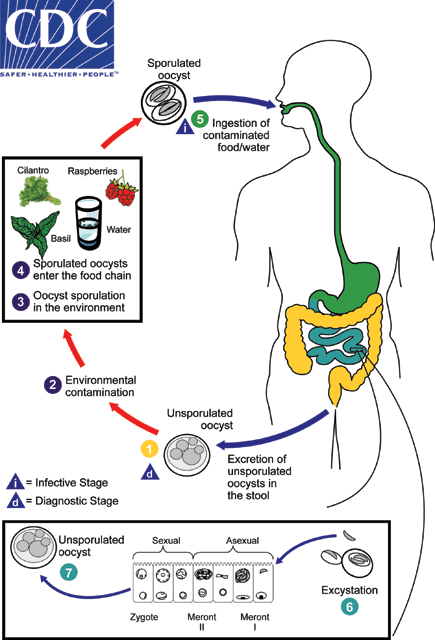
Two ongoing studies funded by the Center for Produce Safety (CPS) are looking to improve detection and control methods for Cyclospora cayetanensis. A complex protozoan parasite, C. cayetanensis is extremely challenging to culture in a laboratory setting, and requires complicated microscopy for detection in samples.

The first project, led by Purdue University’s Lia Stanciu, Ph.D., seeks to use “aptamers”—or short strands of synthesized DNA—to bind to C. cayetanensis. The aptamers would then be used to create a paper-based, low-cost, and easy-to-use water test for the parasite, similar to rapid COVID-19 or pregnancy tests.

The second study is exploring the use of zero-valent iron (ZVI) sand filters to remove C. cayetanensis from water, evaluating the basic principle that physical exclusion might be an option to reduce parasite burdens.

USA – Investigated Illnesses and Outbreaks Table Update for Seafood Related Natural Toxin and Scombrotoxin Fish Poisoning

FDA

January 12, 2023

Table 1: Closed Illness and Outbreak Incidents is a list of investigations that were managed by FDA’s Seafood-Related Natural Toxin and Scombrotoxin Fish Poisoning Team for Fish Other Than Molluscan Shellfish. The listed incidents have been completed at this time.

The table is managed and updated when a significant number of illnesses have been investigated in a specific period of time or at least quarterly.

The table has been updated to illustrate additional information such as

  • Pending analytical results;
  • Confirmed fish/fishery product species identifications; and
  • Completed analytical results are listed in their own column.

The following FDA tracking numbers, and illness type have been added to the table:

  • 20-09-08: CFP;
  • 22-08-15: SFP;
  • 22-08-17: SFP;
  • 22-09-18: SFP;
  • 22-09-20: CFP/SFP;
  • 22-10-21: Unknown;
  • 22-11-22: SFP; and
  • 22-12-23: SFP.

The table may be found at: How to Report Seafood-Related Toxin and Scombrotoxin Fish Poisoning Illnesses | FDA

RASFF Alerts – Animal Feed – Enterobacteriaceae – Dog Chews

RASFF

Enterobacteriaceae in dog chews from Türkiye in Germany

RASFF

Too high count of Enterobacteriaceae in dog chew from Tükiye in Germany

RASFF Alerts – Animal Feed – Salmonella – Poultry Feed – Feed for Dogs and Cats – Soybean Meal – Fish Meal

RASFF

Feed Poultry – Salmonella from the Netherlands in Belgium

RASFF

Salmonella in complete feed for dogs and cats from Belgium in France

RASFF

Salmonella Senftenberg in soybean meal from the Netherlands in Belgium

RASFF

Salmonella in fishmeal from France in Belgium

USA – FDA Closes Mystery Salmonella Outbreak With 274 Sickened

Food Poisoning Bulletin

The FDA has closed another mystery Salmonella outbreak with no resolution. The Salmonella outbreak that sickened at least 274 people has ended, and the investigation has been closed; no food source was identified. This is the 14th outbreak in the last year that has been unsolved by the FDA.

It’s unusual that with so many people sick, a food source could not be found. The pathogen responsible for those illnesses was Salmonella Typhimurium. The FDA did initiate traceback, and conducted sample collection and analysis, but couldn’t solve this mystery Salmonella outbreak.

Research USA – Seafood-Related Natural Toxin and Scombrotoxin Fish Poisoning Illnesses for Fish Other than Molluscan Shellfish Investigation Update

FDA

Investigated Illnesses and Outbreaks Table Update for Seafood Related Natural Toxin and Scombrotoxin Fish Poisoning

Table 1: Closed Illness and Outbreak Incidents is a list of investigations that were managed by FDA’s Seafood-Related Natural Toxin and Scombrotoxin Fish Poisoning Team for Fish Other Than Molluscan Shellfish. The listed incidents have been completed at this time.

The table is managed and updated when a significant number of illnesses have been investigated in a specific period of time or at least quarterly.

The table has been updated to illustrate additional information such as

  • Pending analytical results;
  • Confirmed fish/fishery product species identifications; and
  • Completed analytical results are listed in their own column.

The following FDA tracking numbers, and illness type have been added to the table:

  • 20-09-08: CFP;
  • 22-08-15: SFP;
  • 22-08-17: SFP;
  • 22-09-18: SFP;
  • 22-09-20: CFP/SFP;
  • 22-10-21: Unknown;
  • 22-11-22: SFP; and
  • 22-12-23: SFP.

The table may be found at: How to Report Seafood-Related Toxin and Scombrotoxin Fish Poisoning Illnesses | FDA

Research – Report on surveillance of Campylobacter infections in France in 2021.

Sante Publique

CDC Campy

Key points

In 2021, surveillance of Campylobacter infections confirmed the epidemiological and biological trends already observed in recent years. Specifically, the data shows:

  • a predominance of the species C. jejuni ;
  • a higher number of cases and incidence in children with a maximum incidence in 0-9 year olds (27 cases/100,000 inhabitants);
  • a predominance of infections in men 15 cases per 100,000 inhabitants versus 11 cases per 100,000 for women (less marked trend in people aged 20 to 39);
  • a seasonal peak during the summer period;
  • high resistance to fluoroquinolones and tetracyclines, which has remained stable in recent years;
  • no notable increase in the resistance rates of the six antibiotics tested routinely;
  • consumption of poultry products as the first food (incriminated or suspected) identified as a source of contamination in episodes of collective food poisoning.

The number of Campylobacter strains listed by the CNR has been increasing since 2013, the year in which the network’s laboratories introduced online data entry. By way of comparison, at European level, the trend in the number of Campylobacter infection notifications remained stable over the 2016-2020 period. This increase observed in France could be a reflection of a real increase in Campylobacter infections. However, several factors, such as the grouping of laboratories into technical platforms and the increasingly systematic use of multiplex PCR (diagnostic tests that allow the presence of several targeted pathogens to be tested at the same time from the same sample) , facilitating the detection of Campylobacter sp , could have contributed to the increase in the number of strain isolations and therefore of the notification by the laboratories of the network over time.

Fifteen Tips to Avoid Food Poisoning

Food Poisoning Bulletin

Whenever there is a good poisoning outbreak, odds are that the outbreak notice will include some information about how consumers can protect themselves against contaminated food. While it is illegal for companies to sell food contaminated with enough pathogens to make someone ill, it happens all the time. These 15 tips to avoid food poisoning may help.

Information in the Link Above

Research – An excimer lamp to provide far-ultraviolet C irradiation for dining-table disinfection.

Nature.com

Abstract

Dining tables may present a risk to diners by transmitting bacteria and/or viruses. Currently, there is a lack of an environmental-friendly and convenient means to protect diners when they are sitting together. This investigation constructed far-UVC excimer lamps to disinfect dining-table surfaces. The lamps were mounted at different heights and orientations, and the irradiance on table surfaces was measured. The irradiation doses to obtain different inactivation efficiencies for Escherichia coli (E. coli) were provided. In addition, numerical modeling was conducted for irradiance and the resulting inactivation efficiency. The surface-to-surface (S2S) model was validated with the measured irradiance. The germicidal performance of far-UVC irradiation, the far-UVC doses to which diners were exposed, and the risk of exposure to the generated ozone were evaluated. The results revealed that an irradiation dose of 12.8 mJ/cm2 can disinfect 99.9% of E. coli on surfaces. By varying the lamp irradiance output, the number and positions of the lamps, the far-UVC irradiation can achieve a 3-log reduction for a dining duration of 5 min. Besides, the far-UVC lamp has a low damage risk to diners when achieving an effective inactivation rate. Moreover, there is virtually no ozone exposure risk in a mechanically ventilated dining hall.

Research – Bioprotective Lactic Acid Bacteria and Lactic Acid as a Sustainable Strategy to Combat Escherichia coli O157:H7 in Meat

MDPI

Abstract

Human infection by Enterohemorrhagic Escherichia coli (EHEC) constitutes a serious threat to public health and a major concern for the meat industry. Presently, consumers require safer/healthier foods with minimal chemical additives, highlighting the need for sustainable solutions to limit and prevent risks. This work evaluated the ability of two antagonistic lactic acid bacteria (LAB) strains, Lactiplantibacillus plantarum CRL681 and Enterococcus mundtii CRL35, and their combination in order to inhibit EHEC in beef (ground and vacuum sealed meat discs) at 8 °C during 72 h. The effect of lower lactic acid (LA) concentrations was evaluated. Meat color was studied along with how LAB strains interfere with the adhesion of Escherichia coli to meat. The results indicated a bacteriostatic effect on EHEC cells when mixed LAB strains were inoculated. However, a bactericidal action due to a synergism between 0.6% LA and LAB occurred, producing undetectable pathogenic cells at 72 h. Color parameters (a*, b* and L*) did not vary in bioprotected meat discs, but they were significantly modified in ground meat after 24 h. In addition, LAB strains hindered EHEC adhesion to meat. The use of both LAB strains plus 0.6% LA, represents a novel, effective and ecofriendly strategy to inactivate EHEC in meat.