Category Archives: Food Poisoning

New Zealand – Shellfish biotoxin alert lifted for South Head

MPI

The Ministry for Primary Industries today removed the public health warning against collecting shellfish from the North Island West Coast.

This warning was from South Head (Manukau Harbour) to Tirua Point (South of Kawhia) – North Island.  Further sampling of shellfish along this coastline has shown that Paralytic Shellfish Poisoning (PSP) toxins are now at safe levels.

Other warnings remain in place for West Coast – Waipapakauri to Kaipara – North Island

RASFF Alert – Ochratoxin A – Sweet Paprika

European Food Alerts

RASFF

ochratoxin A (36.2 µg/kg – ppb) in sweet paprika from Hungary in Italy

RASFF Alerts – Salmonella – Frozen Doner Kebab – Chicken Legs – Chicken Drumsticks – Egg Yolk Powder – Cooked Shrimps – Chicken Breast – Whole Chicken

European Food Alerts

RASFF

Salmonella enterica ser. Agona (presence /25g) in frozen doner kebab from Poland in Croatia

RASFF

Salmonella in chilled chicken legs from Poland in Poland

RASFF

Salmonella enterica ser. Infantis (presence /25g) in frozen skinless and boneless chicken drumsticks from Slovakia in Lithuania

RASFF

Salmonella enterica ser. Enteritidis (presence /25g) in egg yolk powder from Ukraine in Latvia

RASFF

Salmonella in cooked shrimps from the Netherlands in the Netherlands

RASFF

Salmonella enterica ser. Newport (in 1 out of 5 samples /25g) in frozen chicken breast from Poland in Denmark

RASFF

Salmonella enterica ser. Typhimurium (presence /25g) in organic whole chicken from France in Denmark

RASFF

Salmonella enterica ser. Enteritidis (presence /25g) in frozen chicken sleeves from Poland in France

RASFF Alerts – Aflatoxin – Dried Figs – Groundnuts – Pistachios –

European Food Alerts

RASFF

aflatoxins (B1 = 15.1 µg/kg – ppb) in dried figs from Turkey in Spain

RASFF

aflatoxins (B1 = 8.5; Tot. = 29.3 µg/kg – ppb) in dried figs from Turkey in Denmark

RASFF

aflatoxins (B1 = 11; Tot. = 13 µg/kg – ppb) in groundnuts from South Africa in Netherlands

RASFF

aflatoxins (Tot. = 50.2 µg/kg – ppb) in pistachio kernels from Iran in Germany

RASFF

aflatoxins (B1 = 19; Tot. = 20 µg/kg – ppb) in dried organic figs from Turkey in Germany

RASFF Alerts – Listeria monocytogenes – Chilled Beef -Organic Goat Cheese

European Food Alerts

RASFF

Listeria monocytogenes (910 CFU/g) in chilled beef from Poland in Germany

RASFF

suspicion of Listeria monocytogenes in organic goat cheese from the Netherlands in Germany

RASFF

suspicion of Listeria monocytogenes in goat’s cheese from the Netherlands in the UK

USA – Outbreak Investigation of Salmonella Stanley: Wood Ear Mushrooms – Dried Fungus (September 2020)

FDA

The FDA, along with CDC and state and local partners, investigated a multistate outbreak of Salmonella Stanley infections linked to wood ear mushrooms imported by Wismettac Asian Foods, Inc. of Santa Fe Springs, CA. Wood ear mushrooms are a dried mushroom, also commonly labelled or referred to as Kikurage, Dried Black Fungus, Dried Fungus, or Mu’er/Mu Er/Mu-Err.

Wismettac Asian Foods, Inc. acted quickly upon being notified of the positive test result and recalled all wood ear mushrooms within shelf life on September 23, 2020.

Recommendation

Wood ear mushrooms imported by Wismettac Asian Foods, Inc. were only sold to restaurants and were not available directly to consumers. Although these items have been recalled, restaurants that received recalled products should use extra vigilance in cleaning and sanitizing any surfaces that may have come in contact with the recalled product, to reduce the risk of cross contamination. All recalled product should be thrown out.


Investigation Update

November 4, 2020

As of November 4, 2020, the CDC declared that this outbreak is over.

General Food Safety Tips for Dried Mushrooms

Dried mushrooms, that have not been recalled due to potential contamination, should always be reconstituted using boiling water to kill any pathogens. This advice does not apply to recalled products, which should be thrown out.

Product Images

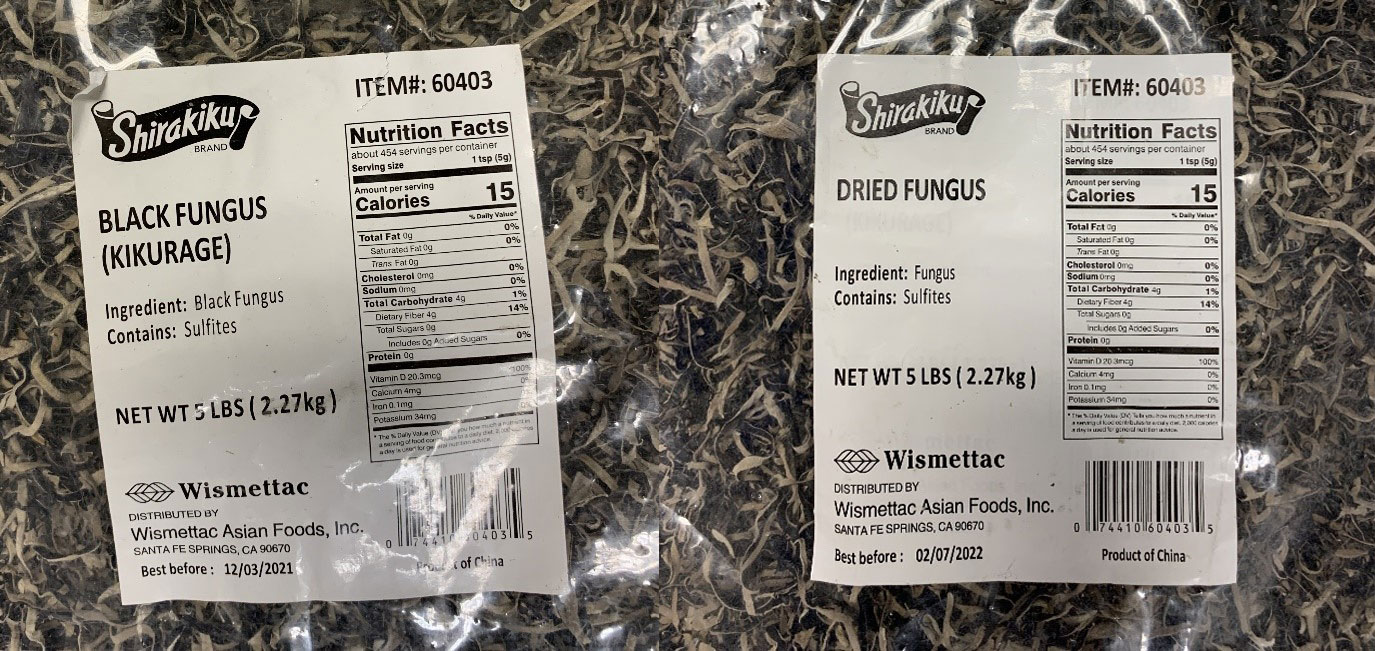
Outbreak Investigation of Salmonella Stanley in Wood Ear Mushrooms (September 2020) - Photos of Recalled Shirakiku Dried Fungus

Recall Information

On September 23, 2020, Wismettac Asian Foods, Inc. recalled Shirakiku brand imported dried fungus. This product was labeled as Shirakiku brand Black Fungus (Kikurage) with UPC Code 00074410604305, imported from China. Product was distributed in six packs of five-pound bags to restaurants in AR, CA, CO, CT, DE, DC, FL, GA, HI, IA, IL, IN, LA, MA, MD, MI, MN, MO, MS, NC, NV, NJ, NY, OH, OR, PA, SC, TN, TX, VA, WA, and WI.

Research – Characteristics of Norovirus Food Poisoning Outbreaks in Korea in the 2000s

Journal of Food Protection

Eurofins

Norovirus food poisoning outbreaks in Korea (South) appeared in 2000s and have been increasing since then. We aimed to investigate the epidemiological features of norovirus food poisoning outbreaks in Korea over the past years (2002 ~ 2017), based on official food poisoning statistics and available reports, and to find their association with climate factors. Norovirus was the most common cause of food poisoning among known causative substances in Korea during the study period. More than one-third of the incidents occurred in group meal-service facilities, including school lunch programs. A few of these facilities used groundwater contaminated with noroviruses to wash / cook food, which contributed to outbreaks. Norovirus occurrences showed strong seasonality; cold and relatively dry winter air may help norovirus to flourish. Both norovirus genotypes GI and GII infectious to humans were detected, with GII becoming more prevalent than GI. According to our correlation analysis in connection with climate factors, average temperatures, the highest and lowest temperatures, precipitation, the number of rain days, and humidity showed a significant negative correlation with a monthly norovirus occurrence (p < 0.05). The lowest temperature and average temperature had higher coefficients of correlation, -0.377 and -0.376, respectively. The norovirus outbreaks in Korea showed complex etiological characteristics, although it more prevailed in wintertime, and are now considered as a major public health problem. The use of groundwater in group meal-service settings has a public health impact as well as norovirus concern, therefore groundwater used in food service facilities / business should be treated for safety.

Korea – McDonald’s HQ Raided in Food Poisoning Investigation of Alleged ‘Hamburger Disease’ – E.coli

Newsweek

Prosecutors have relaunched an investigation of McDonald’s in South Korea for its alleged connection to a recent case of the haemolytic uremic syndrome (HUS)—a life-threatening condition, dubbed the “hamburger disease”, caused by a strain of E.coli.

Spain – Alert for the presence of Shiga toxin-producing Escherichia coli in Brie cheese from France

CFSA

Brie cheese

The Spanish Agency for Food Safety and Nutrition (AESAN) has notified us through the SCIRI of the presence of the bacterium Escherichia coli producing Shiga toxins in the cheese product Brie 100 g, made in France, marketed from Germany by the JERMI company and sold in supermarkets of the Lidl chain.

The German company JERMI, which packs and markets the product, has detected Shiga toxin-producing Escherichia coli in the course of its self-checks and has informed the competent authorities and its customers.

The company Lidl has communicated the information to consumers requesting the return of the product.

The affected product is:

  • Brie cheese 100 g
  • Packed by JERMI KÄSEWERK GMBH
  • Expiry date: 10.2020
  • Lot name: 402

The product has been distributed in Andalusia, Catalonia , the Basque Country, Madrid, Murcia and the Valencian Community.

The AESAN became aware of this through the RASFF alert and reported the same in all regions through the SCIRI in order to continue the withdrawal of the affected product marketing channels.

The presence of Shiga toxin-producing Escherichia coli in food can pose health risks to people who consume it.

With the information available, no case associated with this alert has been confirmed in Spain.

People who have products affected by this alert at home are advised to refrain from consuming them and return them to the point of purchase.


Hong Kong – Not to consume a kind of cheese from Italy with possible Shiga toxin-producing E. coli contamination

CFS

Issue Date 2.11.2020
Source of Information Centre for Food Safety
Food Product Cheese
Product Name and Description Product name: FONTINA D.O.P.

Place of origin: Italy

Producer: COOPERATIVA PRODUTTORI LATTE E FONTINA SOC. COOP.A.R.L.

Importer: Bravo Fine Foods Limitedand New Food Project Limited

Lot: LOTTO C261

Best-before date: November 19, 2020

Reason For Issuing Alert
  • The CFS received a notification from the Rapid Alert System for Food and Feed (RASFF) of the European Commission that the above-mentioned product might have been contaminated with Shiga toxin-producing Escherichia coli (STEC) and is being recalled.
  • Preliminary investigation found that two local importers, Bravo Fine Foods Limited and New Food Project Limited, had imported some of the affected product into Hong Kong.
  • People will contract STEC-causing gastro-intestinal disease through consumption of contaminated water or undercooked and contaminated foods. Intestinal bleeding and serious complications such as hemolytic uraemic syndrome may also develop in some people.
Action Taken by the Centre for Food Safety
  • The CFS immediately contacted local major importers and retailers for follow-up.
  • The importers have initiated a recall according to the CFS’ instructions.
Advice to the Trade
  • The trade should stop using or selling the product concerned immediately if they possess it.
Advice to Consumers
  • Consumers should not consume the affected batches of the product if they have bought any.
  • Enquiries about the recall can be made to the hotlines of Bravo Fine Foods Limited and New Food Project Limited at 3528 0348 and 5248 8527 respectively during office hours.
Further Information The CFS press release