Category Archives: Food Microbiology Research

Research – ComBase models are valid for predicting fate of Listeria monocytogenes on ten whole intact raw fruits and vegetables

Journal of Food Protection

L. monocytogenes was associated with more than 60 produce recalls between 2017 and 2020 including tomato, cherry, broccoli, lemon, and lime recalls. This study describes the effects of temperature, time and food substrate as factors influencing L. monocytogenes behavior on whole intact raw fruits and vegetables. A cocktail of five L. monocytogenes strains previously associated with foodborne outbreaks were used. Ten intact whole fruit and vegetable commodities were chosen based on data gaps identified in a systematic literature review. Produce investigated belong to major commodity families: Ericaceae (blackberry, raspberry, and blueberry), Rutaceae (lemon and mandarin orange), Roseaceae (sweet cherry), Solanaceae (tomato), Brassaceae (cauliflower and broccoli) and Apiaceae (carrot). Intact inoculated whole fruit and vegetable commodities were incubated at 2, 12, 22, 30 and 35 °C with relative humidities matched to typical real-world conditions. Foods were sampled (n=6) for up to 28 days, depending on temperature. Growth and decline rates were estimated using the DMFit for Excel. Growth rates were compared with ComBase modeling predictions for L. monocytogenes. Almost every experiment showed initial growth, followed by subsequent decline. L. monocytogenes was able to grow on whole intact surface of all produce tested, except for carrot. The 10 produce commodities supported growth of L. monocytogenes at 22 and 35°C. Growth and survival at 2 and 12°C varied by produce commodity. The standard deviation of the square root growth and decline rates showed significantly larger variability in both growth and decline rates within replicates as temperature increased. When L. monocytogenes growth occurred, it was conservatively modeled by ComBase Predictor, and growth was generally followed by decreases in concentration. This research will assist in understanding the risks of foodborne disease outbreaks and recalls associated with L. monocytogenes on fresh whole produce.

Norway – Microbiological control of pasteurised and unpasteurised dairy products, 2018

Mattilsynet

The microbiological quality was generally good for the 189 dairy products on the Norwegian market that the Norwegian Food Safety Authority examined in 2018. Nevertheless, we see that there are microbiological challenges in connection with unpasteurised dairy products.

What did we investigate? 189 samples of unpasteurised and pasteurised cheeses and other dairy products produced in Norway and in the EU.
Period: 2018
What were we looking for?

The four categories have been analysed for various disease-causing bacteria (pathogens). These choices are made in order to get the most information for each category.

The different categories are:

PN = pasteurised milk product produced in Norway.

P EU = pasteurised milk product produced outside Norway.

UN = unpasteurised milk product produced in Norway.

U EU = unpasteurised milk product produced outside Norway.
 

The various disease-causing infectious agents we analysed for:

Listeria monocytogenes (pathogen): PN, P EU, UN, U EU, number 189 pcs.

Shigatoxin-producing Escherichia coli (STEC) (pathogen): UN, U EU, number 96 pcs.

E. coli (hygiene parameter): PN, UN, U EU, 169 st.

S. aureus (hygiene parameter): UN, number 71 st.

Toxins (enterotoxin) from S. aureus (pathogen): UN, U EU, number 96 pcs.

Salmonella (pathogen): U EU, number 25 st.

What did we find?

Listeria monocytogenes : No detection in 189 samples of dairy product.

Shigatoxin-producing Escherichia coli (STEC):
One finding in French red cow cheese of cow’s milk ( E. coli O-, stx2 and eae ). A total of 25 unpasteurised milk products produced outside Norway were examined. No findings in 71 unpasteurised milk products from Norway.

Escherichia coli (hygiene parameter):
In 73 pasteurised milk products from Norway, there was a detection and this was above the lower limit value (100 cfu / g) but below the upper limit value (1,000 cfu / g). No E. coli was detected above the detection limit of 10 colony forming units / g sample (cfu / g) in the other samples.

In 61 of the 71 unpasteurised milk products produced in Norway, E. coli was not detected above the detection limit of 10 colony-forming units / g sample (cfu / g). 3 st. (4.2%) was above 100 cfu / g.

In unpasteurised dairy products from the EU (25), 5 (20%) of the products had more than 100 cfu/ g E. coli. There is no microbiological criterion for E. coli in the regulations for unpasteurised cheeses.

Staphylococcus aureus:
Of 71 samples, none exceeded the regulatory limit of 10,000 cfu/ g.

Of the 96 unpasteurised dairy products examined, the enterotoxins AE Toxins (enterotoxins), which some S. aureus can produce , were not detected .

Salmonella was not detected in the 25 samples of unpasteurised milk products produced outside Norway.

Report Link

Research – New Zealand – 75% Of Pregnant Women Aren’t Aware Of Dangerous Foods

Babygaga

Many moms-to-be don’t know all the foods that could potentially be fatal for their unborn child.

Some foods are dangerous during pregnancy and new research from New Zealand has found that 75% of pregnant women aren’t even aware of what they are. This shocking study found that many moms-to-be don’t know all the foods that could potentially be fatal for their unborn child.

Research – Anti‐adhesive effects of sialic acid and Lactobacillus plantarum on Staphylococcus aureus in vitro

Journal of Food Safety

Staphylococcus aureus (S. aureus) is a common food‐borne pathogen that causes severe diseases after adhesion to epithelial cells. Lactobacillus inhibits pathogenic bacterial adhesion and infection. In addition, sialic acid (SA) is widely known for its beneficial biological functions. A new way of reducing the occurrence of diseases and curbing the overuse of antibiotics is ingesting prebiotics and probiotics that regulate the intestinal flora. In this study, we first evaluated the anti‐adhesive effects of several strains of Lactobacillus on S. aureus. The study revealed that the S. aureus adhesion was inhibited by all the strains of Lactobacillus. Besides, the rate of inhibition by L. plantarum Z‐4 was significantly higher than other Lactobacillus species. We then investigated the effects of different SA concentrations (40, 100, 150, 200, and 260 μg/ml) on the growth and adhesion characteristics of L. plantarum and S. aureus. The results showed that SA influences bacterial adhesion by regulating the bacteria’s growth characteristics. Finally, the effects of SA combined with Lactobacillus on the adhesion of S. aureus were assessed by competition, exclusion and displacement methods. SA with a concentration of 260 μg/mL combined with L. plantarum had the highest inhibition effect on the competition assays. In addition, the expression of S. aureus adhesion‐related genes was reduced. This provides a new perspective on the application of SA and/or L. plantarum and its potential to resist adhesion of S. aureus.

Research – Iceland – Electronic publication of salmonella and campylobacter monitoring

MAST

Official results of monitoring Salmonella spp. and Campylobacter spp. in poultry and Salmonella spp. in pigs have been published in a live and interactive dashboard on the website of the Food Administration. The publication is part of the transfer of Matvælastofnun’s monitoring results from the agency’s databases to an accessible electronic form with transparency in mind.

The dashboard offers easy access to information where the user chooses the period he wants to view, whether on an annual or monthly basis, all the way back to 2013. He can also look up when the selected Salmonella serum type was detected and how often. With explanations on the help page (green field Help), the reader is quick to realize options.

Related material

USA – FDA – Investigations of Foodborne Illness Outbreaks

FDA

The following is a list of outbreaks investigations being managed by FDA’s CORE Response Teams. The investigations are in a variety of stages, meaning that some outbreaks have limited information, and others may be near completion.

public health advisory will be issued for outbreak investigations that have resulted in specific, actionable steps for consumers to take to protect themselves. Please direct your attention to those pages for the most up to date information on the investigation and for consumer protection information.

Research – Climate Change and Food Poisoning

The Counter

Fungal toxins known as mycotoxins, including some thought lost to history, are claiming new territory as the Earth warms.

Belgium – Pure pork rosette from the Selecta brand – Salmonella

AFSCA

Recall of Roussel
Product: Pure pork rosette from the Selecta brand.
Problem: presence of Salmonella.


In agreement with the AFSCA, Roussel is withdrawing the “Rosette pur porc” salami from the Selecta brand from sale and is recalling it to consumers because of the presence of Salmonella.

Roussel asks his customers not to consume this product and to bring it back to the point of sale where it was purchased. It will be refunded to them.

Product description

– Product name: Pure pork rosette
– Brand: Selecta
– Best before dates (BBD): 01/12/2020 and 08/12/2020
– Lot number: 20487
– Sale period : from 23/10 / 2020 to 11/17/2020
– Type of packaging: transparent plastic package
– Weight: 500g

The product was distributed through Cora stores in Belgium .

For any further information, contact:

Mr. Philippe Roussel: 052 / 33.18.97 – philippe@rousselslicing.be

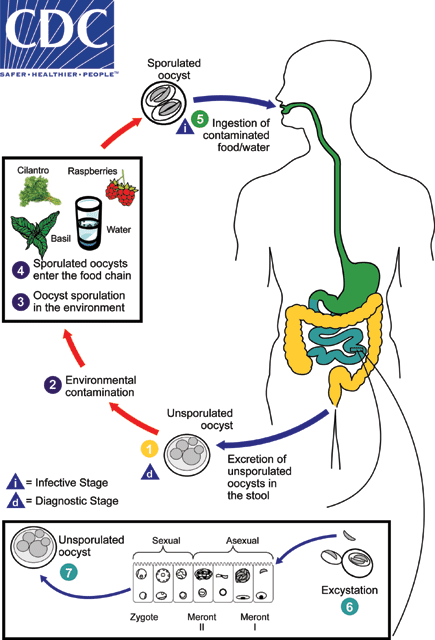
USA – 1071 sick with Cyclospora linked to Fresh Express bagged salad mix containing iceberg lettuce, carrots, and red cabbage

Food Poison Journal

Cyclospora_LifeCycle201

As of November 4, 2020, 370 confirmed cases of Cyclospora illness were reported in the following provinces and territories: British Columbia (1), Ontario (255), Quebec (105), New Brunswick (1), Newfoundland and Labrador (6), and Nunavut (2). Individuals became sick between mid-May and late August 2020. Ten individuals were hospitalized. No deaths were reported. Individuals who became ill were between 0 and 83 years of age. The illnesses are distributed equally among men (50%) and women (50%).

USA/Kenya – CFAES food safety center to research food safety in Kenya

OCJ

The Center for Foodborne Illness Research and Prevention (CFI) at The Ohio State University has been awarded a $770,000 grant to improve food safety and prevent foodborne illnesses in Kenya.

The initiative is one of four new research projects announced by the Feed the Future Innovation Lab for Food Safety, which is funded by the U.S. Agency for International Development as part of Feed the Future, the U.S. government’s global hunger and food security initiative.

The 3.5-year project, “Chakula salama: a risk-based approach to reducing foodborne diseases and increasing production of safe foods in Kenya,” includes a team of researchers from The Ohio State University, the University of Florida, Kenya Medical Research Institute, and the University of Nairobi, who will work to develop and test food-safety interventions to support Kenya’s small-scale poultry producers.

“This project will use a systems-based approach to answer important food safety questions and build an enabling environment that fosters the implementation of risk-based approaches to food safety in Kenya and, eventually, other African countries,” said Barbara Kowalcyk, director of CFI. She is also a faculty member in the Department of Food Science and Technology at the College of Food, Agricultural, and Environmental Sciences (CFAES) and the Translational Data Analytics Institute at Ohio State.