Category Archives: Food Microbiology Research

Research – Risk Assessment of Norovirus Transmission in Food Establishments

FDA

The Risk Assessment of Norovirus Transmission in Food Establishments: Evaluating the Impact of Intervention Strategies and Food Employee Behavior (Duret et al. 2017) evaluates the dynamics of norovirus transmission from ill or infected food employees in food establishments (restaurant setting) to ready-to-eat food and consumers during food preparation and also evaluates the impact of prevention strategies. A discrete event model was developed to study norovirus transmission from the soiled hands of ill or infected food employees and the impact of prevention strategies and their compliance on the prevalence of contaminated servings and the number of resulting infected customers.

The Evaluation of the Impact of Compliance with Mitigation Strategies and Frequency of Restaurant Surface Cleaning and Sanitizing on Control of Norovirus Transmission from Ill Food Employees Using an Existing Quantitative Risk Assessment Model (Fanaselle et al. 2022) uses the previously published FDA quantitative risk assessment model in Duret et al. 2017, to evaluate more than 60 scenarios examining the impact of implementation and compliance with recommendations in the FDA Food Code for: restaurant surface cleaning and sanitizing, hand hygiene and employee health.
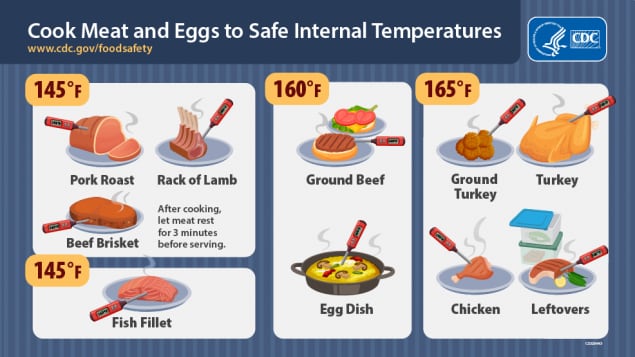
Information – CDC Food Safety Social Media Graphics

CDC

A whole range of free food safety graphics are available at the link above 🙂

Cook Meat and Eggs to a Safe Internal Temperature

Food Safety Education Month Facebook image 7

Telangana: 27 children take ill, hospitalised due to suspected food poisoning.

Live Mint

A total of 27 children were reportedly hospitalised due to food poisoning in Adilabad, said the officials on Tuesday. These children were taken to the hospital after they complained of nausea and vomiting. District Magistrate, Adilabad Prabhakar Reddy said, “yesterday night, 27 children from Kaga Nagar Minority Boys hostel Gurukul were admitted to a local hospital complaining of vomiting and nausea. A detailed inquiry has been ordered and we are investigating the matter,” according to ANI report.

The tragic incident took place after the cooks avoided washing grains and rice before cooking due to a shortage of staff,

Research – Drought-stressed maize is more likely to present mycotoxin risk.

The Cattle Site

The extremely hot weather this summer has meant many maize forage crops have grown under drought stressed conditions, which has increased the likelihood of in-field mycotoxins developing, according to UK agricultural supply company Wynnstay.

Wynnstay dairy specialist Beth Parry urges dairy farmers to be aware of this heightened mycotoxin risk when feeding maize forage this autumn and winter.

“With potentially limited forage stocks following a difficult growing season, farmers are going to need to maximise feed utilisation and digestion to ensure performance isn’t impacted too greatly this winter,” she said.

“In-field mycotoxins are more likely to be present in silages if the crop experienced any kind of stress, such as growing in drought conditions, because moulds and fungi will have had more opportunity to take hold and produce mycotoxins,” she added.

Japan – Escherichia coli O157 outbreak in Kyoto Prefecture, Japan.

Minyu

Kyoto Prefecture announced on the 15th that a woman in her 90s who complained of diarrhea and abdominal pain after eating beef yukhoe sold by MEAT & FRESH TAKAMI, a meat dealer in Uji City, Kyoto Prefecture, died. Enterohemorrhagic E. coli O157 was detected in the woman’s stool.

In addition, 22 men and women between the ages of 9 and 87 who ate yukhoe and roast beef at this restaurant complained of similar symptoms, and O157 was detected in 12 people including asymptomatic people. The prefectural government determined that these foods were the cause of the food poisoning.

 On August 27, the deceased woman ate yukhoe sold as “rare steak” at home, and developed symptoms on September 2. She died in hospital on the 15th. Twenty-two ate from August 21-26.

Research – Interactions Between Infectious Foodborne Viruses and Bacterial Biofilms Formed on Different Food Contact Surfaces

Springer

Bacterial biofilms contribute to contamination, spoilage, persistence, and hygiene failure in the food industry, but relatively little is known about the behavior of foodborne viruses evolving in the complex communities that make up biofilm. The aim of this study was to evaluate the association between enteric viruses and biofilms on food contact surfaces. Formed biofilms of mono- and multispecies cultures were prepared on glass, stainless steel, and polystyrene coupons and 105 pfu/ml of murine norovirus, rotavirus, and hepatitis A virus were added and incubated for 15 min, 90 min, and 24 h. The data obtained clearly demonstrate that the presence of biofilms generally influences the adhesion of enteric viruses to different surfaces. Many significant increases in attachment rates were observed, particularly with rotavirus whose rate of viral infectious particles increased 7000 times in the presence of Pseudomonas fluorescens on polystyrene after 24 h of incubation and with hepatitis A virus, which seems to have an affinity for the biofilms formed by lactic acid bacteria. Murine norovirus seems to be the least influenced by the presence of biofilms with few significant increases. However, the different factors surrounding this association are unknown and seem to vary according to the viruses, the environmental conditions, and the composition of the biofilm.

Research – Prevalence and Characterization of Shiga Toxin Producing Escherichia coli Isolated from Animal Feed in Croatia

MDPI

A survey on prevalence and number of Shiga toxin-producing Escherichia (E.) coli (STEC) in animal feed was carried out over a period of nine years in the Republic of Croatia. A total of 1688 feed samples were collected from feed factories and poultry farms. Analysis included two standard procedures: sample enrichment and (a) immunomagnetic separation and plating on two selective media; or (b) plating on two selective media. Confirmation of STEC included morphological examination, biochemical tests, serotyping, and polymerase chain reaction. Morphological and biochemical characterization revealed 629 E. coli strains. Further serological screening method revealed 78 STEC and EPEC serotypes, while only 27 strains were confirmed as STEC with PCR. All positive samples (1.6%) originated from poultry farms and contained combination of virulence genes: eaeA, stx1, and/or stx2. Since the presence of stx (especially stx2) and eae are identified as risk factors for development of severe diseases in humans, results of this survey indicate that avian sources of STEC infections might be one of those “undefined sources” of human illnesses. Further research is necessary for evaluation of risks posed by contaminated feed, poultry, and environment.

Research – Pulsed Light Application for Campylobacter Control on Poultry Meat and Its Effect on Colour and Volatile Profile

MDPI

Campylobacter on poultry meat needs to be controlled to reduce the risk of infection caused by the consumption of chicken meat. Pulsed light (PL) application on poultry meat was studied to control Campylobacter spp. The effect of this technology was evaluated regarding poultry meat colour and volatile compound changes. Two breast sample groups were prepared: inoculated with Campylobacter (107 bacteria of Campylobacter jejuni strains) and not inoculated. Samples were submitted to PL, five pulses/s of 300 ms, 1 Hz, and 1 J/cm2 in the apparatus, PL Tecum unit (Claranor). A response surface experimental design was applied regarding the factors of voltage (1828 to 3000 W) and distance to the source UV lamp (2.6 to 5.4 cm). The binomial factorial treatment (voltage and distance) with PL induced different energy doses (fluence J/cm2) received by samples, 2.82 to 9.67 J/cm2. Poultry meat pulsed light treated had a significant decrease of Enterobacteriaceae counts. The treatments applied were unable to reduce 1 log Campylobacter cfu/g of poultry meat. The poultry meat PL treated became slightly light, redder, and yellower than those not treated. PL can decrease the proportion of aldehydes on total volatiles in meat, particularly on those associated with chicken-like, chicken skin-like, and sweet odour notes in fresh poultry meat. Further studies of PL with higher energy doses will be necessary to confirm if there are Campylobacter reductions and about poultry meat treated under storage to evaluate if volatile compounds can affect the flavour of PL-treated meat samples. View Full-Text

Research – Cross-Contamination to Surfaces in Consumer Kitchens Using MS2 as a Tracer Organism in Ground Turkey Patties

Journal of Food Protection

It is estimated that one in five cases of foodborne illnesses is acquired in the home. However, how pathogens move around a kitchen environment when consumers are preparing food is not well characterized. The purpose of this study was to determine the prevalence and degree of cross-contamination across a variety of kitchen surfaces during a consumer meal preparation event. Consumers (n=371) prepared a meal consisting of turkey patties containing the bacteriophage MS2 as a tracer organism and a ready-to-eat lettuce salad. Half were shown a video on proper thermometer use before the trial. After meal preparation, environmental sampling and detection were performed to assess cross-contamination with MS2. For most surfaces, positivity did not exceed 20%, with the exception of spice containers, for which 48% of the samples showed evidence of MS2 cross-contamination. Spice containers also had the highest MS2 concentrations, at a mean exceeding 6 log 10 viral genome equivalent copies (GEC) per surface. The high level of MS2 on spice containers drove the significant differences between surfaces, suggesting the significance of spice containers as a vehicle for cross-contamination, despite the absence of previous reports to this effect. The thermometer safety intervention did not affect cross-contamination. The efficiency of MS2 transfer, when expressed as a percentage, was relatively low, ranging from an average of 0.002 to 0.07%. Quantitative risk assessment work using these data would aid in further understanding the significance of cross-contamination frequency and efficiency. Overall, these data will help create more targeted consumer messaging to better influence consumer cross-contamination behaviors.

Research – The Impact of Thyme, Rosemary and Basil Extracts on the Chemical, Sensory and Microbiological Quality of Vacuumed Packed Mackerel Balls

MDPI

The effect of natural extracts (0.05%) and vacuum packaging on the sensory, chemical, and microbiological quality of mackerel balls were evaluated at refrigerated (4 ± 2 °C) storage. Natural extracts thyme (38.13 mg GAE/g), rosemary (81.85 mg GAE/g) and basil (21.08 mg GAE/g) were evaluated. Natural extracts imparted stability to lipids (TBA, FFA, and PV), and the ability was further improved by vacuum packaging. Biochemical changes (TVB-N, pH) and microbiological quality (total viable count) were also retained. Control samples packed under vacuum were found to cross over acceptable limits on day 28. Based on sensory quality evaluation, samples treated with rosemary and thyme extracts showed superior sensory quality over control, whilebasil-treated samples were not found acceptable at day 28. Consequently, the inclusion of thyme and rosemary extracts exhibits preservative quality when combined with vacuum packaging, retaining biochemical, microbial, and sensory quality.