Category Archives: Food Microbiology Blog

Finland – Around 150 cases of food poisoning caused by oysters in Helsinki – Norovirus

Helsinki Times

Food Borne Illness - Norovirus -CDC Photo

Between February 8th and 26th, 2023, around 150 people have reported falling ill after eating oysters in restaurants across Helsinki. The illnesses are related to oysters imported from France and the Netherlands.

Reports of illnesses have been recorded from several different restaurants, prompting inspections and sample collections from affected venues. Importers of the oysters in question have also withdrawn their products from the market.

The examination of food samples is still ongoing, but some patient samples have already been completed. So far, seven individuals have tested positive for norovirus related to this outbreak.

Those who have eaten oysters are being encouraged to contact environmental services to provide information for the ongoing investigation.

USA – FDA expands enoki mushrooms import alert from South Korea, adds China

Food Safety News

On March 1, the FDA announced that it is expanding an import alert issued last July for all enoki mushrooms imported from the Republic of Korea to now also include enoki mushrooms from China for detention without a physical examination at U.S. borders (DWPE) to further protect public health.

Previously, this import alert only included enoki mushrooms from the Republic of Korea. From Oct. 2020 through Feb. 2023, state public health authorities conducted a sampling of enoki mushrooms from retail locations. Multiple state samples detected L. monocytogenes, which led to 18 recalls of enoki mushrooms in the U.S. since 2021. Eight of the recalls were linked to enoki mushrooms grown in the Republic of Korea, and 10 from China, were confirmed via labeling, traceback, or whole genome sequencing (WGS).

During this time, FDA sampled and analyzed 127 shipments of enoki mushrooms imported from China and found 18 to be violative, representing a violation rate of more than 14 percent. This effort identified 15 firms with violative products out of at least 37 declared firms that had exported enoki mushrooms from China to the U.S.

USA – New Hepatitis A outbreak discovered; other outbreak investigations continue

Food Safety News

Federal officials have identified a new outbreak of hepatitis A infections suspected to be from a food source.

The Food and Drug Administration reports that it has begun product traceback efforts, but the agency has not named the product or products being traced.

As of March 1 there have been nine patients identified. The FDA has not reported where the patients live or their ages.

Hepatitis A can be transmitted when food handlers have contaminated hands. This contamination usually comes from microscopic amounts of feces. Thorough hand washing is one of the best ways to prevent transmission of the disease. Food surfaces can become contaminated as well as foods and beverages.

New Zealand – More products containing Tahini recalled over Salmonella fears

MPI

Following yesterday’s recall of tahini-containing products, New Zealand Food Safety is supporting Brelita Foods Ltd in its recall of Seasons Gourmet and Turkish Kitchen brand products containing tahini.

These products also contain imported tahini from Turkey and have been recalled due to the possible presence of Salmonella.

“Salmonellosis can be serious, so it is important that people do not eat these products, or those from Lisa’s, Greater! And Prep Kitchen recalled yesterday,” says New Zealand Food Safety deputy director-general Vincent Arbuckle.

“The products should either be returned to the place of purchase for a refund or be thrown away.

“If you have consumed any of these products and are concerned for your health, contact your health professional, or call Healthline on 0800 61 11 16.

“Symptoms of Salmonellosis appear within 12 to 72 hours and include abdominal cramps, diarrhoea, fever, headache, nausea, and vomiting.”

Turkish Kitchen and Seasons Gourmet brand products are sold in supermarkets and retail outlets throughout New Zealand.

My Food Bag Ltd has also conducted a consumer-level recall of its My Food Bag brand and Turkish Kitchen brand products containing tahini. All affected customers have been contacted.

Up-to-date lists of the affected products can be found on our food recall page.

The products under recall were identified through routine testing and have been removed from store shelves.

“New Zealand Food Safety will be working with manufacturers to understand how the contamination occurred and to prevent a recurrence,” says Mr Arbuckle.

France – FOURME DE ROCHEFORT Cheese – Listeria monocytogenes

Gov france

Identification information of the recalled product

  • Product category Feed
  • Product subcategory Milk and dairy products
  • Product brand name MOUNTAIN GAEC
  • Model names or references LOT 3019075 AGREEMENT NUMBER FROMAGERIE NIVESSE 63.113.093
  • Identification of products
    Batch Date
    BATCH 3019075 Date of minimum durability 04/16/2023
  • Packaging THE CUTTING
  • Marketing start/end date From 10/01/2023 to 24/02/2023
  • Storage temperature Product to be stored in the refrigerator
  • Further information NIVESSE CHEESE FACTORY APPROVAL NUMBER 63.113.093
  • Geographic area of ​​sale ROCHEFORT MOUNTAIN
  • Distributors NIVESE REBATET FRUIT CHEESE FACTORY

Practical information regarding the recall

  • Reason for recall LISTERIA MONOCYTOGENES
  • Risks incurred by the consumer Listeria monocytogenes (causative agent of listeriosis)

USA – FDA Advises Restaurants, Retailers and Consumers to Avoid Recalled Wild Harvest Oysters from Harvest Area FL-3012, Cedar Key, Florida Potentially Contaminated with Salmonella

FDA

Audience

  • Restaurants and food retailers that have received shipments of wild harvest oysters from harvest area FL-3012, Cedar Key, Florida, harvested between December 16, 2022, and February 24, 2023.
  • Consumers who have recently purchased oysters from area FL-3012 sold in Alabama, Florida, and Georgia.

Product

  • Wild harvest oysters from FL-3012, Cedar Key, Florida, harvested between December 16, 2022, and February 24, 2023. The oysters were distributed to restaurants and retailers in Alabama, Florida, and Georgia It is possible that additional states received these oysters through further distribution.
  • Packaged oysters include harvest area information on the packaging.

Purpose

The FDA is advising consumers not to eat, and restaurants and food retailers not to sell, and to dispose of recalled wild harvest oysters from FL-3012, Cedar Key, Florida, harvested between December 16, 2022, and February 24, 2023, due to possible Salmonella contamination. These oysters were sold in Alabama, Florida, and Georgia. Consumers who purchased oysters after December 16, 2022, should check the packaging to see if they were wild harvest oysters from FL-3012, Cedar Key, Florida. Contaminated oysters can cause illness if eaten raw, particularly in people with compromised immune systems. Food contaminated with Salmonella may look, smell, and taste normal. Consumers of these products who are experiencing symptoms of salmonellosis should contact their healthcare provider, who should report their symptoms to their local Health Department.

Summary of Problem and Scope

The Florida Department of Health and the state health departments of Georgia and Alabama have detected a Salmonella outbreak associated with the consumption of raw oysters harvested from shellfish harvesting area FL-3012 in Cedar Key, Florida. To date, there have been 8 cases linked to this outbreak within Florida, Georgia, and Alabama. On February 24, 2023, the Florida Department of Agriculture and Consumer Services issued an emergency closure order for wild harvest oysters from harvest area FL-3012 and initiated a recallExternal Link Disclaimer of wild harvest oysters from harvest area FL-3012 in Cedar Key that were harvested from December 16, 2022, to February 24, 2023. On February 24, the State of Florida also notified the Interstate Shellfish Sanitation Conference of the closure and recall. Florida Department of Health posted an advisory bulletin on February 28. 2023.

FDA Actions

The FDA is issuing this alert advising consumers not to eat, and restaurants and food retailers not to sell, recalled wild harvest oysters from FL-3012, Cedar Key, Florida, harvested between December 16, and February 24, 2023, due to possible Salmonella contamination. The FDA will assist with and coordinate interstate notification efforts as necessary pending receipt of shellfish distribution information.

Symptoms of Salmonellosis

Most people infected with Salmonella will begin to develop symptoms 12 to 72 hours after infection. The illness, salmonellosis, usually lasts four to seven days and most people recover without treatment.

Most people with salmonellosis develop diarrhea, fever, and abdominal cramps. More severe cases of salmonellosis may include a high fever, aches, headaches, lethargy, a rash, blood in the urine or stool, and in some cases may become fatal. The U.S. Centers for Disease Control and Prevention estimated that approximately 450 persons in the United States die each year from acute salmonellosis.

Due to the range in severity of illness, people should consult their healthcare provider if they suspect that they have developed symptoms that resemble a Salmonella infection.

Recommendations for Restaurants and Retailers

Restaurants and retailers should not sell the potentially contaminated oysters. Restaurants and retailers should dispose of any potentially contaminated products by throwing them in the garbage or returning to their distributor for destruction.

Restaurants and retailers should also be aware that oysters and other filter-feeding bivalve molluscan shellfish may be a source of pathogens and should control the potential for cross-contamination of food processing equipment and the food processing environment. They should follow the steps below:

  • Wash hands with warm water and soap following the cleaning and sanitation process.
  • Retailers, restaurants, and other food service operators who have processed and packaged any potentially contaminated products need to be concerned about cross-contamination of cutting surfaces and utensils through contact with the potentially contaminated products.
  • Retailers that have sold bulk product should clean and sanitize the containers used to hold the product.
  • Regular frequent cleaning and sanitizing of food contact surfaces and utensils used in food preparation may help to minimize the likelihood of cross-contamination.

Singapore – SUSPENSION OF MYCHJ380–MENG KEE POULTRY (M) SDN BHD (FARM 6) – Salmonella

SFA

Please note that the following farm has been suspended for import of live chicken broilers into Singapore with immediate effect. Country Malaysia
Farm Code MYCHJ380
Farm Name MENG KEE POULTRY (M) SDN BHD (FARM 6)
Malaysia
This is due to isolation of Salmonella Enteritidis in samples collected from their imported consignment.3The complete list of farms approved to export live chicken broilers is available on our website at http://www.sfa.gov.sg

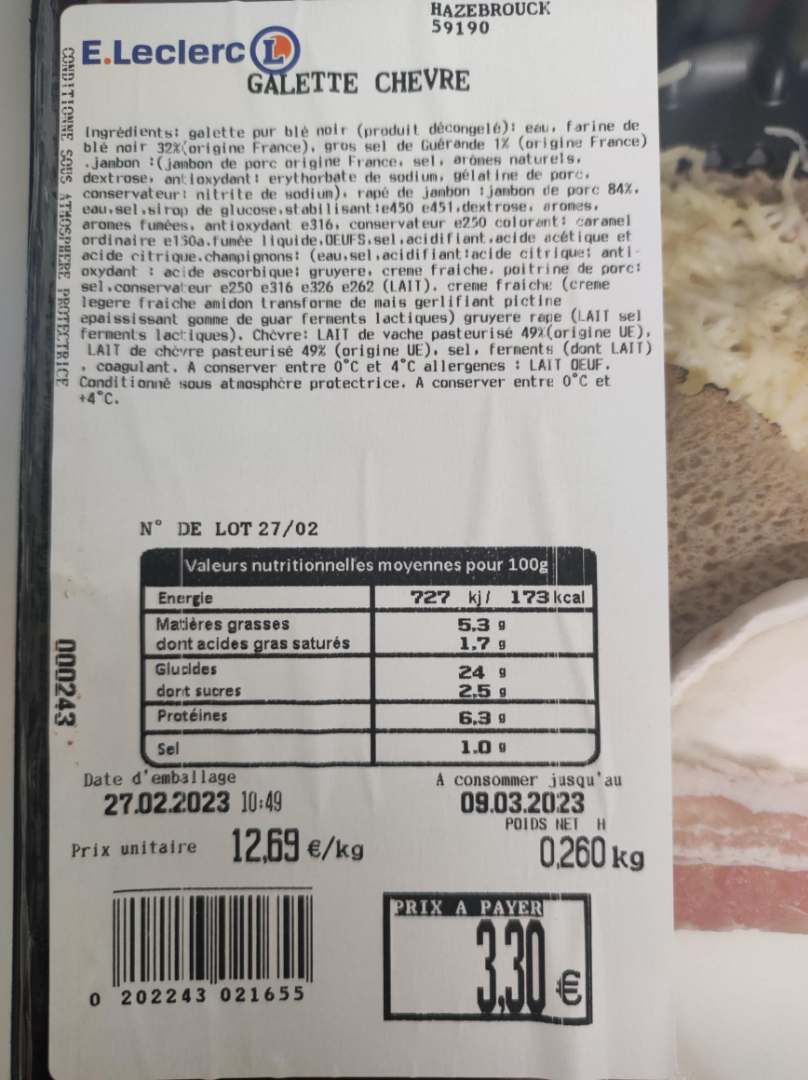
France – GOAT CHEESE CAKE AND COMPLETE CAKE – Listeria monocytogenes

Gov france

Identification information of the recalled product

  • Product category Feed
  • Product subcategory Prepared meals and snacks
  • Product brand name CATERER
  • Model names or references GOAT CAKE 0202243021655 COMPLETE CAKE 0202039019354
  • Identification of products
    GTIN Batch Date
    0202243021655 BATCH NUMBER FROM 27/02 Use-by date 09/03/2023
    0202039019354 BATCH NUMBER FROM 27/02 Use-by date 09/03/2023
  • Marketing start/end date From 02/27/2023 to 03/01/2023
  • Storage temperature Product to be stored in the refrigerator
  • Geographic area of ​​sale E.LECLERC HAZEBROUCK
  • Distributors E.LECLERC HAZEBROUCK

Practical information regarding the recall

  • Reason for recall When assembling the goat and wholemeal pancakes, Tradilège VPF 150g Smoked Ham Grate is used, which is affected by a product recall following the detection of the presence of Listeria monocytogenes.
  • Risks incurred by the consumer Listeria monocytogenes (causative agent of listeriosis)

RASFF Alerts – Salmonella – Polish Chicken Products – Sesame Seeds – Betel Leaves- Live Clams – Sesame Paste – Chilled Chicken Breast

RASFF

Salmonella Typhimurium in turkey meat from France via Belgium in France and the Netherlands

RASFF

Presence of Salmonella enteritidis in live clams (Venus gallina) from Italy in San Merino

RASFF

Salmonella in Indian Sesame seed in the Netherlands

RASFF

Salmonella in betel leaves from India in France

RASFF

Salmonella infantis in halal frozen chicken wings from Poland in Italy

RASFF

Salmonella spp. in sesame paste from Türkiye in Germany

RASFF

Salmonella enterica ser. Enteritidis (presence /25g) in frozen chicken fingers and chicken fillets from Poland in France

RASFF

Salmonella Mbandaka in chilled chicken breast from Ukraine in Hungary, Netherlands and Slovakia

RASFF Alert- Mycotoxin – Ochratoxin A – Pistachios – Dried Raisins – Nutmeg – Indian Rice – Roasted and Salted Pistachios

RASFF

Ochratoxin A in pistachios from Türkiye in Austria, Belgium, Germany, Luxembourg and Netherlands

RASFF

Ochratoxin A (91 ± 17 µg/kg) in dried raisins from Uzbekistan in Latvia

RASFF

Ochratoxin A in nutmeg from Indonesia in the Netherlands

RASFF

Ochratoxin A in Indian Rice in the Netherlands

RASFF

Ochratoxin A in roasted and salted pistachios from the United States in Austria, Belgium, Denmark, Finland, Germany, Luxembourg, Netherlands and Sweden