Category Archives: Decontamination Microbial

Kenya – How Safe Is That Plate Of Meat You Consume?

Kenya News

A significant portion of beef, goat meat and other meat products sold in butcheries and eateries in Nakuru is contaminated with a toxic cocktail of bacteria, a new report by researchers based at Egerton University has revealed.

The study which evaluated microbiological safety of meat and ready-to-eat (RTE) meat products in urban and peri-urban parts of the county, indicates that the presence of Staphylococcus aureusEscherichia coli (abbreviated as E. coli) salmonella spp and Shigella bacteria is worrying and efforts have to be put in place to cut on their levels.

Staphylococcus aureus was the most isolated negative bacteria in 87 beef and goat meat and other meat products samples, with a prevalence of 100 per cent, followed by Shigella spp in 81 samples (93 percent).

Staphylococcus aureus is a pathogen known to cause bloodstream infections, pneumonia, bone and joint infections and soft tissue infections, while infection with some strains of Shigella spp can result in diarrhea (sometimes bloody), fever, and stomach cramps.

The report compiled by lead investigators Dr. Hillary Odeckh Indago, Prof. Joseph Wafula Matofari and Dr. John Masani Nduko further notes that all the 15 samples of water randomly collected from the butcheries and eateries tested positive for E. colisalmonella spp and Shigella bacteria.
CDC issues Salmonella alert for people traveling to Mexico

Food Safety News

Public health officials in the United States are warning travellers who have spent time in Mexico to be aware of multidrug-resistant strains of Salmonella Newport.

The Centers for Disease Control and Prevention reports that some travellers have been infected with the strains, which have developed the ability to defeat drugs designed to kill them. Salmonella infections from the strains can be difficult to treat and result in very serious illnesses.

“Many travelers with MDR (multidrug-resistant) Salmonella Newport infections reported eating beef, cheese — including queso fresco and Oaxaca— beef jerky, or dried beef — carne seca — before they got sick,” according to the alert from the CDC.

Research – USDA Discovers 33 New Mycotoxin-Producing Fungi Species

Food Safety Magazine

The U.S. Department of Agriculture’s Agricultural Research Service (USDA’s ARS) has discovered 33 new species of mycotoxin-producing fungi belonging to the genus Fusarium.

According to ARS scientists, many Fusarium species produce harmful secondary metabolites in plant tissues including trichothecenes, which are among the mycotoxins of greatest concern to food safety and human health. Not only do mycotoxins present an immediate threat to livestock and humans as they can cause illness, they may also be carcinogenic if consumed regularly over a prolonged period.

USA – FDA – Core Outbreak Investigation Table Update

FDA

What’s New

  • For the Listeria monocytogenes outbreak (ref# 1106) in a not yet identified product, traceback has been initiated.
  • For the Salmonella Mississippi outbreak (ref# 1097) in a not yet identified product, the case count changed from 102 to 103.
  • For the Salmonella Senftenberg outbreak (ref# 1087) in a not yet identified product, the case count changed from 27 to 30.
  • For the Salmonella Typhimurium outbreak (ref# 1095) in a not yet identified product, the case count changed from 78 to 84.
  • For the Cyclospora outbreak (ref# 1080) in a not yet identified product, the case count changed from 79 to 81

Nestlé eyes November re-opening of E. coli-hit Buitoni plant

Just Food

Nestlé is lining up the return of production at a Buitoni factory in France at the centre of a fatal E. coli outbreak earlier this year.

The world’s largest food maker said the site, located in Caudry in northern France, could see output resume in November, subject to the approval of local officials.

France’s national public health agency, Santé Publique France, made its first statement on rising cases of haemolytic uremic syndrome (HUS) or Shiga toxin-producing E. coli (STEC) on 25 February.

What Are Common Food Poisoning Pathogen Incubation Periods?

Food Safety Gov

Check out the fact sheets at the link above.

Bacteria and Viruses

Bacteria and viruses are the most common cause of food poisoning. The symptoms and severity of food poisoning vary, depending on which bacteria or virus has contaminated the food.

To prevent illness, always follow the food safety steps: cleanseparatecook, and chill. Other prevention tips for specific bacteria and viruses are included below.

The bacteria and viruses that cause the most illnesses, hospitalizations, or deaths in the United States are described below and include:

Other important bacteria and viruses that cause foodborne illness include:

New Zealand strengthens tahini controls after outbreak

Food Safety News

Authorities in New Zealand have tightened the import rules around tahini and halva from Syria following a recall and outbreak.

An outbreak of Salmonella Kintambo earlier this year involved three patients who had consumed sesame-based products from Syria. Two people were hospitalized. Sequencing of clinical isolates showed cases were closely genetically related and had the same sequence type as in an ongoing European outbreak linked to the same type of products.

In July, Middle East recalled specific batches of Algota brand Sesame Tahini because of the possible presence of Salmonella.

New Zealand Food Safety testing of tahini and halva products found Salmonella Kintambo, Salmonella Amsterdam and Salmonella Orion.

The agency has amended the sampling plan for such high risk products. Changes mean all consignments of crushed sesame seed products, such as tahini and halva, must be sampled and tested for Salmonella, when exported from Syria or if they originate from the country.

Research – Risk Assessment of Norovirus Transmission in Food Establishments

FDA

The Risk Assessment of Norovirus Transmission in Food Establishments: Evaluating the Impact of Intervention Strategies and Food Employee Behavior (Duret et al. 2017) evaluates the dynamics of norovirus transmission from ill or infected food employees in food establishments (restaurant setting) to ready-to-eat food and consumers during food preparation and also evaluates the impact of prevention strategies. A discrete event model was developed to study norovirus transmission from the soiled hands of ill or infected food employees and the impact of prevention strategies and their compliance on the prevalence of contaminated servings and the number of resulting infected customers.

The Evaluation of the Impact of Compliance with Mitigation Strategies and Frequency of Restaurant Surface Cleaning and Sanitizing on Control of Norovirus Transmission from Ill Food Employees Using an Existing Quantitative Risk Assessment Model (Fanaselle et al. 2022) uses the previously published FDA quantitative risk assessment model in Duret et al. 2017, to evaluate more than 60 scenarios examining the impact of implementation and compliance with recommendations in the FDA Food Code for: restaurant surface cleaning and sanitizing, hand hygiene and employee health.

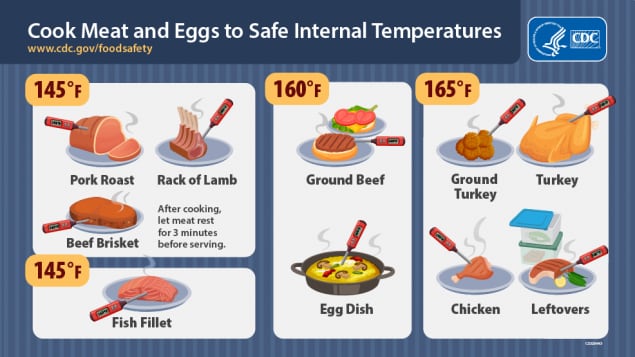
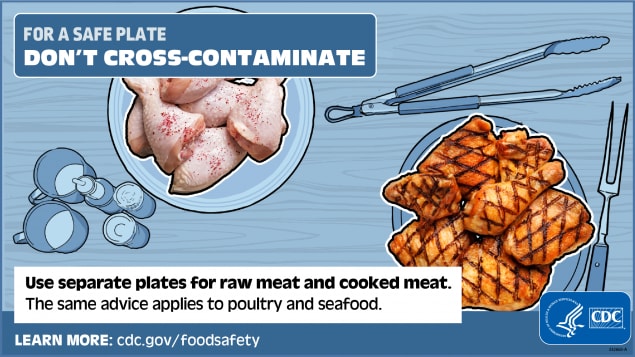
Information – CDC Food Safety Social Media Graphics

CDC

A whole range of free food safety graphics are available at the link above 🙂

Cook Meat and Eggs to a Safe Internal Temperature

Food Safety Education Month Facebook image 7

Telangana: 27 children take ill, hospitalised due to suspected food poisoning.

Live Mint

A total of 27 children were reportedly hospitalised due to food poisoning in Adilabad, said the officials on Tuesday. These children were taken to the hospital after they complained of nausea and vomiting. District Magistrate, Adilabad Prabhakar Reddy said, “yesterday night, 27 children from Kaga Nagar Minority Boys hostel Gurukul were admitted to a local hospital complaining of vomiting and nausea. A detailed inquiry has been ordered and we are investigating the matter,” according to ANI report.

The tragic incident took place after the cooks avoided washing grains and rice before cooking due to a shortage of staff,