Category Archives: Bacillus cereus

RASFF Alert – Bacillus cereus – Spicy Smoked Paprika Powder

RASFF-Logo

RASFF – Bacillus cereus (up to 23000 CFU/g) in spicy smoked paprika powder from Spain in Austria

Research – Biofilm-forming ability of pathogenic strains isolated from retail food in Poland

Journal of Food Protection

Biofilms have a significant impact on food safety in the food industry. Many foodborne outbreaks have been associated with pathogenic strains that can form a biofilm. The present study aimed to examine the ability to form biofilms by pathogenic strains collected from retail food samples under the Official Control and Monitoring Program in Poland. Biofilm formation was assessed by the qualitative detection of EPS production on Congo Red Agar, tube method, crystal violet biofilm assay, and MTT assay. A total of 40 isolates from food samples (10 strains for each of the species Listeria monocytogenes, Staphylococcus aureus, Escherichia coli, and Bacillus cereus ) were examined. . . The study classifies strains as adherent strain, slightly adherent, nonadherent (A, SA and N); as weak, moderate, and strong biofilm formation (WBF, MBF and SBF); and weak, moderate, and high metabolic activity (WMA, MMA and HMA). Incubation conditions and time influenced the biofilm levels formed. Moreover, growth medium had a significant impact on biofilm formation. Results showed that 22.5% strains demonstrated A type in LBB and 77.5% SA type in LBB in the test tube while the stronger adhesion was obtained in BHI with 2% sucrose. Among the isolates incubated in the BHI medium with 2% sucrose, A type was observed in 60% of isolates (60%).. CV assay result show that the after 24 h incubation in LBB, SBP was 7,5% while after 48 h – 37.5% tested strains. For BHI medium supplemented with 2% sucrose after 24 h incubation strains 42.5% was classified as SBP and 37.6% after 48h.MTT assay result indicate that 15% strains incubate in LBB (24h) was HMA, and after 48h incubation time HMA show 25%. For BHI medium supplemented with 2% sucrose after 24 h or 48 h incubation strains 70% and 85 % was classified as HMA.

Research – Microbiological Quality of Cooked Chicken: Results of Monitoring in England (2013-17)

JFP

Results from monitoring of the microbiological quality of 2,721 samples of ready-to-eat cooked chicken collected between 2013 to 2017 in England were reviewed: 70% of samples were from retail, catering or manufacture and 30% were imported and collected at English ports. Samples were tested for a range of bacterial pathogens and indicator organisms. Six samples (<1%) had unsatisfactory levels of pathogens which were potentially injurious to health. Neither Salmonella nor Campylobacter were recovered from any sample. Two samples from catering settings contained either an unsatisfactory level of Bacillus cereus (5 x 10 6 CFU/g) or an unsatisfactory level of coagulase positive staphylococci (1.6 x 10 4 CFU/g). Listeria monocytogenes was recovered from 36 samples (one at manufacture, 26 at catering and nine at retail) and in four instances, unsatisfactory levels (≥10 2 CFU/g) were detected (three samples collected at catering and one at retail). For L. monocytogenes there were no significant differences between the rates of contamination with between the samples collected from ports, manufacture, retail supermarkets and other retailers (p = 0.288). There were no differences between the rates of contamination for other potential pathogens detected between samples from different settings. The prevalence of hygiene indicators ( Escherichia coli , Enterobacteriaceae and Aerobic Colony Counts) at import was significantly lower than in samples collected from manufacturers, retail or catering (p < 0.01). Samples collected from catering gave poorer results than all other settings. Regardless of the stage in the food chain, samples from Thailand and from other non-EU countries were of significantly better microbiological quality with respect to indicator organisms than those from the UK or from other EU countries (p = <0.001).

Research – Optimization on antimicrobial effects of surfactin against Bacillus cereus spore

JFP

Abstract :The purpose of this study was to establish a three-variable bactericidal model of temperature, time, and concentration to determine the optimal conditions for Bacillus cereus  spore inactivation by surfactin. In order to obtain the binary regression equation of the inactivated spore model, a total of 17 simulations were performed using response surface methodology. The experimental results showed that the three factors each had a discernible but non-equal impact on the inactivation response value. Multiple regression analysis of experimental results using Design-Expert software yielded as the following equation: Optimal inactivation of spores was achieved by treatment with surfactin at a concentration of 4 mg/ml for 40 h at 53 °C, with the response value reaching 1.8. The spores were treated with surfactin under these conditions; the microstructural changes of spores were observed by scanning electron microscopy. We found that the structures of the outer wall of the spores were damaged, while the spores in the control sample showed no visible damage.

New Zealand – Soyummy brand Dr. Fermented Bean Paste – Bacillus Cereus

MPI

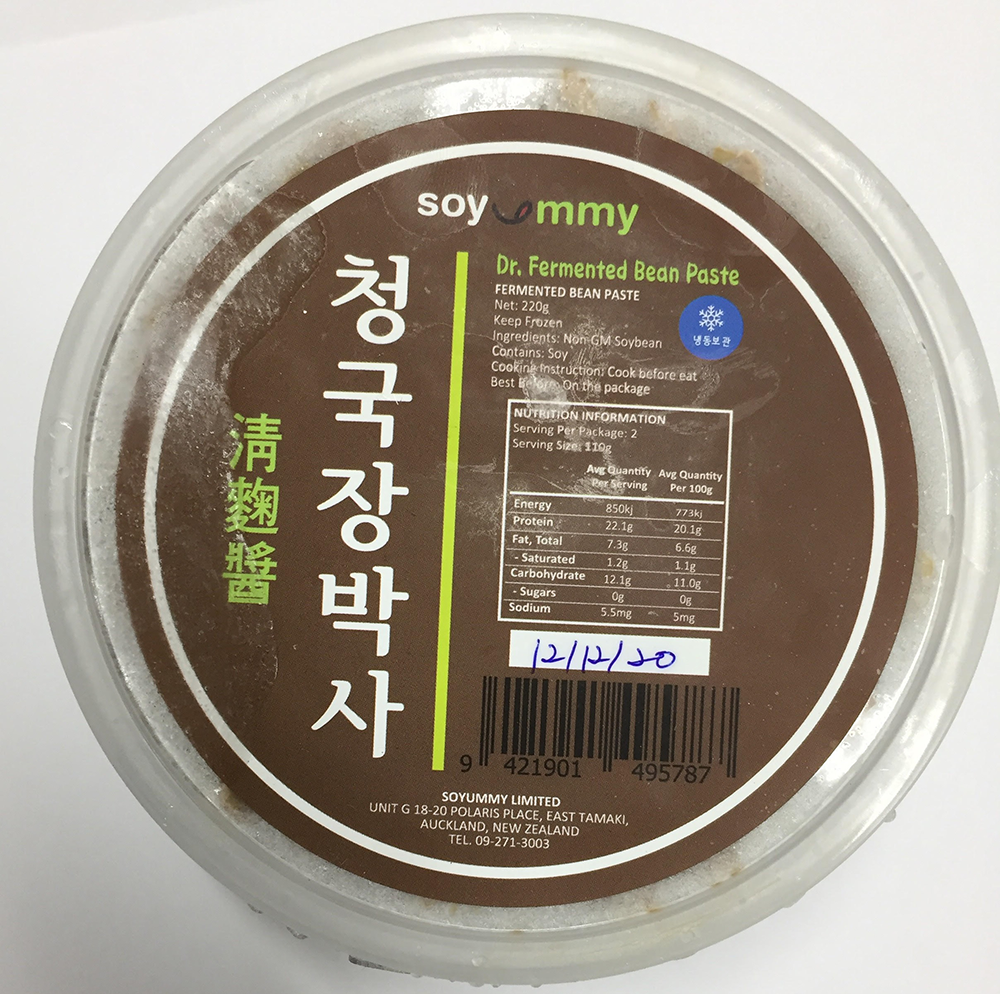
Soyummy Ltd is recalling specific batches of its Soyummy brand Dr. Fermented Bean Paste as the product contains elevated levels of Bacillus cereus bacteria.

Frozen plastic tub of Soyummy brand Dr. Fermented Bean Paste.
Soyummy brand Dr. Fermented Bean Paste (220g tub).


Product identification
Product type Soybean paste
Name of product (size) Soyummy brand Dr. Fermented Bean Paste (220g tub)
Date marking Best before: 30/09/20 and 13/12/20
Package size and description The product is sold frozen in a 220g plastic tub.
Distribution The affected product is sold in ethnic grocery stores throughout Auckland.
Notes This recall does not affect any other Soyummy brand products.

Consumer advice

Customers are asked to check the best before date on the lid of the product.

Affected product should not be consumed. There have been no reports of associated illness, however if you have consumed any of this product and have any concerns about your health, seek medical advice.

Customers should return the product to their retailer for a full refund.

Who to contact

If you have questions, contact Soyummy Limited:

  • Phone: 021 0261 4140
  • Address: Unit G, 18 Polaris Place, East Tamaki, Auckland.

Research – Essential Oils: Their Antibacterial Properties and Potential Applications in Foods–A Review

Pub Med

Abstract

In vitro studies have demonstrated antibacterial activity of essential oils (EOs) against Listeria monocytogenes, Salmonella typhimurium, Escherichia coli O157:H7, Shigella dysenteria, Bacillus cereus and Staphylococcus aureus at levels between 0.2 and 10 microl ml(-1). Gram-negative organisms are slightly less susceptible than gram-positive bacteria. A number of EO components has been identified as effective antibacterials, e.g. carvacrol, thymol, eugenol, perillaldehyde, cinnamaldehyde and cinnamic acid, having minimum inhibitory concentrations (MICs) of 0.05-5 microl ml(-1) in vitro. A higher concentration is needed to achieve the same effect in foods. Studies with fresh meat, meat products, fish, milk, dairy products, vegetables, fruit and cooked rice have shown that the concentration needed to achieve a significant antibacterial effect is around 0.5-20 microl g(-1) in foods and about 0.1-10 microl ml(-1) in solutions for washing fruit and vegetables. EOs comprise a large number of components and it is likely that their mode of action involves several targets in the bacterial cell. The hydrophobicity of EOs enables them to partition in the lipids of the cell membrane and mitochondria, rendering them permeable and leading to leakage of cell contents. Physical conditions that improve the action of EOs are low pH, low temperature and low oxygen levels. Synergism has been observed between carvacrol and its precursor p-cymene and between cinnamaldehyde and eugenol. Synergy between EO components and mild preservation methods has also been observed. Some EO components are legally registered flavourings in the EU and the USA. Undesirable organoleptic effects can be limited by careful selection of EOs according to the type of food.


RASFF Alert – Bacillus cereus- Chilled Veal Dish

RASFF-Logo

RASFF – Bacillus cereus (1.5x10E6 CFU/g) in chilled veal dish from Austria in Austria

France – New report documents rise in foodborne illness outbreaks in France

Food Safety News

More than 1,600 foodborne outbreaks were declared in France in 2018 affecting 14,700 people with two deaths, according to statistics published by the national public health agency.

A total of 1,630 illness outbreaks were reported involving 14,742 people, and 777 of them needed hospital treatment.

Santé Publique France said the number has gone up from 2017 when 1,310 outbreaks were recorded affecting 13,010 people.

The two people that died were more than 85 years old. The first death was because of microbiologically confirmed poisoning from Bacillus cereus. The second followed intoxication where Bacillus cereus and Clostridium perfringens were suspected.

Information – Common Symptoms of All of the Food Poisoning Pathogens

Food Poisoning Bulletin

Food poisoning outbreaks occur every year in the United States. These outbreaks can be caused by bacteria such as E. coli, Salmonella, Listeria Monocytogenes, Clostridium botulinum, Campylobacter, Shigella, Staphylococcus aureus, Brucella, Vibrio, and Bacillus cereus; and viruses such as norovirus and hepatitis A. At least 48,000,000 Americans are sickened with food poisoning every year. Do you know the common symptoms of all of the food poisoning pathogens? Follow the link above to find out.


RASFF Alert- Bacillus cereus – Dark Chocolate Insect Protein Bar

RASFF-Logo

RASFF – Bacillus cereus diarrhoeal enterotoxin (3.8x10E3) in dark chocolate insect protein bar from France in Germany