Category Archives: Research

Research – Are Frozen Fruits and Vegetables Healthy and Safe?

Consumer Reports

At Consumer Reports, we’ll always tell you what we find with our testing—it’s important to highlight when products and services excel and when they fall short. When we look at food through a safety lens, unfortunately we often find reasons to be concerned—whether that’s because of substances like heavy metals in supplements, baby food, or spices, or disease-causing bacteria such as E. coli in ground beef.

But sometimes, as is the case with CR’s recent tests of frozen fruits and veggies, we get good news. Our food scientists recently tested more than 300 samples of eight types of frozen produce and didn’t find any harmful bacteria.

Most frozen vegetables are blanched in hot water or steamed before freezing, which may lead many to think they are already cooked and risk free—people let their toddlers snack on frozen veggies, or might toss them into a salad without cooking them first. But though frozen produce is convenient and generally safe, it may still harbor bacteria that cause foodborne illness, such as Listeria monocytogenes or salmonella.

Read more at the link above.

Research – What Is Listeria Meningitis? Causes, Treatment, and More

Healthline

Listeria meningitis is a type of bacterial meningitis that is a serious complication of a listeria infection. Without prompt treatment, it can quickly become life threatening. After recovering from meningitis, some people are left with permanent disabilities.

Meningitis involves inflammation and swelling of the protective membranes, called meninges, that surround the brain and spinal cord. This can happen for many reasons, including injury and infection.

Listeria infection, also called listeriosis, is a rare disease caused by the bacteria called Listeria monocytogenes. According to the Food and Drug Administration (FDA)Trusted Source, almost all cases stem from consuming contaminated food. It’s most likely to affect pregnant people, newborns, and those with a weakened immune system.

We’ll overview what causes listeria meningitis to occur, how to treat it, prevention, and more.

Research – Preventing Food Poisoning

Food Poisoning News

Food poisoning is a common, yet potentially serious environmental health issue. The occurrence of food poisoning can be reduced by following some simple rules while preparing, cooking, and serving food.

The most common causes of food poisoning are bacteria, viruses, or parasites that are present in foods that are contaminated with human or animal feces or their toxins. Most of the food poisoning cases are due to the consumption of foods that have not been thoroughly cooked or properly stored.

All these micro-organisms that cause food poisoning can be killed if they are exposed to adequate heat for a sufficient time, as in cooking or pasteurization.

USA – Annual Reports on Foodborne Illness Source Attribution Estimates

CDC

Foodborne Illness Source Attribution Estimates for SalmonellaEscherichia coli O157, Listeria monocytogenes, and Campylobacter Using Multi-Year Outbreak Surveillance Data, United States.

Latest Report for 2019

IFSAC analyzed data from 1,532 foodborne disease outbreaks that occurred from 1998 through 2019 to assess which categories of foods were most responsible for SalmonellaE. coli O157, Listeria monocytogenes, and Campylobacter infections. These pathogens were chosen because of the frequency or severity of the illnesses they cause, and because targeted interventions can have a major impact in reducing them. The implicated foods were divided into 17 categories for the analysis, and the method gives the greatest weight to the most recent five years of outbreak data (2015–2019).

Read the 2019 report pdf icon[PDF – 14 pages]

USA – Listeria was Top Pathogen Source of Recalls and Related Deaths in 2021

Food Poisoning Bulletin

In-depth analysis from Food Poisoning Bulletin 

Listeria was the top pathogen source of food recalls and related deaths in 2021, according to an in-depth analysis by Food Poisoning Bulletin. After our second annual analysis of recalls for meat and poultry, which are regulated by the U.S. Department of Agriculture (USDA), we turned our attention to recalls for all other foods which are regulated by the U.S. Food and Drug Administration (FDA). The Listeria findings are some of the key takeaways from our deep dive into 2021 food recalls.

Research – Researchers discover way to disarm potentially deadly Listeria bacteria

UQ EDU

University of Queensland researchers have unlocked a way of fighting Listeria infections, which can cause severe illness in pregnant women and people with compromised immune systems.

During the study, researchers discovered a way to block Listeria from making the proteins that allow bacteria to survive and multiply in immune cells.

UQ Diamantina Institute’s Professor Antje Blumenthal said using a small, drug-like inhibitor has improved their understanding of the Achilles heel of Listeria.

“Listeria is found in the soil and sometimes in raw foods. Once ingested it can hide from the immune system and multiply inside immune cells,” Professor Blumenthal said.

“Instead of killing the bacteria, the immune cells are used by the bacteria to multiply and are often killed by Listeria growing inside them.

“Our study showed the bacteria could be cleared with a small drug-like inhibitor that targets the ‘master regulator’ of the proteins that help Listeria grow in immune cells. The inhibitor helped the immune cells survive infection and kill the bacteria.”

Until now, studies into the ‘master regulator’ – which controls critical proteins that make Listeria virulent ­­– have mostly been based on engineered bacteria, or mutated versions of these proteins.

“By using a drug-like inhibitor, we were able to use molecular imaging and infections studies to better understand what happens to Listeria when the bacteria cannot effectively grow inside immune cells and hide from immune defence mechanisms,” Professor Blumenthal said.

“We hope that our discovery, together with recent research into the master proteins’ molecular structure and functions, could guide the development of inhibitors and new drugs to treat Listeria infection.”

Listeria infection does not cause disease in most people, but can be deadly for the immunocompromised and is also a major health concern during pregnancy and can lead to miscarriage, stillbirth and premature birth.

“Our findings could also inform design of inhibitors against related proteins that are found in different bacteria,” Professor Blumenthal said.

The study has been published in the journal PLOS Pathogens (DOI: 10.1371/journal.ppat.1010166).

This study, led by researchers at The UQ Diamantina Institute, included collaborations with Umeå University, Sweden; UQ School of Chemistry and Molecular Biosciences; Australian Infectious Diseases Research Centre; Institute for Molecular Bioscience; Mater Research Institute; Telethon Kids Institute, University of Western Australia; Monash University; University of Melbourne at the Peter Doherty Institute for Infection and Immunity and Hudson Institute of Medical Research.

Media: PRofessor Antji Blumenthal, a.blumenthal@uq.edu.au; UQ Communications, Angie Trivisonno, med.media@uq.edu.au, +61 (0)7 3365 5118, +61 (0)436 368 746.

Research – What Is Cyclospora?

Food Poisoning News

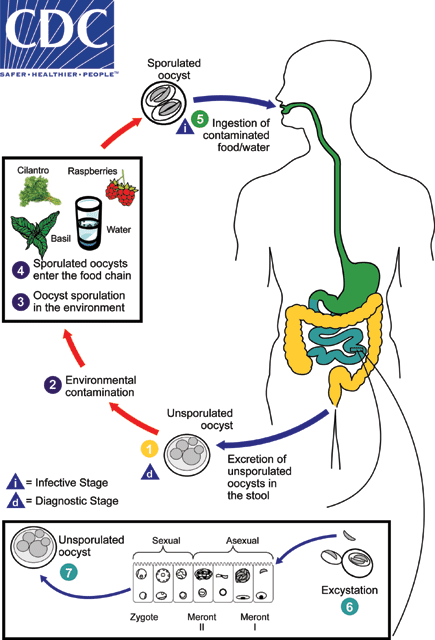
Cyclospora cayetanensis is a protozoan parasite that causes the diarrheal illness known as cyclosporiasis. People acquire this infection by consuming food or water contaminated with feces containing Cyclospora. Cyclosporiasis was not previously a reportable disease in the U.S., so its rise in prevalence is due in large part to the increased availability of tests that can detect Cyclospora. It is now a nationally notifiable disease, so physicians are required to report cases of this infection.

The first three cases of cyclosporiasis were reported in 1977 and 1978, but the parasite that was causing the illnesses could not at that time be identified as Cyclospora cayetanensis; it was not until 1979 that the correct identification was made.

Research – Modelling the Potential Risk of Infection Associated with Listeria monocytogenes in Irrigation Water and Agricultural Soil in Two District Municipalities in South Africa

MDPI

Listeria monocytogenes (L. monocytogenes) is the etiologic agent of listeriosis which significantly affects immunocompromised individuals. The potential risk of infection attributed to L. monocytogenes in irrigation water and agricultural soil, which are key transmission pathways of microbial hazards to the human population, was evaluated using the quantitative microbial risk assessment modelling. A Monte Carlo simulation with 10,000 iterations was used to characterize the risks. High counts of L. monocytogenes in irrigation water (mean: 11.96 × 10² CFU/100 mL; range: 0.00 to 56.67 × 10² CFU/100 mL) and agricultural soil samples (mean: 19.64 × 10² CFU/g; range: 1.33 × 10² to 62.33 × 10² CFU/g) were documented. Consequently, a high annual infection risk of 5.50 × 10⁻² (0.00 to 48.30 × 10⁻²), 54.50 × 10⁻² (9.10 × 10⁻³ to 1.00) and 70.50 × 10⁻² (3.60 × 10⁻² to 1.00) was observed for adults exposed to contaminated irrigation water, adults exposed to contaminated agricultural soil and children exposed to agricultural soil, respectively. This study, therefore, documents a huge public health threat attributed to the high probability of infection in humans exposed to L. monocytogenes in irrigation water and agricultural soil in Amathole and Chris Hani District Municipalities in the Eastern Cape province of South Africa. View Full-Text

Research – Wildlife Waterfowl as a Source of Pathogenic Campylobacter Strains

MDPI

Background: The aim of the study was to determine whether free-living birds belonging to game species whose meat is used for human consumption can constitute a reservoir of pathogenic Campylobacter strains, spreading these bacteria to other hosts or directly contributing to human infection. Methods: A total of 91 cloacal swabs were taken from different species of wildlife waterfowl to estimate the Campylobacter prevalence, the genetic diversity of the isolates, and the presence of virulence genes and to evaluate the antimicrobial resistance. Results: The presence of Campylobacter spp. was confirmed in 32.9% of samples. Based on flaA-SVR sequencing, a total of 19 different alleles among the tested Campylobacter isolates were revealed. The virulence genes involved in adhesion were detected at high frequencies among Campylobacter isolates regardless of the host species. The highest resistance was observed for ciprofloxacin. The resistance rates to erythromycin and tetracycline were observed at the same level. Conclusions: These results suggest that wildlife waterfowl belonging to game species may constitute a reservoir of Campylobacter, spreading these bacteria to other hosts or directly contributing to human disease. The high distribution of virulence-associated genes among wildlife waterfowl Campylobacter isolates make them potentially able to induce infection in humans.

Research – Probiotic Lactobacilli Do Not Protect Chickens against Salmonella Enteritidis Infection by Competitive Exclusion in the Intestinal Tract but in Feed, Outside the Chicken Host

MDPI

Lactobacilli are commonly used as probiotics in poultry to improve production parameters and to increase chicken resistance to enteric infections. However, lactobacilli do not efficiently colonise the chicken intestinal tract, and also, their anti-infection effect in vivo is sometimes questionable. In this study, we therefore evaluated the potential of a mixture of four Lactobacillus species (L. salivariusL. reuteriL. ingluviei and L. alvi) for the protection of chickens against Salmonella Enteritidis infection. Whenever the chickens were inoculated by lactobacilli and S. Enteritidis separately, there was no protective effect of lactobacilli. This means that when lactobacilli and S. Enteritidis are exposed to each other as late as in the crop of chickens, lactobacilli did not influence chicken resistance to S. Enteritidis at all. The only positive effect was recorded when the mixture of lactobacilli and S. Enteritidis was used for the inoculation of feed and the feed was anaerobically fermented for 1 to 5 days. In this case, chickens fed such a diet remained S. Enteritidis negative. In vitro experiments showed that the protective effect was caused by acidification of feed down to pH 4.6 due to lactobacilli fermentation and was associated with S. Enteritidis inactivation. The probiotic effect of lactobacilli was thus expressed in the feed, outside the chicken host. View Full-Text