Category Archives: Microbiology Investigations

Research – Marine Harmful Algal Bloom (HAB)-Related Illness Tracking

OEHHA

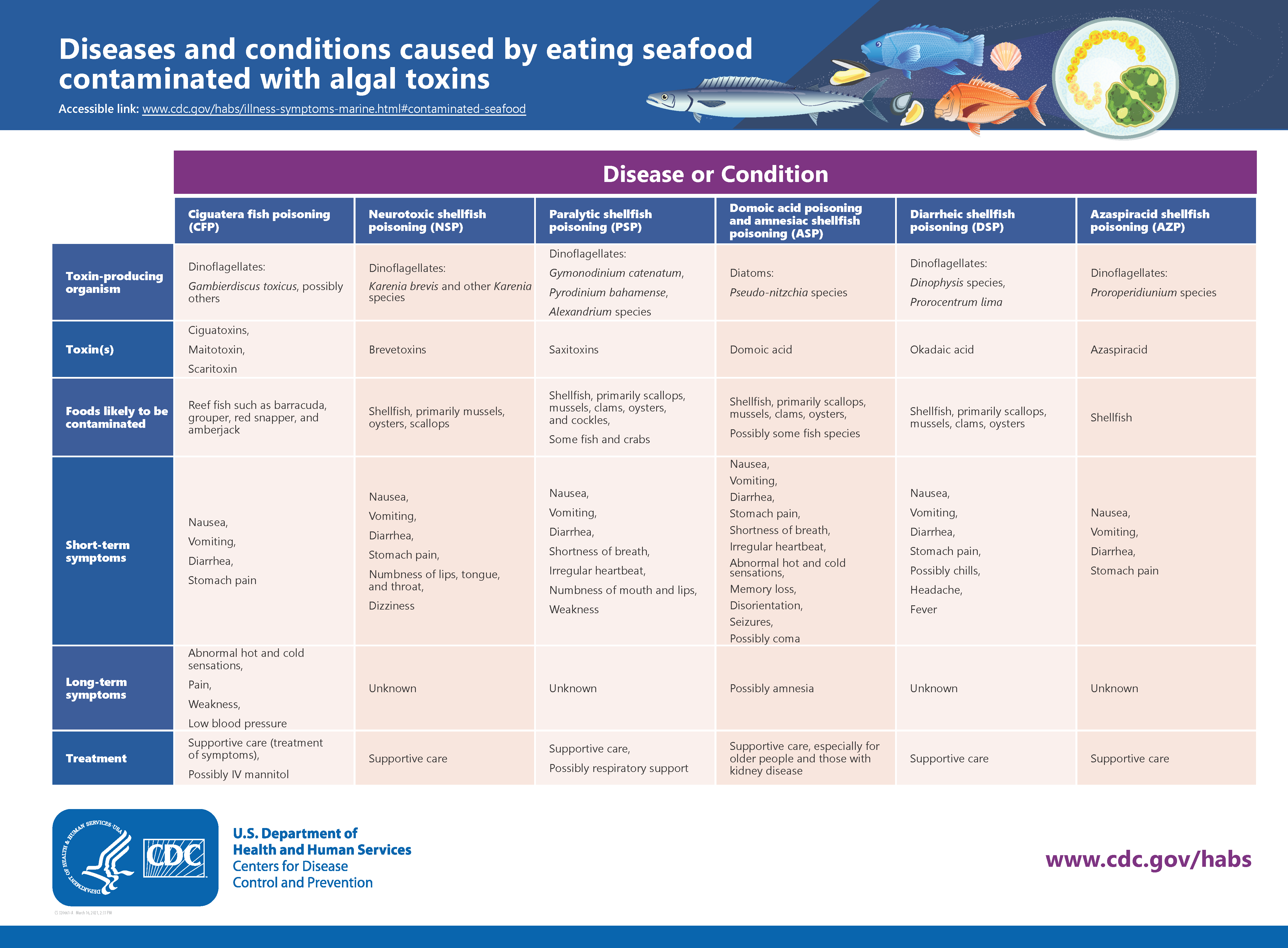
Diseases and conditions caused by eating seafood contaminated with algal toxins

What are marine harmful algal bloom (HAB)-related illnesses?

When phytoplankton and algae in marine waters occur at levels that pose a health risk to humans, animals, and the environment, they are referred to as marine harmful algal blooms (HABs). The US Centers for Disease Control and Prevention (CDC) provide resources on potential human and animal exposures to marine HABs or associated marine biotoxins via skin contact or inhalation, or consumption of fish and shellfish.

Research – Publisher’s Platform: Colonel Colon and his League of Faecal Fighters coming soon to help make your food safer

Food Safety News

Over a decade ago, the mom of two clients who both developed acute kidney failure after consuming E. coli O157:H7-tainted spinach sent me an unexpected present. The outbreak sickened over 205 people, killing five, sending hundreds to the hospital, many with life-altering complications. The gift was a bobble-head that bore a similarity to a younger version on me. On the base it said: “Colonel Colon and his League of Fecal Fighters.” It sits on my desk today.

I have always thought of doing something with the gift, and with the talent of my incredible niece, Janae Dueck, and borrowing from the work of the good food people at the FDA and FSIS, and idea is brewing of a way to help educate us all to be Fecal Fighters.

Over the next year we will be working on comic book, a cartoon video about the adventures of these superheroes, and a food safety jingle (thanks to my friend Vincent).

Read More at the Link Above

India – 11-year-old dies, 4 others ill after taking food at Madrasa

New Indian Express

GUNTUR: A 11-year-old boy died of suspected food poisoning and four other children were hospitalised after reportedly having breakfast served at a madrasa in Palnadu district on Saturday. Police said as many as 18 boys were studying at the Islamia Nurul Huda madrasa in Gurazala.

Gurazala Deputy Superintendent of Police (DSP) Jayaram said preliminary investigation revealed that the boys had consumed food that was brought to the madrasa by a local resident, Hafeez, who had held a house-warming ceremony on Friday night. “The five boys ate the leftover food on Saturday morning and took ill after a couple of hours. Initially, we suspected that the roselle used in the food was not properly cleaned, and had pesticide residue,’’ he said. Hafeez is a pesticide dealer.

The body of the deceased was sent to hospital for post-mortem, police said, adding the cause of the death could be ascertained after getting the autopsy report.

USA – FDA reports illnesses linked to Daily Harvest product have more than doubled

Food Safety News

The number of complaints of illnesses related to Daily Harvest brand French Lentil & Leek Crumbles has more than doubled since the FDA’s report on June 30.

As of July 14 the Food and Drug Administration is reporting 277 reports from people who ate the frozen crumbles. The agency continues to advise people to not eat the product and to check their freezers for it. As of June 30, 133 people had reported illnesses to the FDA. The company has reported receiving more than 470 reports.

India – Food poisoning at RGUKT Basara, 500 students admitted to hospital

The Hindu

Nearly 500 students of the Rajiv Gandhi University of Knowledge Technologies (RGUKT), Basara, were taken ill on Friday due to suspected food poisoning.

The students were treated locally, while some were shifted to Nizamabad for better treatment. It is suspected that fried rice made with rotten eggs could have led to food poisoning. However, officials have not revealed the exact reason.

Research – Epidemiological and microbiological investigation of a large increase in vibriosis, northern Europe, 2018

Eurosurveillance

Food Illness

The habitat of  spp. bacteria is fresh and brackish water with moderate salinity. Non-toxigenic , as well as several human pathogenic non-cholera  species, including  and , cause vibriosis after seawater exposure or consumption of contaminated seafood [1]. Clinical manifestations range from mild gastroenteritis and otitis to wound infections that may lead to severe necrotising fasciitis and septicaemia with a potentially fatal outcome [25].

The Baltic Sea region is one of the areas where increasing numbers of cases related to  species causing vibriosis (VCV) have been reported in the last decades [6]. Several studies have shown how the occurrence of heatwaves, which lead to an increase in sea surface temperature, are linked with an increase in the number of reported vibriosis cases [4,712]. For instance, the years with an especially warm summer in the Baltic Sea region, 2006, 2010 and particularly 2014 (the warmest year in historical records at the time), were also the years with the largest number of vibriosis cases reported [6,11].

However, there is a notable gap in surveillance data for vibriosis since it is not a notifiable disease in the majority of European countries [1,6]. Therefore, the aim of this multi-country study was to describe the epidemiology of vibriosis cases in countries bordering the North and Baltic Seas area during the exceptionally warm year of 2018 [13,14], in order to investigate the extent of these infections in the study countries, map their genetic diversity, understand the predictors for developing severe vibriosis, and propose recommendations for public health measures.

Finland – Food Safety in Finland 2021

This report presents the 2021 results of regulatory control related to food safety, official controls and monitoring programmes on food and feed, as well as research and risk assessments.
The report also assesses, based on the results, the status of food safety and future needs for regulatory activities in Finland.
The report extends the annual report referred to in the EU Control Regulation (EU) No. 2017/625 on official control with respect to food safety; the annual report describes the results of the control in the various sectors of the food supply chain as a whole.
The results of official controls and investigations from 2021 indicate that the control works well and the level of food safety is good. The investigation of epidemics has developed, and the number of epidemics caused by unknown reasons was the smallest in years.
The export controls required by export countries were continued in accordance with the programmes. The number of food recalls has continued to increase dramatically. In 2021, more than 19,000 Oiva reports were published, which is an increase of 19 per cent from the previous year. Control was carried out through prioritised work. The new Food Act and the decrees issued under it entered into force in April 2021.

Switzerland – Swiss outbreaks triple in 2021; illnesses also rise

Food Safety News

The number of foodborne outbreaks almost tripled in Switzerland in 2021 compared to the year before.

This past year, 37 outbreaks were reported with 540 people sick and 40 hospitalized versus 13 outbreaks in 2020.

Officials at the Federal Food Safety and Veterinary Office said the increase could be random, it could be due to better reporting and data collection or it could show the food safety situation has gotten worse, possibly because of the COVID-19 pandemic and other challenges facing businesses.

The agent was unknown in 17 outbreaks but Salmonella caused seven, norovirus four, Campylobacter three, two were due to Bacillus cereus and one each because of Shiga toxin-producing E. coli, Clostridium perfringens and hepatitis E.

Research – WHO Seeks Experts on Microbial Hazards

Food Safety News

The World Health Organization (WHO) is looking for people with experience on risk assessment of microbiological hazards.

The call comes as the Joint FAO/WHO Expert Meeting on Microbiological Risk Assessment (JEMRA) is renewing its expert roster for January 2023 to December 2027.

JEMRA is an international scientific expert group run by the Food and Agriculture Organization of the United Nations (FAO) and WHO. Meetings are convened on an ad-hoc basis, depending on requests from Codex.

One of the main aims is to provide a review of scientific advice on the state of microbiological risk assessment, and to develop the means of achieving risk assessments for specific pathogen -commodity combinations. Work often includes an evaluation of the impacts of different risk management options in the reduction or control of microbiological risks in food based on an analysis of the available knowledge.

LINK

Israel – SFS pastries – Ogle brand – Mould

GovIL

See link above for the recall