Category Archives: Microbiological Risk Assessment

USA – FDA Core Table – Investigations of Foodborne Illness Outbreaks

FDA

What’s New

  • For the Cyclospora outbreak in an unidentified vehicle (ref# 1084), the number of cases has increased from 51 to 60 and sample collection and analysis has been initiated.
  • A new outbreak has been added to the table: Cyclospora in a not yet identified food (ref #1080). Traceback has been initiated.
  • For the Salmonella Paratyphi B var. L(+) tartrate+ outbreak (ref# 1072) in a not identified food, FDA’s investigation status is now closed.
  • For the Listeria monocytogenes outbreak (ref# 1070) in a not identified food, the outbreak status has ended and FDA’s investigation status is now closed.
  • For the Salmonella Braenderup outbreak (ref #1075), the number of cases has increased from 70 to 74.
Date
Posted
Ref Pathogen or
Cause of Illness

Product(s)
Linked to
Illnesses

(if any)
Total
Case Count

Status
8/3/

2022

1080 Cyclospora Not Yet Identified 6 Active
7/27/

2022

1084 Cyclospora Not Yet Identified 60 Active
6/29/

2022

1076 Not Yet Identified Frozen Food See Outbreak
Advisory
Active
6/22/

2022

1075 Salmonella
Braenderup
Not Yet Identified 74 Active
6/22/

2022

1072 Salmonella
Paratyphi B var. L(+) tartrate+
Not Identified 14 Closed
6/15/

2022

1070 Listeria
monocytogenes
Not Identified 12 Closed
6/8/

2022

1068 E. coli
O157:H7
Not Identified 10 Closed
6/1/

2022

1066 Hepatitis A Virus Strawberries See Outbreak
Advisory
Active
5/25/

2022

1067 Salmonella 
Senftenberg
Peanut Butter See Outbreak Advisory Closed
4/20/

2022

1064 Not Yet
Identified
Dry Cereal 558 adverse
event reports
Active
4/13/

2022

1057 Listeria
monocytogenes
Ice Cream See Outbreak Advisory Active
3/30/

2022

1060 None
Identified
Meal Replacement
Drink
6 adverse
event reports
Closed
3/16/

2022

1055 Salmonella
Saintpaul
Not Identified 60 Closed
2/17/

2022

1056 Cronobacter
sakazakii
Powdered
Infant
Formula
See
Advisory
Active (IMG)
2/9/

2022

1040 Listeria
monocytogenes
Not Identified 20 Closed
2/2/

2022

1054 Enteroinvasive
E. coli
O143:H26
Not
Identified
16 Closed
1/10/

2022

1050 E. coli
O121:H19
Romaine 4 Closed

USA – Raw pet food company sues to block FDA public health alert

EFOOD ALERT

Arrow Reliance Inc. (d.b.a. Darwin’s Natural Pet Products) has filed suit in US federal court in an attempt to prevent the US Food and Drug Administration (FDA) from issuing a Public Health Alert about possible Salmonella contamination in a cat food product.

Darwin’s, which is based in Tukwila, Washington, filed the their request for a temporary restraining order on July 29, 2022, in the US District Court, Western District of Washington (Case 2:22-cv-01057).

The lawsuit contends that the FDA “wrongfully” threatened to issue the Public Health Alert if the company refused to issue a recall of its adult cat food.

The FDA’s request for a product recall apparently arose after kittens tested positive for Salmonella.

Finland – Nearly 30 sick in Finnish Salmonella outbreak

Food Safety News

Officials in Finland are trying to find the source of a Salmonella outbreak that has sickened almost 30 people.

Between March and July, 27 people in different parts of Finland have fallen ill with Salmonella Mbandaka infections.

Twenty patients are women. Their average age is 30 years old and the age range is from less than 1 to 74 years old.

Interviews with those who were ill revealed that 17 of 20 had eaten outside the home before becoming sick, said the Finnish Institute for Health and Welfare (THL).

The Finnish Food Authority (Ruokavirasto) and local food control authorities are tracing potential sources based on information given in the interviews.

USA – Cyclospora Illnesses Spike to 384 Sick with 30 Hospitalized

Food Poisoning Bulletin

Cyclospora Illnesses Spike to 384 Sick with 30 Hospitalized

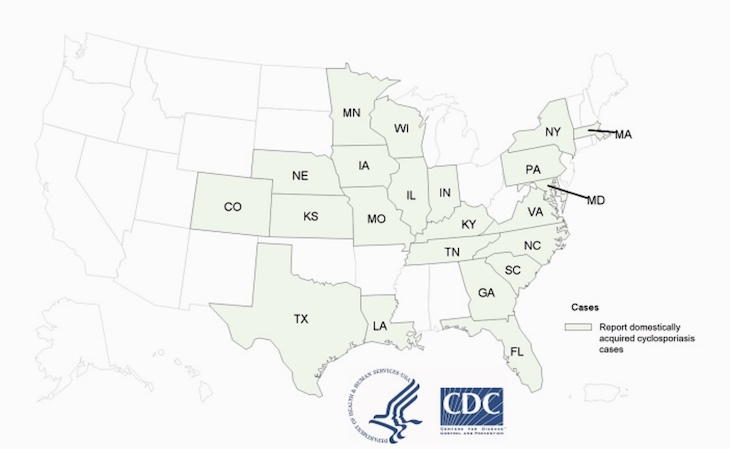
Cyclospora illnesses have spiked to 384 sick in 22 states and 30 hospitalized, according to the Centers for Disease Control and Prevention (CDC). There has been a cyclospora outbreak, in fact, usually several cyclospora outbreaks, in the United States during the spring and summer months every year since 2013. This is an increase of 323 cases since the last update was issued on June 30, 2022. Cases are still being reported.

French E. coli outbreak linked to cucumbers from Belgium

Food Safety News

More than 30 people were sick in France in late 2021 as part of an outbreak traced to contaminated cucumbers.

In September 2021, the Hauts-de-France Regional Health Agency was notified of a suspected foodborne outbreak among students in the Lille area. Two hospitalized children were diagnosed with hemolytic uremic syndrome (HUS). HUS is a severe complication associated with E. coli infection that causes kidney failure. The agency asked Santé publique France for support in investigating the incident.

In total, 35 cases of gastroenteritis, half of whom had bloody diarrhea and fever, were identified. Ten people were hospitalized.

Identified cases were 29 children in four schools and five elderly adults who received meals through a local delivery program. One case was the parent of a pupil. Five children and one adult had meals delivered to them at home.

The median age of patients was 8 with a range of 4 to 89 years old and almost two thirds were female.

School cafeterias and the meal delivery service were all supplied by the same municipal canteen.

450 sick in Ferrero chocolate Salmonella outbreak

Food Safety News

A Salmonella outbreak linked to Kinder chocolate has sickened more than 450 people, based on the latest figures.

Only 10 cases have been reported in the month since the previous European Centre for Disease Prevention and Control (ECDC) update, bringing the total to 455 as of mid-July.

The outbreak has hospitalized a high proportion of people, mostly children younger than 10 years of age, and some had severe clinical symptoms including bloody diarrhea.

The latest monophasic Salmonella Typhimurium case is from the United Kingdom with a sampling date of June 16. Concerns were previously raised by authorities that potentially contaminated chocolate could still be on sale despite a recall in April.

The UK has the most patients with 128 followed by France with 121. Belgium has recorded 66 sick people, 49 are ill in Switzerland, 34 in Germany, 18 in Ireland and 14 in Austria. There are still four cases in Canada and one in the United States.

Sweden, Spain, Norway, Netherlands, Luxembourg, Italy, Denmark and Czech Republic all have single-figure case numbers.

USA – USDA Announces Action to Declare Salmonella an Adulterant in Breaded Stuffed Raw Chicken Products

FSIS USDA

The U.S. Department of Agriculture’s (USDA) Food Safety and Inspection Service (FSIS) is announcing that it will be declaring Salmonella an adulterant in breaded and stuffed raw chicken products.

“Food safety is at the heart of everything FSIS does,” said Agriculture Secretary Tom Vilsack. “That mission will guide us as this important first step launches a broader initiative to reduce Salmonella illnesses associated with poultry in the U.S.”

“Today’s announcement is an important moment in U.S. food safety because we are declaring Salmonella an adulterant in a raw poultry product,” said Sandra Eskin, USDA Deputy Under Secretary for Food Safety. “This is just the beginning of our efforts to improve public health.”

By declaring Salmonella an adulterant in these products, FSIS will be able to ensure that highly contaminated products that could make people sick are not sold to consumers. Since 1998, breaded and stuffed raw chicken products have been associated with up to 14 outbreaks and approximately 200 illnesses. Products in this category are found in the freezer section and include some chicken cordon bleu or chicken Kiev products. These products appear cooked, but they are heat-treated only to set the batter or breading and the product contains raw poultry. Continual efforts to improve the product labeling have not been effective at reducing consumer illnesses.

Research – English E. coli outbreak caused by milk pasteurisation problem in 2019

Cambridge Org

In November 2019, an outbreak of Shiga toxin-producing Escherichia coli O157:H7 was detected in South Yorkshire, England. Initial investigations established consumption of milk from a local dairy as a common exposure. A sample of pasteurised milk tested the next day failed the phosphatase test, indicating contamination of the pasteurised milk by unpasteurised (raw) milk. The dairy owner agreed to immediately cease production and initiate a recall. Inspection of the pasteuriser revealed a damaged seal on the flow divert valve.

Ultimately, there were 21 confirmed cases linked to the outbreak, of which 11 (52%) were female, and 12/21 (57%) were either <15 or >65 years of age. Twelve (57%) patients were treated in hospital, and three cases developed haemolytic uraemic syndrome. Although the outbreak strain was not detected in the milk samples, it was detected in faecal samples from the cattle on the farm. Outbreaks of gastrointestinal disease caused by milk pasteurisation failures are rare in the UK. However, such outbreaks are a major public health concern as, unlike unpasteurised milk, pasteurised milk is marketed as ‘safe to drink’ and sold to a larger, and more dispersed, population. The rapid, co-ordinated multi-agency investigation initiated in response to this outbreak undoubtedly prevented further cases.

Argentina – Botulism case prompts warning in Argentina

Food Safety News

kswfoodworld

Argentinian officials have warned people not to consume a specific product line due to the risk of botulism.

The National Administration of Drugs, Foods and Medical Devices (ANMAT) said a suspected case of botulism has been associated with a product of the A Pleno brand, produced in Villa de las Rosas.

No official details were given about the sick person but local station Radio Verdad was told the patient was 47-years old and remained in the hospital in a serious condition after eating an expired A Pleno product.

The General Directorate of Control of the Food Industry in Córdoba and agencies in the areas of Villa de las Rosas and Villa Dolores are involved in the investigation.

ANMAT advised people not to eat any A Pleno branded products, which include peanut butter and cheese spread alternatives, and told traders to stop selling them.

Another outbreak in Argentina in Misiones earlier this year affected up to 18 people with two deaths. It was linked to homemade sausages made from wild animal meat that were shared in the community.

Research – Thermal inactivation of Salmonella enterica and nonpathogenic bacterial surrogates in wheat flour by baking in a household oven 

Journal of Food Protection

Wheat flour has been implicated in recalls and outbreaks linked to Salmonella and pathogenic Escherichia coli. An instructional online video posted on a popular YouTube channel with over 20 million subscribers claimed that safe raw cookie dough could be made from flour baked in a household oven at 177°C (350°F) for 5 min but no evidence in support of that claim was provided. This study was conducted to assess thermal inactivation of two Salmonella strains, as well as Enterobacter aerogenes and Pantoea dispersa in wheat flour during home oven style baking. Wheat flour was inoculated with Salmonella Enteritidis PT 30, Salmonella Typhimurium PT 42 or their potential surrogates at high concentrations (4.8-6.1 log CFU/g) before baking in consumer-style convection oven (toaster oven) at 149, 177, and 204°C (300, 350, or 400°F) for up to 7 min. Flour was heated in aluminum tray with a maximum depth of ~2 cm. Heated wheat flour samples (5 g each) were enumerated in triplicate, and microbial concentration was expressed in log CFU/g. Thermal profiles of the geometric center of the wheat flour pile and air in the oven during the baking were recorded. Water activity of wheat flour samples was also measured before and after baking. Water activity of wheat flour decreased as baking temperature and time increased. Water activity values ranged from 0.30 to 0.06 after 7 min as oven temperature increased from 149 to 204°C. Thermal inactivation kinetics were linear until counts approached the limit of detection for all microorganisms. D-values for Salmonella and potential surrogate strains ranged from 1.86 to 2.13 min at 149°C air temperature, 1.66 to 1.92 min at 177°C air temperature, and 1.12 to 1.38 min at 204°C air temperature. Both Salmonella strains and surrogates showed similar inactivation patterns. Baking of wheat flour in household toaster ovens has potential as an inactivation treatment of pathogenic bacteria in consumer homes, despite its low water activity.