Category Archives: Microbiological Risk Assessment

Research – New Zealand – National Microbiological Database Programme

MPI

Introduction

This introduction is not part of the Animal Products Notice, but is intended to indicate its general effect.

Purpose

This notice supplements the requirements of the Animal Product Regulations 2021 and sets requirements for microbiological sampling and testing of animal material and animal products intended for human consumption.

Background

The National Microbiological Database (NMD) Programme is a standardised microbiological sampling and testing programme to provide ongoing monitoring of microbiological process control across all industry participants.

Who should read this Animal Products Notice?

You should read this notice if you are:•an operator who processes red meat or poultry intended for human consumption; or•a recognised laboratory that tests red meat or poultry intended for human consumption

Why is this important?

A failure to comply with this notice may be an offence under section 135(1)(c) of the Animal Products Act 1999 and may result in further action by an animal products officer

IAFP 2022: Persistence of Norovirus, Hepatitis A in Low-Moisture Foods

Food Safety.Com

Food Borne Illness - Norovirus -CDC Photo

Hepatitis A and Human Norovirus

Dr. Gibson introduced and gave an overview of the two most relevant enteric viruses in food safety—human Norovirus and Hepatitis A—on which Dr. Jaykus later elaborated. The viruses share several characteristics, such as being resistant to environmental degradation, having a low infectious dose, and shedding from infected individuals at high concentrations. The enteric viruses are also highly persistent on foods and are difficult to inactivate. According to Dr. Jaykus, the viruses can persist on surfaces for days to weeks at room temperature; on foods in water, the viruses can persist for weeks to months if refrigerated, and indefinitely if frozen. Although viral persistence is strong for enteric viruses, the viruses’ survivability depends on the surface, matrix, and temperatures to which they are subject.

Hepatitis A is more common in low-income countries and its common modes of transmission are ready-to-eat (RTE) foods, fresh and frozen produce, and LMFs. Hepatitis A has a public health impact of over 37,000 foodborne cases in the U.S., annually. Norovirus, which causes approximately 5.5 million cases of foodborne illness in the U.S. each year, is mainly transmitted through foods at restaurants due to contamination by infected food handlers; soft, red fruits are also associated with Norovirus due to being hand-harvested. Foods that are handled by humans during harvesting, processing, or preparation are common vehicles for Norovirus as the pathogen can remain infectious and shed from infected individuals for up to eight weeks.

In dry environments, the enteric viruses can transfer between surfaces at a rate of 5–10 percent; in moist environments, the viruses’ rate of transferability increases to over 95 percent. Hepatitis A and Norovirus have also shown to be effective at attaching and sticking to existing biofilms.

Research – Microbiological Safety and Shelf-Life of Low-Salt Meat Products—A Review

MDPI

Salt is widely employed in different foods, especially in meat products, due to its very diverse and extended functionality. However, the high intake of sodium chloride in human diet has been under consideration for the last years, because it is related to serious health problems. The meat-processing industry and research institutions are evaluating different strategies to overcome the elevated salt concentrations in products without a quality reduction. Several properties could be directly or indirectly affected by a sodium chloride decrease. Among them, microbial stability could be shifted towards pathogen growth, posing a serious public health threat. Nonetheless, the majority of the literature available focuses attention on the sensorial and technological challenges that salt reduction implies. Thereafter, the need to discuss the consequences for shelf-life and microbial safety should be considered. Hence, this review aims to merge all the available knowledge regarding salt reduction in meat products, providing an assessment on how to obtain low salt products that are sensorily accepted by the consumer, technologically feasible from the perspective of the industry, and, in particular, safe with respect to microbial stability.

Research – Reclaimed wastewater in agriculture: health risk from pathogens on fruit and vegetables?

BFR

German Federal Institute for Risk Assessment (BfR) advises against irrigation in certain cases

In Germany, fresh produce intended to be eaten raw that grow close to the ground, such as lettuce, carrots, strawberries or fresh herbs, should not be irrigated with reclaimed wastewater. The German Federal Institute for Risk Assessment (BfR) advises against this, particularly with regard to pathogenic viruses and parasites that can get onto or into the plants via this route. Current data are still insufficient for a conclusive risk assessment. However, there is evidence that certain viruses and single-celled parasites (protozoa) can defy environmental influences and cause diseases via raw fruit and vegetables. “Reclaimed wastewater in agriculture poses a new challenge to food safety,” says BfR President Professor Dr Dr Andreas Hensel. “In order to reduce pathogens as much as possible, we need very good treatment and detection methods.”

Climate change, unpredictable weather patterns and droughts are depleting water resources in Germany and Europe. To counteract this, Regulation (EU) 2020/741 sets minimum requirements for the use of reclaimed wastewater for agricultural irrigation. The EU regulation for water reuse applies from June 26, 2023 and is intended to protect the environment and human and animal health. The BfR has assessed possible health risks from the use of reclaimed wastewater for the irrigation of plant-based foodstuffs with regard to selected pathogenic viruses and protozoa. Particular attention was paid to fruit and vegetables that can be eaten raw, in which any pathogens that may be present are not reduced or killed by heating.

On the basis of available data, the BfR recommends not using reclaimed wastewater to irrigate plants, whose parts intended for raw consumption are growing close to or in the ground. This applies until suitable treatment processes and controls can ensure that the irrigation water does not contain pathogens, especially human-pathogenic viruses or protozoa. Because according to the current state of knowledge, pathogens can get onto or into the edible parts of the plants via all of the irrigation systems considered (subsurface drip irrigation, drip irrigation, furrow irrigation, sprinkler system, hydroponic culture) and cause illness in humans when consumed raw. Depending on the type of pathogen and the state of health of the person affected, the health impairment may vary; severe illnesses are possible in risk groups. Further research is required with regard to the suitability of methods for inactivating or reducing pathogens during wastewater treatment.

In the opinion of the BfR, plants whose raw edible fraction grows far from the soil, for example vineyards and fruit trees, can be irrigated with reclaimed wastewater of quality class A or B, provided that direct contact of the raw edible fraction with the reclaimed wastewater (by selecting a suitable irrigation system) and the irrigated soil is excluded. Since the viruses and protozoa under consideration are heat-sensitive, no adverse health effects due to pathogens in the reclaimed wastewater are to be expected for plant foods that are sufficiently heated before consumption.

RASFF Alert – Illness from Drinking Water

RASFF

45 people sick due to drinking water Chateau in Sint Hubert – Belgium and Netherlands

RASFF Alert – Animal Feed -Enterobacteriaceae – Dog Chews

RASFF

Enterobacteriaceae in dog chews from Brazil, via the Netherlands in Germany

RASFF Alert – Animal Feed – Salmonella – Poultry Proteins – Soybean Press Cake

RASFF

Salmonella in processed animal proteins of poultry from Slovenia in Hungary

RASFF

Salmonella spp in organic soybean press cake from China in Germany and Netherlands

RASFF Alert – Animal Feed – Aflatoxin – Cotton Meal

RASFF

Aflatoxin in cotton meal from Bulgaria in the Netherlands

EU – 15 July update: Monophasic Salmonella Typhimurium outbreak linked to chocolate products

ECDC

As of 15 July 2022, 401 confirmed (n=399) and probable (n=2) cases of monophasic S. Typhimurium have been identified in the EU/EEA and the United Kingdom. This is an increase of nine cases since the last update on 3 June 2022. The latest reported case is from the UK with sampling date on 16 June 2022. In addition, cases have been identified in Canada (n=4), Switzerland (n=49), and United States (n=1), bringing the total number of cases to 455 globally.

This outbreak is characterised by high proportion of hospitalised (about 40%) cases, most of these are children below 10 years of age, and some cases with severe clinical symptoms like bloody diarrhoea.

Affected cases have been identified through advanced molecular typing techniques. As this method of testing is not routinely performed in all countries, some cases may be undetected.

Based on epidemiological and microbiological investigations, specific chocolate products from a Belgian chocolate factory were identified as likely vehicles of infection.

The factory was closed on 8 April 2022 (week 14) and product recalls were launched globally. The recalls aimed to prevent the consumption of products potentially contaminated with Salmonella. As a result of control measures, number of cases have declined rapidly.

Further investigations are needed to identify the root cause of the contamination, and to ensure that contaminated products are not put on the market.

Table 1. Number of confirmed and probable cases of monophasic S. Typhimurium in the EU/EEA, the United Kingdom, Canada, Switzerland and the United States, as of 15 July 2022

Country Confirmed cases Probable cases Total number of cases
Austria 14 0 14
Belgium 64 2 66
Czech Republic 1 0 1
Denmark 4 0 4
France 121 0 121
Germany 34 0 34
Ireland 18 0 18
Italy 1 0 1
Luxembourg 2 0 2
Netherlands 3 0 3
Norway 1 0 1
Spain 3 0 3
Sweden 5 0 5
Total EU/EEA 271 2 273
United Kingdom 128 0 128
Total EU/EEA and UK 399 2 401
Canada 4 0 4
Switzerland 49 0 49
United States 1 0 1
Total 453 2 455

USA – Laboratory Accreditation for Analyses of Foods Program

FDA

About the Program

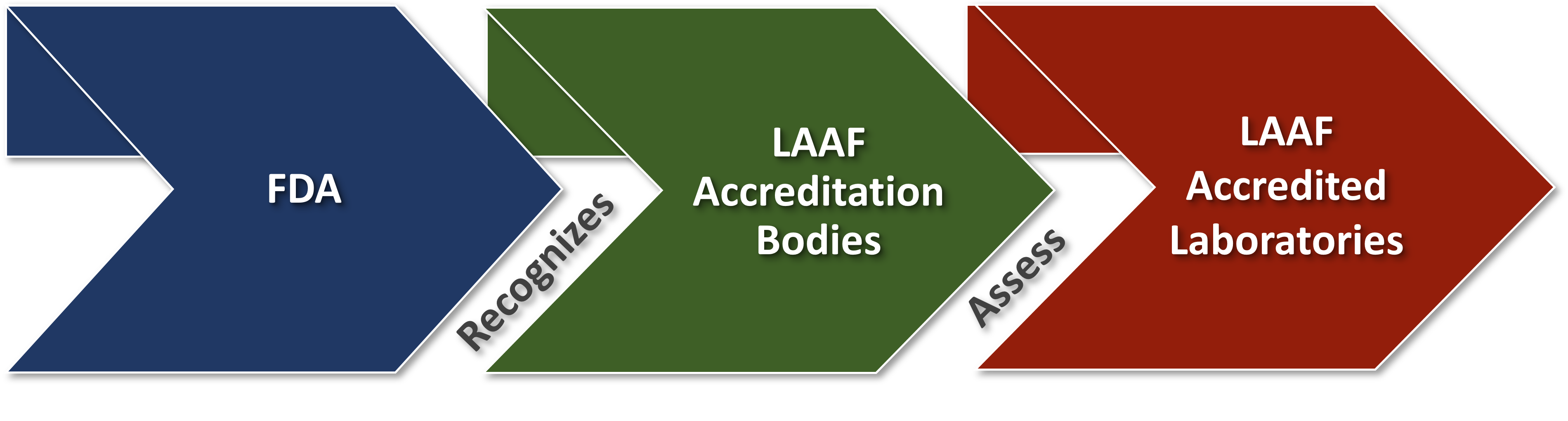
The FDA Food Safety Modernization Act (FSMA) final rule on Laboratory Accreditation for Analyses of Foods (LAAF) establishes a laboratory accreditation program for the testing of food in certain circumstances. Under the LAAF program, FDA will recognize accreditation bodies (ABs) that will accredit laboratories to the standards established in the final rule (referred to as LAAF-Accredited Laboratories).

For additional information and guidance, see FSMA Final Rule on Laboratory Accreditation for Analyses of Foods (LAAF).

FDA recognizes LAAF accreditation bodies which assess LAAF accredited laboratories.

Tables in the link above identify accreditation bodies that have been recognized and laboratories that have been accredited under the LAAF program. One recognized accreditation body (AB) may LAAF-accredit many laboratories. A recognized accreditation body may issue one or many certificates of accreditation for any LAAF-accredited laboratory (AL) location covering one or multiple laboratory scopes (LS). Separate laboratory locations under common ownership may be LAAF-accredited by different recognized accreditation bodies.