Category Archives: Food Microbiology Research

Finland – Around 150 cases of food poisoning caused by oysters in Helsinki – Norovirus

Helsinki Times

Food Borne Illness - Norovirus -CDC Photo

Between February 8th and 26th, 2023, around 150 people have reported falling ill after eating oysters in restaurants across Helsinki. The illnesses are related to oysters imported from France and the Netherlands.

Reports of illnesses have been recorded from several different restaurants, prompting inspections and sample collections from affected venues. Importers of the oysters in question have also withdrawn their products from the market.

The examination of food samples is still ongoing, but some patient samples have already been completed. So far, seven individuals have tested positive for norovirus related to this outbreak.

Those who have eaten oysters are being encouraged to contact environmental services to provide information for the ongoing investigation.

USA – FDA expands enoki mushrooms import alert from South Korea, adds China

Food Safety News

On March 1, the FDA announced that it is expanding an import alert issued last July for all enoki mushrooms imported from the Republic of Korea to now also include enoki mushrooms from China for detention without a physical examination at U.S. borders (DWPE) to further protect public health.

Previously, this import alert only included enoki mushrooms from the Republic of Korea. From Oct. 2020 through Feb. 2023, state public health authorities conducted a sampling of enoki mushrooms from retail locations. Multiple state samples detected L. monocytogenes, which led to 18 recalls of enoki mushrooms in the U.S. since 2021. Eight of the recalls were linked to enoki mushrooms grown in the Republic of Korea, and 10 from China, were confirmed via labeling, traceback, or whole genome sequencing (WGS).

During this time, FDA sampled and analyzed 127 shipments of enoki mushrooms imported from China and found 18 to be violative, representing a violation rate of more than 14 percent. This effort identified 15 firms with violative products out of at least 37 declared firms that had exported enoki mushrooms from China to the U.S.

USA – New Hepatitis A outbreak discovered; other outbreak investigations continue

Food Safety News

Federal officials have identified a new outbreak of hepatitis A infections suspected to be from a food source.

The Food and Drug Administration reports that it has begun product traceback efforts, but the agency has not named the product or products being traced.

As of March 1 there have been nine patients identified. The FDA has not reported where the patients live or their ages.

Hepatitis A can be transmitted when food handlers have contaminated hands. This contamination usually comes from microscopic amounts of feces. Thorough hand washing is one of the best ways to prevent transmission of the disease. Food surfaces can become contaminated as well as foods and beverages.

France Research – Acute gastroenteritis: review of the 2020-2021 and 2021-2022 winter seasons

Sante Publique

Every year, an increase in acute gastroenteritis (AGE) is observed caused mainly by the circulation of noroviruses and rotaviruses. Noroviruses are responsible for AGE in people of all ages, while rotaviruses mainly affect children under 5 years of age. 

During the winter season, Public Health France monitors, with its network of partners , the epidemiological evolution of acute gastroenteritis and publishes weekly national and regional epidemiological bulletins on its website . These data are also made available as open data on Géodes .

Santé publique France is today publishing the winter monitoring report covering the 2020-2021 and 2021-2022 seasons in mainland France and recalls the simple actions to take to limit the risk of contamination.

What are the highlights of the last two seasons?

2020-2021: a season marked by a historically low level of activity

The low level of activity observed from March 2020 (end of the 2019-2020 season), in the context of the COVID-19 pandemic, continued during the 2020-2021 season. In city medicine or in hospital emergency departments, activity remained relatively stable and lower than the years prior to the COVID-19 pandemic in all metropolitan areas. 

A return to activity comparable to pre-COVID seasons during winter 2021-2022

The activity levels recorded throughout the 2021-2022 season were again comparable to those observed during the pre-COVID seasons. In hospital emergencies, activity for acute gastroenteritis remained close to historical maximums, from December 2021 to April 2022. Consultations at SOS Médecins were similar to the data observed before the COVID-19 pandemic.

Research – Legionella pneumophila Risk from Air–Water Cooling Units Regarding Pipe Material and Type of Water

MDPI

Legionella A

Abstract

Legionellosis is a respiratory disease related to environmental health. There have been manifold studies of pipe materials, risk installations and legionellosis without considering the type of transferred water. The objective of this study was to determine the potential development of the causative agent Legionella pneumophila regarding air–water cooling units, legislative compliance, pipe material and type of water. Forty-four hotel units in Andalusia (Spain) were analysed with respect to compliance with Spanish health legislation for the prevention of legionellosis. The chi-square test was used to explain the relationship between material–water and legislative compliance, and a biplot of the first two factors was generated. Multiple correspondence analysis (MCA) was performed on the type of equipment, legislative compliance, pipe material and type of water, and graphs of cases were constructed by adding confidence ellipses by categories of the variables. Pipe material–type of water (p value = 0.29; p < 0.05) and legislative compliance were not associated (p value = 0.15; p < 0.05). Iron, stainless steel, and recycled and well water contributed the most to the biplot. MCA showed a global pattern in which lead, iron and polyethylene were well represented. Confidence ellipses around categories indicated significant differences among categories. Compliance with Spanish health legislation regarding the prevention and control of legionellosis linked to pipe material and type of water was not observed.

USA – FDA Core Outbreak Table – Update

FDA

What’s New

  • A new outbreak of hepatitis A virus infections (ref # 1143) linked to a not yet identified product has been added to the table. FDA has initiated traceback.
  • For the outbreak of Listeria monocytogenes (ref # 1123), FDA has initiated an onsite inspection, sample collection, and analysis. This investigation is ongoing and additional information will be provided as it become available.
  • The outbreak of Salmonella Typhimurium (ref # 1137) linked to alfalfa sprouts has ended and the FDA investigation is closed.

USA – Persistent Strain of E. coli O157:H7 (REPEXH01) Linked to Multiple Sources

CDC

REPEXH01

REPEXH01 is a persistent strain of Shiga toxin-producing E. coli O157:H7 bacteria that has caused illnesses and outbreaks in the United States.

Illness caused by this strain was first reported to PulseNet in 2017. Illnesses caused by this strain occur year-round but are less common in winter.

In the past, the REPEXH01 strain has spread to people through contaminated food and contaminated recreational water.

This strain is relatively diverse genetically. Bacteria in this strain are within 21 allele differences of one another by whole genome sequencing, which is more diverse than typical multistate foodborne outbreaks where bacteria generally fall within 10 allele differences of one another.

Identified outbreak sources*

*Confirmed sources were implicated by epidemiologic
plus traceback or laboratory data. Suspected sources
were implicated by epidemiologic data only. More info

  • Recreational water (confirmed): 1 outbreak
  • Romaine lettuce (confirmed): 1 outbreak
  • Leafy greens (suspected): 1 outbreak
  • Ground beef (suspected): 2 outbreaks

USA – Salmonella Outbreak Linked to Alfalfa Sprouts – Outbreak is Over

CDC

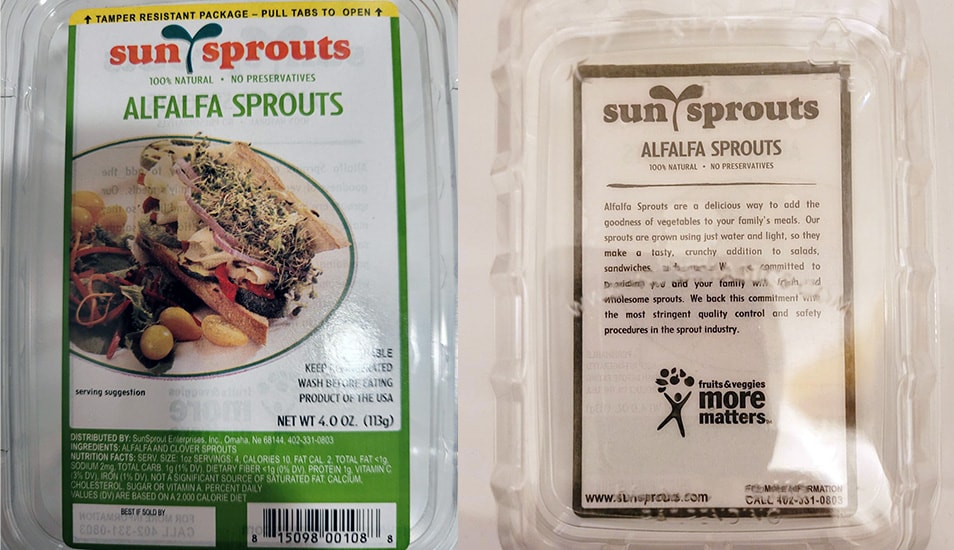
Front and back packaging of alfalfa sprouts in this outbreak

Fast Facts
  • Illnesses: 63
  • Hospitalizations: 10
  • Deaths: 0
  • States: 8
  • Recall: Yes
  • Investigation status: Closed
Outbreak Investigation Summary

Data showed that alfalfa sprouts made people in this outbreak sick.

  • Of the 50 people interviewed, 35 (70%) reported eating alfalfa sprouts.
  • Eight of the people who got sick in this outbreak confirmed they had purchased Sun Sprouts brand alfalfa sprouts from their local grocery store.

On December 29, 2022, SunSprout Enterprises recalled four lots of raw alfalfa sprouts.

USA – Florida – Salmonella Outbreak linked to Oysters

Food Poison Journal

The Florida Department of Health (DOH) and the state health departments of Georgia and Alabama have detected a Salmonella outbreak associated with the consumption of raw oysters harvested from shellfish harvesting area FL-3012 in Cedar Key, Florida. To date, there have been 8 cases linked to this outbreak within Florida, Georgia, and Alabama.

On February 24, 2023, the Florida Department of Agriculture and Consumer Services closed shellfish harvesting area FL-3012 for the harvest of wild oysters and initiated a recall of these wild oysters harvested from December 16, 2022, to February 24, 2023.

Denmark – Ochratoxin A in Pistachios

DVFA

LIDL Danmark A/S is recalling Alesto California Pistachio Kernels, salted and unsalted, as an excessively high content of the fungal toxin ochratoxin A has been found in the product.

The product should be discarded or returned to the store where it was purchased.

Recalled Foods , Published: March 1, 2023

What Food
Alesto California pistachio nuts, salted and unsalted (see picture here )
Net weight: 70 g
Best before dates: 12/08/2023, 13/10/2023 and 14/10/2023
Sold in : LIDL stores throughout the country.
Why
An excessively high content of the mushroom toxin ochratoxin A has been found in the product. A health risk cannot therefore be ruled out if you eat the product. It is important not to have too high an intake of ochratoxin A over a long period of time. However, the individual meal is not decisive, it is consumed over a longer period of time that poses a health risk. Therefore, you will not experience acute symptoms if you have eaten the product.
Read more about ochratoxin A here
What should you do as a consumer?
The Danish Veterinary and Food Administration advises consumers to discard the product or return it to the store where it was purchased.
Who is recalling this product
LIDL Danmark A/S
Profile road 7-9
6000 Kolding