Category Archives: Food Hygiene

Norway -Do not eat the contents of crab shells in Agder – DSP Algal Toxin

Matportalen

The Norwegian Food Safety Authority warns people in Agder against eating the contents of the crab’s shells, following the discovery of diarrhea poison. The meat from the claws is safe to eat.

The Norwegian Food Safety Authority has found high concentrations of the algae poison DSP (Diarrhetic Shellfish Poisoning) in crab from Agder.

DSP is one of the most common types of mussel poisoning in Norway. Once the crab has eaten mussels with DSP, the crab becomes poisonous to people who eat it. DSP causes diarrhoea, nausea, vomiting and abdominal pain. It takes from half an hour to a few hours from the time you eat until you get sick. The symptoms disappear by themselves after 2-3 days.

Since the beginning of July this year, high levels of the algal toxin DSP have been detected in mussels along the Sørland coast, and in Agder the levels of the toxin have increased significantly in recent times. This is the reason why the Norwegian Food Safety Authority has also tested crabs in Agder for DSP. 

USA – Domestically Acquired Cases of Cyclosporiasis — United States, May–August 2022

CDC

LAST UPDATED AUGUST 25, 2022 4:00 PM EDT

Cyclosporiasis illnesses are reported year-round in the United States. However, during the spring and summer months there is often an increase in cyclosporiasis acquired in the United States (i.e., “domestically acquired”). The exact timing and duration of these seasonal increases in domestically acquired cyclosporiasis can vary, but reports tend to increase starting in May. In previous years the reported number of cases peaked between June and July, although activity can last as late as September. The overall health impact (e.g., number of infections or hospitalizations) and the number of identified clusters of cases (i.e., cases that can be linked to a common exposure) also vary from season to season. Previous U.S. outbreaks of cyclosporiasis have been linked to various types of fresh produce, including basil, cilantro, mesclun lettuce, raspberries, and snow peas.

At a Glance
  • Illnesses: 800
  • Hospitalizations: 52
  • Deaths: 0
  • States reporting cases: 30

CDC, along with state and federal health and regulatory officials, monitor cases of cyclosporiasis in the United States in the spring and summer months to detect outbreaks linked to a common food source. However, many cases of cyclosporiasis cannot be directly linked to an outbreak, in part because of the lack of validated laboratory “fingerprinting” methods needed to link cases of Cyclospora infection. Officials use questionnaires to interview sick people to determine what they ate in the 14-day period before illness onset. If a commonality is found, CDC and partners work quickly to determine if a contaminated food product is still available in stores or in peoples’ homes and issue advisories.

Latest Information

  • The number of reported cases of domestically acquired cyclosporiasis illnesses has increased by 416 cases since the last update on July 28, 2022. Cases continue to be reported.
  • As of August 23, 2022, 800 laboratory-confirmed cases of cyclosporiasis in people who had no history of international travel during the 14-day period before illness onset have been reported to CDC by 31 jurisdictions, including 30 states and New York City, since May 1, 2022.
    • The median illness onset date is June 29, 2022 (range: May 3, 2022–August 12, 2022).
    • At least 52 people have been hospitalized; 0 deaths have been reported.

Research – First Description of a Yersinia pseudotuberculosis Clonal Outbreak in France, Confirmed Using a New Core Genome Multilocus Sequence Typing Method

Sante Publique

Yersinia pseudotuberculosis is an enteric pathogen causing mild enteritis that can lead to mesenteric adenitis in children and septicemia in elderly patients. Most cases are sporadic, but outbreaks have already been described in different countries. We report for the first time a Y. pseudotuberculosis clonal outbreak in France, that occurred in 2020. An epidemiological investigation based on food queries pointed toward the consumption of tomatoes as the suspected source of infection. The Yersinia National Reference Laboratory (YNRL) developed a new cgMLST scheme with 1,921 genes specific to Y. pseudotuberculosis that identified the clustering of isolates associated with the outbreak and allowed to perform molecular typing in real time. In addition, this method allowed to retrospectively identify isolates belonging to this cluster from earlier in 2020. This method, which does not require specific bioinformatic skills, is now used systematically at the YNRL and proves to display an excellent discriminatory power and is available to the scientific community. IMPORTANCE We describe in here a novel core-genome MLST method that allowed to identify in real time, and for the first time in France, a Y. pseudotuberculosis clonal outbreak that took place during the summer 2020 in Corsica. Our method allows to support epidemiological and microbiological investigations to establish a link between patients infected with closely associated Y. pseudotuberculosis isolates, and to identify the potential source of infection. In addition, we made this method available for the scientific community.

Auteur : Savin Cyril, Le Guern Anne-Sophie, Chereau Fanny, Guglielmini Julien, Heuzé Guillaume, Demeure Christian, Pizarro-Cerdá Javier
Microbiology spectrum, 2022, p. e0114522

New Zealand – Public health warning for shellfish extended for West Coast, North Island – PSP – Toxins

MPI

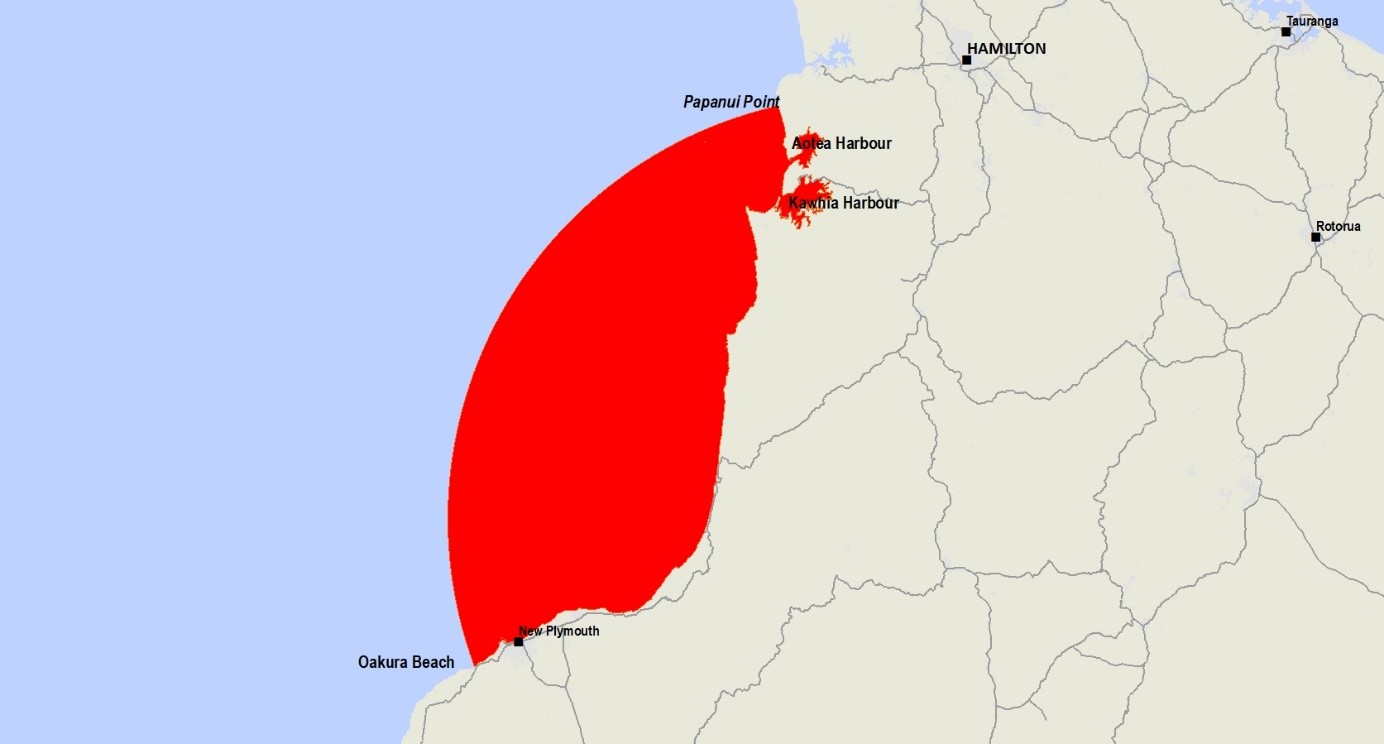
Map of the affected area in the Kawhia Harbour area, West Coast, North Island

New Zealand Food Safety today extended a public health warning against collecting shellfish in the Waikato region and have extended this south to the Taranaki region. The public health warning now applies to the coastline from Papanui Point (south of Raglan), south to Oakura Beach. Paralytic shellfish toxins have been detected at levels above the safe limit set by MPI.

Routine tests on shellfish samples taken from this region have shown levels of Paralytic Shellfish Poisoning (PSP) toxins above the safe limit of 0.8 mg/kg set by New Zealand Food Safety. Anyone eating shellfish from this area is potentially at risk of illness.

Mussels, oysters, tuatua, pipi, toheroa, cockles, scallops, catseyes, kina (sea urchin), and all other bivalve shellfish should not be eaten.

Note, cooking shellfish does not remove the toxin.

Pāua, crab, and crayfish may still be eaten if the gut has been completely removed prior to cooking, as toxins accumulate in the gut. If the gut is not removed, its contents could contaminate the meat during the cooking process.

Symptoms typically appear between 10 minutes and 3 hours after ingestion and may include:

  • numbness and a tingling (prickly feeling) around the mouth, face, and extremities (hands and feet)
  • difficulty swallowing or breathing
  • dizziness
  • headache
  • nausea
  • vomiting
  • diarrhoea
  • paralysis and respiratory failure and in severe cases, death.

If anyone becomes ill after eating shellfish from an area where a public health warning has been issued, phone Healthline for advice on 0800 61 11 16, or seek medical attention immediately. You are also advised to contact your nearest public health unit and keep any leftover shellfish in case it can be tested.

Monitoring of toxin levels will continue and any changes will be communicated accordingly. Commercially harvested shellfish – sold in shops and supermarkets, or exported – is subject to strict water and flesh monitoring programmes by MPI to ensure they are safe to eat.

France – RAW FRESH CREAM – Salmonella

Gov france

Identification information of the recalled product

  • Product category Feed
  • Product subcategory Milk and dairy products
  • Product brand name OLD GRIMBOSQ SCEA
  • Model names or references OLD GRIMBOSQ SCEA
  • Identification of products
    Batch Date
    factory of 08/22/2022 Use-by date 09/09/2022
  • Products List DDPP_product.pdf Attachment
  • Packaging WHITE PLASTIC JARS of 25 cl, 50 cl or packaging at the sight of the customer
  • Marketing start/end date From 08/23/2022 to 08/28/2022
  • Storage temperature Product to be stored in the refrigerator
  • Health mark FR 14 320 003 EC
  • Geographic area of ​​sale Departments: CALVADOS (14)
  • Distributors grocery store delicatessen mini-market market
  • List of points of saleDDPP_delivery_table__22_08_2022_SCEA.pdf

Practical information regarding the recall

  • Reason for recall demonstration of the presence of salmonella
  • Risks incurred by the consumer Salmonella spp (causative agent of salmonellosis)

France – RAW CREAM from the farm -Salmonella

Gov france

Identification information of the recalled product

  • Product category Feed
  • Product subcategory Milk and dairy products
  • Product brand name Joel CATHERINE
  • Model names or references Joel CATHERINE
  • Identification of products
    Batch Date
    factory of 08/26/2022 Use-by date 09/13/2022
  • Products List DDPP_product.pdf Attachment
  • Packaging white plastic pots of 25 cl, 50 cl or packaging at the sight of the customer
  • Marketing start/end date From 08/27/2022 to 08/27/2022
  • Storage temperature Product to be stored in the refrigerator
  • Geographic area of ​​sale Departments: CALVADOS (14)
  • Distributors market
  • List of points of saleDDPP_table_deliveries_26_08_22_JC_(1).pdf

Practical information regarding the recall

  • Reason for recall demonstration of the presence of salmonella
  • Risks incurred by the consumer Salmonella spp (causative agent of salmonellosis)

Germany – Nafa Delicatessen Oxmouth SaladGermany – Listeria monocytogenes

LMW

Alert type: Food
Date of first publication:

09/01/2022

Product name: Nafa Delicatessen Oxmouth Salad
Product images:
Ochsenmaulsalat_33102.jpg
Ochsenmaulsalat_33110.jpg
Ochsenmaulsalat_33130.jpg
Manufacturer (distributor):

NAFA Feinkost GmbH, Jahnstrasse 65-69, 67141 Neuhofen

Reason for warning:

Listeria monocytogenes

RASFF Alert- Mycotoxin – Patulin – Apple Sauce

RASFF

Patulin in Apple sauce From Netherlands in France, Germany and Ireland

RASFF Alert – Staphylococcal Toxin Outbreak – Canned Mushrooms

RASFF

Staphylococcal toxin outbreak due to consumption of canned mushrooms (boletus edulis) from Spain

RASFF Alert – Vibrio vulnificus – Frozen Shrimp

RASFF

Detection of vibrio vulnificus in frozen raw shrimps from Ecuador in France