Monthly Archives: February 2023

USDA Method Update – Isolation and Identification of Salmonella from Meat, Poultry, Pasteurized Egg, Carcass, and Environmental Sponges

This method describes the laboratory procedure for performing Isolation and Identification of Salmonella from Meat, Poultry, Pasteurized Egg, Products and Carcass and Environmental Sponges

Research – Increased Multidrug-Resistant Salmonella enterica I Serotype 4,[5],12:i:- Infections Associated with Pork, United States, 2009–2018

CDC

Abstract

Reports of Salmonella enterica I serotype 4,[5],12:i:- infections resistant to ampicillin, streptomycin, sulphamethoxazole, and tetracycline (ASSuT) have been increasing. We analyzed data from 5 national surveillance systems to describe the epidemiology, resistance traits, and genetics of infections with this Salmonella strain in the United States. We found ASSuT-resistant Salmonella 4,[5],12:i:- increased from 1.1% of Salmonella infections during 2009–2013 to 2.6% during 2014–2018; the proportion of Salmonella 4,[5],12:i:- isolates without this resistance pattern declined from 3.1% to 2.4% during the same timeframe. Among isolates sequenced during 2015–2018, a total of 69% were in the same phylogenetic clade. Within that clade, 77% of isolates had genetic determinants of ASSuT resistance, and 16% had genetic determinants of decreased susceptibility to ciprofloxacin, ceftriaxone, or azithromycin. Among outbreaks related to the multidrug-resistant clade, 63% were associated with pork consumption or contact with swine. Preventing Salmonella 4,[5],12:i:- carriage in swine would likely avert human infections with this strain.

USDA Methods Update – Detection, Isolation, and Identification of Top Seven Shiga Toxin-Producing Escherichia coli (STEC) from Meat Products, Carcass, and Environmental Sponges

FSIS USDA

This method describes the laboratory procedure for analysis of raw and ready-to-eat meat products, and laboratory environmental sponge samples for the seven targeted STEC serogroups (O157, O26, O45, O103, O111, O121 and O145).

Hong Kong – Trade instructed to suspend importing and selling of raw oysters produced by Earl Huitres Geay in France – Norovirus?

CFS

The Centre for Food Safety (CFS) of the Food and Environmental Hygiene Department today (January 31) instructed the trade to suspend the import of raw oysters produced by Earl Huitres Geay FR 17.452.121 CE in France. The trade should also stop using or selling the product concerned immediately should they possess it.

A spokesman for the CFS said, “The CFS was notified by the Centre for Health Protection of the Department of Health of three food poisoning cases which involved consumption of raw oysters at one restaurant in Quarry Bay and two restaurants in Tsim Sha Tsui. The CFS conducted investigations at the restaurants concerned and found that the three restaurants had sold raw oysters which had been produced by Earl Huitres Geay FR 17.452.121 CE in France. For the sake of prudence, the CFS has immediately instructed the trade to suspend the import into and sale within Hong Kong of all raw oysters produced by Earl Huitres Geay FR 17.452.121 CE in France.”

The CFS has also instructed the supplier and restaurants concerned to stop supplying and selling the affected raw oysters immediately, and is tracing the distribution of the affected product. The trade should also stop using or selling the product concerned immediately should they possess it.

Research – Natural Killers: Opportunities and Challenges for the Use of Bacteriophages in Microbial Food Safety from the One Health Perspective

MDPI

Abstract

Ingestion of food or water contaminated with pathogenic bacteria may cause serious diseases. The One Health approach may help to ensure food safety by anticipating, preventing, detecting, and controlling diseases that spread between animals, humans, and the environment. This concept pays special attention to the increasing spread and dissemination of antibiotic-resistant bacteria, which are considered one of the most important environment-related human and animal health hazards. In this context, the development of innovative, versatile, and effective alternatives to control bacterial infections in order to assure comprehensive food microbial safety is becoming an urgent issue. Bacteriophages (phages), viruses of bacteria, have gained significance in the last years due to the request for new effective antimicrobials for the treatment of bacterial diseases, along with many other applications, including biotechnology and food safety. This manuscript reviews the application of phages in order to prevent food- and water-borne diseases from a One Health perspective. Regarding the necessary decrease in the use of antibiotics, results taken from the literature indicate that phages are also promising tools to help to address this issue. To assist future phage-based real applications, the pending issues and main challenges to be addressed shortly by future studies are also taken into account.

USA – FDA – Investigations of Foodborne Illness Outbreaks – Cor Outbreak Table

FDA

What’s New

  • On 1/27/2023, an updated outbreak advisory was issued for the outbreak of Listeria monocytogenes linked to enoki mushrooms (reference #1127) to include additional products.

Hong Kong – Lap-mei (Chinese Preserved Meat) and Food Safety

CFS

Lap-mei is a favourite food of many people, distinctive for its colour, aroma and taste.  There are three types of lap-mei available on the local market.  They are preserved Chinese sausages, preserved pork, and preserved ducks.  Recently, media reported that some people tried to prepare their own home-made lap-mei, which has raised food safety concerns.

Some of the curing ingredients used to prepare lap-mei (e.g. salt) have antimicrobial functions while sodium nitrate/nitrite can also inhibit the growth of Clostridium botulinum and its toxin production.  Improper conditions in processing of lap-mei may lead to food deterioration due to bacterial growth, and may affect health after consumption.  However, it is worth noting that Clostridium botulinum may grow in oxygen free and low acid food (such as home-made Chinese sausages) and produce lethal toxin without causing noticeable deterioration in the food.  Application of nitrate/ nitrite in curing should be limited to the amount required to achieve the intended effect only.  Nitrites may react with other substances found in meat forming nitrosamines, compounds that may cause human cancer.  Moreover, ingestion of significant amount of nitrite can cause methaemoglobinaemia, with red blood cells loses its ability to bind oxygen and causes hypoxia in the affected individuals.  The condition is characterised by headache, weakness and breathlessness, and a bluish discolouration of the skin and mucous membranes.  Infants and young children are more susceptible to this condition because their digestive and methaemoglobin reductase systems are still immature.

Members of the public should buy lap-mei from reliable retailers, maintain a balanced diet and avoid excessive consumption of lap-mei (especially for individuals with diabetes, heart disease and high cholesterol).  In addition, infants are highly susceptible to nitrite toxicity and should avoid consuming lap-mei.  The intake of lap-mei among young children should also be restricted.

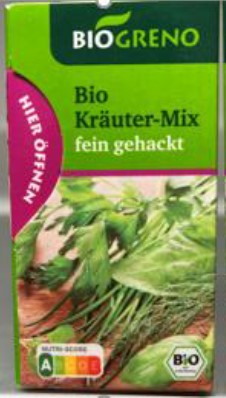
Germany – BIOGRENO Organic Herb Mix, deep-frozen – SeBIOGRENO Organic Herb Mix, deep-frozen -STEC E.coli

LMW

Alert type: Food
Date of first publication: 02/01/2023
Product name:

BIOGRENO Organic Herb Mix, deep-frozen

Product images:

Image BIOGRENO herbal mix.jpg

Photo from the Dresden consumer market by employees

Image batch +BID BIOGRENO herb mix.jpg

Photo from the Dresden consumer market by employees

Manufacturer (distributor):

Manufacturer: Distributor: Darégal SAS Darégal Gourmet Deutschland GmbH 6 boulevard Joffre Gewerbepark 5a F- 91490 Milly-la-Forêt D – 49143 Bissendorf

Reason for warning:

Detection of verotoxin-producing Escherichia coli (VTEC/STEC)

Packaging Unit: Cardboard box – 50g
Durability: 04/26/2025
Production date: 04/26/2022
Lot identification: 22CS000352
Further information:

Escherichia coli (E.coli)

Enterohemorrhagic Escherichia coli (EHEC) An EHEC (synonyms: STEC, VTEC) disease usually manifests itself within a week after infection with diarrhea and abdominal cramps. Babies, small children, the elderly and people with a weakened immune system in particular can develop more severe illnesses with bloody diarrhea. Rarely, especially in small children, acute kidney failure can occur in a second flare-up a few days after the onset of diarrhea. Anyone who has eaten this food and develops severe or persistent symptoms should seek medical attention and report possible EHEC infection. It makes no sense to seek preventive medical treatment without symptoms.

Click to access 2023_01_31+Produktr%FCckruf+BIOGRENO.pdf

Further information on the pathogen can be found here: http://www.infectionsschutz.de/erregersteckbriefe/ehec/

Research – Campylobacter jejuni and Campylobacter coli from Houseflies in Commercial Turkey Farms Are Frequently Resistant to Multiple Antimicrobials and Exhibit Pronounced Genotypic Diversity

MDPI

Abstract

Campylobacter is a leading foodborne pathogen, and poultry are a major vehicle for infection. Houseflies play important roles in colonization of broiler flocks with Campylobacter but comparable information for turkey farms is limited. Here, we investigated houseflies as potential vectors for Campylobacter in 28 commercial turkey flocks. We characterized species, genotypes, and the antimicrobial resistance (AMR) profiles of Campylobacter from turkey feces and houseflies in the same turkey house. Of the 28 flocks, 25 yielded Campylobacter from turkey droppings and houseflies, with an average of 6.25 and 3.11 Campylobacter log CFU/g feces and log CFU/fly, respectively. Three flocks were negative for Campylobacter both in turkey feces and in houseflies. Both C. coli and C. jejuni were detected in turkey feces and houseflies, with C. coli more likely to be recovered from houseflies than feces. Determination of Campylobacter species, genotypes, and AMR profiles revealed up to six different strains in houseflies from a single house, including multidrug-resistant strains. For the predominant strain types, presence in houseflies was predictive of presence in feces, and vice versa. These findings suggest that houseflies may serve as vehicles for dissemination of Campylobacter, including multidrug-resistant strains, within a turkey house, and potentially between different turkey houses and farms in the same region.

Italy – Traditional raw salami – Salmonella and Listeria monocytogenes

Salute

Brand : Agrisalumeria Luiset

Denomination : Traditional raw salami

Reason for reporting : Remind for microbiological risk

Date of publication : 1 February 2023

Documentation