Norovirus in oysters from France in Belgium, Denmark, Finland, Germany, Italy, Netherlands, Poland and Sweden
Norovirus in oysters from France in the Netherlands

Norovirus in oysters from France in Belgium, Denmark, Finland, Germany, Italy, Netherlands, Poland and Sweden
Norovirus in oysters from France in the Netherlands
Aflatoxin in peanuts from Egypt in Germany
Aflatoxins in groundnuts in shell from the United States in Germany
Aflatoxin in Egyptian groundnuts in the Netherlands
Aflatoxin B1 in Pakistan brown basmati rice in the Netherlands
Aflatoxins in peanuts from Italy in Germany and the Netherlands
Aflatoxins in rice from Pakistan in Belgium, Italy and UK
Aflatoxins in pistachios from the Islamic Republic of Iran in Germany
Excessive levels of aflatoxin B1 in dried and chopped organic figs from Turkey in Germany
Aflatoxins in groundnut-kernels from the USA in the Netherlands and Belgium
Aflatoxins in chilli powder extra hot from India in Italy and Spain
Aflatoxin B1 in Basmati rice from India in Netherlands and Germany
Aflatoxin B1 in Basmati rice from India in the Netherlands
Posted in Aflatoxin, Aflatoxin B1, food contamination, food handler, Food Hazard, Food Hygiene, Food Inspections, Food Micro Blog, Food Microbiology, Food Microbiology Blog, Food Microbiology Testing, Food Poisoning, food recall, Food Safety, Food Safety Alert, Food Temperature Abuse, Food Testing, Food Toxin, Mold Toxin, Mould Toxin, Mycotoxin, RASFF
Salmonella Llandoff in soy bean meal from Italy in Austria and Switzerland
Salmonella in Soy bean meal extracted from Italy in Austria
Presence of Salmonella in fishmeal from Spain in Italy
Salmonella in Spray dried porcine haemoglobin cells from the UK and Denmark
Listeria monocytogenes is a foodborne pathogen and causes illnesses with a high mortality rate in susceptible populations. Several dairy-related outbreaks have been attributed to contamination by L. monocytogenes, which requires antimicrobial interventions to enhance the safety of these products. This study aimed to determine the antimicrobial activity of the ohelo berry (Vaccinium calycinum), a Hawaiian wild relative of cranberry, against L. monocytogenes in culture media and milk products. The effect of ohelo berry juice at its sub-inhibitory concentrations on the physicochemical properties, biofilm formation, and gene expression of L. monocytogenes was also investigated. The minimum inhibitory concentration of ohelo berry juice against L. monocytogenes was 12.5%. The sub-inhibitory concentration of ohelo berry juice (6.25%) significantly increased the auto-aggregation and decreased the hydrophobicity, swimming motility, swarming motility, and biofilm formation capability of L. monocytogenes. The relative expression of genes for motility (flaA), biofilm formation and disinfectant resistance (sigB), invasion (iap), listeriolysin (hly), and phospholipase (plcA) was significantly downregulated in L. monocytogenes treated by the 6.25% juice. L. monocytogenes was significantly inhibited in whole and skim milk supplemented with 50% ohelo berry juice, regardless of the fat content. These findings highlight the potential of ohelo berry as a natural preservative and functional food to prevent L. monocytogenes infection.
Posted in Biofilm, Decontamination Microbial, Food Micro Blog, Food Microbiology, Food Microbiology Blog, Food Microbiology Research, Food Microbiology Testing, Food Pathogen, Listeria, Listeria monocytogenes, Listeriolysin, microbial contamination, Microbiological Risk Assessment, Microbiology, Pathogen, pathogenic, Research
Postbiotic feed additives may aid foodborne pathogen reduction during poultry rearing. The study objective was to evaluate a postbiotic additive in parallel to an industry control diet and the subsequent associated burden of Salmonella enterica on a single, commercial broiler farm in Honduras. Twelve houses were matched and assigned the standard diet (CON) or standard diet plus postbiotic (SCFP). New litter was placed in each house and retained across flock cycles with sampling prior to each chick placement and three consecutive rearing cycles. At ~33–34 days, 25 ceca were collected on-farm from each house, treatment, and cycle. Salmonella prevalence in litter for CON (30.6%) and SCFP (27.8%) were equivalent; however, Salmonella load within positive samples was lower (p = 0.04) for SCFP (3.81 log10 MPN/swab) compared to CON (5.53 log10 MPN/swab). Cecal prevalence of Salmonella was lower (p = 0.0006) in broilers fed SCFP (3.4%) compared to CON (12.2%). Salmonella load within positive ceca were numerically reduced (p = 0.121) by 1.45 log10 MPN/g for SCFP (2.41 log10 MPN/g) over CON (3.86 log10 MPN/g). Estimated burden was lower (p = 0.003) for SCFP flocks (3.80 log10 MPN) compared to CON (7.31 log10 MPN). These data demonstrate the preharvest intervention potential of postbiotics to reduce Salmonella enterica in broiler chickens. View Full-Text
Posted in Decontamination Microbial, Food Micro Blog, Food Microbiology, Food Microbiology Blog, Food Microbiology Research, Food Microbiology Testing, microbial contamination, Microbiological Risk Assessment, Microbiology, Microbiology Investigations, Research, Saccharomyces cerevisiae, Salmonella, Salmonella in Chicken
Food recalls increased for the sixth year in a row in 2021, according to the Finnish Food Agency (Ruokavirasto).
The amount of alerts passed 300 for the first time and were mainly because of microbiological contamination, allergens and pesticide residues. The 309 recall total was 42 more than in 2020.
Microbiological concerns such as Salmonella, Listeria and other bacteria caused 49 recalls, which is up 9 percent compared to the previous year. Salmonella was behind 26 recalls in products including fresh herbs and eggs while Listeria in items such as cheese caused five recalls.
Switzerland has revealed the number of recalls and public warnings issued in 2020.
The Federal Food Safety and Veterinary Office (FSVO) published 28 public warnings and 49 recalls for food. Warnings were most often because of pesticide residues, pathogenic microorganisms or allergens. Recalls were mainly because of pesticide residues, foreign bodies or mycotoxins.
At the beginning of 2020, Swiss authorities were informed about norovirus in oysters and mussels from France. Eight other EU countries received mussels from affected French production sites. In Switzerland, illnesses occurred following consumption of these products.
A total of 241 RASFF notifications concerned Switzerland and 62 were issued by the country.
For the 241 notifications, almost a third related to pesticide residues and 27 were because of microbial contamination. Of notices raised by Switzerland, 15 were because of mycotoxins and pesticide residues caused eight. Fifteen products from Switzerland were the subject of a RASFF post. The most frequent hazard was microbial contamination with four notifications.
WARNING TO THE POPULATION
QUEBEC CITY, March 2, 2022 /CNW Telbec/ – The Ministry of Agriculture, Fisheries and Food (MAPAQ), in collaboration with the Food Inspection Division of the City of Montreal and the company Boulangerie -Pâtisserie L’Artisan, located at 4780, avenue Papineau, in Montreal, warns the public not to consume the products indicated in the table below, because they have not been prepared and packaged in such a way as to ensure their safety.
|
Product name |
Format |
Affected lot |
|
BREADS |
Various formats, various flavors |
Units sold until |
|
PASTRIES |
||
|
PREPARED MEALS |
||
|
CAKES |
||
|
PASTRY SHOP |
The products that are the subject of this warning were offered for sale until March 2, 2022, and only at the establishment designated above. They were sold chilled or at room temperature. The products were packed in a bag or in a cardboard box. They have no label.
The operator is voluntarily recalling the products in question. It has agreed with MAPAQ and the Food Inspection Division of the City of Montreal to distribute this warning as a precautionary measure. Also, people who have any of these products in their possession are advised not to consume it. They must return it to the establishment where they bought it or throw it away. Even if the affected products show no signs of tampering or suspicious odors, their consumption may represent a health risk. It should be noted that no case of illness associated with the consumption of these foods has been reported to MAPAQ to date.
The FDA and CDC, in collaboration with state and local partners, investigated illnesses in a multistate outbreak of E. coli O157:H7. According to the CDC, as of March 2, 2022, this outbreak has ended. Consumer purchase data indicated that seven people purchased Nature’s Basket Power Greens or Simple Truth Organic Power Greens at grocery stores before becoming sick.
FDA conducted a traceback investigation on the products of interest. Farms from both the Yuma, AZ and Salinas, CA growing regions were identified to have supplied product that could have been available to consumers, however no single production code was identified by the traceback. During FDA’s investigation, environmental samples collected near farms identified in the traceback in the Yuma, AZ and Salinas, CA growing regions tested positive for Shiga-toxin producing E. coli (STEC), however all were different strains and did not match the strain identified in this outbreak.
CDC announced this outbreak is over. The product is past expiration and should no longer be available to consumers. Therefore, there are no recommendations for consumers, retailers, or suppliers.
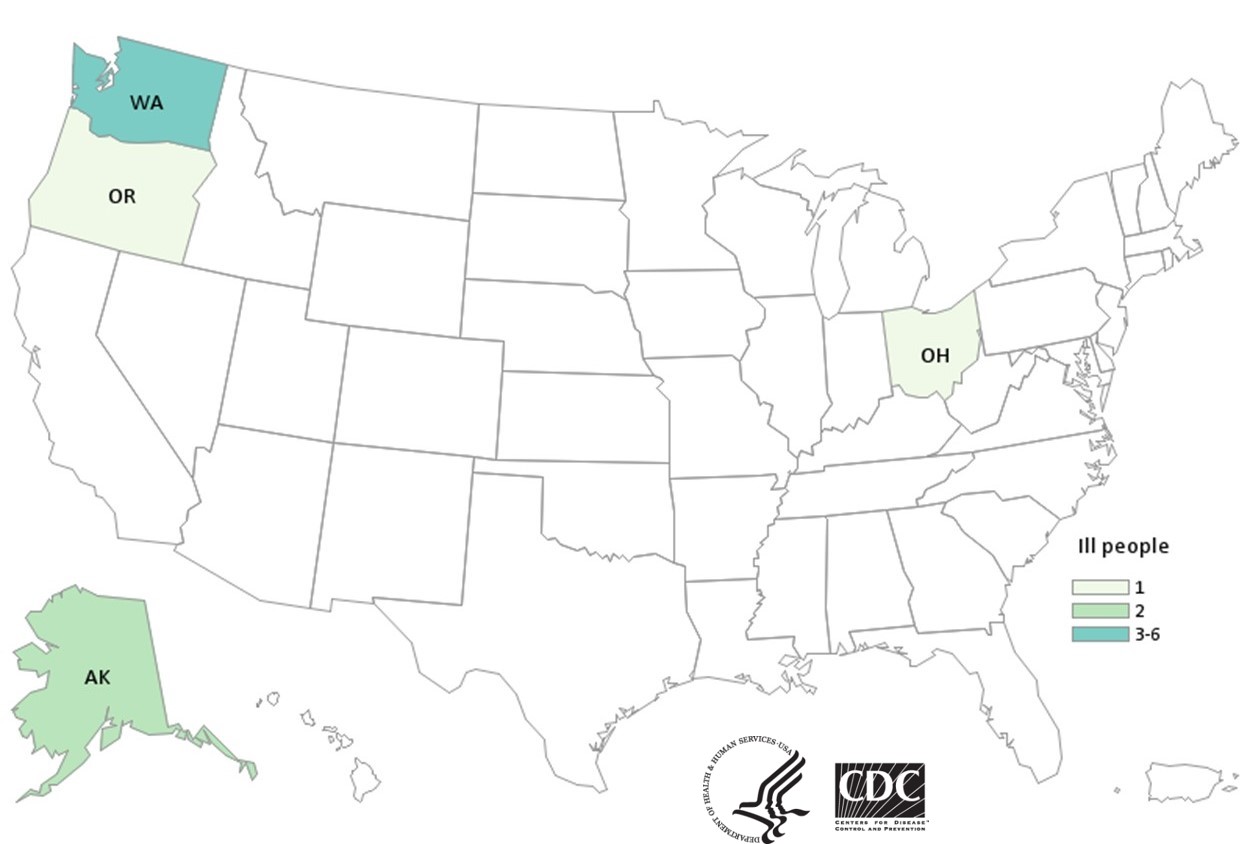
Total Illnesses: 10
Hospitalizations: 4
Deaths: 0
Last Illness Onset: December 19, 2021
States with Cases: AK (2), OH (1), OR (1), WA (6)
Posted in food bourne outbreak, food contamination, food handler, Food Hazard, Food Hygiene, Food Illness, Food Inspections, Food Micro Blog, Food Microbiology, Food Microbiology Blog, Food Microbiology Testing, Food Pathogen, Food Safety, Food Safety Alert, Food Testing, Foodborne Illness, foodborne outbreak, foodbourne outbreak, Illness, outbreak
| Date Posted |
Ref |
Pathogen |
Product(s) Linked to Illnesses (if any) |
Total Case Count |
Status |
| 2/17/2022 | 1056 | Cronobacter sakazakii & Salmonella Newport |
Powdered Infant Formula |
See Advisory |
Active |
| 2/9/2022 | 1040 | Listeria monocytogenes |
Not Yet Identified |
14 | Active |
| 2/2/2022 | 1054 | Enteroinvasive E. coli O143:H26 |
Not Yet Identified |
16 | Closed |
| 1/10/2022 | 1050 | E. coli O121:H19 |
Romaine | 4 | Closed |
| 12/29/2021 | 1052 | E. coli O157:H7 |
Packaged Salad |
See Outbreak Advisory |
Closed |
| 12/20/2021 | 1039 | Listeria monocytogenes |
Packaged Salad |
See Outbreak Advisory |
Active |
| 12/15/2021 | 1048 | Listeria monocytogenes |
Packaged Salad |
See Outbreak Advisory |
Active |
Posted in Cronobacter sakazakii, E.coli O121, FDA, food bourne outbreak, food death, Food Illness, Food Micro Blog, Food Microbiology, Food Microbiology Blog, Food Microbiology Testing, Food Poisoning Death, Foodborne Illness, foodborne outbreak, foodbourne outbreak, Illness, Listeria, Listeria monocytogenes, microbial contamination, Microbiological Risk Assessment, Microbiology, Microbiology Investigations, O143:H26, outbreak, Salmonella
Bern, 02.03.2022 – Aligro has informed the Department of Consumer Affairs and Veterinary Affairs of the Canton of Vaud as well as the Federal Office for Food Safety and Veterinary Affairs (OSAV) that listeria have been detected in herring fillets and smoked haddock fillets. A health risk cannot be excluded. Aligro immediately removed the implicated items from its shelves and ordered a recall.
What risk do these products represent?
In people without immune deficiency, an infection with the bacterium Listeria monocytogenes most often causes mild symptoms, or no symptoms at all. Immunocompromised people, on the other hand, can manifest a whole series of serious symptoms, the outcome of which can be fatal in certain circumstances. During pregnancy, a listeria infection can lead to miscarriage or cause sepsis or meningitis in the baby when it is born.
What products are affected?
Smoked haddock/haddock fillets 200 g
– Item number: 84627
– Producer: Fournier et Fils, France
– Use-by date: 5.3.2022
– Batch: 2204306
– Health stamp: FR 62 193 100 CE
Herring fillets/Heringfilet geräuchert 200 g
– Item number: 84628
– Producer: Fournier et Fils
– Use-by date: 20.3.2022
– Batch: 2204507
– Health stamp: FR 62 193 100 CE
What should affected consumers do?
The OSAV recommends that the population not consume these products and eliminate them.
Address for sending questions
Consumers:
Federal Office for Food Safety and Veterinary Affairs (FSVO)
Infodesk Tel. 058 463 30 33
info@blv.admin.ch
Journalists:
Federal Food Safety and Veterinary Office (OSAV)
Media Service Tel. 058 463 78 98
media@blv.admin.ch
Posted in food contamination, food handler, Food Hazard, Food Hygiene, Food Inspections, Food Micro Blog, Food Microbiology, Food Microbiology Blog, Food Microbiology Testing, Food Pathogen, food recall, Food Safety, Food Safety Alert, food safety training, Food Testing, Listeria, Listeria monocytogenes

 FoodWorld