Monthly Archives: February 2022

RASFF Alert- Ochratoxin A – Dates

RASFF

Ochratoxin A in dates from Tunisia in Belgium

RASFF Alert – Animal Feed – Enterobacteriaceae

RASFF

Enterobacteriaceae in dog chews from Poland in France and Belgium

RASFF Alerts – Animal Feed -Salmonella – Sunflower Seed Cake – Rapeseed Meal – Rabbit Meal

RASFF

Salmonella Senftenberg in sunflower seed cake from Croatia in Poland, Belgium and the Netherlands

RASFF

Salmonella Livingstone in rapeseed meal from Germany in Switzerland

RASFF

Salmonella in rabbit meal from the Netherlands in the Czech Republic and Austria

Research – Characterization of Microbiological Quality of Whole and Gutted Baltic Herring

MDPI

There is growing interest in Baltic herring (Clupea harengus membras) and other undervalued, small-sized fish species for human consumption. Gutting or filleting of small-sized fish is impractical; hence, the aim of this study was to explore the suitability of the whole (ungutted) herring for food use. The microbiological quality of commercially fished whole and gutted herring was analysed with culture-dependent methods combined with identification of bacterial isolates with MALDI-TOF Mass Spectrometry and culture-independent 16S rRNA gene amplicon sequencing. Whole and gutted herring had between 2.8 and 5.3 log10 CFU g−1 aerobic mesophilic and psychrotrophic bacteria and between 2.2 and 5.6 log10 CFU g−1 H₂S-producing bacteria. Enterobacteria counts remained low in all the analysed herring batches. The herring microbiota largely comprised the phyla Proteobacteria, Firmicutes, and Actinobacteria (71.7% to 95.0%). ShewanellaPseudomonas, and Aeromonas were the most frequently isolated genera among the viable population; however, with the culture-independent approach, Shewanella followed by Psychrobacter were the most abundant genera. In some samples, a high relative abundance of the phylum Epsilonbacteraeota, represented by the genus Arcobacter, was detected. This study reports the bacterial diversity present in Baltic herring and shows that the microbiological quality was acceptable in all the analysed fish batches. View Full-Text

USA – FDA Core Outbreak Table Update – New Listeria monocytogenes Outbreak

FDA

Date
Posted

Ref

Pathogen
 

Product(s)
Linked to
Illnesses

(if any)

Investigation
Status

2/9/

2022

1040

Listeria
monocytogenes

Not Yet Identified

Active

2/2/

2022

1054

Enteroinvasive E. coli
O143:H26

Not Yet Identified

Active

1/10/

2022

1050

E. coli
O121:H19

Romaine

Closed

12/29/

2021

1052

E. coli
O157:H7

Packaged Salad

Active

12/20/

2021

1039

Listeria
monocytogenes

Packaged Salad

Active

12/15/

2021

1048

Listeria
monocytogenes

Packaged Salad

Active

USA – Gastrointestinal illness outbreak reported at Issaquah restaurant

Komo News

King County Public Health is investigating an outbreak of gastroenteritis associated with an Issaquah restaurant.

Health officials said five people from one party reported becoming ill a few days after after eating food delivering from Chinese Taste on Jan. 29.

The symptoms and timing of illness suggest a bacterial toxin such as Bacillus cereus or Clostridium perfringens, health officials said.

The exact food or drink that caused the illness has not been identified, but health officials said it is not uncommon for outbreaks associated with a bacterial toxin.

Research – Salmonellosis in Australia in 2020: possible impacts of COVID-19 related public health measures

1 Health

kswfoodworld salmonella

Abstract

Background

More than seventy per cent of salmonellosis in Australia is thought to be due to contaminated food. Rates of salmonellosis vary across the Australian states and territories, with the highest rates in the Northern Territory. In 2020, to control coronavirus disease 2019 (COVID-19), Australia implemented public health measures including border closures, physical distancing and hygiene advice. This study analyses salmonellosis notification rates in 2020 and considers possible impacts of COVID-19 measures.

Methods

Monthly and annual salmonellosis notifications per 100,000 population, for each of Australia’s eight states and territories for the years 2015 to 2020, were extracted from Australia’s publicly accessible National Notifiable Diseases Surveillance System. For each jurisdiction, the salmonellosis rate each month in 2020 was compared with the previous 5-year median rate for that calendar month. The possible impacts of COVID-19 public health measures on salmonellosis notifications in the respec-tive states and territories were examined.

Results

The annual Australian salmonellosis notification rate was 27% lower in 2020 than the previous 5-year median. The reduction in salmonellosis rate varied throughout Australia. States and territories with more stringent, more frequent or longer COVID-19 public health measures had generally greater salmonellosis rate reductions. However, Tasmania had a 50% deeper reduction in salmonellosis rate than did the Northern Territory, despite similar restriction levels.

Conclusions

Salmonellosis notifications decreased in Australia during the global COVID-19 pandemic. The reduction in notifications corresponded with the implementation of public health measures. Persistence of high rates in the Northern Territory could indicate the overarching importance of demographic and environmental factors.

France – Cantal farmer raw milk – Listeria monocytogenes

Gov france

Identification information of the recalled product

  • Product category Food
  • Product subcategory Milk and dairy products
  • Product brand name Antoninus
  • Model names or references ANTONINUS
  • Identification of products
    Lot Dated
    250886 Use-by date 02/12/2022
  • Products List scan1733.pdf Attachment
  • Packaging1/8 = 5kg
  • Marketing start/end date Since 01/01/2022
  • Storage temperature Product to be stored in the refrigerator
  • Further informationFR47001716
  • Geographic area of ​​sale Departments: GERS (32)
  • Distributors Intermarché

Practical information regarding the recall

  • Reason for recall Listeria
  • Risks incurred by the consumer Listeria monocytogenes (causative agent of listeriosis)

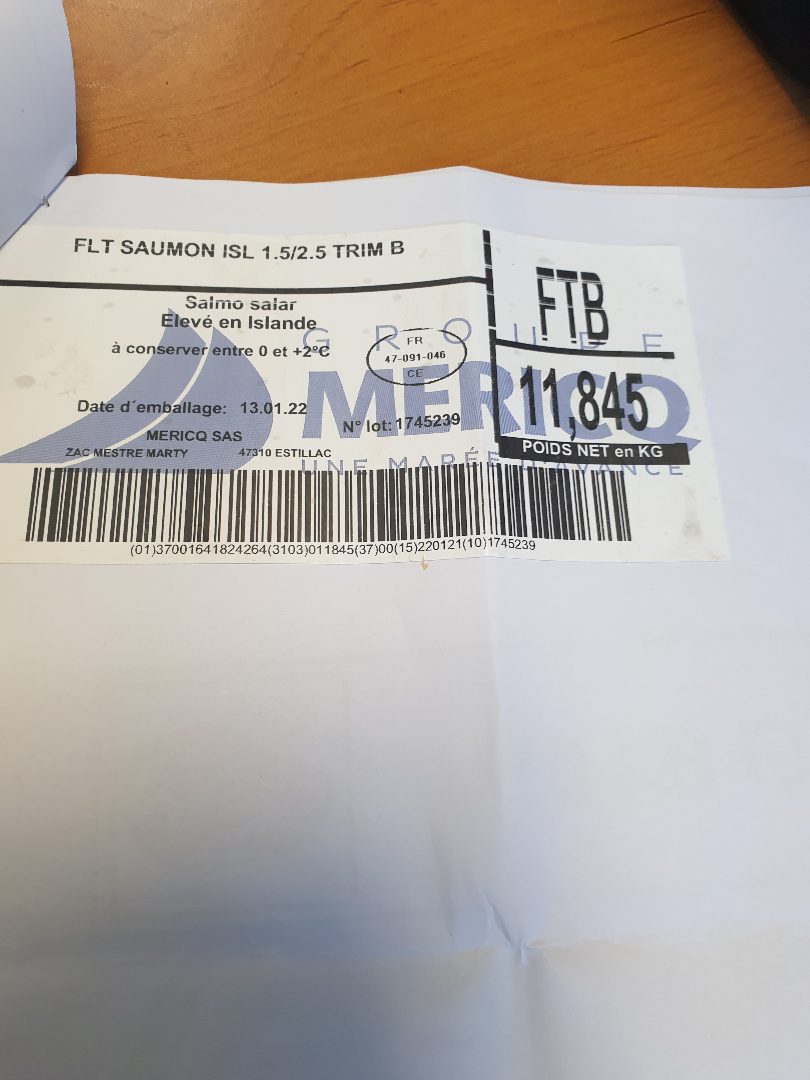
France – Smoked salmon – Listeria monocytogenes

Gov france

Identification information of the recalled product

  • Product category Food
  • Product subcategory Fishery and aquaculture products
  • Product brand name MERICQ
  • Model names or references MERICQ smoked salmon
  • Identification of products
    Lot Dated
    1745239 Use-by date 04/02/2022
  • Products List scan1738.pdf Attachment
  • Packaging4.8KG
  • Marketing start/end date From 18/01/2022 to 24/01/2022
  • Storage temperature Product to be stored in the refrigerator
  • Health mark MERICQ
  • Further information FR 47-091-046
  • Geographic area of ​​sale Intermarché Auch
  • Distributors Intermarché Auch

Practical information regarding the recall

  • Reason for recall Listeria
  • Risks incurred by the consumer Listeria monocytogenes (causative agent of listeriosis)

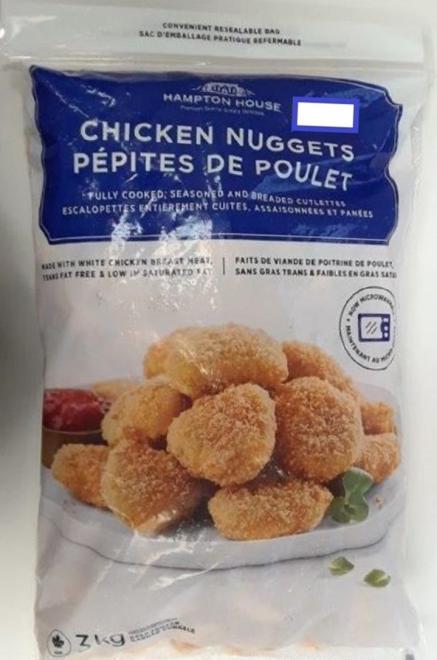
Canada – Hampton House brand Chicken Nuggets recalled due to Salmonella

CFIA

Hampton House brand Chicken Nuggets - 3 kilograms

Summary

Product
Chicken Nuggets
Issue
Food » Microbial Contamination » Salmonella
What to do

Do not consume the recalled product.

Issue

JD Sweid Foods (2013) Ltd. is recalling Hampton House brand Chicken Nuggets from the marketplace due to possible Salmonella.

The recalled product has been sold in British Columbia, Alberta, Saskatchewan and Manitoba.

What you should do

  • If you think you became sick from consuming a recalled product, call your doctor
  • Check to see if you have the recalled product in your home
  • Do not consume the recalled product
  • Recalled products should be thrown out or returned to the location where they were purchased

Food contaminated with Salmonella may not look or smell spoiled but can still make you sick. Young children, pregnant women, the elderly and people with weakened immune systems may contract serious and sometimes deadly infections. Healthy people may experience short-term symptoms such as fever, headache, vomiting, nausea, abdominal cramps and diarrhea. Long-term complications may include severe arthritis.