Research – Insights into the Bacterial Diversity and Detection of Opportunistic Pathogens in Mexican Chili Powder

MDPI

Chili powder is the most frequently consumed spice in Mexican diets. Thus, the dissemination of microorganisms associated with chili powder derived from Capsicum annuum L. is significant during microbial quality analysis, with special attention on detection of potential pathogens. The results presented here describe the initial characterization of bacterial community structure in commercial chili powder samples. Our results demonstrate that, within the domain Bacteria, the most abundant family was Bacillaceae, with a relative abundance of 99% in 71.4% of chili powder samples, while 28.6% of samples showed an average relative abundance of 60% for the Enterobacteriaceae family. Bacterial load for aerobic mesophilic bacteria (AMB) ranged from 104 to 106 cfu/g, while for sporulated mesophilic bacteria (SMB), the count ranged from 102 to 105 cfu/g. Bacillus cereus sensu lato (s.l.) was observed at ca. ˂600 cfu/g, while the count for Enterobacteriaceae ranged from 103 to 106 cfu/g, Escherichia coli and Salmonella were not detected. Fungal and yeast counts ranged from 102 to 105 cfu/g. Further analysis of the opportunistic pathogens isolated, such as B. cereus s.l. and Kosakonia cowanii, using antibiotic-resistance profiles and toxinogenic characteristics, revealed the presence of extended-spectrum β-lactamases (ESBLs) and Metallo-β-lactamases (MBLs) in these organisms. These results extend our knowledge of bacterial diversity and the presence of opportunistic pathogens associated with Mexican chili powder and highlight the potential health risks posed by its use through the spread of antibiotic-resistance and the production of various toxins. Our findings may be useful in developing procedures for microbial control during chili powder production. View Full-Text

Research – Bacteriocin Production by Escherichia coli during Biofilm Development

MDPI

Escherichia coli is a highly versatile bacterium ranging from commensal to intestinal pathogen, and is an important foodborne pathogen. E. coli species are able to prosper in multispecies biofilms and secrete bacteriocins that are only toxic to species/strains closely related to the producer strain. In this study, 20 distinct E. coli strains were characterized for several properties that confer competitive advantages against closer microorganisms by assessing the biofilm-forming capacity, the production of antimicrobial molecules, and the production of siderophores. Furthermore, primer sets for E. coli bacteriocins–colicins were designed and genes were amplified, allowing us to observe that colicins were widely distributed among the pathogenic E. coli strains. Their production in the planktonic phase or single-species biofilms was uncommon. Only two E. coli strains out of nine biofilm-forming were able to inhibit the growth of other E. coli strains. There is evidence of larger amounts of colicin being produced in the late stages of E. coli biofilm growth. The decrease in bacterial biomass after 12 h of incubation indicates active type I colicin production, whose release normally requires E. coli cell lysis. Almost all E. coli strains were siderophore-producing, which may be related to the resistance to colicin as these two molecules may use the same transporter system. Moreover, E. coli CECT 504 was able to coexist with Salmonella enterica in dual-species biofilms, but Shigella dysenteriae was selectively excluded, correlating with high expression levels of colicin (E, B, and M) genes observed by real-time PCR. View Full-Text

Research – Sporadic Occurrence of Enteroaggregative Shiga Toxin–Producing Escherichia coli O104:H4 Similar to 2011 Outbreak Strain

CDC

Abstract
We describe the recent detection of 3 Shiga toxin–producing enteroaggregative Escherichia coli O104:H4 isolates from patients and 1 from pork in the Netherlands that were genetically highly similar to isolates from the 2011 large-scale outbreak in Europe. Our findings stress the importance of safeguarding food supply production chains to prevent future outbreaks.

Shiga toxin–producing Escherichia coli (STEC) is a zoonotic pathogen that causes illness ranging from mild diarrhea to haemolytic uremic syndrome and death. During 2011, an exceptionally large outbreak caused by serotype O104:H4 STEC occurred in Europe, mainly in Germany and France, that was associated with sprouts grown from imported fenugreek seeds (1). Besides the ability to produce Shiga toxin, specifically stx2a, the strain had the genetic characteristics and phylogenetic backbone of an enteroaggregative E. coli (EAEC) pathotype (2) but lacked other classical STEC virulence markers eae and hlyA (3). In addition, the outbreak strain carried plasmid-borne blaCTX-M-15 and blaTEM-1 genes. The epidemiologic investigation revealed that a contaminated batch of fenugreek seeds imported into the European Union from Egypt was the most probable source of the pathogen causing the outbreak (4).

After the 2011 outbreak in Germany and France, only a few sporadic cases of infection with Shiga toxin–producing EAEC O104:H4 were reported, most related to travel to Turkey or North Africa (5–8). We describe the sporadic occurrence of Shiga toxin–producing EAEC O104:H4 isolates in the Netherlands, originating from 2 clinical cases from 2019 and 2020 and 1 food isolate from 2017. In addition, we report a clinical case from Austria in 2021.

Netherlands -Safety warning Ardo Forest fruit mix 1kg Coop -Hepatitis A

NVWA

Safety warning Ardo Forest fruit mix 1kg Coop

Coop warns against Ardo Forest Fruit Mix 1kg. The Hepatitis A virus has been found in the product. Do not eat the product!

See the Coop website

Which product is it?

  • Ardo Forest fruit mix
  • Best Before: 11/2024
  • Lot codes: 58622130 and 58622131

You can return the product to the store and receive a refund of the purchase amount. For questions you can call Ann Engelbert van Ardo on telephone number +32 51 31 06 21 (Belgium) or email info@ardo.com

Sincerely

The Dutch Food and Consumer Product Safety Authority

Denmark – Mold/Mould on pita bread

DVFA

Salling Group recalls Bakersfield Pita bread due to mold found in the product.

Recalled Foods , Published: September 2, 2022

Which food:
Bakersfield Pita bread (see picture here )
Best before dates: 07/10/2022 and 10/10/2022
Net weight: 400g
EAN code: 5712873998906

Sold in:
Netto stores throughout the country

Company that is recalling:
Salling Group, Rosbjergvej 33, 8220 Brabrand

Reason:
The company has established that there is a risk of mold in the product.

Risk:
Mold formation makes the product unsuitable as food.

Advice to consumers:
The Danish Food and Drug Administration advises consumers to return the product to the store where it was purchased, or to discard it.

Sweden – Histamine in fish again – 20 Sick

Food Safety News

Meanwhile, 20 people fell sick recently in Sweden due to histamine levels in fish. The foodborne outbreak was linked to tuna from Vietnam.

In April 2021, 19 people were affected by histamine poisoning in Stockholm after eating tuna loins from Vietnam at three different restaurants.

In 2020, there were three outbreaks of histamine poisoning in tuna from Vietnam in three months. These incidents affected about 60 people but contaminated tuna came from different batches. Patients were from different areas in southern and central Sweden.

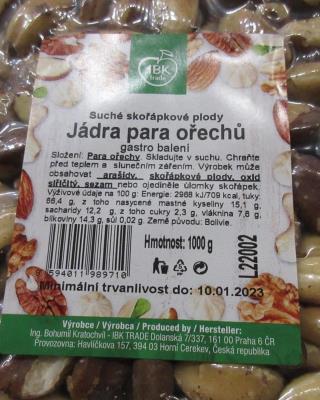
Czech Republic – Brazil Nuts – kernels – Aflatoxin B1

Potravinynapranyri

Illustrative photo #1

Place of inspection:
Horní Cerekev ( Havlíčkova 157, 394 03 Horní Cerekev )
ID: 07361092
Food group: Nuts / Nuts

Brazil nuts – kernels
Category: Dangerous foods
Invalid parameter:

aflatoxin B1

In Brazil nuts, the limit for the content of contaminating substances – aflatoxins – was exceeded twice.

Aflatoxins are classified as mycotoxins. 

Batch: L74-22
Best before date: 30/3/2023
Packaging: plastic bag 20 kg
Quantity of the product in the package: 20 kg
Distributor: Supplier: CATZ INTERNATIONAL BV, BLAKEBURG build, Blaak 22, ROTTERDAM
Country of origin:  Bolivia
Date of sample collection: 5/3/2022
Reference number: 22-000336-SZPI-CZ
The sample was detected by the official control of the State Agricultural and Food Inspection.

Czech Republic -Boni CHEESE THREADS steamed cheese – Mold/Mould

Potravinynapranyri

Illustrative photo #1

Illustrative photo #5

Place of inspection:
Jablonec nad Nisou ( Ivana Olbracht 4582/8, 466 05 Jablonec nad Nisou )
ID: 64945880
Food group: Milk and milk products / Cheese

Boni CHEESE THREADS steamed cheese
Category: Dangerous foods
Invalid parameter:

fungi visible to the eye

On the surface of the food, in the vast majority of the inspected packages, white mold colonies were found under the packaging. Food is not considered safe if it shows signs of spoilage.

Unsuitable storage temperatures of this product were not detected during the inspection. The food did not have an expiration date.

Expiration date: 24/08/2022
Packaging: PP bag with printing, protective atmosphere
Quantity of the product in the package: 0.1 kg
Producer: SIMABELLE s.r.o., no. 1074, 739 98 Mosty u Jablunkova, premises: Rudé armády 1820, 733 01 Karviná – Hranice
Date of sample collection: 18/07/2022
Reference number: 22-000327-SZPI-CZ
The sample was detected by the official control of the State Agricultural and Food Inspection.

Czech Republic -Boni CHEESE THREADS smoked steamed cheese – Mold/Mould

Potravinynapranyri

Illustrative photo #1

Illustrative photo #4

Place of inspection:
Jablonec nad Nisou ( Ivana Olbracht 4582/8, 466 05 Jablonec nad Nisou )
ID: 64945880
Food group: Milk and milk products / Cheese

Boni CHEESE THREADS smoked steamed cheese
Category: Dangerous foods
Invalid parameter:

fungi visible to the eye

On the surface of the food, in some of the inspected packages, there were mold colonies visible with the naked eye under the packaging. Food is not considered safe if it shows signs of spoilage.

Unsuitable storage temperatures of this product were not detected during the inspection. The food did not have an expiration date.

Expiration date: 03/08/2022
Packaging: PP bag with printing, protective atmosphere
Quantity of the product in the package: 0.1 kg
Producer: SIMABELLE s.r.o., no. 1074, 739 98 Mosty u Jablunkova, premises: Rudé armády 1820, 733 01 Karviná – Hranice
Date of sample collection: 18/07/2022
Reference number: 22-000328-SZPI-CZ
The sample was detected by the official control of the State Agricultural and Food Inspection.

Norway -Do not eat the contents of crab shells in Agder – DSP Algal Toxin

Matportalen

The Norwegian Food Safety Authority warns people in Agder against eating the contents of the crab’s shells, following the discovery of diarrhea poison. The meat from the claws is safe to eat.

The Norwegian Food Safety Authority has found high concentrations of the algae poison DSP (Diarrhetic Shellfish Poisoning) in crab from Agder.

DSP is one of the most common types of mussel poisoning in Norway. Once the crab has eaten mussels with DSP, the crab becomes poisonous to people who eat it. DSP causes diarrhoea, nausea, vomiting and abdominal pain. It takes from half an hour to a few hours from the time you eat until you get sick. The symptoms disappear by themselves after 2-3 days.

Since the beginning of July this year, high levels of the algal toxin DSP have been detected in mussels along the Sørland coast, and in Agder the levels of the toxin have increased significantly in recent times. This is the reason why the Norwegian Food Safety Authority has also tested crabs in Agder for DSP.