Category Archives: STEC

Research – Investigation of grouped cases of haemolytic-uremic syndrome (HUS) and shiga-toxin-producing E. coli (STEC) infections linked to the consumption of Buitoni® brand Fraîch’Up pizzas. Update on May 4, 2022.

Sante Publique

Public Health France and the National Reference Center (CNR) E. coli and its associated laboratory (Institut Pasteur, Paris, and Microbiology Laboratory of the Robert Debré Hospital, Paris), in conjunction with the Directorate General for Food, the Directorate General for Competition, Consumer Affairs and Fraud Prevention, and in coordination with the Directorate General for Health, have been investigating since 02/10/2022 an increase in the number of cases of haemolytic uremic syndrome (HUS) pediatric infections and Shiga toxin-producing Escherichia coli (STEC) infections.

The epidemiological, microbiological and traceability investigations carried out since that date have confirmed a link between the occurrence of these grouped cases and the consumption of frozen pizzas from the Buitoni brand Fraîch’Up range contaminated with STEC bacteria. On 03/18/2022, the company proceeded with the withdrawal-recall of all the pizzas in the Fraîch’Up range, marketed since June 2021 and the authorities asked the people who hold these pizzas not to consume them and to destroy them.

The total number of HUS cases linked to the consumption of these pizzas has stabilized since the withdrawal-recall. Other reports of STEC infection are investigated as part of routine surveillance. To date, these reports are not linked to grouped cases or consumption of Fraîch’Up pizzas.

Case of SHU in France: update on 04/05/22

As of 04/05/2022, 56 confirmed cases have been identified, of which 54 are linked to STEC O26 strains, and 2 to STEC O103 strains.

These 56 cases occurred in 55 children and 1 adult, who presented symptoms between 18/01/2022 (week 3) and 05/04/2022 (week 14) (Figure 1). The epidemic peak is in week 7 (14/02 to 20/02) and week 9 (28/02 to 06/03), with 10 cases each of these weeks.

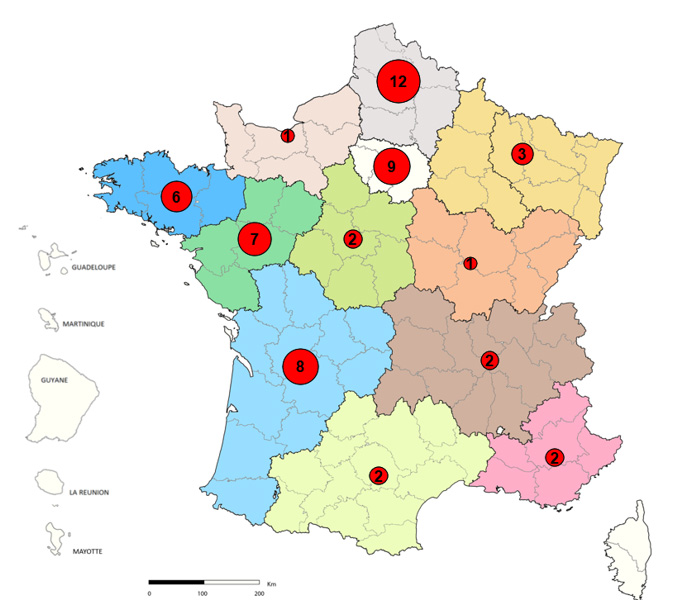
These 56 cases occurred in 12 regions of metropolitan France: Hauts-de-France (12 cases), Ile-de-France (9 cases), New Aquitaine (8 cases), Pays de la Loire (7 cases), Brittany ( 6 cases), Grand Est (3 cases), Provence-Alpes-Côte d’Azur (3 cases), Auvergne-Rhône-Alpes (2 cases), Occitanie (2 cases), Center Val-de-Loire (2 cases) , Bourgogne Franche-Comté (1 case) and Normandy (1 case) (Figure 2).

The 55 sick children are aged from 1 to 17 years old with a median age of 6 years; 25 (45%) are female; 48 (87%) presented with HUS, 7 (13%) with STEC gastroenteritis. Two children died. The adult did not present with HUS.

Figure 1: Epidemic curve: number of confirmed cases of HUS and STEC infections, by week of onset of symptoms – metropolitan France, weeks 3 to 14, 2022 (N=54: week of onset of symptoms not specified for 2 cases )
Figure 1: Epidemic curve: number of confirmed cases of HUS and STEC infections, by week of onset of symptoms - metropolitan France, weeks 3 to 14, 2022 (N=54: week of onset of symptoms not specified for 2 cases )
Figure 2: Geographical distribution of confirmed cases of HUS and STEC infections (N=56) linked to the consumption of Buitoni® brand Fraîch’Up pizzas, by region of residence in metropolitan France, weeks 3 to 14, 2022
Figure 2: Geographical distribution of confirmed cases of HUS and STEC infections (N=56) linked to the consumption of Buitoni® brand Fraîch'Up pizzas, by region of residence in metropolitan France, weeks 3 to 14, 2022

Research – Joint FAO/WHO Expert Meeting on Microbiological Risk Assessment (JEMRA) on Shiga toxin-producing Escherichia coli (STEC) associated with meat and dairy products

FAO

Shiga toxin-producing Escherichia coli (STEC) are an important cause of food-borne disease. Infections can result in a wide range of disease symptoms from mild intestinal discomfort and hemorrhagic diarrhea to severe conditions including haemolytic uremic syndrome (HUS), end-stage renal disease and death. In its report on the global burden of food-borne disease, WHO estimated that in 2010 food-borne STEC caused more than 1.2 million illnesses, 128 deaths, and nearly 13 000 Disability Adjusted Life Years (DALYs) (WHO, 2015). The Codex Committee on Food Hygiene (CCFH) has highlighted the importance of STEC in foods since its 32nd Session in 1999, when it prioritized their presence in beef and sprouts as significant public health problems in Member countries (FAO and WHO, 2000). Following a request from the 47th Session in November 2015 (FAO and WHO, 2016), the FAO and WHO published the report Shiga toxin-producing Escherichia coli (STEC) and food: attribution, characterization and monitoring in 2018 (FAO and WHO, 2018). As part of the 50th session of CCFH in November 2018, the FAO/WHO further updated the committee with additional information on STEC that was subsequently published in the report Attributing illness caused by Shiga toxin-producing Escherichia coli (STEC) to specific foods (FAO and WHO, 2019a). The Codex Alimentarius Commission (CAC) at the 42nd Session, July 2019, approved new work on the development of guidelines for the control of STEC in beef, raw milk and cheese produced from raw milk, leafy greens and sprouts (FAO and WHO, 2019b). To support this work, the Joint FAO/WHO Expert Meeting on Shiga toxin-producing Escherichia coli(STEC) associated with Meat and Dairy Products was convened virtually from 1 to 26 June 2020 to review relevant measures for pre- and post-harvest control of STEC in animals and foods of animal origins. The scientific literature describing physical, chemical and biological control measures (and their combinations) against STEC during primary production, processing and post-processing of raw meat, raw milk and raw milk cheeses was reviewed. The efficacy and utility of reported control measures were scored as high, medium or low, based on expert opinion informed by systematic reviews and/or meta-analyses, when available.

Research – The effectiveness and safety of high pressure food treatment

asca

Definition and applicable regulations

Type of food treated and processing conditions

Intrinsic and extrinsic factors of food that influence the effectiveness of high pressure treatment

Possible chemical and microbiological hazards associated with high pressure treatment

High pressure treatment as an alternative to pasteurization of milk

Efficacy of high pressure treatment for the control of Listeria monocytogenes in ready-to-eat foods

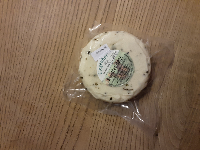
Germany – Herb goat natural and nettle – STEC E.coli

LMW

product image.jpg

Alert type: Food
Date of first publication: 05/05/2022
Product name: Herb goat natural and nettle
Manufacturer (distributor):

Ziegenhof Fam. Filgertshofer

Reason for warning:

Detection of Vero/Shiga toxin-forming VTEC/STEC, stx1- positive

Manufacturer’s website:

Click to access e-coli-Pressemitteilung.pdf

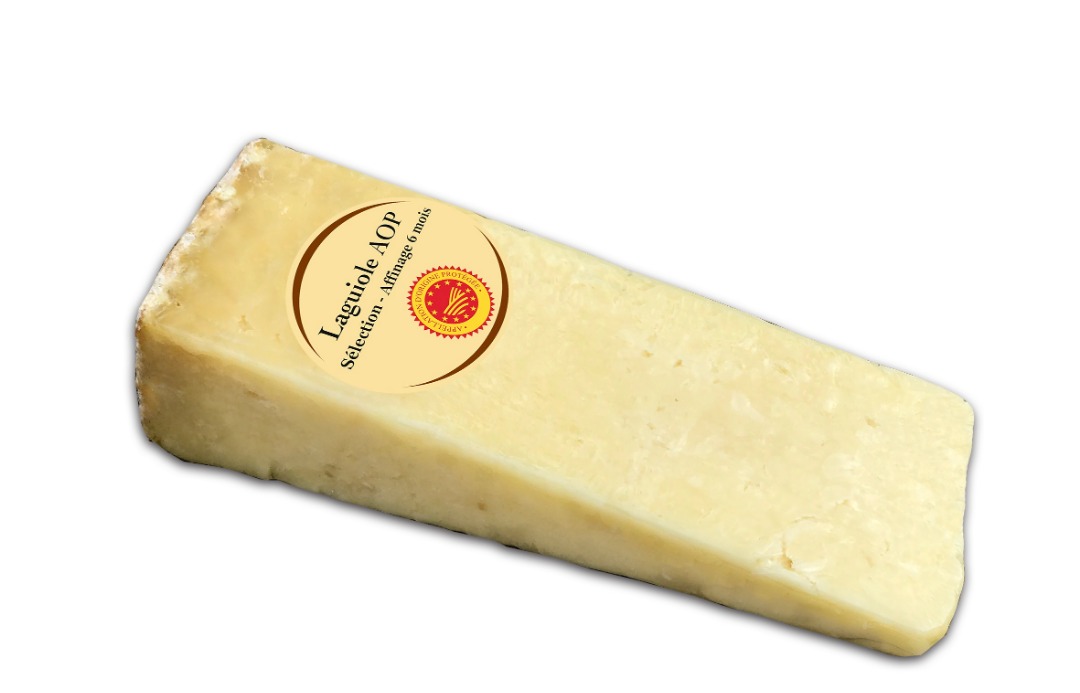
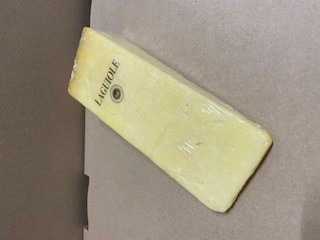
France – Laguiole Selection Aged 6 months lots 21229 and 21248 – STEC E.coli O26:H11

Gov france

Identification information of the recalled product

  • Product category Food
  • Product subcategory Milk and dairy products
  • Product brand name Unbranded
  • Model names or references Laguiole 6 months fresh packed
  • Identification of products
    GTIN Batch Date
    3321271194579 21229123 Use-by date 04/23/2022
    3321271194579 21248134 Use-by date 04/26/2022
    3321271194579 21229123 Use-by date 04/18/2022
  • Packaging Portions fresh packaged 275g approx
  • Marketing start/end date From 03/24/2022 to 04/26/2022
  • Storage temperature Product to be stored in the refrigerator
  • Health mark FR 63 113 081 EC
  • Geographic area of ​​sale Whole France
  • Distributors Intermarché
  • List of points of sale Press release.pdf

Practical information regarding the recall

  • Reason for recall Presence of STEC strain O26:H11
  • Risks incurred by the consumer Toxigenic Shiga Escherichia coli (STEC)

France -Laguiole 6 months, lot 21229 – STEC E.coli O26:H11

Gov france


Identification information of the recalled product

  • Product category Food
  • Product subcategory Milk and dairy products
  • Product brand name Unbranded
  • Model names or references Laguiole 6 months, fresh packed
  • Identification of products
    GTIN Batch Date
    3321271197556 21229 Use-by date 04/17/2022
    3321271196351 21229 Use-by date 04/21/2022
    3321271195675 21229063 Use-by date 04/18/2022
    3321271195583 21229 Use-by date 04/17/2022
  • Packaging Portions fresh packaged 200g approx
  • Marketing start/end date From 03/03/2022 to 21/04/2022
  • Storage temperature Product to be stored in the refrigerator
  • Health markFR12119054CE
  • Geographic area of ​​sale Whole France
  • Distributors Auchan, Casino, Leclerc Socamil, Solignac garden center (31)
  • List of points of sale Press release.pdf

Practical information regarding the recall

  • Reason for recall Presence of STEC strain O26:H11
  • Risks incurred by the consumer Toxigenic Shiga Escherichia coli (STEC)

France – Investigation of grouped cases of haemolytic-uremic syndrome (HUS) and shiga-toxin-producing E. coli (STEC) infections linked to the consumption of Buitoni® brand Fraîch’Up pizzas. Update on April 25, 2022.

Sante Publique

Update on April 25, 2022 on the grouped cases of haemolytic-uremic syndrome and E. coli infections producing shiga-toxin and the consumption of frozen pizzas from the Fraîch’Up range of the Buitoni® brand.

Public Health France and the National Reference Center (CNR) E. coli and its associated laboratory (Institut Pasteur, Paris, and Microbiology Laboratory of the Robert Debré Hospital, Paris), in conjunction with the Directorate General for Food, the Directorate General for Competition, Consumer Affairs and Fraud Prevention, and in coordination with the Directorate General for Health, have been investigating since 02/10/2022 an increase in the number of cases of haemolytic uremic syndrome (HUS) pediatric infections and Shiga toxin-producing Escherichia coli (STEC) infections.

The epidemiological, microbiological and traceability investigations carried out since that date have confirmed a link between the occurrence of these grouped cases and the consumption of frozen pizzas from the Buitoni brand Fraîch’Up range contaminated with STEC bacteria. On 03/18/2022, the company proceeded with the withdrawal-recall of all the pizzas in the Fraîch’Up range, marketed since June 2021 and the authorities asked the people who hold these pizzas not to consume them and to destroy them.

The total number of HUS cases linked to the consumption of these pizzas seems to have stabilized since the withdrawal-recall.

Case of SHU in France: update on 04/25/22

As of 04/25/2022, 55 confirmed cases have been identified, of which 53 are linked to STEC O26 strains, and 2 to STEC O103 strains. 

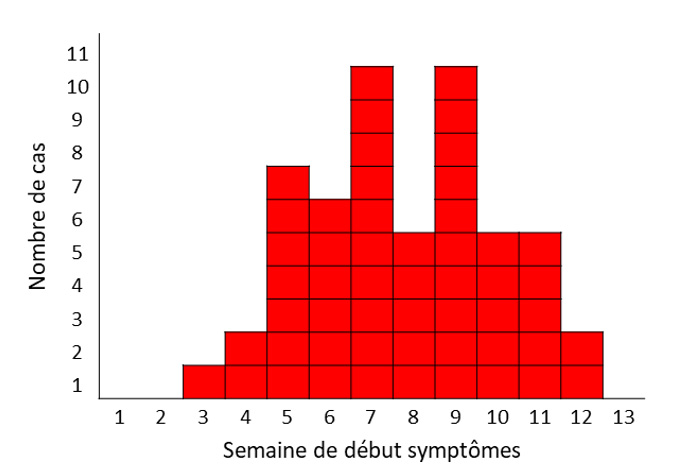
These 55 cases occurred in 54 children and 1 adult, who presented symptoms between 18/01/2022 (week 3) and 25/03/2022 (week 12) (Figure 1). The epidemic peak is in week 7 (14/02 to 20/02) and week 9 (28/02 to 06/03), with 10 cases each of these weeks.
These 55 cases occurred in 12 regions of metropolitan France: Hauts-de-France (12 cases), Ile-de-France (9 cases), New Aquitaine (8 cases), Pays de la Loire (7 cases), Brittany ( 6 cases), Grand Est (3 cases), Auvergne-Rhône-Alpes (2 cases), Occitanie (2 cases), Provence-Alpes-Côte d’Azur (2 cases), Center Val-de-Loire (2 cases) , Bourgogne Franche-Comté (1 case) and Normandy (1 case) (figure 2).

The 54 sick children are aged from 1 to 17 years with a median age of 7 years; 24 (44%) are female; 47 (87%) presented with HUS, 7 (13%) with STEC gastroenteritis. Two children died. The adult did not present with HUS.
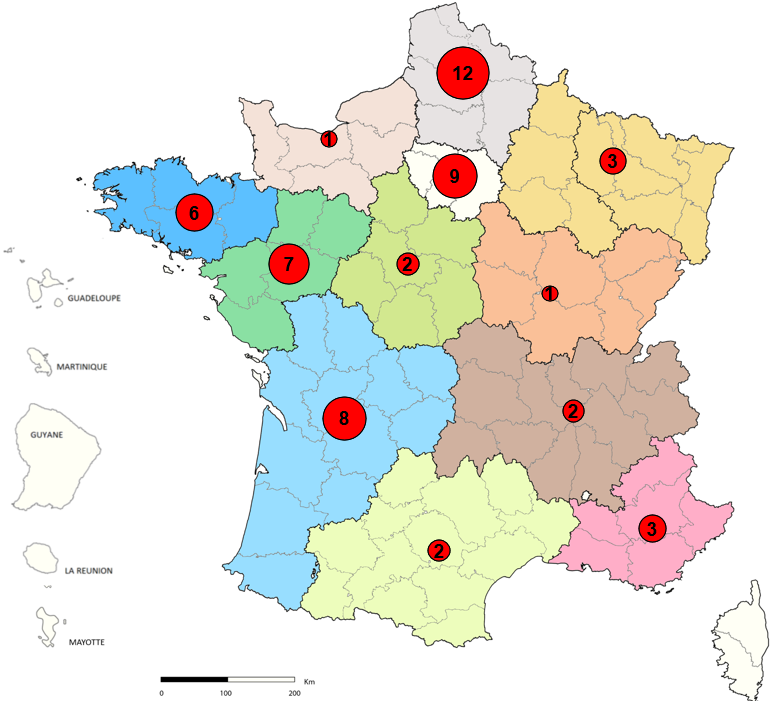
Figure 1 – Epidemic curve: number of confirmed cases of HUS and STEC infections, by week of onset of symptoms – Metropolitan France, weeks 3 to 12, 2022 (N=53: week of onset of symptoms not specified for 2 cases )
Figure 1 - Epidemic curve: number of confirmed cases of HUS and STEC infections, by week of onset of symptoms - Metropolitan France, weeks 3 to 12, 2022 (N=53: week of onset of symptoms not specified for 2 cases )
Figure 2 – Geographical distribution of confirmed cases of HUS and STEC infections (N=55) linked to the consumption of Buitoni® brand Fraîch’Up pizzas, by region of residence in metropolitan France, weeks 3 to 12, 2022
Figure 2 - Geographical distribution of confirmed cases of HUS and STEC infections (N=55) linked to the consumption of Buitoni® brand Fraîch'Up pizzas, by region of residence in metropolitan France, weeks 3 to 12, 2022

RASFF Alert – STEC E.coli – Bovine Carcass

RASFF

STEC (stx+;eae+) in bovine carcass from Belgium in France

USA – FSIS Issues Public Health Alert for Ground Beef Products Due to Possible E. coli O26 Contamination

FSIS USDA

WASHINGTON April 27, 2022, – The U.S. Department of Agriculture’s Food Safety and Inspection Service (FSIS) is issuing a public health alert due to concerns that specific ground beef products may be adulterated with E. coli O26. A recall was not requested because the products are no longer available for purchase.

The ground beef items for this public health alert were produced on December 16 and 17, 2021. The following products subject to the public health alert are [view labels]:

  • 1-lb. foam trays containing “ALL NATURAL LAURA’S LEAN BEEF 92% LEAN 8% FAT GROUND BEEF.” The product is labeled with 350/(timestamp)/Est.31805/002, with the timestamp ranging from 0602 to 1721.
  • 1-lb. foam trays containing “Kroger GROUND BEEF CARNE MOLIDA 96% LEAN 4% FAT.” The product is labeled with 350/(timestamp)/Est.31805/002, with the timestamp ranging from 0602 to 1721.
  • 1-lb. foam trays containing “Kroger GROUND BEEF CARNE MOLIDA 85% LEAN 15% FAT.” The product is labeled with 350/(timestamp)/Est.31805/002, with the timestamp ranging from 0602 to 1721.
  • 1.3-lb. foam trays containing “PRIVATE SELECTION ANGUS BEEF 90% LEAN 10% FAT GROUND SIRLOIN.” The product is labeled with 350/(timestamp)/Est.31805/002, with the timestamp ranging from 0602 to 1721. Additional product is labeled with 351/(timestamp)/Est. 31805/003, with the timestamp ranging from 1549 to 1651.
  • 1-lb. foam trays containing “Kroger GROUND BEEF CARNE MOLIDA 93% LEAN 7% FAT.” The product is labeled with 350/(timestamp)/Est.31805/002, with the timestamp ranging from 0602 to 1721.
  • 1-lb. foam trays containing “Kroger GROUND BEEF CARNE MOLIDA 80% LEAN 20% FAT.” The product is labeled with 350/(timestamp)/Est.31805/002, with the timestamp ranging from 0602 to 1721.

The ground beef products were distributed to warehouses in Oregon and Washington and sold at retail locations.

The problem was discovered after a consumer submitted a retail package of ground beef produced by Empire Packing bearing a use or freeze by date of “December 24, 2021” to a third-party laboratory for microbiological analysis. The consumer reported previously becoming ill but did not get tested for E coli.  The third-party laboratory confirmed the ground beef sample was positive for E. coli O26.

Anyone concerned about an injury or illness should contact a healthcare provider.

Many clinical laboratories do not test for non-O157 STEC, such as O26 because it is harder to identify than STEC O157:H7. People can become ill from STECs 2–8 days (average of 3–4 days) after consuming the organism.

Most people infected with STEC O26 develop diarrhea (often bloody) and vomiting. Some illnesses last longer and can be more severe. Infection is usually diagnosed by testing of a stool sample. Vigorous rehydration and other supportive care is the usual treatment; antibiotic treatment is generally not recommended. Most people recover within a week, but, rarely, some develop a more severe infection. Hemolytic uremic syndrome (HUS), a type of kidney failure, is uncommon with STEC O26 infection. HUS can occur in people of any age but is most common in children under 5 years old, older adults and persons with weakened immune systems. It is marked by easy bruising, pallor and decreased urine output. Persons who experience these symptoms should seek emergency medical care immediately

FSIS is concerned that some product may be in consumers’ freezers. Consumers who have purchased these products are urged not to consume them. These products should be thrown away or returned to the place of purchase.

FSIS advises all consumers to safely prepare their raw meat products, including fresh and frozen, and only consume ground beef that has been cooked to a temperature of 160 F. The only way to confirm that ground beef is cooked to a temperature high enough to kill harmful bacteria is to use a food thermometer that measures internal temperature, https://www.fsis.usda.gov/safetempchart.

Media and consumers with questions regarding the public health alert can contact Debbie Robinson, Vice President of Customer Service, Empire Packing, at drobinson@empirepk.com.

Consumers with food safety questions can call the toll-free USDA Meat and Poultry Hotline at 888-MPHotline (888-674-6854) or live chat via Ask USDA from 10 a.m. to 6 p.m. (Eastern Time) Monday through Friday. Consumers can also browse food safety messages at Ask USDA or send a question via email to MPHotline@usda.gov. For consumers that need to report a problem with a meat, poultry, or egg product, the online Electronic Consumer Complaint Monitoring System can be accessed 24 hours a day at https://foodcomplaint.fsis.usda.gov/eCCF/.

Product Images

Company Information

ESTABLISHMENT ID
PROCESSING CATEGORY

Raw – Non Intact

Company Contact Information

COMPANY MEDIA CONTACT
Empire Packing
Debbie Robinson, Vice President of Customer Service

FSIS Contact Information

MEDIA CONTACT
Congressional and Public Affairs
Cody Kahlig
(202)720-9113

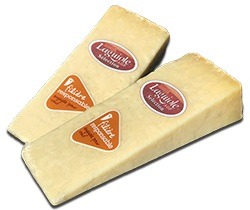
France – Fresh packaged Laguiole – STEC E.coli

Gov france

Identification information of the recalled product

  • Product category Food
  • Product subcategory Milk and dairy products
  • Product brand name Unbranded
  • Model names or references Fresh packaged Laguiole
  • Identification of products
    GTIN Batch Date
    3760038279638 21229113 Use-by date 08/04/2022
    3760038279638 21229123 Use-by date 04/15/2022
    3573230004300 21229134 Use-by date 04/26/2022
  • Packaging portions fresh packed 250g
  • Marketing start/end dateFrom 03/18/2022 to 04/27/2022
  • Storage temperature Product to be stored in the refrigerator
  • Health markFR.63 113 081 EC
  • Geographic area of ​​sale Whole France
  • Distributors Carrefour U express St Saturnin (via Services Included)

Practical information regarding the recall

  • Reason for recall Receipt of an analysis made by a customer on Laguiole lot 21229: non-compliant result detection of STEC strain O26:H11
  • Risks incurred by the consumer Toxigenic Shiga Escherichia coli (STEC)