Category Archives: Shigatoxin

India – Shigella caused food poisoning in girl who died after eating shawarma: Kerala health department

India Express

Shigella - kswfoodworld

Kerala health department on Tuesday identified shigella bacteria as the cause of food poisoning which claimed the life of a student and led to the hospitalisation of around 30 others in the state’s Kasaragod district.

District medical officer Dr S K Ramdas said the presence of shigella was confirmed after testing the blood and faeces of those undergoing treatment for food poisoning. The samples collected from the hospitalised persons were tested at the government medical college hospital in Kozhikode, he said.

France – Laguiole Selection Aged 6 months lots 21229 and 21248 – STEC E.coli O26:H11

Gov france

Identification information of the recalled product

  • Product category Food
  • Product subcategory Milk and dairy products
  • Product brand name Unbranded
  • Model names or references Laguiole 6 months fresh packed
  • Identification of products
    GTIN Batch Date
    3321271194579 21229123 Use-by date 04/23/2022
    3321271194579 21248134 Use-by date 04/26/2022
    3321271194579 21229123 Use-by date 04/18/2022
  • Packaging Portions fresh packaged 275g approx
  • Marketing start/end date From 03/24/2022 to 04/26/2022
  • Storage temperature Product to be stored in the refrigerator
  • Health mark FR 63 113 081 EC
  • Geographic area of ​​sale Whole France
  • Distributors Intermarché
  • List of points of sale Press release.pdf

Practical information regarding the recall

  • Reason for recall Presence of STEC strain O26:H11
  • Risks incurred by the consumer Toxigenic Shiga Escherichia coli (STEC)

France -Laguiole 6 months, lot 21229 – STEC E.coli O26:H11

Gov france


Identification information of the recalled product

  • Product category Food
  • Product subcategory Milk and dairy products
  • Product brand name Unbranded
  • Model names or references Laguiole 6 months, fresh packed
  • Identification of products
    GTIN Batch Date
    3321271197556 21229 Use-by date 04/17/2022
    3321271196351 21229 Use-by date 04/21/2022
    3321271195675 21229063 Use-by date 04/18/2022
    3321271195583 21229 Use-by date 04/17/2022
  • Packaging Portions fresh packaged 200g approx
  • Marketing start/end date From 03/03/2022 to 21/04/2022
  • Storage temperature Product to be stored in the refrigerator
  • Health markFR12119054CE
  • Geographic area of ​​sale Whole France
  • Distributors Auchan, Casino, Leclerc Socamil, Solignac garden center (31)
  • List of points of sale Press release.pdf

Practical information regarding the recall

  • Reason for recall Presence of STEC strain O26:H11
  • Risks incurred by the consumer Toxigenic Shiga Escherichia coli (STEC)

France – Investigation of grouped cases of haemolytic-uremic syndrome (HUS) and shiga-toxin-producing E. coli (STEC) infections linked to the consumption of Buitoni® brand Fraîch’Up pizzas. Update on April 25, 2022.

Sante Publique

Update on April 25, 2022 on the grouped cases of haemolytic-uremic syndrome and E. coli infections producing shiga-toxin and the consumption of frozen pizzas from the Fraîch’Up range of the Buitoni® brand.

Public Health France and the National Reference Center (CNR) E. coli and its associated laboratory (Institut Pasteur, Paris, and Microbiology Laboratory of the Robert Debré Hospital, Paris), in conjunction with the Directorate General for Food, the Directorate General for Competition, Consumer Affairs and Fraud Prevention, and in coordination with the Directorate General for Health, have been investigating since 02/10/2022 an increase in the number of cases of haemolytic uremic syndrome (HUS) pediatric infections and Shiga toxin-producing Escherichia coli (STEC) infections.

The epidemiological, microbiological and traceability investigations carried out since that date have confirmed a link between the occurrence of these grouped cases and the consumption of frozen pizzas from the Buitoni brand Fraîch’Up range contaminated with STEC bacteria. On 03/18/2022, the company proceeded with the withdrawal-recall of all the pizzas in the Fraîch’Up range, marketed since June 2021 and the authorities asked the people who hold these pizzas not to consume them and to destroy them.

The total number of HUS cases linked to the consumption of these pizzas seems to have stabilized since the withdrawal-recall.

Case of SHU in France: update on 04/25/22

As of 04/25/2022, 55 confirmed cases have been identified, of which 53 are linked to STEC O26 strains, and 2 to STEC O103 strains. 

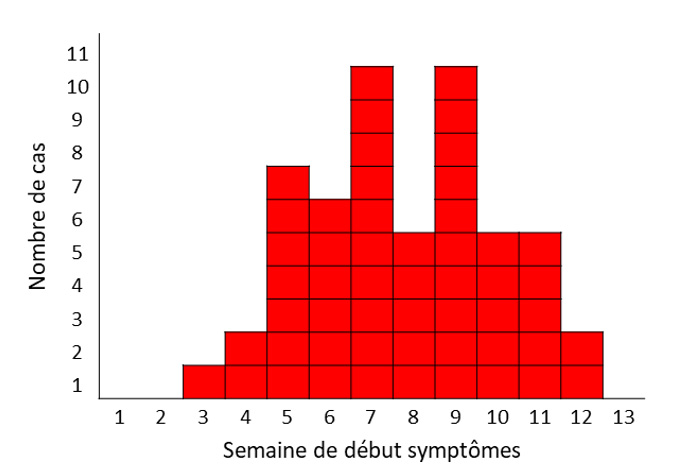
These 55 cases occurred in 54 children and 1 adult, who presented symptoms between 18/01/2022 (week 3) and 25/03/2022 (week 12) (Figure 1). The epidemic peak is in week 7 (14/02 to 20/02) and week 9 (28/02 to 06/03), with 10 cases each of these weeks.
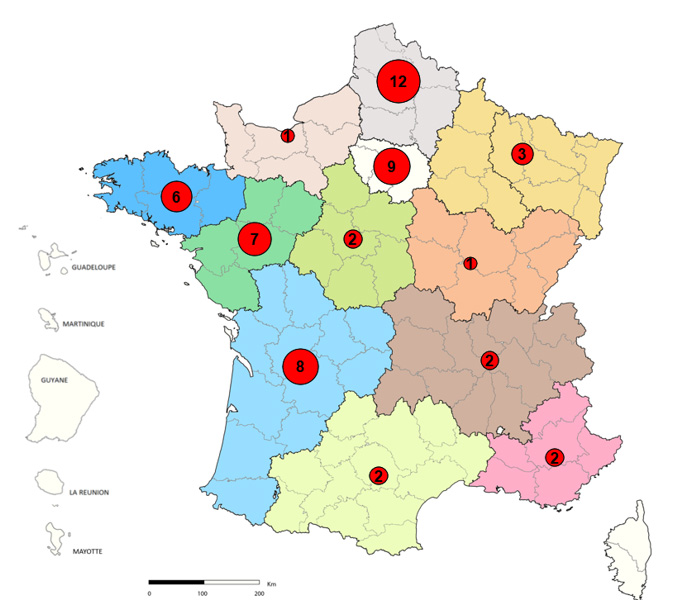
These 55 cases occurred in 12 regions of metropolitan France: Hauts-de-France (12 cases), Ile-de-France (9 cases), New Aquitaine (8 cases), Pays de la Loire (7 cases), Brittany ( 6 cases), Grand Est (3 cases), Auvergne-Rhône-Alpes (2 cases), Occitanie (2 cases), Provence-Alpes-Côte d’Azur (2 cases), Center Val-de-Loire (2 cases) , Bourgogne Franche-Comté (1 case) and Normandy (1 case) (figure 2).

The 54 sick children are aged from 1 to 17 years with a median age of 7 years; 24 (44%) are female; 47 (87%) presented with HUS, 7 (13%) with STEC gastroenteritis. Two children died. The adult did not present with HUS.

Figure 1 – Epidemic curve: number of confirmed cases of HUS and STEC infections, by week of onset of symptoms – Metropolitan France, weeks 3 to 12, 2022 (N=53: week of onset of symptoms not specified for 2 cases )
Figure 1 - Epidemic curve: number of confirmed cases of HUS and STEC infections, by week of onset of symptoms - Metropolitan France, weeks 3 to 12, 2022 (N=53: week of onset of symptoms not specified for 2 cases )
Figure 2 – Geographical distribution of confirmed cases of HUS and STEC infections (N=55) linked to the consumption of Buitoni® brand Fraîch’Up pizzas, by region of residence in metropolitan France, weeks 3 to 12, 2022
Figure 2 - Geographical distribution of confirmed cases of HUS and STEC infections (N=55) linked to the consumption of Buitoni® brand Fraîch'Up pizzas, by region of residence in metropolitan France, weeks 3 to 12, 2022

USA- Shigella Outbreak in Eureka, California Sickens Five, 11 Suspected

Food Poisoning Bulletin

Shigella - kswfoodworld

Image CDC

Shigella outbreak in Eureka, California has sickened at least three people, according to the Humboldt County Department of Health and Human Services. Three cases are lab confirmed, and two cases are being investigated as of February 2022. In a March 5, 2022 update, there are now five cases and 11 more illnesses being investigated according to news reports.

The cases occurred in multiple households and involve school age children, adults, and one person who is experiencing homelessness. The confirmed and suspected cases have been linked to locations on the waterfront area on the U.S. Highway 101 corridor in greater Eureka, according to an update by the health department.

The update, which was on a video narrated by public health nurse Daniel Tran, states, “Based on current and ongoing investigations we suspect the spread may be greater than our current understanding. Therefore, we are alerting medical providers in the area to consider testing for and treating shigella to help both understand the extent of the problem and to help stop the spread of this highly contagious bacterial illness.”

Officials think that the bacteria has been spread through laundromats in the Eureka area where an infected person supposedly washed clothing that was contaminated. Two laundry facilities in Eureka have been sanitized.

Research – Shiga Toxin-Producing Escherichia coli and Milk Fat Globules

MDPI

Shiga toxin-producing Escherichia coli (STEC) are zoonotic Gram-negative bacteria. While raw milk cheese consumption is healthful, contamination with pathogens such as STEC can occur due to poor hygiene practices at the farm level. STEC infections cause mild to serious symptoms in humans. The raw milk cheese-making process concentrates certain milk macromolecules such as proteins and milk fat globules (MFGs), allowing the intrinsic beneficial and pathogenic microflora to continue to thrive. MFGs are surrounded by a biological membrane, the milk fat globule membrane (MFGM), which has a globally positive health effect, including inhibition of pathogen adhesion. In this review, we provide an update on the adhesion between STEC and raw MFGs and highlight the consequences of this interaction in terms of food safety, pathogen detection, and therapeutic development. View Full-Text

Research – Assessment of the Microbiological Quality and Safety of Unpasteurized Milk Cheese for Sale in England between 2019 and 2020

Journal of Food Protection

Cheese made with unpasteurized milk has been associated with outbreaks of illness. However, there are limited data on the prevalence of Shiga toxin–producing Escherichia coli (STEC) in these products and a lack of clarity over the significance of E. coli as a general indicator of hygiene in raw milk cheeses. The aim of this study was to provide further data to address both of these issues, as well as assessing the overall microbiological quality of raw milk cheeses available to consumers in England. A total of 629 samples of cheese were collected from retailers, catering premises, and manufacturers throughout England. The majority (80%) were made using cow’s milk, with 14% made from sheep’s milk and 5% from goat’s milk. Samples were from 18 different countries of origin, with the majority originating from either the United Kingdom (40%) or France (35%). When interpreted against European Union microbiological criteria and United Kingdom guidance, 82% were considered to be of satisfactory microbiological quality, 5% were borderline, and 12% were unsatisfactory. Four samples (0.6%) were potentially injurious to health due to the isolation of STEC from one, >104 CFU/g of coagulase-positive staphylococci in two, and >100 CFU/g of Listeria monocytogenes in the fourth sample. Indicator E. coli and Listeria species were detected more frequently in soft compared with hard cheese. Higher levels of indicator E. coli were significantly associated with a greater likelihood of detecting Shiga toxin genes (stx1 and/or stx2).

RASFF Alert – STEC E.coli – New Zealand Lamb Pucks

RASFF

Shigatoxin-producing Escherichia coli in frozen lamb plucks from New Zealand in Bulgaria

Research – Desiccation survival in Salmonella enterica, Escherichia coli and Enterococcus faecium related to initial cell concentration and cellular components

Journal of Food Protection

Salmonella enterica is well-known for its ability to survive and persist in low-moisture environments.  Previous studies have indicated a link between the initial cell concentration and the population of Salmonella that survive upon desiccation and subsequent storage; however, how the initial cell concentration affects survival is unknown.  This study examined the basis of this phenomena and whether it occurred in other microorganisms, specifically Shiga toxigenic Escherichia coli (STEC), and Enterococcus faecium . Salmonella, STEC, and E. faecium were grown as lawns on TSAYE and harvested using buffered peptone water (BPW). To determine recovery at different initial cell levels, cultures were diluted to 9, 7, and 5 log CFU/mL and applied to filters.  Filters were dried for 24 h, then stored for 28 d at 25°C/33% RH. During storage, cells were recovered from filters using BPW and cultivated on TSAYE.  Both Salmonella and E. coli , but not E. faecium , showed non-proportional recovery. Less viability remained with lower initial starting population after 24 h desiccation such that ≥10 log CFU/mL were recovered when 11 log CFU/mL was desiccated, but ❤ log CFU/mL were recovered when 5 log CFU/mL was desiccated. Once dried, persistence did not appear affected by initial cell concentration. When dead cells (heat-treated) were added to the diluent, recovery of Salmonella was proportional with respect to the initial cell concentration. To further examine the response on desiccation, Salmonella was diluted in BPW containing one of 11 different test cell components related to quorum sensing or known to affect desiccation resistance to assess recovery and persistence. Of the 11 additions only cell debris fractions, cell-free extract, and peptidoglycan improved recovery of Salmonella . Desiccation survival appears related to cell wall components, however, the exact mechanism affecting survival remains unknown.

Research -EU One Health report: drop in reported zoonotic diseases in humans and foodborne outbreaks in 2020

EFSA

Campylobacteriosis was the most reported zoonosis in the EU in 2020, with 120,946 cases compared to more than 220,000 the previous year. It was followed by salmonellosis, which affected 52,702 people compared to 88,000 in 2019. The number of reported foodborne outbreaks also fell by 47%. These findings are based on the annual EU One Health zoonosis report, by EFSA and ECDC.

Experts acknowledged the impact of the COVID-19 pandemic in Europe in the remarkable drop in reported zoonotic diseases in humans – ranging from 7% to 53% depending on the reported disease in question – and foodborne outbreaks.

Possible factors behind the large decrease in cases include changes in health seeking behaviour, restrictions on travel and on events, the closing of restaurants, quarantine, lockdown, and other mitigation measures such as the use of masks, physical distancing and hand sanitisation.  

The next most commonly reported diseases were yersiniosis (5,668) and infections caused by Shigatoxin-producing E.coli (4,446). Listeriosis was the fifth most reported zoonosis (1,876 cases), mainly affecting people over the age of 64.

Listeriosis and West Nile virus infections were the diseases with the highest case fatality and hospitalisation rates – with most locally acquired human infections of West Nile virus reported in Greece, Spain and Italy.

The report also monitors foodborne outbreaks in the EU, events during which at least two people contract the same illness from the same contaminated food. A total of 3,086 foodborne outbreaks were reported in 2020. Salmonella remained the most frequently detected agent and caused about 23% outbreaks. The most common sources of salmonellosis outbreaks were eggs, egg products and pig meat.

The report also includes data on Mycobacterium bovis/caprae, BrucellaTrichinellaEchinococcus, Toxoplasma gondii, rabies, Q fever and tularaemia.

EFSA is publishing two interactive communication tools on foodborne outbreaks – a story map and a dashboard. The story map provides general information on foodborne outbreaks, their causative agents and implicated food vehicles. The dashboard allows people to search and query the large amount of data on foodborne outbreaks collected by EFSA from EU Member States and other reporting countries since 2015.