Category Archives: Research

Research – Evaluation of steam-ultrasound decontamination on naturally contaminated broilers through the analysis of Campylobacter, total viable count, and Enterobacteriaceae

Journal of Food Protection

Combined steam-ultrasound process was investigated for decontamination of freshly slaughtered broilers. Combined steam-ultrasound was delivered simultaneously through specially designed nozzles. The nozzles were installed inside of a constructed machine that allowed for continuous processing. The aim of this study was to evaluate the decontamination effect of the steam- ultrasound application with a capacity of 10,500 birds/hour on naturally contaminated broilers, using three different skin sampling areas for microbial analysis (back, breast and the neck skin). Microbial analysis of Campylobacter , Enterobacteriaceae and Total Viable Count (TVC), was performed pre- and -post steam-ultrasound treatment. A total of 648 skin samples were analyzed for Campylobacter and a total of 216 samples were analyzed for Enterobacteriaceae and TVC. R esults showed significant (p<0.001) Campylobacter reductions of 0.8 log, 1.1 log and 0.7 log, analyzed from skin samples taken from the back, breast and the neck, respectively. Significant reductions of Enterobacteriaceae (p<0.001) by 1.6 log, 1.9 log and 1.1 log and significant reductions of TVC (p<0.001) by 2.0 log, 2.4 log and 1.3 log were found on back, breasts and neck, respectively. Refrigeration effect on Campylobacter numbers pre- and post- steam-ultrasound treatment and incubation at 4°C for eight days was determined in a small trial with 12 samples. Results showed significant (p<0.01) reductions of 0.9 log analyzed on breast skin samples, and 0.7 log reduction (p<0.05) on neck skin samples. Results in this study showed that significant bacteria reduction was achieved on three different surface areas on broilers at a slaughter-speed of 10,500b/h with temperatures over 80°C. The rapid treatment of less than 1.5s exposure time per bird chamber, makes this technology potentially suitable for modern and fast poultry processing lines.
USA – FDA Releases Report on Findings from Sampling of Romaine Lettuce in Yuma, AZ

FDA

Eurofins Food Testing UK

October 7, 2021

The FDA is releasing the findings of a sampling assignment for which FDA collected and tested romaine lettuce from commercial coolers in Yuma County, Arizona during February and March 2021. The agency tested the lettuce for Shiga toxin-producing Escherichia coli (STEC), specifically enterohemorrhagic Escherichia coli (EHEC), and Salmonella spp. This assignment was part of the FDA’s ongoing surveillance following multistate E. coli O157:H7 outbreaks of foodborne illness in recent years linked to or potentially linked to romaine lettuce.

The agency’s goal in conducting this assignment was to determine whether the target pathogens and specific strains may be present in romaine lettuce from the Yuma agricultural region, to help prevent foodborne illness when possible. If product that tested positive for EHEC or Salmonella was found, the Agency planned to work with industry and state regulatory partners to identify the cause (e.g., farm follow-up investigation) to inform future regulatory and/or research efforts and to develop strategies that could help preventive additional outbreaks.

The FDA collected 504 romaine samples for EHECs and Salmonella spp., with the testing performed by an independent laboratory on contract, as part of a pilot project. Each sample consisted of 10 subsamples, and each subsample was made up of at least 300 grams of romaine lettuce (whole heads, hearts or individual leaves).  Collecting and testing samples composed of multiple subsamples increases the probability of detecting pathogens if present, since microbial hazards may not be uniformly present.

During the assignment the FDA detected E. coli O130:H11 in one sample.  The isolate was found to be moderate to high risk and could be capable of causing severe illness in humans, though it was not linked to any known human illnesses, and no product ever reached consumers. The owner of the product did not harvest the remaining crop from the field where it was grown.

In response to the finding, FDA conducted an investigation at the farm to identify possible sources and routes of contamination. The FDA was able to collect romaine lettuce from the field, multiple samples of soil, water, sediment, and animal fecal material. FDA also assessed farm equipment and other surfaces. Only one of the total 24 samples yielded STEC (specifically, E. coli O116:H-). This sample came from the outer leaves of romaine lettuce. The strain was further characterized as low risk to human health, and FDA’s analysis indicated the strain was not linked with any past known foodborne illness outbreaks.

Helping to ensure the microbiological safety of leafy greens continues to be a priority of the FDA. Romaine lettuce and other leafy greens are among the most widely consumed vegetables in the United States and are an important part of a healthy diet. The agency is working on several fronts to help prevent microbial contamination of leafy greens and to prevent outbreaks of foodborne illness. Chief among these efforts is the FDA’s Leafy Greens STEC Action Plan (LGAP), which features public health approaches related to response, prevention and addressing knowledge gaps. The FDA continues to collaborate with industry, states, academia and other stakeholders through activities outlined in the LGAP to address this important public health issue.

Research – Whole genome sequencing reveals great diversity of Vibrio spp in prawns at retail

Microbiology Research

Food Illness

Consumption of prawns as a protein source has been on the rise worldwide with seafood identified as the predominant attributable source of human vibriosis. However, surveillance of non-cholera is limited both in public health and in food. Using a population- and market share-weighted study design, 211 prawn samples were collected and cultured for spp. Contamination was detected in 46 % of samples, and multiple diverse isolates were obtained from 34 % of positive samples. Whole genome sequencing (WGS) and phylogenetic analysis illustrated a comprehensive view of species diversity in prawns available at retail, with no known pathogenicity markers identified in and . Antimicrobial resistance genes were found in 77 % of isolates, and 12 % carried genes conferring resistance to three or more drug classes. Resistance genes were found predominantly in , though multiple resistance genes were also identified in and . This study highlights the large diversity in derived from prawns at retail, even within a single sample. Although there was little evidence in this study that prawns are a major source of vibriosis in the UK, surveillance of non-cholera is very limited. This study illustrates the value of expanding WGS surveillance efforts of non-cholera Vibrios in the food chain to identify critical control points for food safety through the production system and to determine the full extent of the public health impact.

EU – EU-funded project targets produce safety

Food Safety News

A sensor is being developed by an EU-funded consortium to check for pesticides or bacteria in fruits and vegetables.

The project, called GRACED, is coordinated by the Cyprus Research and Innovation Centre and includes experts from across Europe.

The detector uses light particles to spot traces of pesticide or bacteria. From preparing a sample to detection, the system can give a result in 30 minutes.

It uses laser light to detect chemical or biological analytes. Called a plasmo-photonic bimodal multiplexing sensor, it can spot bacteria or pesticides without having to use chemicals or dyes as a marker.

Current safety checks on fruit and vegetables are made in random batches then sent to a laboratory for testing, a process that can take two to three days to get a result. Analyzing data from these checks can be time consuming and costly.

USA – Domestically Acquired Cases of Cyclosporiasis — United States, May–August 2021

CDC

cardcyclosporasme

LAST UPDATED SEPTEMBER 30, 2021 4:00 PM EDT

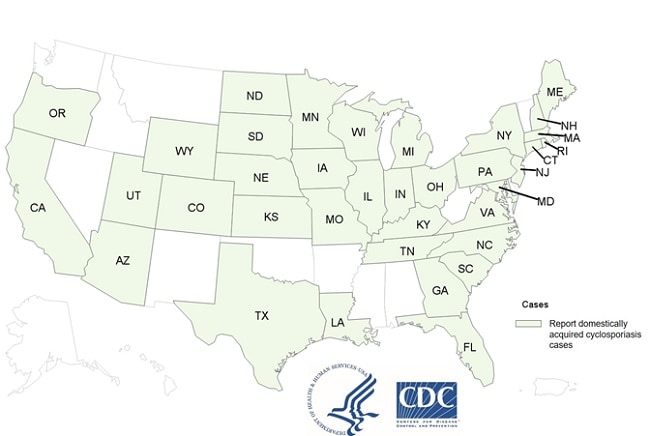
Cyclosporiasis illnesses are reported year-round in the United States. However, during the spring and summer months there is often an increase in cyclosporiasis acquired in the United States (i.e., “domestically acquired”). The exact timing and duration of these seasonal increases in domestically acquired cyclosporiasis can vary, but reports tend to increase starting in May. In previous years the reported number of cases peaked between June and July, although activity can last as late as September. The overall health impact (e.g., number of infections or hospitalizations) and the number of identified clusters of cases (i.e., cases that can be linked to a common exposure) also vary from season to season. Previous U.S. outbreaks of cyclosporiasis have been linked to various types of fresh produce, including basil, cilantro, mesclun lettuce, raspberries, and snow peas.

At a Glance
  • Illnesses: 1020
  • Hospitalizations: 70
  • Deaths: 0
  • States reporting cases: 36

CDC, along with state and federal health and regulatory officials, monitor cases of cyclosporiasis in the United States in the spring and summer months to detect outbreaks linked to a common food source. However, many cases of cyclosporiasis cannot be directly linked to an outbreak, in part because of the lack of validated laboratory “fingerprinting” methods needed to link cases of Cyclospora infection. Officials use questionnaires to interview sick people to determine what they ate in the 14-day period before illness onset. If a commonality is found, CDC and partners work quickly to determine if a contaminated food product is still available in stores or in peoples’ homes and issue advisories.

Final Update

  • In 2021, multiple outbreaks of cyclosporiasis cases associated with different restaurants or events were investigated by state public health authorities, CDC, and FDA.
    • CDC investigated two large multistate outbreaks of cyclosporiasisexternal icon, one including 40 illnesses and one with 130 illnesses, in which ill people reported eating various types of leafy greens. State officials and FDA conducted traceback investigations for these two outbreaks, but a specific type or grower of leafy greens was not identified as the source of either outbreak.
  • As of September 28, 2021, 1,020 laboratory-confirmed cases of cyclosporiasis in people who had no history of international travel during the 14-day period before illness onset have been reported to CDC by 37 jurisdictions, including 36 states and New York City, since May 1, 2021.
    • The median illness onset date is June 25, 2021 (range: May 1–August 31, 2021).
    • At least 70 people have been hospitalized; no deaths have been reported.

September 30, 2021

Geographic Distribution of Reported Cases of Domestically Acquired Cyclosporiasis—May 1 to August 31, 2021*

outbreak_map_season_9_30_21

* Data are current as of 09/28/2021 (9:00am EDT). States/jurisdictions highlighted on the map have each reported at least one case. New York State includes case reports from New York City. Data are preliminary and subject to change. For questions related to the number of cases reported in each state, contact that state’s health department.

Research – Here’s why it’s dangerous to let your dog lick your plate

Country Living

Should you let your dog lick your plate? While many owners share table scraps with their furry friends, one vet has warned of the possible health dangers if your dog shares food directly from your plate.

According to Team Dogs, plates licked by dogs can harbour hidden bacteria such as salmonella which cannot be destroyed by dishwashing. As well as this, many foods still lingering on human plates can be poisonous to dogs, resulting in your pup becoming poorly.

New research by Wren Kitchens found that one in six (15%) of households in the UK let their dogs lick their plates, meanwhile Twitter findings by Team Dogs discovered that 61.5% of voters said they don’t let their dogs lick the plate. It might seem like a harmless dinnertime treat, but owners should keep dog and human dishes separate at all times.

Research – The Use of Organic Acids (Lactic and Acetic) as a Microbial Decontaminant during the Slaughter of Meat Animal Species: A Review

MDPI

Wild ungulate species provide a much-needed protein source to many communities in developed and developing countries. Frequently, these game meat animals are slaughtered, and the meat is unknowingly contaminated by microorganisms and released to the unsuspecting public. This review investigates the global usage of organic acids (lactic and acetic acids) as microbial decontamination strategies during slaughter. The results show that there is a more open-minded approach to adopting possible decontamination plans as a tool to improve meat safety during slaughter. Developed countries continue to adopt these strategies, while developing countries are lagging behind. While decontamination of carcasses can lead to a reduction of microbial load on these carcasses, this strategy must not be seen as a replacement of hygiene management during the animals’ slaughter. View Full-Text

Research – Foodborne Botulism in Western Romania: Ten Years’ Experience at a Tertiary Infectious Disease Hospital

MDPI

Objectives: The purpose of this study was to analyze epidemiological data concerning foodborne botulism in Western Romania over the last decade. Botulism, the toxin formed by the bacterium Clostridium botulinum, results in a neuroparalytic disorder capable of severe clinical progression that begins in the cranial nerves and progressively descends. Preventing progression to a severe case entails timely diagnosis since curative assets are restricted. Ingesting food containing a preformed toxin (foodborne botulism) is the most typical form. Methods: Medical records were retrospectively analyzed from 2010 to 2020 for all food botulism cases. A seroneutralization test was performed with type A, B and E anti-botulinum sera to establish the kind of toxin involved. Results: Overall, 18 cases of foodborne botulism were admitted to the hospital during this period and confirmed by laboratory analysis. Most of the participants in our study were men (61.1%), and 77.8% of the total lived in rural areas. All the participants showed classic symptoms of botulism, and dysphagia was present in all cases. The trivalent ABE antitoxin was administered by the hospital, and toxin type B was isolated in all patients. The main sources of the toxin were pork, ham and canned pork meat. Conclusions: Stronger efforts are needed to foster community awareness of foodborne botulism, particularly in home-preserved food. View Full-Text

Research – Chemical-Based Methodologies Approaches to Extend the Shelf Life of Fresh Fish—A Review

MDPI

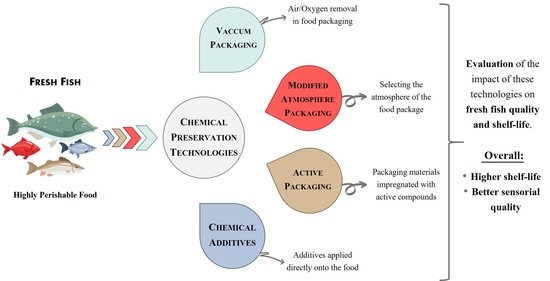
Due to its characteristics, fresh fish is a highly perishable food with a very short shelf-life under refrigeration. Several methods have been introduced to slow down its deterioration, such as by means of oxygen depletion of the food package (vacuum packaging), or by changing the natural atmosphere that is in contact with the fresh fish (modified atmosphere packaging), or by the use of chemicals generally recognized as safe: such compounds can be directly applied (by dipping or spraying) or incorporated into packaging materials and slowly migrate to the product, exerting a hurdle effect against microbial development and lipid oxidation (active packaging). This review aims to cover the most recent advances in chemical-based approaches for fresh fish preservation, applied either singly or in combination. Vacuum packaging, modified atmosphere, and active packaging preservation methodologies are presented, along with the inclusion of chemical additives, such as organic acids and natural extracts, and their combination with icing systems. Advantages and disadvantages of these methodologies and their impact on fresh fish quality and shelf-life are discussed, reaching the conclusion that both are positively influenced overall. Indeed, the contribution of chemical-based strategies for fresh fish preservation is undeniable, and is expected to be a research topic of increasing interest in the future. View Full-Text

Research – Listeria monocytogenes in a Cheese Processing Facility – Learning from Contamination Scebnarios over Three Years of Sampling

Academia Edu

The aim of this study was to analyse the changing patterns of Listeria monocytogenes contamination in a cheese processing facility manufacturing a wide range of ready-to-eat products. Characterization of L. monocytogenes isolates included genotyping by pulsed-field gel electrophoresis (PFGE) and multi-locus sequence typing (MLST). Disinfectant-susceptibility tests and the assessment of L. monocytogenes survival in fresh cheese were also conducted. During the sampling period between 2010 and 2013, a total of 1284 environmental samples were investigated. Overall occurrence rates of Listeria spp. And L. monocytogenes were 21.9% and 19.5%, respectively. Identical L. monocytogenes genotypes were found in the food processing environment (FPE), raw materials and in products. Interventions after the sampling events changed contamination scenarios substantially. The high diversity of globally, widely distributed L. monocytogenes genotypes was reduced by identifying the major sources of contamination. Although susceptible to a broad range of disinfectants and cleaners, one dominant L. monocytogenes sequence type (ST) 5 could not be eradicated from drains and floors. Significantly, intense humidity and steam could be observed in all rooms and water residues were visible on floors due to increased cleaning strategies. This could explain the high L. monocytogenes contamination of the FPE (drains, shoes and floors) throughout the study (15.8%). The outcome of a challenge experiment in fresh cheese showed that L. monocytogenes could survive after 14 days of storage at insufficient cooling temperatures (8 and 16 °C). All efforts to reduce L. monocytogenes environmental contamination eventually led to a transition from dynamic to stable contamination scenarios. Consequently, implementation of systematic environmental monitoring via in-house systems should either aim for total avoidance of FPE colonization or emphasize first reduction of L. monocytogenes to sites where contamination of the processed product is unlikely. Drying of surfaces after cleaning is highly recommended to facilitate the L. monocytogenes eradication.