Category Archives: Microbiology

Research – Comparative study of microbiological transfer from four materials used in direct contact with apples

Science Direct

Several materials such as plastic, wood, cardboard or stainless steel are used as working surfaces or packaging in direct contact with foodstuffs. In food industries, the hygienic surface status is one of the criteria to product conform packaging as described in the European regulation ECR 1935/2004. Today in European Union, it exists one harmonized regulation specific for Food Contact material made of plastic called EU N°10/2011 (Anonymous 2011a). This regulation specifies that materials intended for safe foodstuff contact must not modify food characteristics in terms of chemical, microbiological and sensorial properties.

This study aims to compare the survival and transfer of Penicillium expansum conidia and Escherichia coli cells from several materials to apples. Poplar, cardboards, newly manufactured plastic and reusable plastic specimens were artificially inoculated with both microorganisms, subsequently put in contact with apples and stored under realistic storage conditions. After incubation for up to 1 week, apples and specimens were analysed to assess the survival of the microorganisms and their transfer from materials to apples.

While P. expansum survived and did not grow on any of the materials, E. coli mortality was observed after 1 h on wood and cardboard and after 1 week on both plastics. The proportion of microorganisms transferred was different according to the considered material. This transfer was lower than 1% for wood.
Research -Determination of Enterococcus faecium thermal reduction in normal and high oleic peanut products

Wiley Online

During processing, peanut butter can become contaminated with pathogenic bacteria (e.g., Salmonella ). The introduction of an additional heat treatment step after roasting can help inactivate these microorganisms. In this study, trials were conducted to determine Enterococcus faecium (Salmonella surrogate) reduction rates during the roasting of high oleic (HO) peanuts and heat‐treatment of normal oleic (NO) and HO peanut butters. HO peanuts were inoculated with E. faecium and roasted in a convection oven at 190°C. There was a 2 and 6 log CFU/g reduction at 300 and 480 s, respectively. ‐values for HO peanut butter at 110, 120, and 125°C were 438.9, 165.1, and 80.6 s, respectively. The ‐value was calculated to be 20.8°C. There was no significant difference in ‐values and ‐values between NO and HO peanut butter. In a pilot scale experiment, HO peanut butter was inoculated with E. faecium and agitated in a heated mixer for 21.5 min. E. faecium was reduced by 5.1 log CFU/g after 16.5 min with no apparent change in viscosity or texture. This study demonstrated that significant reductions in E. faecium can be achieved during roasting and through an additional heat‐treatment step.


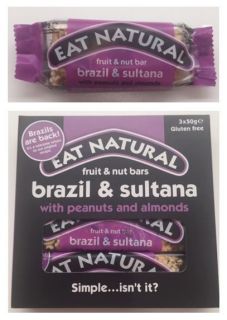
Luxembourg – RECALL: FRUIT & NUT BARS – BRAZIL & SULTANA (WITH PEANUTS AND ALMONDS) – PACKAGING: INDIVIDUAL OR MULTIPACK (3X) OF THE EAT NATURAL BRAND – POSSIBLE PRESENCE OF SALMONELLA

SAP

Last name FRUIT & NUT BARS – BRAZIL & SULTANA (with peanuts and almonds) – packaging: individual or multipack (3x)
Mark NATURAL EAT
Unit 50 g
Bar code Individual: 50 g – EAN 50676262

Multipack: 3 X 50 g – EAN 5013803666149

Date of Minimum Durability (DDM) August 2020 to June 2021

Danger  : Possible presence of Salmonella

Salmonella can cause symptoms such as nausea, vomiting, abdominal cramps, diarrhea, fever and headache within 6 to 72 hours after consumption. These symptoms may be aggravated in young children, immunocompromised individuals and the elderly. People who have consumed these products and who present these symptoms are advised to consult a doctor, notifying him of this consumption.

Source of information: Mandatory notification and RASFF (Rapid Alert System for Food and Feed)

Communicated by: Government Commission for Quality, Fraud and Food Safety .

Research – Variation of antibiotic resistance in Salmonella Enteritidis, Escherichia coli O157 :H7 , and Listeria monocytogenes after exposure to acid, salt, and cold stress

Wiley Online

Abstract

Bacteria with antibiotic‐resistant could seriously threaten to human health, increasing the treatment cost for infections and negatively affecting treatment outcomes. Stress adaptation is one possible mechanism for the acquisition or enhancement of antibiotic resistance in bacteria as a result of cross‐protection. In this study, the effects of acid, salt, and cold stress on the antibiotic resistance of Salmonella Enteritidis, Listeria monocytogenes , and Escherichia coli O157:H7 were investigated using the disc diffusion method. For S. Enteritidis, acidic growth conditions increased resistance to ciprofloxacin and erythromycin ( < .05), and addition of 4% NaCl to growth media decreased resistance to chloramphenicol ( < .05). Irrespective of pH and the NaCl concentration of the growth medium, refrigerated E. coli O157:H7 showed increased resistance to amoxycillin, ciprofloxacin, gentamicin, streptomycin, and erythromycin ( < .05). Acid‐adapted L. monocytogenes showed decreased the resistance to amoxycillin, ampicillin, chloramphenicol, ciprofloxacin, erythromycin, gentamicin, streptomycin, and tetracycline ( < .05). In conclusion, prolonged exposure of foodborne pathogens to acid, salt, and cold stress alters their antibiotic resistance. However, the effect of acid, salt, and cold stress on bacterial antibiotic resistance depend on both the bacterial species and the specific antibiotic. Therefore, multiple factors need to be considered for a foodborne antimicrobial resistant risk assessment.

Research – Quantitative microbial spoilage risk assessment (QMSRA) of pasteurized strawberry purees by Aspergillus fischeri (teleomorph Neosartorya fischeri)

Science Direct

Aspergillus fischeri ascospores are known as potential spoilage microorganisms of pasteurized fruit products due to their high incidence in fruits, the ability to survive pasteurization and to grow in acidic conditions. This study aimed to develop a quantitative microbial spoilage risk assessment (QMSRA) model approach to estimate the spoilage risk of packaged strawberry purees due to A. fischeri under various scenarios regarding product formulation, processing and storage conditions. The development of the risk assessment comprised three steps: (1) initial contamination level of raw material by ascospores (N0), (2) inactivation of ascospores during thermal processing (Np) and (3) determination of the number of ascospores which are able to survive thermal processing and develop visible mycelia (D = 2 mm) during storage (Nf). Data of visible growth (tv, days) comprised distributions previously obtained as function of water activity (aw) (0.860–0.985), oxygen (0–21%), temperature (8–30 °C) and pasteurization (95–105 °C/15 s). The simulations were performed in triplicate with 100,000 iterations using the software R. The outcome “spoilage risk” was defined as the probability of having at least one ascospore (Nf) capable of forming visible colonies in 100 g-pack strawberry puree within the typical use-by dates. Overall, high probabilities of spoilage were estimated for purees pasteurized at milder treatments at 85 °C/15–60 s (67%) and 90 °C/15–60 s (≥40%) stored at ambient temperature (22 °C). The spoilage risk was only effectively reduced (0.02%) by increasing pasteurization conditions to 95 °C for at least 45 s. Moreover, the microbial stability of such purees, i.e., spoilage risk <0.001% (=less than 1 spoilage pack out of 105 produced units) was predicted to occur for purees treated at 100 °C/15 s or stored at chilled conditions (≤8 °C) or at strict anaerobic conditions or produced as concentrates (aw ≤ 0.860). Based on the outcomes obtained, a set of specifications for Heat-Resistant Moulds (HRMs) in raw material and pasteurized purees aimed to be used as an ingredient was suggested. Furthermore, the results can be used to support risk management decisions in identifying and quantifying the impact of possible interventions during formulation, processing and storage conditions of fruit purees to effectively reduce this risk.

USA – Public Health declares Salmonella outbreak after 13 cases confirmed

CBC

Public Health says outbreak is not related to recent onion recall in the U.S.

New Brunswick Public Health has declared a salmonella outbreak after discovering 13 confirmed cases in the province and two that are still under investigation.

Bruce Macfarlane, a spokesperson for the Department of Health, said the cases were founded in the north and eastern regions of the province but wouldn’t elaborate where in those regions.

The cases were confirmed between June 16 and July 27, the Department of Health said in a news release.

The Department of Health doesn’t know what caused the outbreak.

Macfarlane said the cases were not related to the more than 300 Canadians who became ill from salmonella, which have been linked to a recall of U.S. grown onions.

USA – Target Recalls Peaches – Salmonella Outbreak

Target recalls peaches after being linked to Salmonella outbreak

Target is recalling peaches because of possible Salmonella contamination.

Minnesota state health and food safety officials are warning Minnesota consumers not to eat fresh, whole peaches supplied by Wawona Packing Company and purchased at retail locations including Aldi and Target after linking Salmonella infections to the produce.

The Minnesota Department of Health (MDH) and Minnesota Department of Agriculture (MDA), along with the U.S. Centers for Disease Control and Prevention (CDC), the U.S. Food and Drug Administration (FDA) are investigating a multi-state outbreak of Salmonella Enteritidis infections linked to consumption of peaches supplied by Wawona Packing Company.

According to the MDH, ill people have reported purchasing peaches from Aldi, Target, and possibly other retail locations. On August 19, Aldi announced a recall of peaches from Wawona Packing Company, including both loose and bagged peaches.


USA – An Outbreak of Salmonella Enteritidis Linked with Peaches Emerges Across Various States in the U.S.

An Outbreak of 68 Salmonella Enteritidis Cases in Nine States has been Traced to Wawona Peaches

The U.S. Food and Drug Administration (FDA) recently announced yet another Salmonella outbreak. The FDA has declared an ongoing investigation in regards to the numerous confirmed cases of Salmonella Enteritidis found across multiple states. The initial cases were traced back through epidemiological methods. Health officials discovered a likely connection between the Salmonella Enteritis cases and bagged peaches sold by ALDI’s. The peaches of concern were sold by ALDI’s between June 1, 2020 and August 19, 2020, when ALDI issued a voluntary recall on their Wawona-brand 2 pound, bagged peaches sold in clear plastic bags. An image of the bagged peaches and their packaging can be viewed here.

On August 19, 2020, the Center for Disease Control and Prevention (CDC) announced that there are a total of 68 cases of illness, 14 hospitalizations, and 0 deaths, due to the Salmonella Enteritidis Outbreak. The 9 states with confirmed cases are IA, MD, MI, MN, NJ, NY, PA, VA, WI. The following states have been confirmed to have also had the recalled peaches shipped to various grocery and retail locations; CT, IA, IL, KY,  MA, MI, MN, ND, NH, NY, OH,  RI, SD, VT, WI, and WV.

New Zealand – Shellfish Biotoxin Alerts

MPI

ALL WARNINGS ARE UP TO DATE

Warnings are reviewed weekly following sampling results. Information on this page is then updated if needed.

If you have questions, email info@mpi.govt.nz

Current warnings

Hawke’s Bay – North Island

West Coast – South Head to Tauratahi Point – North Island

Previous changes
  • 19 August: Hawke Bay Warning extended to Young Nicks Head.
  • 12 August: NI West Coast – South Head to Tauratahi Point warning issued
  • 12 August: Port Levy warning removed.
  • 10 July 2020: Hawke’s Bay warning extended.
  • 2 July 2020: Hawke Bay warning issued

RASFF Alerts – Diarrhoeic Shellfish Poisoning (DSP) – Live Mussels

European Food Alerts

RASFF

Diarrhoeic Shellfish Poisoning (DSP) toxins (sum of lipophilic toxins > 320 µg/kg – ppb) in live mussels (Mytilus Galloprovincialis) from Italy in Italy

RASFF

Diarrhoeic Shellfish Poisoning (DSP) toxins – okadaic acid (148 µg/kg – ppb) in live mussels (Mytilus galloprovincialis) from Italy in Spain