Category Archives: Microbiological Risk Assessment

Information – Safe Minimum Cooking Temperatures Chart

Food Safety.GOV

Follow the guidelines below for minimum cooking temperatures and rest time for meat, poultry, seafood, and other cooked foods. Be sure to use a food thermometer to check whether meat has reached a safe internal temperature that is hot enough to kill harmful germs that cause food poisoning.

Food Safety.GOV

Research -Application of Whole Genome Sequencing to Aid in Deciphering the Persistence Potential of Listeria monocytogenes in Food Production Environments

MDPI

Listeria monocytogenes is the etiological agent of listeriosis, a foodborne illness associated with high hospitalizations and mortality rates. This bacterium can persist in food associated environments for years with isolates being increasingly linked to outbreaks. This review presents a discussion of genomes of Listeria monocytogenes which are commonly regarded as persisters within food production environments, as well as genes which are involved in mechanisms aiding this phenotype. Although criteria for the detection of persistence remain undefined, the advent of whole genome sequencing (WGS) and the development of bioinformatic tools have revolutionized the ability to find closely related strains. These advancements will facilitate the identification of mechanisms responsible for persistence among indistinguishable genomes. In turn, this will lead to improved assessments of the importance of biofilm formation, adaptation to stressful conditions and tolerance to sterilizers in relation to the persistence of this bacterium, all of which have been previously associated with this phenotype. Despite much research being published around the topic of persistence, more insights are required to further elucidate the nature of true persistence and its implications for public health.

Research – Monitoring by a Sensitive Liquid-Based Sampling Strategy Reveals a Considerable Reduction of Listeria monocytogenes in Smeared Cheese Production over 10 Years of Testing in Austria

MDPI

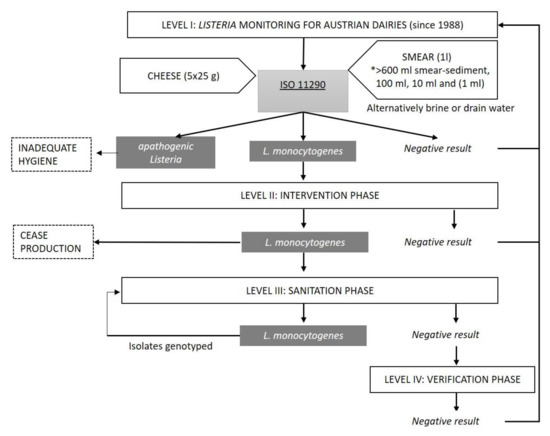
Most Austrian dairies and cheese manufacturers participated in a Listeria monitoring program, which was established after the first reports of dairy product-associated listeriosis outbreaks more than thirty years ago. Within the Listeria monitoring program, up to 800 mL of product-associated liquids such as cheese smear or brine are processed in a semi-quantitative approach to increase epidemiological sensitivity. A sampling strategy within cheese production, which detects environmental contamination before it results in problematic food contamination, has benefits for food safety management. The liquid-based sampling strategy was implemented by both industrial cheese makers and small-scale dairies located in the mountainous region of Western Austria. This report considers more than 12,000 Listeria spp. examinations of liquid-based samples in the 2009 to 2018 timeframe. Overall, the occurrence of L. monocytogenes in smear liquid samples was 1.29% and 1.55% (n = 5043 and n = 7194 tested samples) for small and industrial cheese enterprises, respectively. The liquid-based sampling strategy for Listeria monitoring at the plant level appears to be superior to solid surface monitoring. Cheese smear liquids seem to have good utility as an index of the contamination of cheese up to that point in production. A modelling or validation process should be performed for the new semi-quantitative approach to estimate the true impact of the method in terms of reducing Listeria contamination at the cheese plant level. View Full-Text

USA- FDA Core Investigation Table Updates

FDA

Cyclospora Increase

India – 100 People Suffer Food Poisoning After Attending Wedding Feast in Rajasthan’s Churu

India.com

Jaipur: Over 100 people, including 45 children, fell ill on Wednesday after having food at a wedding ceremony in Rajasthan’s Churu. People who fell in after having contaminated food had to be rushed to a hospital for treatment. “Some people came to hospital last night with complaint of vomiting after attending a wedding in Shobhasar village. Around 90 people were discharged after treatment,” an official told news agency

Korea – Food Poisoning Victims Sue ‘Gimbap’ Franchise – Salmonella

Korea BizWire

Over 130 people have lodged a damages suit against a restaurant franchise that sells “gimbap,” or seaweed rice rolls with vegetables, over food poisoning.

Park Young-saeng, an attorney at Jungjin law firm, said Tuesday that he filed a damages suit the previous day with the Suwon District Court in Seongnam, a Gyeonggi Province city just south of Seoul, on behalf of 135 victims of food poisoning incidents at two stores of a gimbap chain in the city.

The victims have requested a total of about 400 million won (US$342,960) in compensation, or 3 million won per person, from the franchise and the two restaurants.

A total of 276 people who ate gimbap at the two branches of a gimbap chain in Seongnam between July 29 and Aug. 2 showed food poisoning symptoms. Forty of them were hospitalized for treatment.

According to health authorities, salmonella bacteria were found in clinical specimens from the patients and cooking tools used at the restaurants.

Research – Epidemiological investigations identified an outbreak of Shiga toxin-producing Escherichia coli serotype O26:H11 associated with pre-packed sandwiches

Cambridge Org

In October 2019, public health surveillance systems in Scotland identified an increase in the number of reported infections of Shiga toxin-producing Escherichia coli (STEC) O26:H11 involving bloody diarrhoea. Ultimately, across the United Kingdom (UK) 32 cases of STEC O26:H11 stx1a were identified, with the median age of 27 years and 64% were male; six cases were hospitalised. Among food exposures there was an association with consuming pre-packed sandwiches purchased at outlets belonging to a national food chain franchise (food outlet A) [odds ratio (OR) = 183.89, P < 0.001]. The common ingredient identified as a component of the majority of the sandwiches sold at food outlet A was a mixed salad of Apollo and Iceberg lettuce and spinach leaves. Microbiological testing of food and environmental samples were negative for STEC O26:H11, although STEC O36:H19 was isolated from a mixed salad sample taken from premises owned by food outlet A. Contamination of fresh produce is often due to a transient event and detection of the aetiological agent in food that has a short-shelf life is challenging. Robust, statistically significant epidemiological analysis should be sufficient evidence to direct timely and targeted on-farm investigations. A shift in focus from testing the microbiological quality of the produce to investigating the processes and practices through the supply chain and sampling the farm environment is recommended.

USA – Active Food Poisoning Outbreak Investigations From FDA and USDA

Food Poisoning Bulletin

What are the current active food poisoning outbreak investigations that the FDA and USDA are investigating? While there have been several outbreak investigations that have closed, there are still six open investigations on the FDA Outbreak Table, and one, possibly two, investigations on the USDA Table.

USA – Recalled: Nom Nom Chicken Cuisine Cat Food – Listeria monocytogenes

Petful

Maker: NomNomNow Inc.
Cause: Potential for listeria
Announcement: Company letter to customers, dated July 8, 2021
What was recalled: Chicken Cuisine cat food—only with the following lot numbers: 18700, 18714, 18728, 18742, 18756 and 18770 (the lot number has the initials “CC” before it)

Nom Nom has announced its first-ever cat food recall, and it comes after one of its suppliers, Tyson Foods Inc., recalled millions of pounds of chicken because of possible listeria contamination.

The affected Nom Nom cat food, called Chicken Cuisine, was produced between March 8 and May 17 of this year. All customers have been notified, and only the lot numbers listed above are part of the recall. No other Nom Nom product is affected.

Research – Is Fresh Produce in Tigray, Ethiopia a Potential Transmission Vehicle for Cryptosporidium and Giardia?

MDPI

CDC Giardia2

In rural Ethiopia, where people often share their homes with their livestock, infections of humans and animals with Cryptosporidium and Giardia are relatively common. One possible transmission route is consumption of contaminated fresh produce; this study investigated the occurrence of Cryptosporidium and Giardia in fresh produce in four districts of rural Tigray in Ethiopia. Fresh produce samples (n = 55) were analysed using standard laboratory procedures. Overall, 15% (8/55) of samples were found to be contaminated. Although contamination levels were mostly low, a few samples had high numbers of Giardia cysts (up to around 70 cysts per 30 g sample). Molecular analyses were largely unsuccessful, but Giardia Assemblage A was identified in one sample. Contamination with these parasites was identified in two of the four districts, but, although a similar pattern has already been described for water contamination, this may be at least partially explained by sampling bias. Nevertheless, we speculate that access to clean water sources may be an important factor for reducing the occurrence of these pathogens. Given the public health and veterinary burden associated with both parasites, the factors which are of importance for their circulation in the communities and environments deserve further investigation. View Full-Text