Category Archives: Food Microbiology Research

Hong Kong – Do Not Eat Raw Freshwater Fish to Avoid Harmful Bacteria and ParasitesRaw Freshwater Fish toAvoid Harmful Bacteria and Parasites

Click to access Bacteria_and_Parasites_e.pdf

USA – FDA Releases Report on Findings from Sampling of Romaine Lettuce in Yuma, AZ

FDA

Eurofins Food Testing UK

October 7, 2021

The FDA is releasing the findings of a sampling assignment for which FDA collected and tested romaine lettuce from commercial coolers in Yuma County, Arizona during February and March 2021. The agency tested the lettuce for Shiga toxin-producing Escherichia coli (STEC), specifically enterohemorrhagic Escherichia coli (EHEC), and Salmonella spp. This assignment was part of the FDA’s ongoing surveillance following multistate E. coli O157:H7 outbreaks of foodborne illness in recent years linked to or potentially linked to romaine lettuce.

The agency’s goal in conducting this assignment was to determine whether the target pathogens and specific strains may be present in romaine lettuce from the Yuma agricultural region, to help prevent foodborne illness when possible. If product that tested positive for EHEC or Salmonella was found, the Agency planned to work with industry and state regulatory partners to identify the cause (e.g., farm follow-up investigation) to inform future regulatory and/or research efforts and to develop strategies that could help preventive additional outbreaks.

The FDA collected 504 romaine samples for EHECs and Salmonella spp., with the testing performed by an independent laboratory on contract, as part of a pilot project. Each sample consisted of 10 subsamples, and each subsample was made up of at least 300 grams of romaine lettuce (whole heads, hearts or individual leaves).  Collecting and testing samples composed of multiple subsamples increases the probability of detecting pathogens if present, since microbial hazards may not be uniformly present.

During the assignment the FDA detected E. coli O130:H11 in one sample.  The isolate was found to be moderate to high risk and could be capable of causing severe illness in humans, though it was not linked to any known human illnesses, and no product ever reached consumers. The owner of the product did not harvest the remaining crop from the field where it was grown.

In response to the finding, FDA conducted an investigation at the farm to identify possible sources and routes of contamination. The FDA was able to collect romaine lettuce from the field, multiple samples of soil, water, sediment, and animal fecal material. FDA also assessed farm equipment and other surfaces. Only one of the total 24 samples yielded STEC (specifically, E. coli O116:H-). This sample came from the outer leaves of romaine lettuce. The strain was further characterized as low risk to human health, and FDA’s analysis indicated the strain was not linked with any past known foodborne illness outbreaks.

Helping to ensure the microbiological safety of leafy greens continues to be a priority of the FDA. Romaine lettuce and other leafy greens are among the most widely consumed vegetables in the United States and are an important part of a healthy diet. The agency is working on several fronts to help prevent microbial contamination of leafy greens and to prevent outbreaks of foodborne illness. Chief among these efforts is the FDA’s Leafy Greens STEC Action Plan (LGAP), which features public health approaches related to response, prevention and addressing knowledge gaps. The FDA continues to collaborate with industry, states, academia and other stakeholders through activities outlined in the LGAP to address this important public health issue.

Research – Whole genome sequencing reveals great diversity of Vibrio spp in prawns at retail

Microbiology Research

Food Illness

Consumption of prawns as a protein source has been on the rise worldwide with seafood identified as the predominant attributable source of human vibriosis. However, surveillance of non-cholera is limited both in public health and in food. Using a population- and market share-weighted study design, 211 prawn samples were collected and cultured for spp. Contamination was detected in 46 % of samples, and multiple diverse isolates were obtained from 34 % of positive samples. Whole genome sequencing (WGS) and phylogenetic analysis illustrated a comprehensive view of species diversity in prawns available at retail, with no known pathogenicity markers identified in and . Antimicrobial resistance genes were found in 77 % of isolates, and 12 % carried genes conferring resistance to three or more drug classes. Resistance genes were found predominantly in , though multiple resistance genes were also identified in and . This study highlights the large diversity in derived from prawns at retail, even within a single sample. Although there was little evidence in this study that prawns are a major source of vibriosis in the UK, surveillance of non-cholera is very limited. This study illustrates the value of expanding WGS surveillance efforts of non-cholera Vibrios in the food chain to identify critical control points for food safety through the production system and to determine the full extent of the public health impact.

EU – EU-funded project targets produce safety

Food Safety News

A sensor is being developed by an EU-funded consortium to check for pesticides or bacteria in fruits and vegetables.

The project, called GRACED, is coordinated by the Cyprus Research and Innovation Centre and includes experts from across Europe.

The detector uses light particles to spot traces of pesticide or bacteria. From preparing a sample to detection, the system can give a result in 30 minutes.

It uses laser light to detect chemical or biological analytes. Called a plasmo-photonic bimodal multiplexing sensor, it can spot bacteria or pesticides without having to use chemicals or dyes as a marker.

Current safety checks on fruit and vegetables are made in random batches then sent to a laboratory for testing, a process that can take two to three days to get a result. Analyzing data from these checks can be time consuming and costly.

USA – Outbreak Investigation of Salmonella Typhimurium: Bright Farms Packaged Salad Greens (July 2021) -Outbreak is over

FDA

The FDA, along with CDC and state and local partners, investigated a multistate outbreak of Salmonella Typhimurium infections linked to the consumption of BrightFarms packaged salad greens produced in the firm’s Rochelle, IL facility.

FDA visited the facility and collected samples. Some environmental samples taken inside the facility tested positive for Salmonella Liverpool, but were not a match to the outbreak strain. In addition, a sample collected from an outdoor storm water drainage pond adjacent to the facility was analyzed and reported to be Salmonella Typhimurium and a genetic match to the outbreak strain.

Although no clear route of contamination was readily identified, the FDA is preparing a report to discuss findings and provide information to assist in future prevention efforts.

Recommendation

CDC has declared this outbreak to be over.

Investigation Background

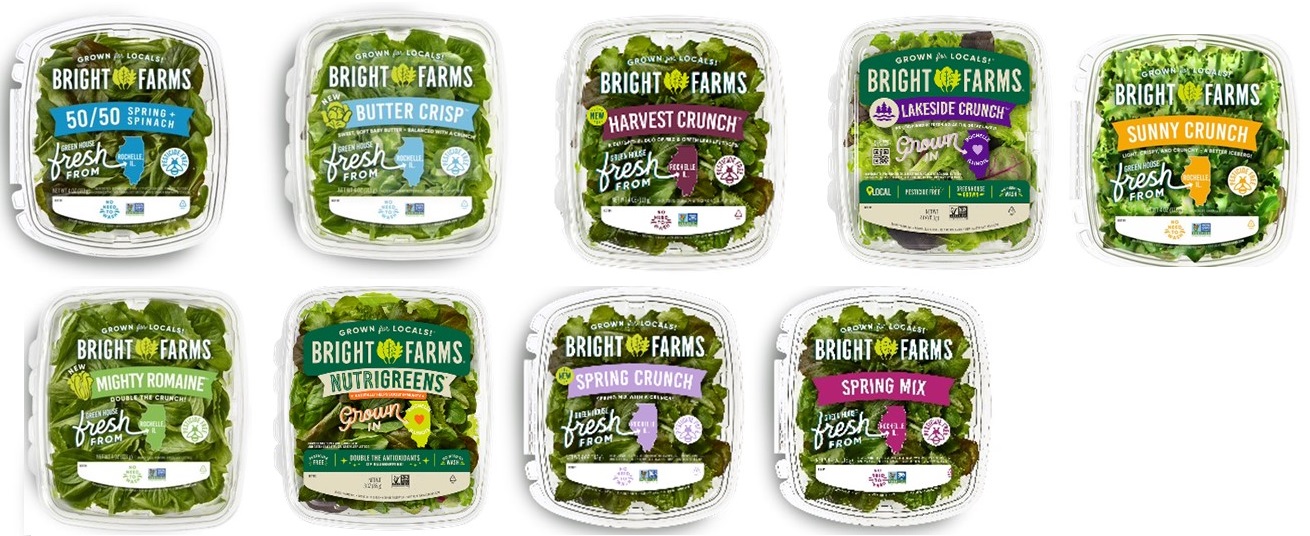
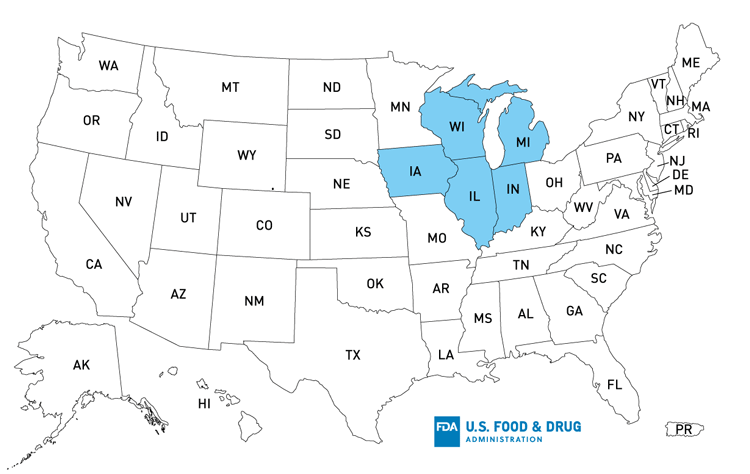
On July 15, 2021, BrightFarms recalled packaged salad greens produced in its Rochelle, Illinois (Ogle County) greenhouse farm sold in Illinois, Indiana, Iowa, and Wisconsin. On July 21, 2021, Michigan was added to the list of states that received recalled products. Interview data and shopper card records show that 15 people ate or bought multiple types of BrightFarms brand salad products before they got sick, including Sunny Crunch, 50/50 Spring & Spinach, Harvest Crunch, and Butter Crisp. FDA conducted a traceback investigation and identified the farm in Rochelle, IL, as the likely source of the BrightFarms brand salad bought by people who became ill. On July 28, 2021, following positive sample results, BrightFarms expanded their recall to include Baby Spinach packaged in clear, plastic clamshells with “Best By” dates through 7/26/2021.


Product Images

Outbreak Investigation of Salmonella Typhimurium in BrightFarms Packaged Salad Greens - Product Images

View Larger Images

Map of U.S. Distribution of Recalled BrightFarms Products

Outbreak Investigation of Salmonella Typhimurium in BrightFarms Packaged Salad Greens - Map of U.S. Distribution of Recalled Products (October 6, 2021)

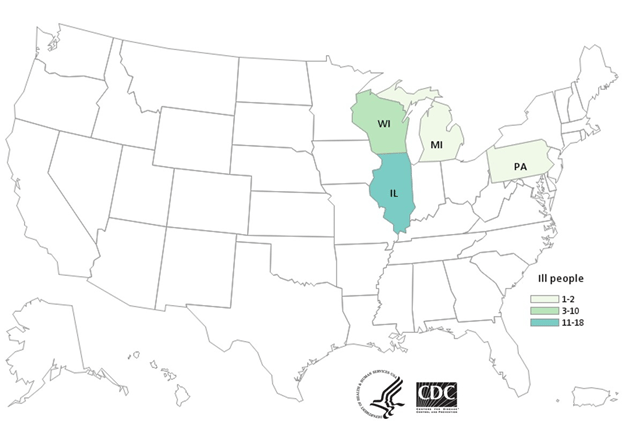
Case Count Map Provided by CDC

Outbreak Investigation of Salmonella Typhimurium in BrightFarms Packaged Salad Greens - CDC Case Count Map (October 6, 2021)

Case Counts

Total Illnesses: 31
Hospitalizations: 4
Deaths: 0
Last Illness Onset: August 18, 2021
States with Cases: IL (18), MI(1), PA (2), WI (10)
Product Distribution*: IA, IL, IN, MI, WI
*Distribution has been confirmed for states listed, but product could have been distributed further, reaching additional states

Research – Cryptosporidiosis – Annual Epidemiological Report for 2018

ECDC

Executive summary

  • For 2018, 20 European Union/European Economic Area (EU/EEA) countries reported 14 299 cryptosporidiosis cases, of which 14 252 were confirmed.
  • The notification rate was 4.4 confirmed cases per 100 000 population.
  • Four countries accounted for 76% of all confirmed cases, with the United Kingdom (UK) alone accounting for 41%.
  • As in previous years, most of the cases were reported in autumn (peak in September), but in 2018 a smaller peak was also observed in spring (April).
  • Children aged 0–4 years had the highest notification rate of 15.8 cases per 100 000 population.

Click to access CRYP_AER_2018_Report.pdf

USA – Domestically Acquired Cases of Cyclosporiasis — United States, May–August 2021

CDC

cardcyclosporasme

LAST UPDATED SEPTEMBER 30, 2021 4:00 PM EDT

Cyclosporiasis illnesses are reported year-round in the United States. However, during the spring and summer months there is often an increase in cyclosporiasis acquired in the United States (i.e., “domestically acquired”). The exact timing and duration of these seasonal increases in domestically acquired cyclosporiasis can vary, but reports tend to increase starting in May. In previous years the reported number of cases peaked between June and July, although activity can last as late as September. The overall health impact (e.g., number of infections or hospitalizations) and the number of identified clusters of cases (i.e., cases that can be linked to a common exposure) also vary from season to season. Previous U.S. outbreaks of cyclosporiasis have been linked to various types of fresh produce, including basil, cilantro, mesclun lettuce, raspberries, and snow peas.

At a Glance
  • Illnesses: 1020
  • Hospitalizations: 70
  • Deaths: 0
  • States reporting cases: 36

CDC, along with state and federal health and regulatory officials, monitor cases of cyclosporiasis in the United States in the spring and summer months to detect outbreaks linked to a common food source. However, many cases of cyclosporiasis cannot be directly linked to an outbreak, in part because of the lack of validated laboratory “fingerprinting” methods needed to link cases of Cyclospora infection. Officials use questionnaires to interview sick people to determine what they ate in the 14-day period before illness onset. If a commonality is found, CDC and partners work quickly to determine if a contaminated food product is still available in stores or in peoples’ homes and issue advisories.

Final Update

  • In 2021, multiple outbreaks of cyclosporiasis cases associated with different restaurants or events were investigated by state public health authorities, CDC, and FDA.
    • CDC investigated two large multistate outbreaks of cyclosporiasisexternal icon, one including 40 illnesses and one with 130 illnesses, in which ill people reported eating various types of leafy greens. State officials and FDA conducted traceback investigations for these two outbreaks, but a specific type or grower of leafy greens was not identified as the source of either outbreak.
  • As of September 28, 2021, 1,020 laboratory-confirmed cases of cyclosporiasis in people who had no history of international travel during the 14-day period before illness onset have been reported to CDC by 37 jurisdictions, including 36 states and New York City, since May 1, 2021.
    • The median illness onset date is June 25, 2021 (range: May 1–August 31, 2021).
    • At least 70 people have been hospitalized; no deaths have been reported.

September 30, 2021

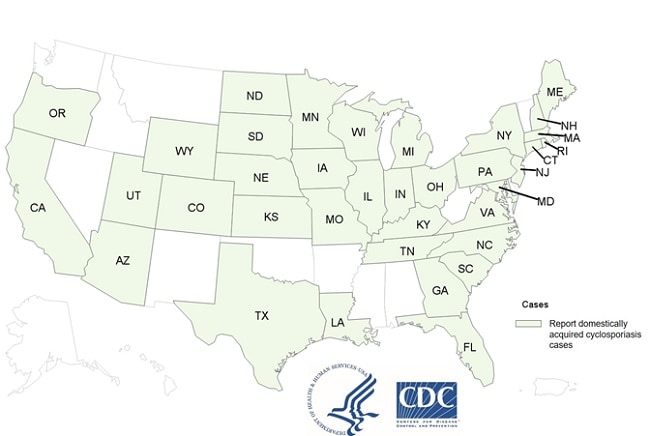
Geographic Distribution of Reported Cases of Domestically Acquired Cyclosporiasis—May 1 to August 31, 2021*

outbreak_map_season_9_30_21

* Data are current as of 09/28/2021 (9:00am EDT). States/jurisdictions highlighted on the map have each reported at least one case. New York State includes case reports from New York City. Data are preliminary and subject to change. For questions related to the number of cases reported in each state, contact that state’s health department.

Research – Here’s why it’s dangerous to let your dog lick your plate

Country Living

Should you let your dog lick your plate? While many owners share table scraps with their furry friends, one vet has warned of the possible health dangers if your dog shares food directly from your plate.

According to Team Dogs, plates licked by dogs can harbour hidden bacteria such as salmonella which cannot be destroyed by dishwashing. As well as this, many foods still lingering on human plates can be poisonous to dogs, resulting in your pup becoming poorly.

New research by Wren Kitchens found that one in six (15%) of households in the UK let their dogs lick their plates, meanwhile Twitter findings by Team Dogs discovered that 61.5% of voters said they don’t let their dogs lick the plate. It might seem like a harmless dinnertime treat, but owners should keep dog and human dishes separate at all times.

Belgium – Bouchot mussels (1.4kg), Mytilimer brand. – E.coli

AFSCA

WE ARE RECALLING THE PRODUCT DESCRIBED BELOW FOLLOWING A NON-COMPLIANCE WHICH MAY LEAD TO A RISK FOR THE CONSUMER:

Expiration dates (
BBD ): 07/10/2021 Lot: 9152709271

These products were sold in the Match supermarkets in Couvin (5660) and Marcinelle (6001).

Match has decided, in consultation with the AFSCA (Federal Agency for the Safety of the Food Chain) to recall this product to consumers.
Customers who have purchased this product will be asked not to consume it and return it to the point of sale, where it will be refunded.

In the meantime, the product has been taken off the shelves of all stores.

We sincerely apologize to our customers for these inconveniences and assure them that we are taking the most effective measures to prevent such incidents.

Any customer who wants more information can contact our quality department by e-mail at the following address : jan.clara@foodqualityassistance.be

Match quality service

Research – The Use of Organic Acids (Lactic and Acetic) as a Microbial Decontaminant during the Slaughter of Meat Animal Species: A Review

MDPI

Wild ungulate species provide a much-needed protein source to many communities in developed and developing countries. Frequently, these game meat animals are slaughtered, and the meat is unknowingly contaminated by microorganisms and released to the unsuspecting public. This review investigates the global usage of organic acids (lactic and acetic acids) as microbial decontamination strategies during slaughter. The results show that there is a more open-minded approach to adopting possible decontamination plans as a tool to improve meat safety during slaughter. Developed countries continue to adopt these strategies, while developing countries are lagging behind. While decontamination of carcasses can lead to a reduction of microbial load on these carcasses, this strategy must not be seen as a replacement of hygiene management during the animals’ slaughter. View Full-Text