Category Archives: Food Microbiology Research

Belgium – The FASFC has decided to issue a conditional authorization to Ferrero – Kinder – Salmonella

AFSCA

In late March – early April, consumers fell ill after consuming Kinder brand chocolate products. Following epidemiological investigations and the analysis of samples, a link was established with the Ferrero factory in Arlon.

The FASFC then immediately began an in-depth investigation at Ferrero in Arlon and decided on April 8 to withdraw the authorization for this factory and to recall all the products in the Kinder range from this production site.

In May, Ferrero applied to the AFSCA for authorization to be able to produce again.

The FASFC has decided to give Ferrero a conditional authorization for their production plant in Arlon.

This conditional authorization will be granted for a period of 3 months . During this period, the raw materials, as well as each batch of foodstuffs produced, will be analysed. It is only if these analyses give a compliant result that the products can be placed on the market.

This decision comes after several weeks of in-depth analyses during which the FASFC carried out several on-site checks both at the level of the internal procedures put in place by Ferrero and of the factory’s infrastructure.

The FASFC is of the opinion that, in the current state of affairs, Ferrero offers the necessary guarantees of compliance with food safety rules and requirements.

Nevertheless, the FASFC opted for a conditional authorization because the Agency considers that it is essential to be able to verify the concrete application of all the internal procedures once the factory has resumed its production activities.

In the event of favourable inspection results at the end of this 3-month period, a final authorization may be issued.

For his part, the Federal Minister of Agriculture, David Clarinval, in charge of the FASFC, is delighted with the favourable progress of the file: “ I salute the quality work carried out by the FASFC in this complicated file. The conditional authorization of the Ferrero factory in Arlon is the first step towards a final authorization. I will continue to follow developments in this case closely. »

Italy – MILK & LAIT – Microbiology Risk

Salute

Brand : WORLD TRADE SRL

Name : MILK & LAIT

Reason for reporting : Recall due to microbiological risk

Publication date : June 16, 2022

Research – Vital Surveillances: Epidemiological Analysis of Foodborne Botulism Outbreaks — China, 2004–2020

China CDC

kswfoodworld

  • Abstract

    IntroductionFoodborne botulism is a rare, potentially fatal illness resulting from the ingestion of foods contaminated with preformed botulinum neurotoxin types A, B, E, or F, produced by Clostridium botulinum. The descriptive epidemiology of foodborne botulism outbreaks in China during 2004−2020 was performed to inform public health response strategies.

    MethodsData from 22 of 31 provincial-level administrative divisions (PLADs) of the National Foodborne Disease Outbreaks Surveillance System during 2004−2020 and Embase, China National Knowledge Infrastructure (CNKI), Wanfang Data, and Chinese Science and Technique Journals (CQVIP) from January 2004 to December 2020 to identify indexed publications in the Chinese literature using the following search terms “botulism,” or “botulinum toxin,” or “Clostridium botulinum.” The number and proportion of outbreaks, illnesses, and deaths by PLAD, food types, and contributing factors were calculated.

    ResultsDuring 2004−2020, a total of 80 foodborne botulism outbreaks occurred in China, involving 386 illnesses and 55 deaths; most outbreaks were reported between June and August, with a sharp peak in January; 22 out of 31 PLADs reported foodborne botulism outbreaks, Xinjiang reported the largest number of outbreaks (20), followed by Qinghai (13); the most commonly implicated food was home-prepared traditional processed stinky tofu and dried beef, accounting for 51.25% events. Improper processing and improper storage in contributing factors accounted for 77.50% outbreaks. Initial misdiagnosis occurred in 27.50% of cases.

    ConclusionsOutbreaks of foodborne botulism had a high case-fatality rate. Targeted food safety and popularization education to farmers and herdsmen in Xinjiang and Qinghai related to botulism prevention should be carried out, and timely outbreak investigation and hospital surge capacity should be improved.

  • Belgian scholars in consumers of sausages first described botulism in 1896 (1). It was confirmed that the growth and germination of toxins occurred only under particular conditions in an anaerobic low salt, low-acid environment. People who ingest food contaminated with botulinum neurotoxin (BoNT) produced by botulinum toxin can have a potentially fatal outcome (2). Outbreaks have been reported worldwide. In Canada, the first Clostridium botulinum type E outbreak in 1944 in Nanaimo, British Columbia was reported in 1947 (3); In China, Wu et al. first reported botulism in Xinjiang in 1958 due to edible semi-finished noodle sauce (4). A better understanding of the epidemiology of botulism outbreaks can help tailor local prevention and public health response strategies. Here, we reviewed surveillance data on outbreaks, illnesses, and deaths of botulism in China from 2004 to 2020.

Hong Kong – Food safety of eggs and eggs products

CFS

Food safety of eggs and eggs products

Consuming raw or undercooked eggs potentially causes Salmonella infection, which can pose severe, sometimes life-threatening, health risks, especially to susceptible populations. During August 2017 to August 2020, the Centre for Food Safety has received referrals of more than 300 food poisoning outbreaks related to food premises, involving nearly 1000 victims, caused by Salmonella species.

Both the outside and the inside of eggs can be contaminated with Salmonella.  Egg shells can be contaminated with faecal matter and germs may enter through pores or cracks on the shell of eggs.  Moreover, Salmonella can be introduced to the egg from infected reproductive tissues of poultry prior to shell formation. Eggs contaminated with Salmonella may look normal.

To assist the food trade in preventing food poisoning due to Salmonella in eggs and egg products, the Centre for Food Safety gives out practical food safety advice about using eggs in food preparation:

Choose safe raw materials

Purchase eggs from reliable sources and only accept eggs that are clean without cracks or leakage.

For dishes that often use lightly cooked or uncooked eggs, choose pasteurised eggs, egg products or dried egg powder. Pasteurisation is the process of applying low heat to kill pathogens and inactivate spoilage enzymes.

Storing and handling of raw eggs

  • Shell eggs should be stored in a cool, dry place, ideally in the refrigerator, and used on a first-in-first-out basis.
  • Wash hands thoroughly before and after using eggs. All utensils and other food contact surfaces such as whisks, bowls and benches should be cleaned and sanitised every time before handling eggs and egg products.
  • Washing shell eggs is unnecessary because this facilitates the entry of bacteria from the outside of the shell to inside the egg through the pores in the shell.
  • When separating the yolk from the white, it is better to use a clean egg separator instead of the egg shell which may contain traces of Salmonella on the surface.

Pooling eggs is a high-risk practice when preparing egg dishes

  • Pooling refers to the practice of breaking a number of eggs into containers and using the combined eggs to make multiple servings of egg dishes or for use in multiple recipes.
  • Pooling is a common practice in some restaurants to save time and control portion size. However, pooling eggs can allow one or more infected eggs to contaminate the whole pool of eggs. If people consume egg dishes prepared from the pool without thorough cooking, they may get food poisoning.
  • Restaurants should only break enough eggs for immediate service in response to a consumer’s order.
  • If choose to break eggs for later use, keep the pooled eggs in covered containers in the refrigerator and only take out the amount as needed.
  • Use all pooled eggs on the same day and do not top up with new eggs.
  • As pooled eggs have a higher chance of harbouring bacteria, they should be cooked thoroughly and not be used for making raw or lightly cooked dishes.

Cook eggs thoroughly and keep them at a safe temperature

  • The best way of eliminating harmful bacteria is to cook the eggs thoroughly until the core temperature reaches 75°C or the yolks are firm.
  • If not consumed immediately after preparation, hot dishes such as soft-scrambled eggs should always be served or kept at above 60°C, and cold dishes such as sandwiches and desserts should be kept at 4°C or below.

The above advice is applicable not only in food businesses but also in domestic settings to reduce risks of food poisoning.

Guideline

Pamphlets

Poster

Periodical and Publication

Food Safety Focus

Short video

Related information

USA – FDA Core Investigation Table Update

FDA

Date
Posted
Ref
#
Pathogen or
Cause of Illness

Product(s)
Linked to
Illnesses

(if any)
Total
Case Count

Status
6/15/

2022

1070 Listeria
monocytogenes
Not Yet Identified 12 Active
6/8/

2022

1068 E. coli
O157:H7
Not Yet Identified 10 Active
6/1/

2022

1066 Hepatitis A Virus Strawberries See Outbreak
Advisory
Active
5/25/

2022

1067 Salmonella 
Senftenberg
Peanut Butter See Outbreak Advisory Active
4/20/

2022

1064 Not Yet
Identified
Dry Cereal 558 adverse
event reports
Active
4/13/

2022

1057 Listeria
monocytogenes
Not Yet
Identified
21 Active
3/30/

2022

1060 Not Yet
Identified
Meal Replacement
Drink
6 adverse
event reports
Closed
3/16/

2022

1055 Salmonella
Saintpaul
Not Identified 60 Closed
2/17/

2022

1056 Cronobacter
sakazakii
Powdered
Infant
Formula
See
Advisory
Active (IMG)
2/9/

2022

1040 Listeria
monocytogenes
Not Identified 20 Closed
2/2/

2022

1054 Enteroinvasive
E. coli
O143:H26
Not
Identified
16 Closed
1/10/

2022

1050 E. coli
O121:H19
Romaine 4 Closed

Ukraine – HOW TO PROTECT YOURSELF FROM BOTULISM IN SUMMER

PHC

Since the beginning of the week, six people with a previous diagnosis of botulism have been hospitalized in different regions of Ukraine – Volyn, Chernihiv, Zhytomyr, Rivne, Kherson and Kyiv. Among the causes of the disease, experts from the Centers for Disease Control and Prevention call the use of fried and dried river fish of their own cooking or unknown production, home canned food. 

We remind you that botulism is a food poisoning that can lead to serious consequences. In summer, when the air temperature rises, you should pay attention to the conditions of storage and cooking. Therefore, to protect against botulism, you should avoid the following products if you have doubts about their quality and storage / transportation conditions:  

  • dried, smoked, salted and canned fish;
  • canned meat and mushrooms;
  • home canned food.

Symptoms of botulism:

  • visual impairment – you can’t read the text, but you can see objects well;
  • severe dry mouth;
  • difficult to speak (voice becomes quiet, hoarse or disappears);
  • increased fatigue, muscle weakness;
  • dizziness;
  • short-term signs of damage to the digestive system (nausea, vomiting, weak stools), and then – the stage of intestinal paresis (bloating, constipation);
  • lesions of the muscles of the neck and limbs.

Symptoms of botulism often appear gradually, without sharp rises in temperature, so there is an illusion of frivolity. Later there is a visual impairment – one of the first signs of botulism. At the same time there is thirst, dryness of the mucous membranes, swallowing disorders, may change the tone of voice. Patients complain of a feeling of “lump” in the throat, pain when swallowing, sore throat.

Neurological symptoms last for several days and are accompanied by a general toxic syndrome – patients complain of severe headache, dizziness, insomnia, general weakness, fever. In severe cases, patients are concerned about the feeling of shortness of breath. Respiratory failure develops, which is the cause of death in botulism.

At the slightest suspicion of botulism, see a doctor immediately! 

Hong Kong- Food Safety Focus – Histamine in Fish and Fish Products

CFS

 Histamine in Fish and Fish Products

Reported by Mr. Kenneth Yung, Research Officer,
Risk Assessment Section, Centre for Food Safety

Fish is an important part of many types of cuisine that we savour.  However, the consumption of fish and fish products containing high level of histamine may cause scombrotoxin fish poisoning (SFP), also called histamine poisoning.  In Hong Kong, the Centre for Health Protection of the Department of Health recorded a total of 26 local SFP cases, affecting 45 persons from 2009 to 2018.  In this article, we discuss how histamine is formed and the ways to control level of histamine in fish and fish products..
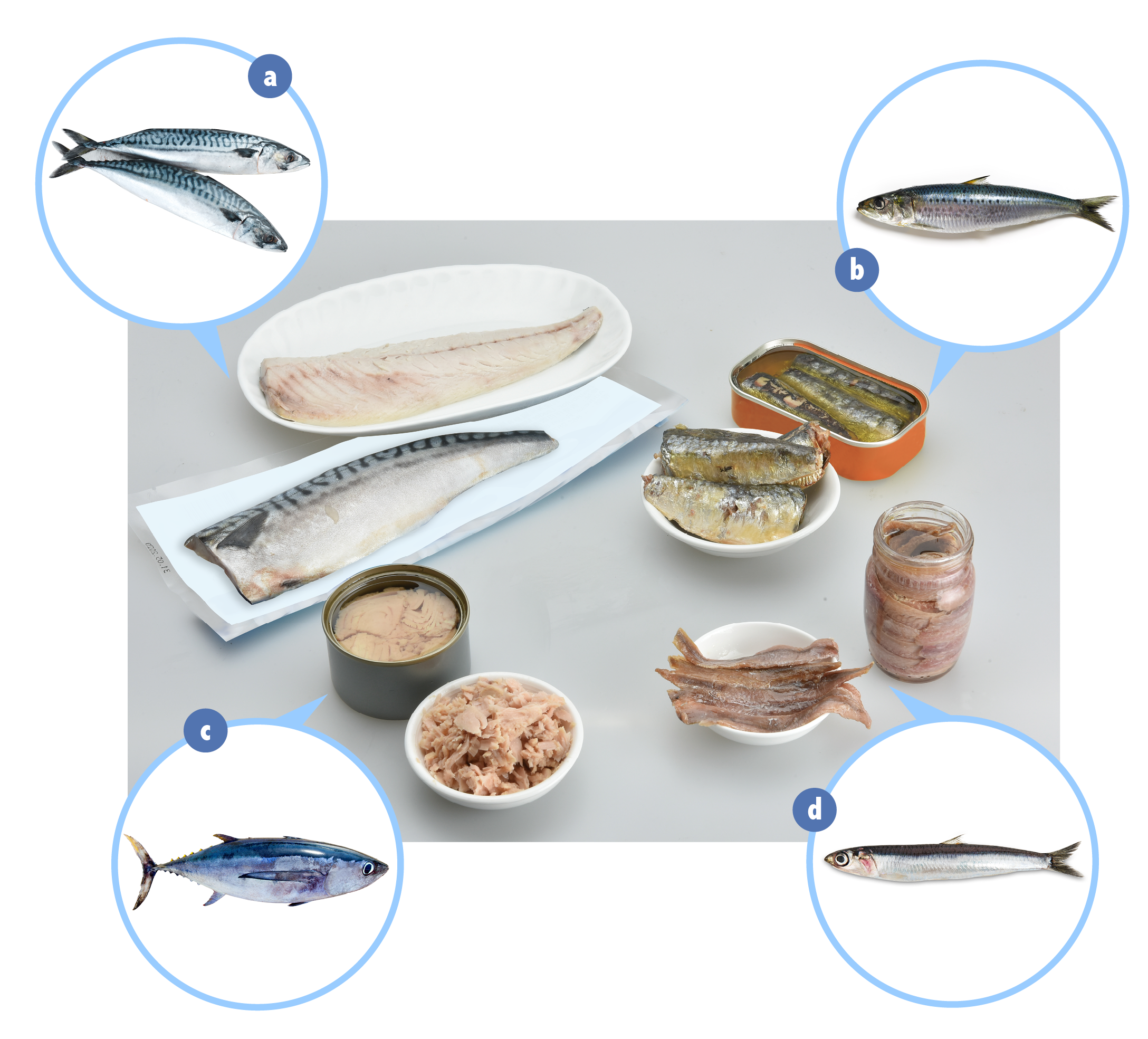
Examples of fish which contain elevated levels of naturally

Examples of fish which contain elevated levels of naturally occurring histidine: (a) mackerel, (b) sardine, (c) tuna and (d) anchovy.  Some of their respective products have also been found to contain high levels of histamine.

Formation of Histamine in Fish and Fish Products

Histamine is a toxic metabolite produced by histamine-producing bacteria during spoilage and fermentation of fish and fish products.  Many histamine-producing bacteria are part of the natural microflora of the skin, gills and gut of freshly caught fish.  Histidine decarboxylase (HDC) enzymes, synthesized by histamine-producing bacteria when they multiply, convert the amino acid histidine that are naturally present in fish into histamine.

The level of histamine in fish and fish products mainly depends on species of fish and time-temperature control. Certain fishes like mackerel, sardine, tuna and anchovy naturally contain high amount of histidine and have been associated with SFP cases in Hong Kong and/or other places.

Time and temperature control is the most effective method for ensuring food safety for fish species prone to histamine production.  In the absence of proper time-temperature control such as refrigeration and freezing, formation of histamine may occur at any point throughout the supply chain.  Previous study conducted jointly by the Food and Environmental Hygiene Department and the Consumer Council revealed that high levels of histamine (up to 2600 mg/kg) that can cause SFP were detected in opened canned fish samples that were left at room temperature for 24 hours.  However, histamine was not detected in samples that were kept at 2°C for up to 168 hours.

Health Effects of Histamine

SFP is caused by the ingestion of food containing high levels of histamine i.e. consuming a serving size of 250g fish or fish product with histamine level exceeding 200 mg/kg may cause symptoms in healthy individuals.  Symptoms of SFP include tingling and burning sensation around the mouth, facial flushing and sweating, nausea, vomiting, headache, palpitations, dizziness and rash.  Exacerbation of asthma and more serious cardiac manifestations were reported in more severe cases.  The onset of symptoms is within a few hours after consumption and these symptoms will normally disappear in 12 hours without long term effect.

Control of Histamine in Fish and Fish Products

High levels of histamine can build up in fish and fish products before any signs of spoilage (e.g. bad smell or taste) develop.  Therefore, measures for control of histamine should be taken along the food chain from harvest to consumption.

Care should be taken that the cold chain is maintained at or below 4°C along the supply chain, including points of transfer such as offloading of fish from the vessel and processing procedures.  Frozen fish and fish products should be kept at or below -18°C.  Transport vehicles or vessels should be adequately equipped to keep fish cold and pre-chilled before loading fish where applicable.  Adequate heat treatment (e.g. cooking, hot smoking) can kill histamine-producing bacteria and inactivate HDC enzymes, but cannot destroy pre-formed histamine.  Recommendations in the Code of Practice for Fish and Fishery Products (CAC/RCP 52-2003), issued by Codex Alimentarius Commission, should be observed to ensure food safety.
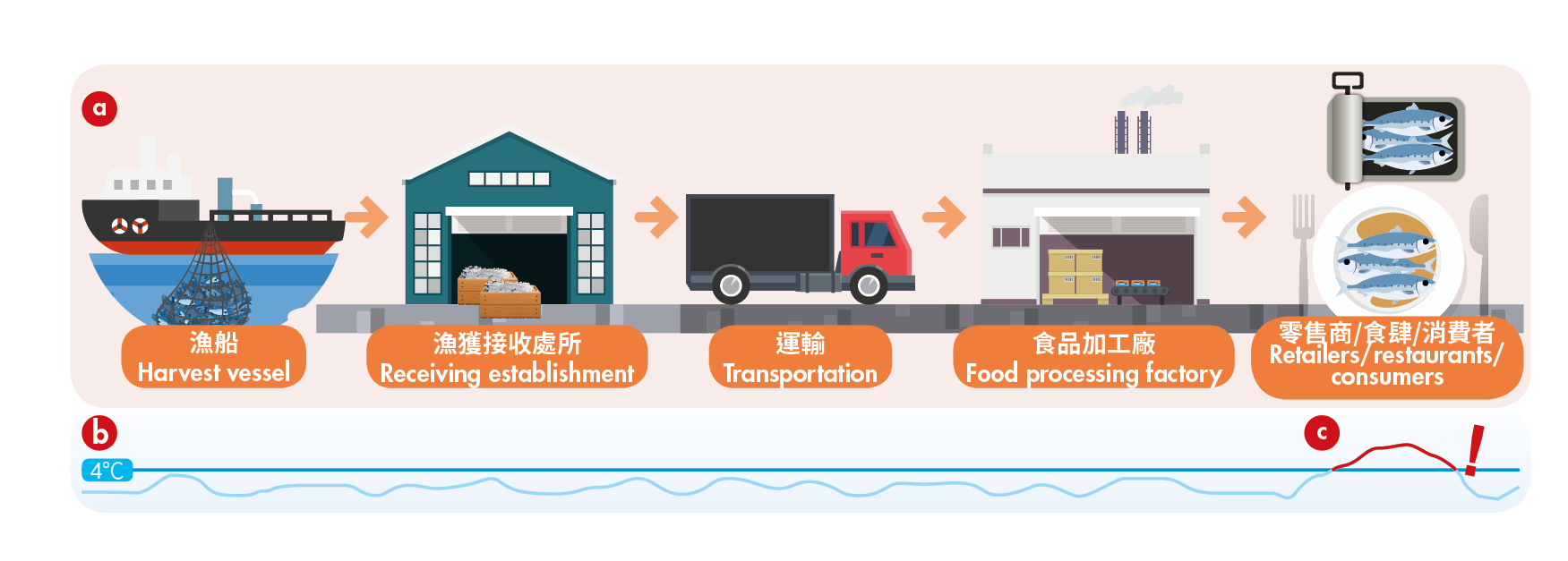
Food chain from harvest to consumption

(a) Cold chain should be maintained throughout the whole supply chain. (b) Refrigerated fish and fish products should be kept at or below 4°C. (c) The time which fish products are kept under ambient temperature should be minimised.

At the consumer level, fish should be chilled rapidly after purchase.  For prepackaged fish and fish products, store according to the instructions of the manufacturer (e.g. keep refrigerated). If cooked fish and ready-to-eat fish products (e.g. tuna fish sandwiches and opened canned fish) are placed at room temperature all day long, they can be re-contaminated and histamine can form.  Therefore, if these foods are not being eaten immediately, they should be kept under refrigeration and be finished as soon as possible.


USA – FSIS Stopping Salmonella Sampling of Raw Siluriformes in all raw fish

Food Safety News

USDA’s Food Safety and Inspection Service (FSIS) has issued a notice informing inspection program personnel (IPP) that FSIS will stop sampling for Salmonella sampling in raw fish in both domestic and imported products.

The final rule “Mandatory Inspection of Fish of the Order Siluriformes and Products Derived from Such Fish” (80 FR 75590; December 2, 2015) amended the Agency’s regulations to establish a mandatory inspection program for these fish and products derived from these fish. FSIS conducted exploratory sampling for Salmonella in raw fish to monitor its presence.

FSIS inspection program personnel are informed that the agency is stopping Salmonella sampling for raw fish in domestic and imported products.  After July 13, 2022, IPP will no longer receive sampling tasks for the project codes:

If any sampling tasks remain after July 13, 2022, IPP should cancel the remaining sampling tasks and select “Not collected for miscellaneous reasons” as the reason for the cancellation.

Research – Novel Approaches to Environmental Monitoring and Control of Listeria monocytogenes in Food Production Facilities

MDPI

Listeria monocytogenes is a serious public health hazard responsible for the foodborne illness listeriosis. L. monocytogenes is ubiquitous in nature and can become established in food production facilities, resulting in the contamination of a variety of food products, especially ready-to-eat foods. Effective and risk-based environmental monitoring programs and control strategies are essential to eliminate L. monocytogenes in food production environments. Key elements of the environmental monitoring program include (i) identifying the sources and prevalence of L. monocytogenes in the production environment, (ii) verifying the effectiveness of control measures to eliminate L. monocytogenes, and (iii) identifying the areas and activities to improve control. The design and implementation of the environmental monitoring program are complex, and several different approaches have emerged for sampling and detecting Listeria monocytogenes in food facilities. Traditional detection methods involve culture methods, followed by confirmation methods based on phenotypic, biochemical, and immunological characterization. These methods are laborious and time-consuming as they require at least 2 to 3 days to obtain results. Consequently, several novel detection approaches are gaining importance due to their rapidness, sensitivity, specificity, and high throughput. This paper comprehensively reviews environmental monitoring programs and novel approaches for detection based on molecular methods, immunological methods, biosensors, spectroscopic methods, microfluidic systems, and phage-based methods. Consumers have now become more interested in buying food products that are minimally processed, free of additives, shelf-stable, and have a better nutritional and sensory value. As a result, several novel control strategies have received much attention for their less adverse impact on the organoleptic properties of food and improved consumer acceptability. This paper reviews recent developments in control strategies by categorizing them into thermal, non-thermal, biocontrol, natural, and chemical methods, emphasizing the hurdle concept that involves a combination of different strategies to show synergistic impact to control L. monocytogenes in food production environments.

USA – Will There Be a Cyclospora Outbreak in the U.S. This Summer?

Food Poisoning Bulletin

Will there be a cyclospora outbreak in the United States this summer? There have been multiple cyclospora outbreaks in the past nine years, including in 2013, 2014, 2015, 2016, 2017, 2018, 2019, 2020, and 2021. This year may be no exception.

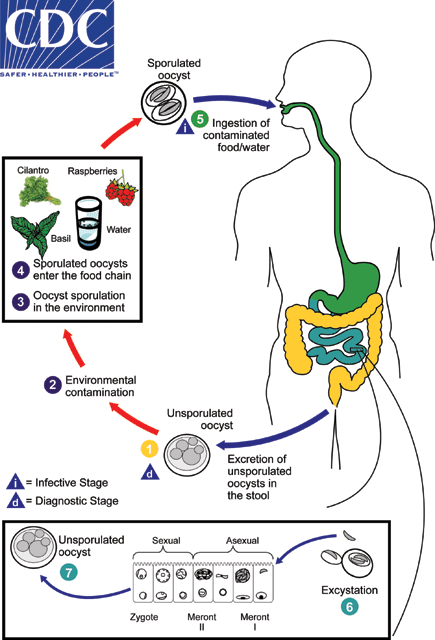
In the past, Cyclospora outbreaks have been linked to fresh produce, including cilantro, raspberries, basil, mesclun, vegetable trays, bagged salad mixes, and snow peas. The cyclospora parasite is transmitted through human feces. The oocyst must mature, or sporulate, outside of the body before it becomes infectious. This infection is not passed person-to-person.

It is very difficult to protect yourself against this parasite, since it can cling to produce, especially produce such as leafy greens and herbs, and is not easily washed or rinsed off. And since most of the foods it contaminates are eaten without being heated, there is no kill step to destroy the parasite.