Category Archives: Food Microbiology Research

Research – New, Free Toolkit Looks to Improve Food Safety Culture

Quality Assurance Mag

Stop Foodborne Illness Logo

The Alliance to Stop Foodborne Illness created what it said is an evolving food safety culture toolkit tailored for small and medium-sized food businesses to help companies mature their food safety cultures.

Food safety culture is one of the biggest drivers of change across the food industry. By definition, a mature and positive food safety culture consists of shared values, norms and beliefs that affect mindsets and behaviors toward food safety in, across and throughout the company. Leaders in mature and positive cultures demonstrate ownership and recognize food safety is integral to the consumer and the success of their company.

Every company has a food safety culture — good, bad or okay — but how do you work to improve when you might not know how to start?

The Alliance to Stop Foodborne Illness created an evolving food safety culture toolkit tailored for small and medium-sized food businesses to help companies mature their food safety cultures.

Because one more person impacted by foodborne illness is too many, the toolkit is offered for free to strengthen food safety behaviors that help prevent our friends, loved ones, and neighbors from getting sick.

This is a initiative between Stop Foodborne Illness (STOP) and members of the Alliance — which consists of industry-leading food safety practitioners from Fortune 500 companies and guided by Dr. Lone Jespersen, STOP board member.

The Alliance working group spent the last year creating this initial guide drawing on science, personal food safety culture experiences, and working with STOP constituent advocates negatively impacted by a foodborne illness.

The toolkit helps businesses create a strategy to improve their food safety culture. “This toolkit helps food companies shift from doing the bare minimum to avoid recalls to making good, holistic choices to protect overall public health,” said Dr. Vanessa Coffman, Director of Alliance to Stop Foodborne Illness. “By sharing our Alliance members’ best practices, smaller companies can now build a path toward improving their own food safety culture. This toolkit is not a checklist. It is a process of continual learning, a helpful guide in choosing tools most effective for your workforce.”

Much like a food safety culture journey, the toolkit will evolve with additional resources, guides and how-to strategies. “We will continue to enhance this toolkit for as long as organizations continue to want to keep products and families safe from foodborne illness,” said Coffman.
UK – Three dead in UK fish Listeria outbreak

Food Safety News

Three people have died in an ongoing Listeria outbreak linked to fish in the United Kingdom.

The UK Health Security Agency, Food Standards Agency (FSA), Public Health Scotland and Food Standards Scotland (FSS) are investigating the Listeria monocytogenes outbreak that was first made public in April.

Twelve patients across the UK have been identified, including three in Scotland, with onset dates of illness between October 2020 to March 2022.

Ten sick people are over the age of 65, and one is a pregnant woman. Three of those affected who are older than 65 have died.

Six people have fallen ill since January 2022. The majority of patients reported eating smoked fish.

The FSA and FSS are doing food chain and microbiological investigations including whole genome sequencing (WGS) but the cause is yet to be confirmed.

Quebec – Notice not to consume Below Zero brand frozen IQF whole raspberries sold by La Corne d’Abundance – Norovirus

Quebec

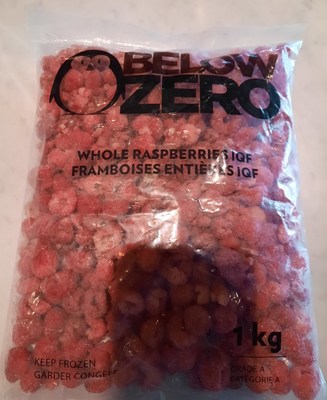
IQF whole raspberries (CNW Group/Ministry of Agriculture, Fisheries and Food)

The Ministry of Agriculture, Fisheries and Food (MAPAQ), in collaboration with the company La Corne d’Abundance, advises the population not to consume the product listed in the table below, as this food may have been contaminated with norovirus.

This warning stems from a Canadian Food Inspection Agency food recall involving Below Zero brand IQF Whole Raspberries originating from China and distributed to several establishments across Canada .

The product was offered in a frozen state. Its label includes, in addition to its name, the mentions “Below Zero” and “Mantab”.

Establishment

Product name

Format

Affected lot

The cornucopia

1988 Notre Dame Street

L’Ancienne-Lorette

“IQF WHOLE RASPBERRIES”

1kg

Lot No. XT21253

PO: M14475

BB/MA: 2023-SE-09

The company named in the table is voluntarily recalling the product in question. It has agreed with MAPAQ to issue this warning as a precautionary measure. In addition, people who have this product in their possession are advised not to consume it. They must return it to the establishment where they bought it or throw it away.

Even if the product does not show signs of tampering or suspicious odor, it could be contaminated with norovirus and cause illness when consumed. Generally the possible symptoms are nausea, vomiting, diarrhea and abdominal cramps. Muscle pain, fatigue, fever, chills and headache may also occur. People exposed to norovirus usually show these symptoms within 24 to 48 hours of eating contaminated food. Cases of illness have been reported to MAPAQ and could be associated with the consumption of this food.

Quebec – Notice not to consume creton packaged in glass jars and sold by the company Comptoir La Boustifaille – Food Safety

Quebec

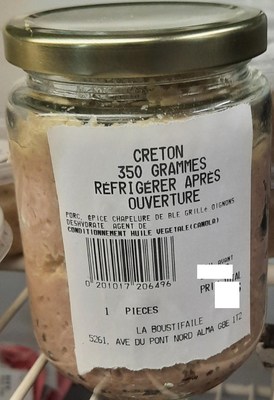
creton (CNW Group/Ministry of Agriculture, Fisheries and Food)

The Ministry of Agriculture, Fisheries and Food (MAPAQ), in collaboration with the company Comptoir La Boustifaille, located at 5261, avenue du Pont Nord, in Alma , warns the population not to consume the product indicated in the table below, because it has not been prepared and packaged in such a way as to ensure its harmlessness.

Product name

Format

Affected lot

“Creton”

350 grams

Units sold until June 13, 2022

The product that is the subject of this warning was offered for sale until June 13, 2022 at the establishment named above. The product was packaged in glass jars with a gold lid and sold chilled. The product label includes, in addition to its name, the mention “La Boustifaile” as well as the list of ingredients.

The operator is voluntarily recalling the product in question. It has agreed with MAPAQ to issue this warning as a precautionary measure. In addition, people who have this product in their possession are advised not to consume it. They must return it to the establishment where they bought it or throw it away. Even if the affected product shows no signs of tampering or suspicious odors, its consumption may represent a health risk. No case of illness associated with the consumption of this food has been reported to MAPAQ to date.

Research – Impact of chlorinated water on pathogen inactivation during wheat tempering and resulting flour quality

Journal of Food Protection

Outbreaks of enteric pathogens linked to wheat flour have led the wheat milling industry to seek solutions addressing this food safety concern. Chlorinated water at 400-700ppm has been used in the flour milling industry as a tempering aid to control growth of yeast and mold in tempering bins. However, the effectiveness of chlorinated water for inactivating enteric pathogens on wheat kernels remained unknown. Five strains of Shiga-toxin producing Escherichia coli (STEC) and two strains of Salmonella were inoculated onto hard red spring wheat at 7 log CFU/g and stored at room temperature for 1-month. Inoculated wheat was tempered with four concentrations (0, 400, 800, 1200ppm) of chlorinated water (pH 6.5). The reduction due to chlorine was determined by calculating change in cell density at each chlorine level using the response at 0ppm as a reference. Uninoculated wheat tempered with chlorinated water was used to measure flour quality parameters. Changes in pathogen density over 18 hours ranged from -2.35 to -0.30 log CFU/g with 800ppm chlorinated water and were not significantly different from changes at 400ppm and 1200ppm. Significant (p< 0.05) differences in the extent of reduction were observed among strains. However, the effect of chlorinated water at reducing native microbes on wheat kernels was minimal, with an average reduction of 0.39 log CFU/g for all concentrations. No significant (p>0.05) changes occurred in flour quality and gluten functionality, or during breadmaking for grains tempered at 400 and 800ppm chlorinated water. There were small but significant (p<0.05) changes in flour protein content, final viscosity, and water absorption when tempered with 1200ppm chlorinated water. The data showed that the level of chlorinated water currently used in industry for tempering could reduce enteric pathogen numbers by 1.22 log CFU/g for STEC and 2.29 log CFU/g for Salmonella, with no significant effects on flour quality and gluten functionality.

Research – Growth Kinetics of Listeria monocytogenes on Cut Red Cabbage

Journal of Food Protection

Listeria monocytogenes is a foodborne pathogen associated with fresh produce vectors such as leafy greens. Recent outbreaks and recalls associated with red cabbage-containing salads have brought attention to this food commodity. While data on the proliferation of L. monocytogenes is available for different varieties of white cabbage, no information is available on the fate of this pathogen on red cabbage. The aim of this study was therefore to explore the survival of L. monocytogenes on cut red cabbage (var. capitata f. rubra ) during storage at different temperatures. Red cabbage was cut into 5 × 4 cm pieces and spot inoculated with a six-strain cocktail of rifampicin-resistant L. monocytogenes , resulting in an initial inoculation level of at 4 log CFU/g. Samples were stored at 5 or 10°C for 14 d, or at 25°C for 7 d. At intervals during storage, L. monocytogenes was enumerated by homogenization of cabbage with Butterfield’s phosphate buffer (BPB), and serial dilutions were plated onto Brain Heart Infusion (BHI) agar supplemented with rifampicin. No growth of L. monocytogenes was observed on cut red cabbage during storage at 5°C, and only minimal proliferation was observed at the higher temperatures. Significant population increases of 0.83 and 1.07 log CFU/g were determined after 3 d storage at 10 and 25°C, respectively. The modeled growth rates for L. monocytogenes on cut red cabbage storage at 5 and 10°C were 0.11±0.03 and 0.27±0.07 log CFU/g per d, with calculated times to a 1 log CFU/g increase of 9.51 and 3.70 d, respectively; however, L. monocytogenes did not achieve a 1 log increase at either temperature in this study. At 25°C, the modeled growth rate of L. monocytogenes on cut red cabbage was 1.15±0.36 log CFU/g, leading to calculated and observed 1 log increases in 0.87 and 3.00 d, respectively. Results from this study aid in understand the fate of L. monocytogenes on cut red cabbage during storage at different temperatures.

Indonesia – Indonesian Masters: Organisers probe suspected food poisoning involving Malaysian, Thai players

Malay Mail

The 2022 Indonesian Masters organising committee is investigating cases of Malaysian and Thai badminton players who came down with suspected food poisoning after having breakfast at a hotel here yesterday.

A spokesman of the All Indonesia Badminton Association centre manager, Broto Happy, said they sympathised with the victims and took a serious view of the incident, which they found out through social media.

The affected players or team managers have not lodged any official reports with the organising committee so far, he said in a statement today.

After liaising with the organising committee, the Badminton World Federation (BWF) urged team managers to remind their players to be cautious when ordering food from outside the hotel or consuming certain types of food.

Meanwhile, Broto said laboratory tests showed that the players who received treatment had probably eaten unhygienic food but there was no food poisoning.

“In cases of food poisoning, the effects are immediate,” said Dr Grace Corlesa Joselini, the tournament doctor.

She said players staying at the two official tournament hotels are free to order food online or eat at nearby restaurants.

Online media reports last night said five Malaysian and Thai players had sought treatment at hospitals for food poisoning.

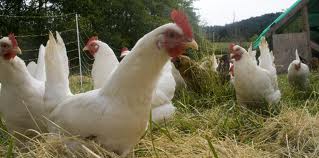
USA- CDC Media Alert: Backyard poultry contact linked to more than 200 Salmonella illnesses in 2022

CDC

Salmonella Campylobacter

A CDC investigation notice regarding multistate outbreaks of Salmonella infections has been posted: https://www.cdc.gov/salmonella/backyardpoultry-06-22/index.html

Key points:

  • CDC and public health officials in several states are investigating multistate outbreaks of Salmonella infections linked to contact with backyard poultry.
  • In total, 219 illnesses have been reported from 38 states, and 27 people have been hospitalized.
  • One in four sick people are children younger than 5 years.
  • One death has been reported from Tennessee.
  • The true number of sick people is likely much higher than the reported number, as many people recover without medical care and are not tested for Salmonella.
  • Backyard poultry can carry Salmonella germs even if they look healthy and clean. These germs can easily spread in areas where the poultry live and roam.
  • These outbreaks occur annually and coincide with the increase in baby poultry purchases, beginning in the spring. Last year in 2021, a total of 1,135 people got sick from contact with backyard poultry.
  • These Salmonella outbreaks are not related to recent cases of H5N1 bird flu viruses detected in U.S. wild birds and poultry. However, backyard poultry owners should be aware that the steps needed to stay healthy around their flocks are similar for both diseases.

Take steps to enjoy your birds while staying healthy:

  • Always wash your hands for 20 seconds after touching birds, their supplies or collecting eggs.
  • Use a pair of dedicated shoes or boots for your coop and don’t wear them inside your house.
  • Keep birds and supplies outside the house to prevent spreading germs into your house.
  • Don’t let children younger than 5 years touch the birds (including chicks and ducklings) or anything in the area where the birds live and roam. This helps protect young children from getting sick, as their immune systems are still developing,  are more likely to put items in their mouths or not wash hands fully.

About Salmonella:

  • Most people infected with Salmonella develop diarrhea, fever, and stomach cramps 6 hours to 6 days after being exposed to the bacteria.
  • The illness usually lasts 4 to 7 days, and most people recover without treatment.
  • In some people, the illness may be so severe that the patient is hospitalized.
  • Children younger than 5, adults 65 and older, and people with weakened immune systems are more likely to have severe illness.

If you have questions about cases in a particular state, please call that state’s health department.

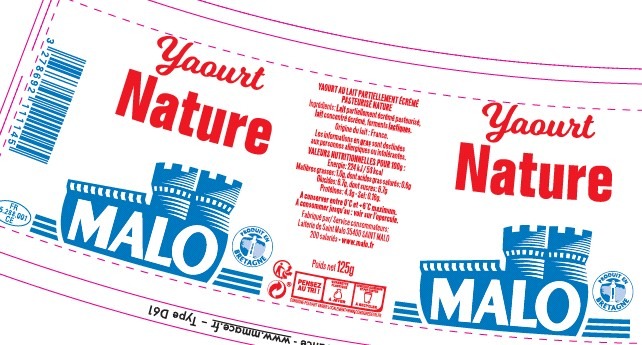
France – Natural Yogurt – Enterobacteriaceae – E.coli

Gov france

Identification information of the recalled product

  • Product category Feed
  • Product subcategory Milk and dairy products
  • Product brand name LOCATION
  • Model names or references natural yogurt brand MALO packaging cardboard pot
  • Identification of products
    GTIN Lot Date
    3278692111145 DLC 11/07/2022 Use-by date 07/11/2022
  • Packaging Packaging UVC cardboard jar 4x125g
  • Marketing start/end date From 09/06/2022 to 11/07/2022
  • Storage temperature Product to be stored in the refrigerator
  • Health mark FR 35.288.001 CE
  • Geographic area of ​​sale Whole France
  • Distributors LECLERC-LOGIDIS-SYSTEM U-AUCHAN-CASINO-TRANSGOURMET-ATAC-INTERMARCHE-MONOPRIX-EURODISNEY-LA GRANDE EPICERIE-AFINEUR DES HALLES
  • List of points of saleTraceability_Yoghurt_pot_carton_nature_Malo.pdf

Practical information regarding the recall

  • Reason for recall Suspicion of Enterobacteriaceae germ contamination
  • Risks incurred by the consumer Escherichia coli

UK – UK establishes new food safety network

EFOOD ALERT

The United Kingdom’s Food Standards Agency (FSA) has entered into a partnership with the country’s Biotechnology and Biological Sciences Research Council (BBSRC) and the Quadram Institute, a private non-profit company, to form a new Food Safety Research Network.

The FSA and BBSRC have invested a combined £1.6 million in the network, which will be hosted by Quadram.

Quadram describes itself as a state-of-the-art facility for bioscience and clinical research.

“[T]he network will ensure that the FSA is well-placed to tackle the challenges of foodborne illnesses by bringing together experts from government, industry and academia to address current and emerging issues of food safety in the UK,” said the FSA’s Chief Scientific Adviser, Professor Robin May.

According to the FSA, there are an estimated 2.4 million cases of foodborne illness a year in the UK, or roughly 35 cases per 1000 population. The annual cost of these illnesses is estimated to be £9 billion (with £6 billion from unknown causes).