Category Archives: Food Micro Blog

France – Withdrawal – preventive recall of batches of Buitoni brand Fraîch’Up frozen pizzas due to possible contamination by the bacterium Escherichia coli O26

Gov france

As part of the investigations carried out by the authorities on the cases of serious haemolytic and uraemic syndromes reported since January 1, 2022 on national territory, the analyzes (epidemiological, microbiological and traceability) carried out suggest, at this stage, a possible link with the consumption of frozen pizzas from the Fraîch’Up range of the Buitoni brand.

Investigations are continuing to determine the origin of the contamination, including for other products, as well as epidemiological investigations in order to establish potential links with all the cases detected on the territory since the beginning of January 2022.

Consequently, as a precautionary measure, and pending additional analyses, the company is proceeding today with the withdrawal-recall of all the pizzas in the Fraîch’Up range, of the Buitoni brand, marketed on this day.

Canada – Certain Stellar Bay Shellfish brand Oysters recalled due to Norovirus

CFIA

Summary

Product
Certain oysters
Issue
Food – Microbial Contamination – Norovirus
What to do

Do not consume, use, sell, serve, or distribute the recalled products

Issue

Stellar Bay Shellfish is recalling certain oysters from the marketplace due to possible norovirus contamination.

The recalled products have been sold in British Columbia, Alberta, Quebec and Ontario and may have been distributed in other provinces and territories.

What you should do

  • If you think you became sick from consuming a recalled product, call your doctor
  • Check to see if you have the recalled products in your home or establishment
  • Do not consume the recalled products
  • Do not serve, use, sell, or distribute the recalled products
  • Recalled products should be thrown out or returned to the place of purchase
  • Consumers who are unsure if they have purchased the affected products are advised to contact their retailer

People with norovirus illness usually develop symptoms of gastroenteritis within 24 to 48 hours, but symptoms can start as early as 12 hours after exposure. The illness often begins suddenly. Even after having the illness, you can still become re-infected by norovirus. The main symptoms of norovirus illness are diarrhea, vomiting (children usually experience more vomiting than adults), nausea and stomach cramps. Other symptoms may include low-grade fever, headache, chills, muscle aches and fatigue (a general sense of tiredness). Most people feel better within one or two days, with symptoms resolving on their own, and experience no long-term health effects. As with any illness causing diarrhea or vomiting, people who are ill should drink plenty of liquids to replace lost body fluids and prevent dehydration. In severe cases, patients may need to be hospitalized and given fluids intravenously.

Research – Novel Salmonella Phage, vB_Sen_STGO-35-1, Characterization and Evaluation in Chicken Meat

MDPI

Salmonellosis is one of the most frequently reported zoonotic foodborne diseases worldwide, and poultry is the most important reservoir of Salmonella enterica serovar Enteritidis. The use of lytic bacteriophages (phages) to reduce foodborne pathogens has emerged as a promising biocontrol intervention for Salmonella spp. Here, we describe and evaluate the newly isolated Salmonella phage STGO-35-1, including: (i) genomic and phenotypic characterization, (ii) an analysis of the reduction of Salmonella in chicken meat, and (iii) genome plasticity testing. Phage STGO-35-1 represents an unclassified siphovirus, with a length of 47,483 bp, a G + C content of 46.5%, a headful strategy of packaging, and a virulent lifestyle. Phage STGO-35-1 reduced S. Enteritidis counts in chicken meat by 2.5 orders of magnitude at 4 °C. We identified two receptor-binding proteins with affinity to LPS, and their encoding genes showed plasticity during an exposure assay. Phenotypic, proteomic, and genomic characteristics of STGO-35-1, as well as the Salmonella reduction in chicken meat, support the potential use of STGO-35-1 as a targeted biocontrol agent against S. Enteritidis in chicken meat. Additionally, computational analysis and a short exposure time assay allowed us to predict the plasticity of genes encoding putative receptor-binding proteins.

Research – Co-Occurrence of L. monocytogenes with Other Bacterial Genera and Bacterial Diversity on Cleaned Conveyor Surfaces in a Swine Slaughterhouse

MDPI

Bacterial pathogens, such as Listeria monocytogenes, can show resistance to disinfection and persistence on working surfaces, permitting them to survive and contaminate food products. Persistence—a complex phenomenon involving interactions between many bacteria within a biofilm—is modulated by in situ characteristics. This study aimed to describe, in silico, the microbiota identified in a swine slaughterhouse after sanitation procedures to better understand the presence of L. monocytogenes on these surfaces. Molecular tools for characterization of microbial communities were used to assess the relative contribution of different bacteria resulting from this phenomenon, and the 16S rRNA sequencing method was used on samples from meat conveyor belt surfaces collected on four sampling visits to study the co-occurrence between L. monocytogenes and other bacteria. From the background microbiota, a total of six genera were found to be negatively correlated with Listeria spp., suggesting Listeria growth inhibition, competition, or at least an absence of shared habitats. Based on these results, a complete scenario of interactions of Listeria with components of background microbiota was established. This work contributes to identifying avenues that could prevent the growth and persistence of L. monocytogenes on food-processing surfaces. View Full-Text

Research – Campylobacter jejuni vaccine candidate set for human trials

Outbreak News Today

A potential vaccine developed by University of Guelph researchers to combat one of the main causes of bacterial diarrheal illness worldwide is set to be tested on people early this year.

Human clinical trials of a novel sugar-based vaccine will take place in 2022 at the Cincinnati Children’s Hospital Medical Center. The trials will be funded by the United States National Institutes of Health.

Dr. Mario Monteiro, a professor in the College of Engineering and Physical Sciences, hopes recent refinements to the vaccine in his lab following earlier phase one trials will improve its effectiveness against the Campylobacter jejuni bacterium.

Research – Report on the equivalence between the disinfection of tools in slaughterhouses and cutting rooms with hot water, at a temperature not lower than 82 °C, and various alternative disinfection systems.

AESAN

The different tools and utensils used in slaughterhouses and cutting rooms may lead to cross contamination if unsuitable cleaning and disinfecting procedures are used. In this regard, Regulation (EC) No. 853/2004 laying down specific hygiene rules for food of animal origin establishes that slaughterhouses and cutting rooms for ungulates as well as poultry and lagomorphs must have facilities for disinfecting

The Scientific Committee of the Spanish Agency for Food Safety and Nutrition (AESAN) has assessed several studies carried out in order to establish whether disinfection with four alternative systems may be considered equivalent to that conducted with water supplied at a temperature not less than 82 ºC.
After reviewing the studies, the AESAN Scientific Committee concludes that a notable effort has been made to demonstrate the equivalence of these systems. It is observed in these studies that the use of these compounds leads to reductions in the microorganisms studied which, under the testing conditions, appear to be similar to those obtained with the official method.
However, these studies have methodological limitations (number of repetitions, sampling plan, the microorganisms studied and method of analysis) which prevent establishing this equivalence.
Accordingly, the Committee makes a series of recommendations for conducting these studies: using swabs instead of contact slides; including the analysis of foodborne pathogenic microorganisms of interest in slaughterhouses; including detailed information on the disinfecting products used as well as the method of analysis; harmonising sampling and analysis procedures; guaranteeing the representativeness of the samples taken (it is suggested to take 5 samples per slaughterhouse per day-taken from at least 4 different locations-, using 4 different slaughterhouses in the study, during 5 non-consecutive days, uniformly distributed over a period of 3 months; that is to say, a total of 100 samples); ensuring that all samples analysed are acceptable based on the established criteria for mesophilic aerobes (0-10 cfu/cm2), enterobacteria (0-1 cfu/cm2), as well as the absence/cm2 for the pathogens Listeria monocytogenes and Salmonella.
Likewise, it is also recommended to draw up a sector-based Guide that, based on the recommendations made in this report, provides a detailed description of the protocol to be followed in order to demonstrate equivalence between the disinfection of tools in slaughterhouses and cutting rooms with hot water supplied at a temperature not less than 82 ºC and disinfection with alternative methods.

France- Superior smoked cooked ham, sold by the cut – Listeria monocytogenes

Gov france

Identification information of the recalled product

  • Product category Food
  • Product subcategory Meats
  • Product brand name unbranded (sold at the stand department with service)
  • Model names or references Superior smoked cooked ham, sold by the cut
  • Identification of products
    Lot
    product sold between 05/03/2022 and 08/03/2022
  • Packaging ham sold at the stand by the cut
  • Marketing start/end date From 05/03/2022 to 08/03/2022
  • Storage temperature Product to be stored in the refrigerator
  • Health mark/
  • Geographic area of ​​sale Vesoul
  • Distributors Cora store in Vesoul

Practical information regarding the recall

  • Reason for recall Presence of listeria
  • Risks incurred by the consumer Listeria monocytogenes (causative agent of listeriosis)

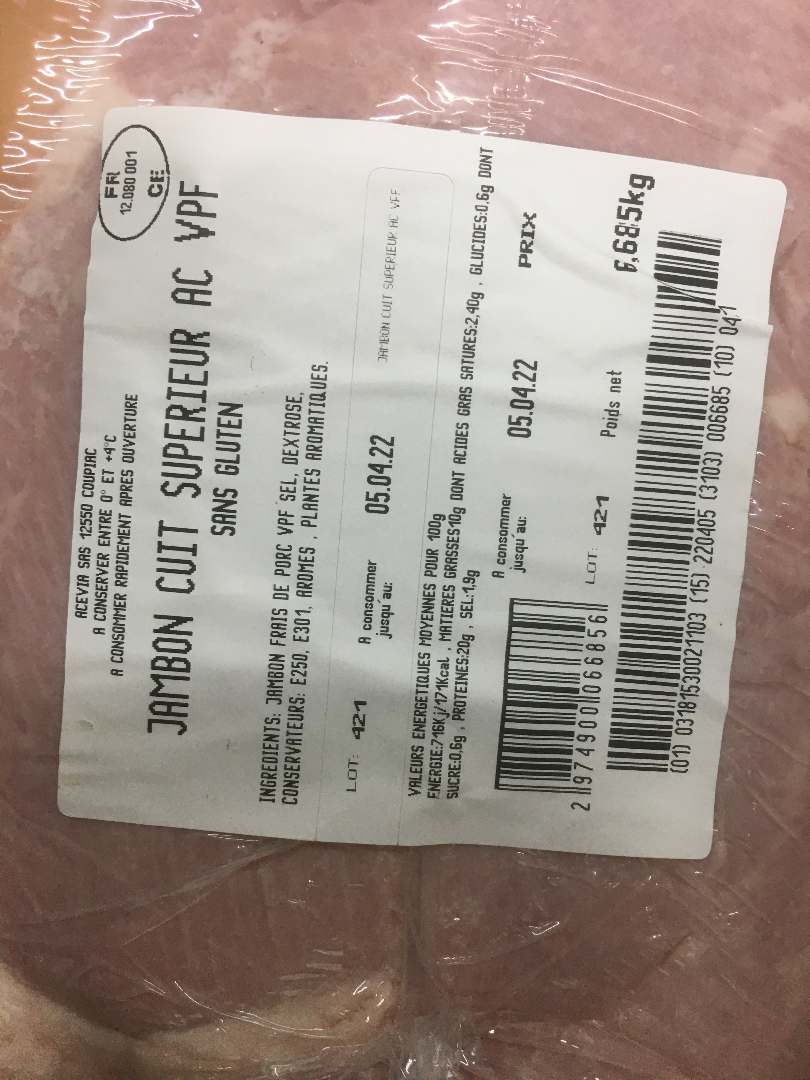
France – Superior cooked ham – Listeria monocytogenes

Gov france

Identification information of the recalled product

  • Product category Food
  • Product subcategory Meats
  • Product brand name Unbranded
  • Model names or references Superior cooked ham
  • Identification of products
    Lot Dated
    421 Use-by date 03/19/2022
  • Marketing start/end date From 02/03/2022 to 15/03/2022
  • Storage temperature Product to be stored in the refrigerator
  • Health mark EN 12.080.001 CE
  • Geographic area of ​​sale Whole France
  • Distributors Intermarché Mauguio

Practical information regarding the recall

  • Reason for recall Non-compliant presence of listeria
  • Risks incurred by the consumer Listeria monocytogenes (causative agent of listeriosis)

USA – Mystery Salmonella and Listeria Outbreaks sicken 75 in United States while infant formula kills 2

Food Poison Journal

The Food and Drug Administration has posted an increase in the number of patients in an outbreak of Listeria monocytogenes infections as it continues investigations into three other outbreaks.

The new patient count in the Listeria outbreak is 16, up from 14 reported a week ago. As of March 16 the FDA had not determined the cause of the outbreak. The agency has initiated traceback efforts, but has not revealed what food or foods are involved in those activities.

The FDA has not revealed any demographic information on the Listeria patients and has not reported where they live.

In other outbreak news the FDA is investigating a new outbreak of Salmonella SaintPaul infections that has sickened 59 people. The agency announced the outbreak on March 16. As with the Listeria outbreak investigation, the FDA has not released any patient information for the Salmonella outbreak and has not reported where the patients live. Traceback efforts have begun, according to the FDA, but the agency did not report what food or foods are involved.

RASFF Alert – Mycotoxin – Alternaria Toxins –

RASFF

Alternaria toxins in tomato paste from Italy in Germany