Category Archives: Food Micro Blog

Canada – Fresh and Local brand Turkey, Bacon Sub recalled due to Listeria monocytogenes

CFIA

Fresh and Local - Turkey, Bacon Sub - 200 g - label

Fresh and Local - Turkey, Bacon Sub - 200 g - side

Summary

Product; Turkey, Bacon Sub

Issue

Food – Microbial Contamination – Listeria

What to do

Do not consume, use, sell, serve, or distribute recalled products

Fresh and Local Turkey, Bacon Sub 205 g 8 77838 48482 7 Best before
22SE21
22SE22
22SE25
22SE26

Issue

The affected product is being recalled from the marketplace due to possible Listeria monocytogenes contamination.

The recalled product has been sold in British Columbia.

What you should do

  • If you think you became sick from consuming a recalled product, contact your healthcare provider
  • Check to see if you have recalled products
  • Do not consume, serve, use, sell, or distribute recalled products
  • Recalled products should be thrown out or returned to the location where they were purchased

Food contaminated with Listeria monocytogenes may not look or smell spoiled but can still make you sick. Symptoms can include vomiting, nausea, persistent fever, muscle aches, severe headache and neck stiffness. Pregnant women, the elderly and people with weakened immune systems are particularly at risk. Although infected pregnant women may experience only mild, flu-like symptoms, the infection can lead to premature delivery, infection of the newborn or even stillbirth. In severe cases of illness, people may die.

France – Montbéliard knife tartare 3% 2x180g- Salmonella

Gov france

Identification information of the recalled product

  • Product category Feed
  • Product subcategory Meats
  • Product brand name The beautiful nature
  • Model names or references Montbéliard knife tartare 3% 2x180g
  • Identification of products
    GTIN Batch Date
    3700502707243 22257-3790 Use-by date 09/26/2022
  • Products List product_list.pdf Attachment
  • Packaging vacuum pack
  • Marketing start/end date From 09/14/2022 to 09/26/2022
  • Storage temperature Product to be stored in the refrigerator
  • Health markFR.13.097.003.CE
  • Geographic area of ​​sale Whole France
  • Distributors Pedavia-Pomona-TSA Meats
  • List of points of saleliset_clients.pdf

Practical information regarding the recall

  • Reason for recall Presence of salmonella
  • Risks incurred by the consumer Salmonella spp (causative agent of salmonellosis)

France- Grilled chicken slices- Listeria monocytogenes

Gov france

Identification information of the recalled product

  • Product category Feed
  • Product subcategory Meats
  • Product brand name Provol & Lachenal
  • Model names or references Sliced ​​grilled chicken tray
  • Identification of products
    GTIN Batch Date
    3304030001325 Tray 1 kg Batches 2372440 – 2382440 – 2412440 Use-by date 01/10/2022
    3304030001325 1 kg tray Lots 2422480 and 2432480 Use-by date 05/10/2022
    3304030001325 1 kg tray Lots 2442490 and 2482490 Use-by date 06/10/2022
    3304030001325 Tray 1 kg Lot 2502510 Use-by date 08/10/2022
    3304030001318 Tray 500g Lot 2372440 Use-by date 01/10/2022
    3304030001318 Tray 500g Lot 2502510 Use-by date 08/10/2022
  • Packaging Tray 1kg and 500g
  • Marketing start/end date From 02/09/2022 to 14/09/2022
  • Storage temperature Product to be stored in the refrigerator
  • Health markFR.69.178.012.CE
  • Geographic area of ​​saleWhole France
  • Distributors André butchers: Vinzelles, Rillieux, Bourg en Bresse, Tignieu. Promocash Nivolas And Wholesalers

Practical information regarding the recall

  • Reason for recall Suspicion of Listeria monocytogenes
  • Risks incurred by the consumer Listeria monocytogenes (causative agent of listeriosis)

France – Fresh Cheeses – Listeria monocytogenes

Gov france

Identification information of the recalled product

  • Product category Feed
  • Product subcategory Milk and dairy products
  • Product brand name cream cheese
  • Model names or references fresh cheeses
  • Identification of products
    Batch Date
    0309;0709;0809;0909 Use-by date 09/21/2022
  • Packaging box
  • Marketing start/end date From 03/09/2022 to 09/09/2022
  • Storage temperature Product to be stored in the refrigerator
  • Geographic area of ​​sale Departments: CORREZE (19)
  • Distributors groceries

Practical information regarding the recall

  • Reason for recall non-compliant microbiological analysis. Presence of listeria monocytogenes
  • Risks incurred by the consumer Listeria monocytogenes (causative agent of listeriosis)

Norway – Organic Whole Grain Rye Pasta – Ochratoxin A

Matportalen

“Bartolini Eko macaron 100% żytni pełnoziarnisty (ekologiczny) gniazda” with a best before date of 30/06/2024 will be withdrawn from the market. The reason is that the mold substance Ochratoxin A has been detected in the product.

Favoritt Mat AS in Stavanger reports that the products were sold to consumers as of 3 November 2021. The products are sold out in the store now, but can still be found at consumers’ homes.

Favoritt Mat AS asks consumers who have bought the product to throw it away or return it to the store.

Ochratoxin A is a naturally occurring toxin that is most often detected in moldy grain, legumes, coffee beans, some dried fruits, as well as juice and wine produced from grapes. Ochratoxins can cause kidney damage in humans and animals, and are suspected of being carcinogenic.

Contact information

Favorite Food AS: Piotr Demski tel: 968 78 600

What Are Common Food Poisoning Pathogen Incubation Periods?

Food Safety Gov

Check out the fact sheets at the link above.

Bacteria and Viruses

Bacteria and viruses are the most common cause of food poisoning. The symptoms and severity of food poisoning vary, depending on which bacteria or virus has contaminated the food.

To prevent illness, always follow the food safety steps: clean, separate, cook, and chill. Other prevention tips for specific bacteria and viruses are included below.

The bacteria and viruses that cause the most illnesses, hospitalizations, or deaths in the United States are described below and include:

Other important bacteria and viruses that cause foodborne illness include:

New Zealand strengthens tahini controls after outbreak

Food Safety News

Authorities in New Zealand have tightened the import rules around tahini and halva from Syria following a recall and outbreak.

An outbreak of Salmonella Kintambo earlier this year involved three patients who had consumed sesame-based products from Syria. Two people were hospitalized. Sequencing of clinical isolates showed cases were closely genetically related and had the same sequence type as in an ongoing European outbreak linked to the same type of products.

In July, Middle East recalled specific batches of Algota brand Sesame Tahini because of the possible presence of Salmonella.

New Zealand Food Safety testing of tahini and halva products found Salmonella Kintambo, Salmonella Amsterdam and Salmonella Orion.

The agency has amended the sampling plan for such high risk products. Changes mean all consignments of crushed sesame seed products, such as tahini and halva, must be sampled and tested for Salmonella, when exported from Syria or if they originate from the country.

Research – Risk Assessment of Norovirus Transmission in Food Establishments

FDA

The Risk Assessment of Norovirus Transmission in Food Establishments: Evaluating the Impact of Intervention Strategies and Food Employee Behavior (Duret et al. 2017) evaluates the dynamics of norovirus transmission from ill or infected food employees in food establishments (restaurant setting) to ready-to-eat food and consumers during food preparation and also evaluates the impact of prevention strategies. A discrete event model was developed to study norovirus transmission from the soiled hands of ill or infected food employees and the impact of prevention strategies and their compliance on the prevalence of contaminated servings and the number of resulting infected customers.

The Evaluation of the Impact of Compliance with Mitigation Strategies and Frequency of Restaurant Surface Cleaning and Sanitizing on Control of Norovirus Transmission from Ill Food Employees Using an Existing Quantitative Risk Assessment Model (Fanaselle et al. 2022) uses the previously published FDA quantitative risk assessment model in Duret et al. 2017, to evaluate more than 60 scenarios examining the impact of implementation and compliance with recommendations in the FDA Food Code for: restaurant surface cleaning and sanitizing, hand hygiene and employee health.

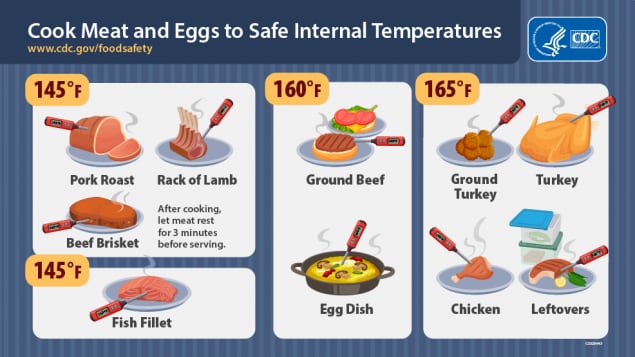
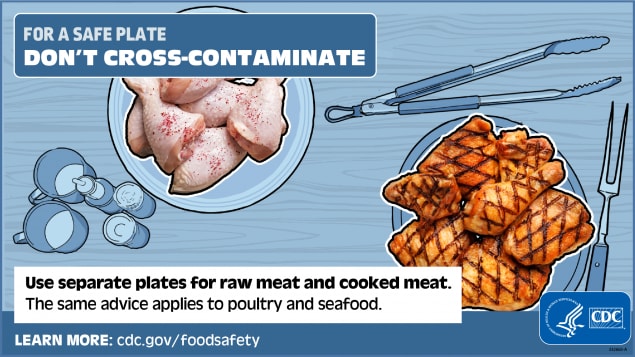
Information – CDC Food Safety Social Media Graphics

CDC

A whole range of free food safety graphics are available at the link above 🙂

Cook Meat and Eggs to a Safe Internal Temperature

Food Safety Education Month Facebook image 7

Man Utd players hit by food poisoning after FC Sheriff win

The Sun

MANCHESTER UNITED players and staff were hit by a bout of suspected food poisoning following their Europa League victory in Moldova.