Category Archives: Food Hygiene

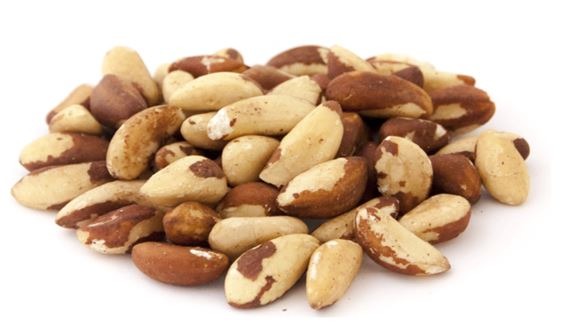
France – ORGANIC AMAZONIAN NUTS – ORGANIC VILLAGE – SOLD IN BULK – Aflatoxin B1

Gov france

Identification information of the recalled product

  • Product category Food
  • Product subcategory Nuts and seeds
  • Product brand name ORGANIC VILLAGE
  • Model names or references ORGANIC AMAZONIAN NUTS – ORGANIC VILLAGE – SOLD IN BULK
  • Identification of products
    Batch Date
    These nuts were marketed in the bulk department from 02/14/2022 to 04/25/2022 Date of minimum durability 01/24/2023
  • Packaging BULK
  • Marketing start/end date From 02/14/2022 to 04/25/2022
  • Storage temperature Product to be stored at room temperature
  • Further information These nuts were marketed in the bulk department from 02/14/2022 to 04/25/2022. The DDM concerned is 24/01/2023.
  • Geographic area of ​​sale Whole France
  • Distributors E.LECLERC

Practical information regarding the recall

  • Reason for recall Presence of aflatoxins B1 and total aflatoxins
  • Risks incurred by the consumer Aflatoxins

New Zealand- Elite brand confectionery products -Salmonella

MPI

Logo of Elite brand

28 April 2022: Benedikt Imports Pty Ltd is recalling all batches, all dates, all packaging, or size and all flavour variations of Elite branded confectionery products, including Elite chocolate, Elite cakes, Elite wafers, Energy grain snacks, Energy chocolate rice cakes, gum and toffee candies due to the possible presence of Salmonella.

Product identification
Product type Confectionery products
Name of product (size) All packaging, or size and all flavour variations of Elite brand confectionery products, manufactured by Elite-Strauss, Israel are affected by this recall, including:

  • Elite brand chocolate
  • Elite brand cakes
  • Elite brand wafers
  • Elite brand Energy grain snacks
  • Elite brand Energy chocolate rice cakes
  • Elite brand gums
  • Elite brand toffee candies
Batch and date marking All batches and all dates
Package size and description The products are sold in various weights in various packaging variations.
Distribution The products are sold at the below ethnic grocery stores and may have been provided to community groups:

  • Chabad New Zealand Hebrew Charitable Trust, 788 Remuera Road, Remuera, Auckland
  • The Greys Ave Deli or The Kosher Deli, 108 Greys Avenue Auckland Central, Auckland and online – The Kosher Deli 
  • Wellington Kosher Co-Operative, 80 Webb Street, Te Aro, Wellington

The products were sold as part of the ‘Home Away From Home Gift Box’ from The Greys Ave Deli or The Kosher Deli in Auckland and online via the company’s website. Only the Elite brand confectionery products in the gift box are affected by this recall and should not be consumed.

The products have not been re-exported.

Notes This recall does not affect any other Elite brand products, or any other products imported by Benedikt Imports Pty Ltd.

If you are a retailer of any of the Elite brand products listed in this recall notice, you need to download a copy of the below Point of Sale notice and display in your store for one month:

Point of sale notice [PDF, 45KB]

Consumer advice

Customers are asked to check the brand of products before consumption.

Affected products should not be consumed. There have been cases of illnesses in Israel reportedly linked to Elite brand confectionery products, manufactured by Elite-Strauss Group, Israel. There have been no confirmed cases of illnesses in New Zealand, however if you have consumed any of these products and have any concerns about your health, seek medical advice.

Customers should return the products to their retailer for a full refund.

Who to contact

If you have questions, contact Benedikt Imports Pty Ltd:

International outbreak of salmonellosis in young children linked to the consumption of Kinder brand products. Update on April 27, 2022.

Sante Publique

Update on 04/27/22 following the recall of several Kinder range products manufactured in a factory in Belgium due to suspected contamination by  Salmonella Typhimurium .

Following the investigations carried out by the Belgian health authorities, together with their English, European and in particular French counterparts, the company Ferrero proceeded on April 5, 2022 to the recall of several Kinder range products manufactured in a factory in Belgium due to suspected contamination by Salmonella Typhimurium . On April 8, 2022, the recall finally affected all Kinder products from this factory, regardless of their expiry date. On April 14, 2022, an update of the recalled products, including the 2021 Christmas Advent Calendars, was released.

Case of salmonellosis in France: update on April 27, 2022

In total, as of 04/27/2022: 59 cases of salmonellosis with a strain belonging to the epidemic have been identified by the National Reference Center (CNR) for salmonella at the Institut Pasteur in France. 

The 59 cases are spread over 11 regions (Ile-de-France (11 cases), Grand-Est (10 cases), Provence-Alpes-Côte d’Azur (9 cases), Auvergne-Rhône-Alpes (7 cases) , Hauts-de-France (6 cases), Bourgogne-Franche-Comté (4 cases), Normandy (4 cases), New Aquitaine (3 cases), Brittany (2 cases), Occitanie (2 cases), and Corsica ( 1 case)), with a median age of 3 years, and involved 29 boys and 30 girls.

Forty-two cases were able to be questioned by Public Health France. All the cases report, before the onset of their symptoms (which occurred between 20/01 and 31/03/2022), the consumption of chocolates of the brand cited here. Seventeen people were hospitalized for their salmonellosis, all since discharged. No deaths were reported.

Public Health France is continuing its investigations with the families of cases recently reported by the CNR. 

The successive withdrawals and recalls of the Kinder brand products concerned, produced by the Belgian factory with its closure by the Belgian authorities, should limit the occurrence in France of new cases of salmonellosis in the coming days/weeks. 

To find out the list of products concerned by the withdrawal-recall: https://rappel.conso.gouv.fr/

People who have consumed the products mentioned above and who present symptoms (gastrointestinal disorders, fever within 72 hours of consumption), are invited to consult their doctor without delay, notifying him of this consumption.

In order to limit person-to-person transmission (especially in households with young children), it is recommended to wash your hands well with soap and water after using the toilet, after changing your child, and before to cook.

International situation

See the previous points

France – Investigation of grouped cases of haemolytic-uremic syndrome (HUS) and shiga-toxin-producing E. coli (STEC) infections linked to the consumption of Buitoni® brand Fraîch’Up pizzas. Update on April 25, 2022.

Sante Publique

Update on April 25, 2022 on the grouped cases of haemolytic-uremic syndrome and E. coli infections producing shiga-toxin and the consumption of frozen pizzas from the Fraîch’Up range of the Buitoni® brand.

Public Health France and the National Reference Center (CNR) E. coli and its associated laboratory (Institut Pasteur, Paris, and Microbiology Laboratory of the Robert Debré Hospital, Paris), in conjunction with the Directorate General for Food, the Directorate General for Competition, Consumer Affairs and Fraud Prevention, and in coordination with the Directorate General for Health, have been investigating since 02/10/2022 an increase in the number of cases of haemolytic uremic syndrome (HUS) pediatric infections and Shiga toxin-producing Escherichia coli (STEC) infections.

The epidemiological, microbiological and traceability investigations carried out since that date have confirmed a link between the occurrence of these grouped cases and the consumption of frozen pizzas from the Buitoni brand Fraîch’Up range contaminated with STEC bacteria. On 03/18/2022, the company proceeded with the withdrawal-recall of all the pizzas in the Fraîch’Up range, marketed since June 2021 and the authorities asked the people who hold these pizzas not to consume them and to destroy them.

The total number of HUS cases linked to the consumption of these pizzas seems to have stabilized since the withdrawal-recall.

Case of SHU in France: update on 04/25/22

As of 04/25/2022, 55 confirmed cases have been identified, of which 53 are linked to STEC O26 strains, and 2 to STEC O103 strains. 

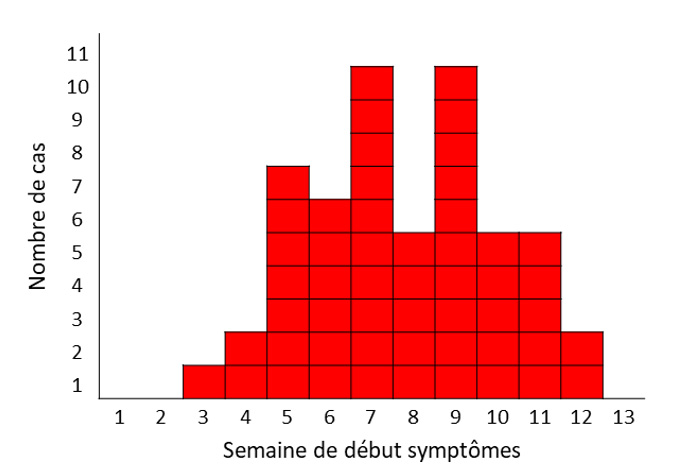
These 55 cases occurred in 54 children and 1 adult, who presented symptoms between 18/01/2022 (week 3) and 25/03/2022 (week 12) (Figure 1). The epidemic peak is in week 7 (14/02 to 20/02) and week 9 (28/02 to 06/03), with 10 cases each of these weeks.
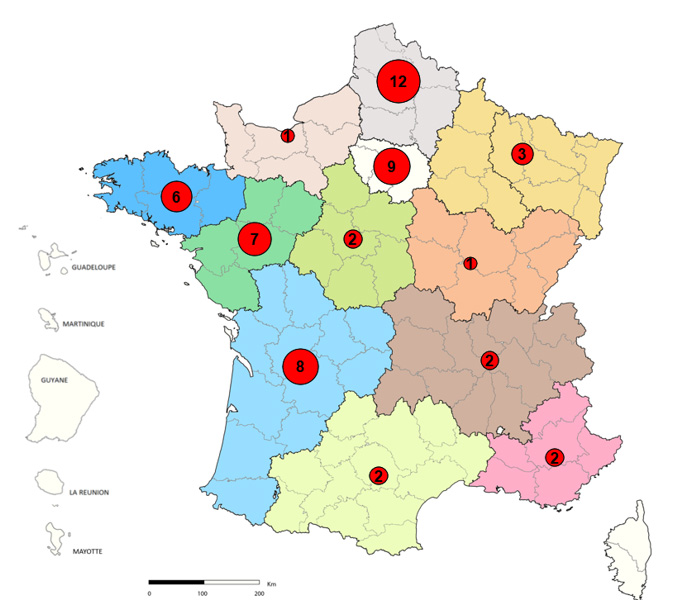
These 55 cases occurred in 12 regions of metropolitan France: Hauts-de-France (12 cases), Ile-de-France (9 cases), New Aquitaine (8 cases), Pays de la Loire (7 cases), Brittany ( 6 cases), Grand Est (3 cases), Auvergne-Rhône-Alpes (2 cases), Occitanie (2 cases), Provence-Alpes-Côte d’Azur (2 cases), Center Val-de-Loire (2 cases) , Bourgogne Franche-Comté (1 case) and Normandy (1 case) (figure 2).

The 54 sick children are aged from 1 to 17 years with a median age of 7 years; 24 (44%) are female; 47 (87%) presented with HUS, 7 (13%) with STEC gastroenteritis. Two children died. The adult did not present with HUS.

Figure 1 – Epidemic curve: number of confirmed cases of HUS and STEC infections, by week of onset of symptoms – Metropolitan France, weeks 3 to 12, 2022 (N=53: week of onset of symptoms not specified for 2 cases )
Figure 1 - Epidemic curve: number of confirmed cases of HUS and STEC infections, by week of onset of symptoms - Metropolitan France, weeks 3 to 12, 2022 (N=53: week of onset of symptoms not specified for 2 cases )
Figure 2 – Geographical distribution of confirmed cases of HUS and STEC infections (N=55) linked to the consumption of Buitoni® brand Fraîch’Up pizzas, by region of residence in metropolitan France, weeks 3 to 12, 2022
Figure 2 - Geographical distribution of confirmed cases of HUS and STEC infections (N=55) linked to the consumption of Buitoni® brand Fraîch'Up pizzas, by region of residence in metropolitan France, weeks 3 to 12, 2022

RASFF Alerts – Norovirus – Clams and Sea Truffles

RASFF

Norovirus (GI – GII viral genome) in clams (ruditapes ph.) from Spain in Italy and Portugal

RASFF

Norovirus (GI-GII viral genome) in sea truffles (Venus verrucosa) from Spain in Portugal and Italy

RASFF Alert – STEC E.coli – Bovine Carcass

RASFF

STEC (stx+;eae+) in bovine carcass from Belgium in France

RASFF Alert – Listeria monocytogenes – Pigs Head

RASFF

Listeria monocytogenes in pig’s head from Belgium in Luxembourg

RASFF Alert – Traceability related to the foodborne outbreak suspected (Salmonella Typhimurium monophasic) to be caused by chocolate products from Belgium

RASFF

 Albania (d) Andorra (d) Argentina (d) Armenia (d) Australia (d) Austria (d)(ffa) Azerbaijan (d) Belarus (d) Belgium (n)(o)(d)(op)(ffa) Bosnia and Herzegovina (d) Bulgaria (d)(ffa) Canada (d) Chile (d) Costa Rica (d) Croatia (d)(ffa) Cyprus (d)(ffa) Czech Republic (d)(ffa) Denmark (d)(ffa) Dominican Republic (d) Egypt (d) El Salvador (d) Estonia (d)(ffa) Ethiopia (d)Faeroe Islands (d) Finland (d)(ffa) France (d)(ffa) French Guiana (d) French Polynesia (d) Georgia (d) Germany (d)(ffa) Greece (d)(ffa) Guadeloupe (d) Guatemala (d) Honduras (d) Hong Kong (d) Hungary (d)(ffa)INFOSAN (ffa) Iceland (d)(ffa) India (d) Iraq (d) Ireland (d)(ffa) Israel (d) Italy (d)(ffa) Jordan (d) Kazakhstan (d)Kosovo (d) Kuwait (d) Kyrgyzstan (d) Latvia (d)(ffa) Lebanon (d) Lithuania (d)(ffa) Luxembourg (d)(ffa) Madagascar (d) Malaysia (d) Malta (d)(ffa) Mauritius (d) Mayotte (d) Mexico (d)Moldova (d) Mongolia (d) Montenegro (d) Morocco (d) Netherlands (d)(ffa) New Caledonia (d) New Zealand (d) Nicaragua (d) Norway (d)(ffa) Oman (d) Panama (d) Paraguay (d) Poland (d)(ffa) Portugal (d)(ffa) Qatar (d)Republic of North Macedonia (d) Romania (d)(ffa)Russia (d) Réunion (d) San Marino (d) Saudi Arabia (d) Serbia (d) Singapore (d) Slovakia (d)(ffa) Slovenia (d)(ffa) Spain (d)(ffa) Sweden (d)(ffa) Switzerland (d)(ffa)Syria (d)Taiwan (d) Tajikistan (d) Tunisia (d) Turkey (d) Turkmenistan (d) Ukraine (d) United Arab Emirates (d) United Kingdom (d) United States (d) Uruguay (d) Uzbekistan (d)Vatican City (d)

(n) Notifying | (o) Origin | (d) Distribution | (op) Operator
(ffup) Flagged for Follow-Up | (ffa) Flagged For Attention

RASFF Alerts -Salmonella – Polish Chicken Products – Black Pepper – Chicken Neck Skins – Ham and Pistachio Roll – Chicken Liver – Frozen Pork Meat – Organic Coriander Seed –

RASFF

Salmonella enteritidis in chicken neck skins from the Czech Republic in Slovakia

RASFF

Salmonella Infantis in 25 g of the product – poultry meat from Poland in the Czech Republic

RASFF

Salmonella in meat product (ham and pistachio roll) from Belgium in France

RASFF

Salmonella spp. in Chicken elements and chicken neck skin from Poland in the UK and Germany

RASFF

Salmonella Enteritidis in official samples of chicken neck skins from Poland in the Netherlands

RASFF

Salmonella in frozen pork meat from Spain in Finland

RASFF

Salmonella gr C in chicken filet from Poland in the Netherlands

RASFF

Salmonella spp. in organic coriander seed of unknown origin, via Italy in Germany

RASFF

Salmonella spp. in black pepper from Brazil in Germany

RASFF

Salmonella spp. in black pepper from Brazil in Germany

RASFF

Salmonella spp. in black pepper from Brazil in Germany

RASFF

Salmonella spp. in black pepper from Brazil in Germany

RASFF

Salmonella spp. in black pepper from Brazil in Germany

RASFF

Salmonella spp. in black pepper from Brazil in Germany

RASFF

Salmonella spp. in black pepper from Brazil in Germany and  the Netherlands

RASFF

Salmonella in chicken liver from Poland in the Netherlands

RASFF

Salmonella spp. in black pepper from Brazil in Germany

RASFF Alerts – Ochratoxin A – Raisins

RASFF

Ochratoxin A (68 mg/kg – ppm) in raisins from Uzbekistan, via Lithuania in Latvia