Category Archives: Food Hygiene

USA – Fullei Fresh Issues Correction on Alfalfa Sprout Recall Because of Possible Health Risk – Listeria monocytogenes

FDA

Summary

Company Announcement Date:
FDA Publish Date:
Product Type:
Food & Beverages
Spices, Flavors &  Salts
Foodborne Illness
Reason for Announcement:
Contamination with shiga toxin-producing E. coli
Company Name:
Fullei Fresh
Brand Name:
Fullei Fresh
Product Description:
Alfalfa Sprouts

Company Announcement

MIAMI, FL – Fullei Fresh is voluntarily recalling Alfalfa Sprouts due to the detection of Shiga toxin producing E.coli (STEC.) Shiga toxin producing E.coli is an organism that can cause foodborne illness in a person who eats a food item contaminated with it. Symptoms of infection may include stomach cramps, diarrhea, and vomiting. The illness primarily impacts elderly individuals, children, and people with weakened immune systems. Most healthy adults and children rarely become seriously ill.

STEC is a bacterial strain that is not part of our routine microbial testing conducted in compliance with the FDA’s Produce Safety Rule Subpart M on every lot we produce. It was detected upon sampling of finished product by the FDA.

There have been no known illnesses reported to date in connection with this product.

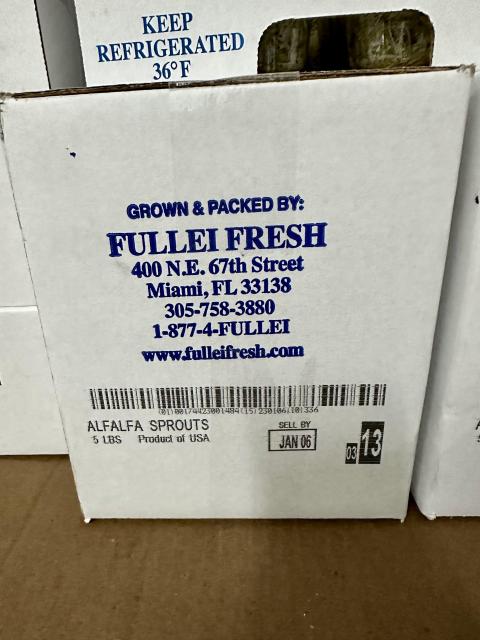
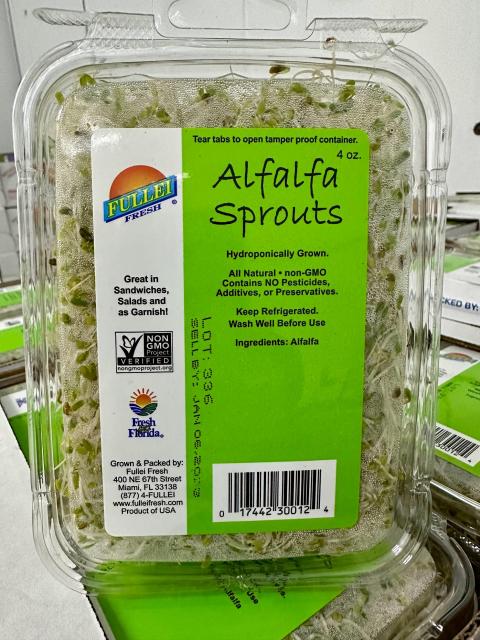
The affected Fullei Fresh brand alfalfa sprout lot number is 336. They were shipped to distributors and retailers in Florida between December 9-23, 2022. No other lots or products are affected.

The lot numbers are printed on the 4 ounce retail packs and on 5 lb. bulk cardboard boxes in the barcode (the last 3 digits being 336.) Pictures are below.

Should you be in possession of these products, please discard.

This recall is being made with the knowledge of the Food and Drug Administration and the Florida Department of Agriculture.

If you require further information, please contact sales@fulleifresh.com or (305) 758-3880 Monday through Friday between 8:00 AM and 4:00PM EST.

Company Contact Information

Consumers:
 305-758-3880
 sales@fulleifresh.com

Product Photos

New Zealand – Pams brand Carrot Batons – E.coli

MPI

Pams brand Carrot Batons (300g)

20 January 2023: Foodstuffs Own Brands Ltd is recalling a specific batch of its Pams brand Carrot Batons due to the possible presence of E.coli.

Product type Carrots
Name of product (size) Pams brand Carrot Batons (300g)
Date marking Use By Date 20/01/23
Package size and description The product is sold in a 300g plastic package.
Distribution The product is sold at Pak’n Save, New World and Four Square stores throughout New Zealand.

The product has not been exported.

Notes This recall does not affect any other Pams brand products.

Point of sale notice for retailers

If you are a retailer of the product in this recall notice, you need to download a copy of the below Point of sale notice and display it in your store for one month.

Point of sale notice – Pams brand Carrot Batons [PDF, 47 KB]

Consumer advice

Customers are asked to check the date mark on the back of the packaging.

Affected product should not be consumed. There have been no reports of associated illness, however if you have consumed any of this product and have any concerns about your health, seek medical advice.

Customers should return the product to their retailer for a full refund.

Who to contact

If you have questions, contact Foodstuffs Own Brands Ltd:

  • Phone: 0800 24 51 14
  • Address: 35 Landing Drive, Mangere, Auckland.

Sweden – Wernersson Ost recalls grated cheese 500g and 1 kg – may contain Listeria

Livsmedelsverket

2023-01-19

Wernersson Ost recalls grated cheese 500g and 1 kg because they may contain listeria.

RASFF Alerts – Aflatoxin – Dried Figs – Peanuts -Groundnut Kernels –

RASFF

Aflatoxins in dried figs from Turkey in Slovakia

RASFF

Aflatoxin B1 in U.S.A. peanuts in the Netherlands

RASFF

Aflatoxin B1 in Argentine groundnut kernels in the Netherlands

RASFF

Aflatoxins in U.S.A. peanuts in the Netherlands

RASFF

Aflatoxins in peanuts in shell from Egypt in Germany

RASFF

Aflatoxins in peanuts from the United States in Germany

RASFF

Aflatoxin B1 in peanuts from the United States in Germany

RASFF

Aflatoxins in peanuts in shell from Egypt in Germany

RASFF Alert- Mold/Mould – Gouda Cheese

RASFF

Mould on gouda cheese from the Netherlands in Sweden and Denmark

RASFF Alert – Norovirus in Oysters from France

RASFF

Norovirus in Oysters from France in Hungary, Italy, Latvia, Moldova, Netherlands, Romania, Singapore and Switzerland

RASFF Alert – Vibrio cholerae – Shrimps

RASFF

Vibrio cholerae (NON 014/NON 0139) was detected in frozen shrimps from Venezuela in Spain

RASFF Alert – Listeria monocytogenes – Mixed Meat Platter – Chilled Smoked Salmon – Hummus – Mortadella – Gorgonzola

RASFF

Salmonella and Listeria in mixed meat platter from Belgium in Luxembourg

RASFF

Listeria monocytogenes (530 CFU/g) in chilled smoked salmon from France in Slovenia

RASFF

Listeria monocytogenes in hummus from the Netherlands in Germany

RASFF

Mortadelle – Listeria monocytogenes from Italy in France

RASFF

Listeria monocytogenes in gorgonzola from Italy in Austria

RASFF Alerts – Salmonella – Polish Chicken Products – Sesame Seeds – Black Pepper – Black Mushrooms – Steam Cooked Chicken Breast – Laying Hens – Mixed Meat Platter

RASFF

Salmonella in sesame seeds from Nigeria in Greece

RASFF

Salmonella in sesame seeds from Nigeria in Greece

RASFF

Salmonella in black mushrooms from Côte d’Ivoire in France

RASFF

Salmonella spp. in black pepper from Brazil in Germany

RASFF

Salmonella in sesame seeds from Nigeria in Greece

RASFF

Salmonella Mbandaka in frozen steam cooked chicken breast from Ukraine in Estonia and the Netherlands

RASFF

Zoonotic Salmonella enteritidis contamination in laying hens from Germany in the Netherlands

RASFF

Salmonella Enteritidis in chicken neck skin and chicken elements from Poland in Lithuania and Latvia

RASFF

Salmonella Kentucky and Salmonella Senftenberg in sesame seeds from India in Germany and Austria

RASFF

Salmonella and Listeria in mixed meat platter from Belgium in Luxembourg

Sweden – Salmonella Enteritidis (December 2022-)

Folkhalsomyndigheten

hazegg.jpg

Since the beginning of December 2022, 22 cases of illness infected with one and the same strain of Salmonella Enteritidis have been reported to the Public Health Authority. The infection is suspected to originate from eggs that have now been recalled.

At the end of December 2022, Salmonella Enteritidis was identified at a major Swedish egg producer, which has led to several recalls of fresh eggs.

Recalls of eggs – January 2023 (livsmedelsverket.se)

An outbreak of Salmonella Enteritidis involving 22 people from eleven different regions has now been identified and is being investigated. Since several of the sick have eaten dishes containing raw eggs from the now recalled batches, there are strong reasons to suspect a connection to the earlier Salmonella finding at the egg producer. The disease cases are aged 7-90 years (median=40 years), twelve of the cases are women and the illnesses occurred between December 7, 2022 and January 6, 2023 (see Figure 2023-01-18).

During the past ten days, a larger number of people with salmonella infection than usual have been reported. The Salmonella isolates from these disease cases have not yet been typed to determine the specific strain, but since several have stated consumption of products with raw eggs from suspected contaminated batches, there is a risk that the number of people identified as infected in the outbreak will increase.

Although because of the recalls there should be no contaminated eggs left in stores or in restaurants, it is possible that you may have eggs left at home from the recalled batches. Via the Swedish Food Agency’s website, you can find out who these lots are and what you should do with these eggs.

The outbreak is being investigated in collaboration between the Swedish Agency for Agriculture, the Swedish Food Agency, SVA, the Public Health Agency, regional infection control and other regional and local authorities.