Category Archives: Research

Research – Reduction of Salmonella enterica in Turkey breast slices kept under aerobic and vacuum conditions by application of lactic acid, a bacteriophage, and ultrasound

Wiley Online

The effects of different antimicrobial applications against Salmonella enterica subs. enterica DSM 18522 strain in turkey breast slices kept under either aerobic or anaerobic-vacuum conditions for different keeping times of 30 min and 6 hr at 4°C were evaluated. In this study, it was aimed to compare chemical (lactic acid, 3%), biopreservation (bacteriophage Felix O1, 1 × 108 pfu/ml), and physical (ultrasound, 20 kHz) antimicrobial applications in reducing a high initial S. enterica DSM 18522 count (~6 log cfu/g) in turkey breast slices at different conditions. The highest reduction in S. enterica DSM 18522 counts (1.62 log units) was observed in turkey breast slices kept under aerobic condition for 6 hr after being treated with lactic acid. The bacteriophage application significantly (p < .05) reduced S. enterica DSM 18522 counts 1.22 and 1.41 log cfu/g in turkey breast slices that kept under aerobic and anaerobic-vacuum conditions for 30 min, respectively. There was no significant effect of keeping time under aerobic or anaerobic-vacuum conditions on S. enterica DSM 18522 counts in turkey breast slices treated with bacteriophage or ultrasound. However, the reduction of S. enterica DSM 18522 counts in turkey breast slices treated with lactic acid increased with keeping time under aerobic or anaerobic-vacuum conditions. Regardless of keeping conditions, the lowest reductions in S. enterica DSM 18522 counts were detected in turkey breast slices treated with ultrasound. The results of this study show that lactic acid and bacteriophage applications are effective in reducing S. enterica DSM 18522 counts in turkey breast slices.

Research – Effects of Combined Aerosolization with Ultraviolet C Light-Emitting Diode on Enterohemorrhagic Escherichia coli and Staphylococcus aureus Attached to Soft Fresh Produce

MDPI

Washing soft fresh produce such as strawberries, baby leaves, and sliced onions with sanitizing agents is challenging due to their fragile texture. Thus, treatments like aerosolization using slightly acidic electrolyzed water (SAEW) and ultraviolet C light-emitting diode (UVC LED) irradiation may be good alternatives. In the present study, the reduction effects of a combined treatment of aerosolization using SAEW and UVC LED irradiation on enterohemorrhagic Escherichia coli (EHEC) and Staphylococcus aureus attached to strawberries, baby leaves, and sliced onions were investigated. The behaviours of EHEC and S. aureus, moisture loss, colour measurement, and visual appearance were also analyzed at 10 and 15 °C for 7 days. The reduction effect of the combined treatment with 100 SAEW and UVC LED was higher (0.53–0.92 log CFU g−1) than a single aerosolization treatment (0.11–0.41 log CFU g−1), regardless of samples or pathogens. A greater effect on EHEC and S. aureus reduction was observed in strawberries (0.74 and 0.92 log CFU g−1) than in baby leaves (0.62 and 0.53 log CFU g−1) and sliced onions (0.55 and 0.62 log CFU g−1). The combined treatment further reduced the EHEC and S. aureus populations in strawberries during 7 days of storage at 10 and 15 °C. However, the EHEC and S. aureus populations were maintained in baby leaves and sliced onions at 10 °C for 7 days. Additionally, the greatest effect on the maintenance of colour and appearance was obtained in the combined treatment. Since the combined treatment reduces EHEC and S. aureus populations and preserves visual quality, it could be expected to extend the shelf life of soft fresh produce at the retailer stage of the supply chain. View Full-Text

Research – Foodborne Botulism in Ukraine from 1955 to 2018

Mary Anne Liebert

kswfoodworld

We aim to identify possible biological, social, and economic factors that could influence the prevalence of foodborne botulism (FB). The objective of this article is to assess epidemiological peculiarities of FB in Ukraine from 1955 to 2018 using national epidemiological surveillance data. This article presents an epidemiological descriptive population-based study of the epidemiology of FB using correlation analysis. From 1955 to 2018, 8614 cases of botulism were recorded in Ukraine causing 659 deaths. The distribution of types of botulism toxins is represented by type A (7.97%), B (59.64%), suspected as C (0.56%), E (25.47%), others (5.33%), and unidentified (1.04%). From 1990 to 2015, the rate correlation between Human Development Index (HDI) and incidence of botulism was −0.75 ± 0.20. Homemade canned meat and fish continue to be the leading causes of botulism in Ukraine. Cases related to commercial food were rare or absent, but in recent years (2017–2018), their percentage has increased to 32.56%. The HDI and botulism have an inverse mathematical correlation and predictable logical relationship: with an HDI increase, the incidence of FB decreased. In general, food botulism in Ukraine is related to traditional socioeconomic factors related to cultural food habits. In the face of declining living standards and uncertainty that food products will be physically or economically available, homemade preservation increases. Home food preservation is a major cause of botulism in Ukraine. The elimination of FB is possible in Ukraine only with the complete cessation of home canning and state control over the manufacture and sale of commercial canned products.

Research – Fate of Salmonella and Enterohemorrhagic Escherichia coli on Wheat Grain

Journal of Food Protection

Wheat flour has been connected to outbreaks of foodborne illnesses with increased frequency in recent years, specifically, outbreaks involving Salmonella enterica and enterohemorrhagic Escherichia coli (EHEC). However, there is little information regarding the survival of these pathogens on wheat grain during long-term storage in a low-moisture environment. This study aims to evaluate the long-term survival of these enteric pathogens on wheat grain over the course of a year. Hard red spring wheat was inoculated with strains of four serovars of Salmonella enterica (Enteritidis , Agona, Tennessee, and Montevideo) and six serotypes of EHEC (O157:H7, O26:H11, O121:H19, O45:NM, O111:H8, and O103:H2) in triplicate, sealed in Mylar bags to maintain the water activity, and stored at room temperature (22 ± 1°C). The survival of each pathogen was evaluated by plating onto differential media . Viable counts of strains from all four serovars of Salmonella (Enteritidis , Agona, Tennessee, and Montevideo) were detected on wheat grain stored at room temperature (22 ± 1°C) for the duration of the study (52 weeks). Viable counts of strains from EHEC serotypes O45:NM, O111:H8, and O26:H11 were only detected for 44 weeks and strains from serotypes O157:H7, O121:H19, and O103:H2 were only detected for 40 weeks until they passed below the limit of detection (2.0 log CFU/g). D -values were found to be significantly different between Salmonella and EHEC (adj. p ≤ 0.05) with Salmonella D -values ranging from 22.9 ± 2.2 to 25.2 ± 1.0 weeks and EHEC D -values ranging from 11.4 ± 0.6 to 13.1 ± 1.8 weeks. There were no significant differences amongst the four Salmonella strains or amongst the six EHEC strains (adj. p > 0.05). These observations highlight the wide range of survival capabilities of enteric pathogens in a low-moisture environment and confirm these pathogens are a food safety concern when considering the long shelf life of wheat grain and its products.

Research – Application of chitosan microparticles against human Norovirus

Journal of Food Protection

Human norovirus (HuNoV) is the leading causative agent of foodborne outbreaks and is associated with the second most prevalent cause of waterborne infections in the United States. The goal of this research was to investigate the antiviral activity of chitosan microparticles (CM) against HuNoV GII.4 Sydney and its cultivable surrogate, Tulane virus (TuV), in suspensions mimicking fecally-contaminated water. CM was prepared by crosslinking chitosan molecules with sodium sulfate, and then its anti-noroviral activity was assessed using infectivity assay on TuV and RT-qPCR on TuV and HuNoV. A 3% CM suspension in PBS (pH 7.2) showed binding to TuV particles but with a negligible impact on virus infectivity (p>0.05). TuV and HuNoV suspended in fecal suspensions showed a 1.5-log10 reduction in genomic copies per ml following a 10-min contact time (p<0.05). Despite the negligible impact on viral infectivity, CM moderately binds to virus particles and helps purify environmental water by removing infectious virus particles. In this study, TuV served as a suitable surrogate for HuNoV by showing a similar log10 reduction in fecal suspension. Overall, the outcomes of thisresearch highlight the potential application of CM as a novel, natural treatment to minimize the spread of water-transmitted viral pathogens.


Research – FAO/WHO Joint Expert Meeting on Microbiological Risk Assessment (JEMRA): Twenty Years of International Microbiological Risk Assessment

MDPI

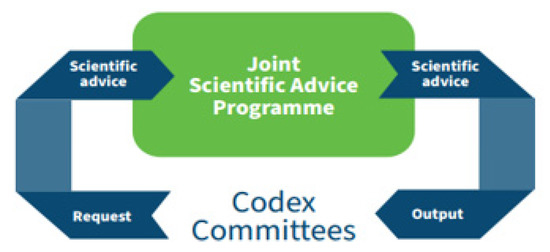
Since the late 1990s, the Food and Agriculture Organization (FAO) of the United Nations and the World Health Organization (WHO) has convened expert meetings and consultations to address the microbiological risk assessment (MRA). These meetings are held to provide scientific advice in response to requests for from Codex Alimentarius, the international food standard-setting body. Individuals participate in the FAO/WHO joint expert meetings on the microbiological risk assessment (JEMRA) in their personal capacity, as technical experts, yet bring diverse regional and national perspectives that contribute to practical applications, particularly for low- and middle-income countries (LMICs). Over 370 experts from around the globe have contributed to the meeting outcomes that have been published in nearly 40 monographs in the FAO/WHO microbial risk assessment (MRA) series, addressing particular food commodities with microbial hazard(s) combinations or a methodological aspect of microbial risk assessment. FAO/WHO MRA series inform Codex decision-making for the development of international standards for safe food and faire trade in food products; are consulted by risk managers such as food safety authorities and food business operators to make science-based decisions; and are used by academics to advance food safety research and educate the next generation of food safety professionals. View Full-Text

Research – Interaction of Escherichia coli with growing salad spinach plants

PubMed

In this study, the interaction of a bioluminescence-labeled Escherichia coli strain with growing spinach plants was assessed. Through bioluminescence profiles, the direct visualization of E. coli growing around the roots of developing seedlings was accomplished. Subsequent in situ glucuronidase (GUS) staining of seedlings confirmed that E. coli had become internalized within root tissue and, to a limited extent, within hypocotyls. When inoculated seeds were sown in soil microcosms and cultivated for 42 days, E. coli was recovered from the external surfaces of spinach roots and leaves as well as from surface-sterilized roots. When 20-day-old spinach seedlings (from uninoculated seeds) were transferred to soil inoculated with E. coli, the bacterium became established on the plant surface, but internalization into the inner root tissue was restricted. However, for seedlings transferred to a hydroponic system containing 10(2) or 10(3) CFU of E. coli per ml of the circulating nutrient solution, the bacterium was recovered from surface-sterilized roots, indicating that it had been internalized. Differences between E. coli interactions in the soil and those in the hydroponic system may be attributed to greater accessibility of the roots in the latter model. Alternatively, the presence of a competitive microflora in soil may have restricted root colonization by E. coli. The implications of this study’s findings with regard to the microbiological safety of minimally processed vegetables are discussed.

EU – Who does what? Reference book gives an overview of the food safety institutions in Europe

BRF

The 5th edition of the BfR’s “EU Food Safety Almanac” has been pub-lished in English

How is food and feed safety organised in Europe? Which institutions exist in the respective countries?  And what are they responsible for? The reference work “EU Food Safety Almanac” by the German Federal Institute for Risk Assessment (BfR) provides an up-to-date overview of the responsibilities of the key players in 37 European countries. “With the new edition of the Almanac, we are making an important contribution to networking the institutions responsible for consumer health protection with the EU,” says Professor Dr. Dr. Andreas Hensel, BfR President and German member of the Advisory Forum of the European Food Safety Authority (EFSA). The globalization of food production and trade provides consumers in Europe with an ever increasing choice of products. However, with the growing supply from all over the world, the requirements for scientific assessment, necessary measures and communication of possible health risks are increasing at the same time. “We need stronger international cooperation in order to ensure the safety of food and feed along such complex supply chains,” emphasises Hensel.

Link to Language Versions

Research -Reducing the risks of bacterial-borne diseases in shrimp farms

The Fish Site

KSWFOODWORLD

Vibrios are some of the most unwelcome bacteria in the global shrimp farming sector, causing diseases including EMS and costing the sector billions as year. However, as we explain in this article, there are a huge number of ways for farmers to reduce the risks of vibrio-related diseases.

Vibriosis is one of the most severe bacterial diseases in shrimp aquaculture, and is caused by the infection of pathogenic and/or opportunistic Vibrio bacteria. It can lead to mortality of up to 100 percent and is estimated to cause the shrimp sector US$ 3 billion in global losses a year. One of the most recent cases of vibrio-related diseases is early mortality syndrome (EMS), which is also known as acute hepatopancreatic necrosis disease (AHPND) and has put a huge dent in the profits from Asian shrimp production in the last decade.

Research – Antimicrobial Efficacy and Spectrum of Phosphorous-Fluorine Co-Doped TiO2 Nanoparticles on the Foodborne Pathogenic Bacteria Campylobacter jejuni, Salmonella Typhimurium, Enterohaemorrhagic E. coli, Yersinia enterocolitica, Shewanella putrefaciens, Listeria monocytogenes and Staphylococcus aureus

MDPI

Contamination of meats and meat products with foodborne pathogenic bacteria raises serious safety issues in the food industry. The antibacterial activities of phosphorous-fluorine co-doped TiO2 nanoparticles (PF-TiO2) were investigated against seven foodborne pathogenic bacteria: Campylobacter jejuniSalmonella Typhimurium, Enterohaemorrhagic E. coliYersinia enterocoliticaShewanella putrefaciensListeria monocytogenes and Staphylococcus aureus. PF-TiO2 NPs were synthesized hydrothermally at 250 °C for 1, 3, 6 or 12 h, and then tested at three different concentrations (500 μg/mL, 100 μg/mL, 20 μg/mL) for the inactivation of foodborne bacteria under UVA irradiation, daylight exposure or dark conditions. The antibacterial efficacies were compared after 30 min of exposure to light. Distinct differences in the antibacterial activities of the PF-TiO2 NPs, and the susceptibilities of tested foodborne pathogenic bacterium species were found. PF-TiO2/3 h and PF-TiO2/6 h showed the highest antibacterial activity by decreasing the living bacterial cell number from ~106 by ~5 log (L. monocytogenes), ~4 log (EHEC), ~3 log (Y. enterolcolitcaS. putrefaciens) and ~2.5 log (S. aureus), along with complete eradication of C. jejuni and S. Typhimurium. Efficacy of PF-TiO2/1 h and PF-TiO2/12 h NPs was lower, typically causing a ~2–4 log decrease in colony forming units depending on the tested bacterium while the effect of PF-TiO2/0 h was comparable to P25 TiO2, a commercial TiO2 with high photocatalytic activity. Our results show that PF-co-doping of TiO2 NPs enhanced the antibacterial action against foodborne pathogenic bacteria and are potential candidates for use in the food industry as active surface components, potentially contributing to the production of meats that are safe for consumption. View Full-Text